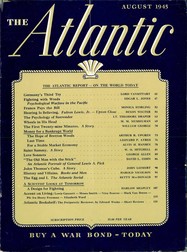
August 1945
In This Issue
Explore the August 1945 print edition below. Or to discover more writing from the pages of The Atlantic, browse the full archive.
Articles
A Design for Fighting
Feeling Tired?
Recordings
Twang That Lyre Somewhere Else, Muse
Horse Cavalry
The Chickadee
The Mittens That Multiplied Like Rabbits
The Peripatetic Reviewer
New Chum
Fighting Liberal
Home to India
The Fates Are Laughing
Latin America
The Atlantic Report on the World Today: Washington
Europe
Germany's Third Try
Fighting With Words: Psychological Warfare in the Pacific
France Pays the Bill
Hearing Is Believing: Fulton Lends, Jr. — Upton Close
The influence of the radio reporter and the news analyst has been explored for the Atlantic by an American historian, DIXON WECTER, in a series of three articles. In our June issue, Mr. Wecter examined the relationships between the FCC, the networks, the radio stations, and those companies which sponsor the commentators. Last month he scrutinized the individual records of a number of the commentators, their reliability, their prejudices, and their mistakes. In this third article, he continues that scrutiny and comes to his conclusions.
The Psychology of Surrender
Wheels in His Head
The First Twenty-Nine Minutes
The Hope of Bretton Woods
Associate Editor, Minneapolis Star-Journal, and Professor of Economics, University of Minnesota Formerly Vice President and Economist, Federal Reserve Bank of Minneapolis
Last Time
Executive Vice President of the Cleveland Trust Company, Cleveland, Ohio Chairman of the Economic Policy Commission of the American Bankers Association
For a Stable Market Economy
The Pacific War
Saint Sammy
Love Sonnets
"The Old Man With the Stick": General Lewis A. Pick
John Thomas's Cube
History and Villains
The Egg and I: "All Kids Have Fits"
SUMMARY. — The daughter of a mining engineer who trained her to be self-reliant, BETTY MACDONALD was born in 1908 and spent her childhood in some of the more rugged spots of this hemisphere — in Mexico, Idaho, and Montana. She entered the University of Washington expecting to major in art. But instead she fell in love and married. Bob, her husband, was fired with the idea of opening a chicken ranch on the Northwest Coast, and by pooling their wedding presents, their savings, and a small legacy, he and Betty scraped together $1500, enough to purchase forty acres, a six-room log house, a barn, two small chicken houses, twelve pullets, and, as spring came on, ten cartons, each carton containing one hundred baby chicks.