Lookout
By JAMES BOYD, JR.
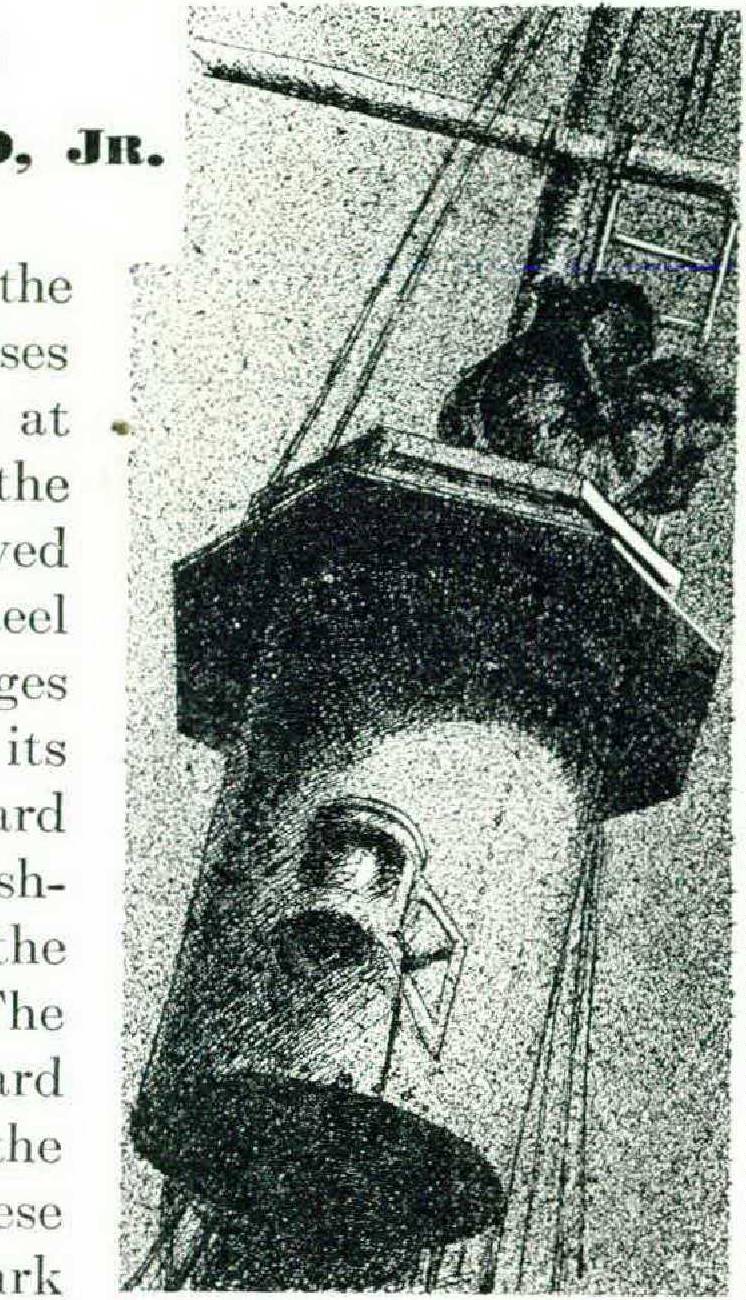
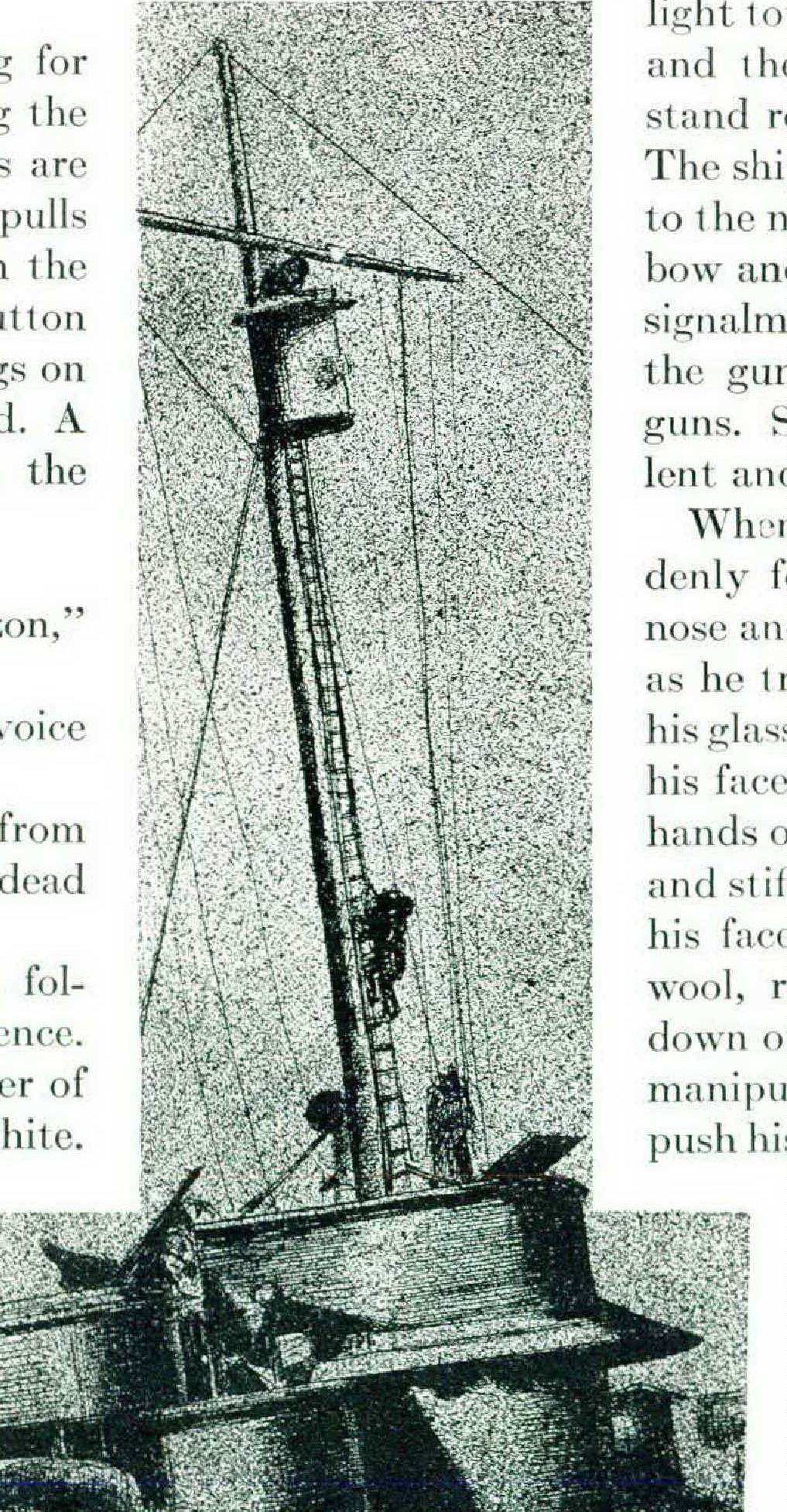
SEVENTY feet above deck the wind rises to a shriek, tearing at that gray steel box, the crow’s-nest. A gloved hand grips its cold steel side as the ship plunges forward. It loosens its grip and moves upward to a muffled face, brushing away tears from the eyes in that face. The tears freeze in a hard brown crust on the glove. Around these eyes is a heavy dark wool mask that covers the man’s face. Little white flecks of frozen spray hang on the wool. Black binoculars snuggle against his chest. A high-collared brown sheepskin towers around his head, and heavy blue pants disappear into the shadows at his feet. He squints ahead through icy winds at the misty sea below and before him, and at the flying clouds overhead.
Behind the flying clouds, like a frozen crust of snow, is a glaring white mat of cloud across the sky. A fresh gust of icy wind makes the seaman gasp for breath and turn away. He tries to put his hands into his pockets to warm them, but the constant plunge and roll of the ship makes him grab the side of the crow’s-nest and brace his back against the mast. Every few minutes he rockets forward and his ears block up as if he were going down in a fast elevator. The plunge stops and his knees push hard against the steel as the crow’s-nest pulls out of its power dive, shaking like a wet cat. Below, a narrow, whiteiced bow rises dripping above the seas. Crouched seamen on gun watch peer over the iced turret, their black sou’westers glistening. Small streams of green water dig new channels along the icy deck. The flying bridge with its searchlights and light guns is white from frozen spray.
Directly below the crow’s-nest is the black, cavernous mouth of the stack with wisps of white smoke scurrying out and past the mast. Every now and then, in a lull in the wind, the lookout can hear the steady dum-dum of the engines and the cough of the exhaust. Aft, he can see the smooth lines of the ship and the long white wake astern. Two tiny black figures walk back and forth in the round turret of the after gun. Below are toy-like lifeboats, swung out over the sea, which, like the ship, seem to be plunging and cutting through the icy swells.
Just behind the lookout flaps the ensign, its torn red and white stripes standing out straight in the wind. On the beam are the flag halyards, four on each side, taut and bowed. Farther down, their black threads turn to dirty white, then to pure white where the salt Spray hits and freezes. He sees, with a thrill of fear, ice forming on the ratlines below — his only way to warmth and comfort.
As the wind tears at him harder, he shivers and beats his gloved hands against the side of the crow’snest and stamps his booted feet on the steel deck. Ahead is nothing but white-crested waves, which stretch out one after another till they dissolve into a white mass that forms forever-changing tiny bumps on the horizon.
Suddenly one of these bumps seems larger and bursting higher in foam! He grabs the binoculars and strains to balance them for just a second on that spot; hundreds of crested waves pour before him. He looks away from his glasses to wipe his eyes, then looks again. Wait. Is that a wave? No! It is an object.
He reaches behind him, feeling f the little red button that will ring the bridge, but his large, stiff mittens are too clumsy to find it. Cursing, he pulls them off, still keeping his eyes on the object ahead. He feels for the button again, finds it, presses it, and drags on a pair of headphones over his head. A metallic voice answers through the black discs over his ears: —
“Bridge, aye!”
“Object dead ahead on the horizon,”he shouts into the mouthpiece.
“What? Speak clearer,” the voice answers.
He pulls away the w oolen mask from his face and speaks again: “Object dead ahead on the horizon!”
“Aye, aye,” replies the voice, followed by a click as the phones silence.
Wait, there it is again — a tower of spray knifing up, a bit of gray, of white. It is a ship! She is painted that weird white and blue used by ships in the North Atlantic. He presses the red button again. Almost before he stops pressing, a voice answers: —
“Bridge, aye.”
“Object identified as ship. Camouflaged white and gray,” the lookout shouts into the mouthpiece.
“What?”
“Ship painted white and gray!”
“Aye, aye!”
The faint sound of the howler pierces the wind. The lookout glances below for a second to see the gun crew tearing off ice-coated canvas covers from the guns, and crowds of tiny men pouring out of hatches like ants out of a disturbed anthill. Men appear directly below pulling peaked gun covers off the light guns and round covers off the searchlights.
He glances out to sea again. The buzzer sounds behind him.
“Lookout, aye,” he answers.
“Lookout, does she look like a friendly ship?” a voice asks.
“Can’t tell, sir. Looks like a British corvette. She—”
“A British corvette?” interrupts the voice.
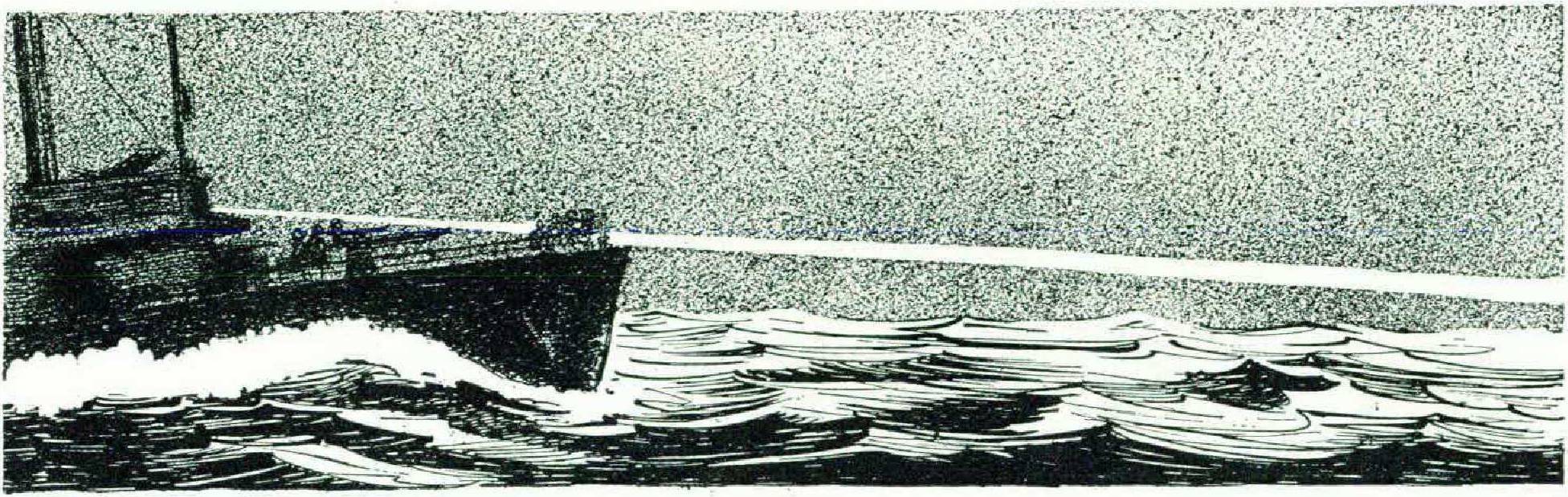
Suddenly a bright blue light flashes through the spray.
“Sir, she’s blinking at us,” the lookout yells into the phones.
“Very well.” The phones click silent.
He sees his own signalmen swing their big searchlight towards the ship, steady the light, and then answer. All the gun crews stand ready, guns trained on the ship. The ship blinks a reply and turns away to the north, waves breaking across her bow and a confused wake astern. The signalmen secure their big light, and the gun crews pull covers over their guns. Soon the decks are bare and silent and cold again.
When the lookout relaxes, he suddenly feels a tingle at the end of his nose and notices his face is almost solid as he tries to move his lips. He drops his glasses against his chest and feels for his face. Then he notices his hands — hands once strong and brown now blue and stiff. He tries to pull the mask over his face, but his hands slide over the wool, refusing to grasp it. He leans down out of the cold blast and tries to manipulate the gloves so that he can push his hands into them, but his hands fold up and will not be pushed.
A sudden terror seizes him. He tries to calm himself as he turns and looks for the small red button to the bridge. There it is, next to the mast, about waist-high. He crouches down and leans his shoulder against the button, but the ship rolls, throwing him crashing against the side of the crow’s-nest. Desperately he tries again, bracing himself with his knees and his feet as he leans heavily on the button, listening. Then through the awful quiet of wind and cold a voice answers: —
“Bridge, aye.”
“Bridge. My — my face is frozen. So are my hands,” he mumbles over the phones.
“What is that?” says the voice.
“Need relief. Hands and face frozen!” he shouts desperately.
“Hands frozen! All right, be right up!”
He crouches in the crow’s-nest still trying to pull on the gloves, but his hands are useless. “God damn, God damn it to hell,” he mutters, almost breaking into tears with desperation.
“Hey, where are you?” someone suddenly shouts on the outside of the crow’s-nest close at hand. The lookout looks up to see a gloved hand reach in and fumble for the latch to the small steel door of the crow’s-nest.
“Down here,” the lookout answers helplessly.
A heavily dressed figure in blue with a black felt face-mask worms his way through the narrow door.
“Christ, haven’t you got any gloves?” asks the fellow with the felt mask.
“Gloves too stiff. Had to take off to call bridge,” the lookout explains, his mouth moving painfully. The figure bends down and covers the lookout’s white face and then starts to rub his hands.
“Feel anything?” the man with the mask asks.
“Yes, a little. Sorry to be so—”
The buzzer rings. The man with the mask pulls the phones off the lookout’s head and puts them on his own head.
“Hello, bridge!” he says.
“Say, is that man all right?” asks an urgent voice.
“Well, sir, he’ll be all right in a minute. I’m trying to thaw his hands out now.”
“Can he come down?” asks the voice.
The man with the mask turns to the lookout and asks: “The Captain wants to know if you can come down. ”
“Yes,” the lookout says, starting slowly to flex his fingers.
“Yes, sir, he thinks he can,” says the man with the mask.
“All right. Secure the lookout. You get below him and help him down. Take it easy and I’ll try to keep the ship steady,” the voice instructs.
“Aye, aye, sir!” He takes off the phones and hangs them on a hook by the mast.
“O.K. You ready to go down?” he asks.
“Yah. Let’s go,” says the lookout.
On the main deck the Captain leans against the port railing, staring aloft at that small gray box that sways back and forth against the racing clouds. A bundled figure in blue suddenly emerges from the box and steps down a few rungs on the ratlines. The ship rolls a little.
“Keep her steady on that course!” yells the Captain to the helmsman.
A second black bundle appears. The figure sways for a minute, then starts slowly down the ratlines, the man below guiding him and holding on to his feet. They move as one, step by step. As they reach the iced ratlines they move more slowly. The top figure in his brown sheepskin, his arms wrapped around the ratlines, seems to slide more than step each time he moves. Step, stop, step, stop; two tiny figures moving across a gray sky on a white, latticed ladder. Suddenly the ship swings off the wind and rolls heavily to port. The two figures stop and hang on as they move dizzily through space. The top figure slips and slowly slides over, over, and then stops, hanging there on one side, his arms locked around the ratlines, his body bending dangerously over space.
“Quartermaster, take the wheel and keep her on that course!” orders the Captain.
“Aye, aye, sir!”
Slowly the ship comes up into the wind again and steadies. The lower figure, pressing tight against the other’s legs, reaches up and pulls him back straight on the ratlines. They stand there for a moment: the one looking up, the other looking down through the steel rungs of the ratlines. Then they start down again, disappearing behind the protecting wing of the life rafts rigged high along the ship’s side. The Captain moves down the companionway to the main deck and hurries aft where a group of men crowd around the base of the ratlines.
“Gangway,” someone shouts. The men promptly move apart to let the Captain through where two men, standing on the pin rack, help the first man down. The lookout above hangs on silently looking at the men below.
“O.K. Come on down,” calls a tall seaman, his shaggy black hair blowing in the wind. He grips one of the lookout’s legs while the man on the other side grips the other leg.
“All right, look lively now!” cautions the Captain.
The men press in eagerly, reaching up, watching. The lookout’s legs dangle from the ratlines while other hands grab him around the waist and slowly lower him to the deck. He wobbles for a moment, then gets his balance, his arms hanging limp by his side. The whole front part of him, from head to foot, is covered with ice and grease.
“Get him to the sick bay quick,” orders the Captain. “You did a good job, Lookout. Good work!”
“Thank you, sir,” he mumbles, trying feebly to salute.