Wanted: An All-American Bard
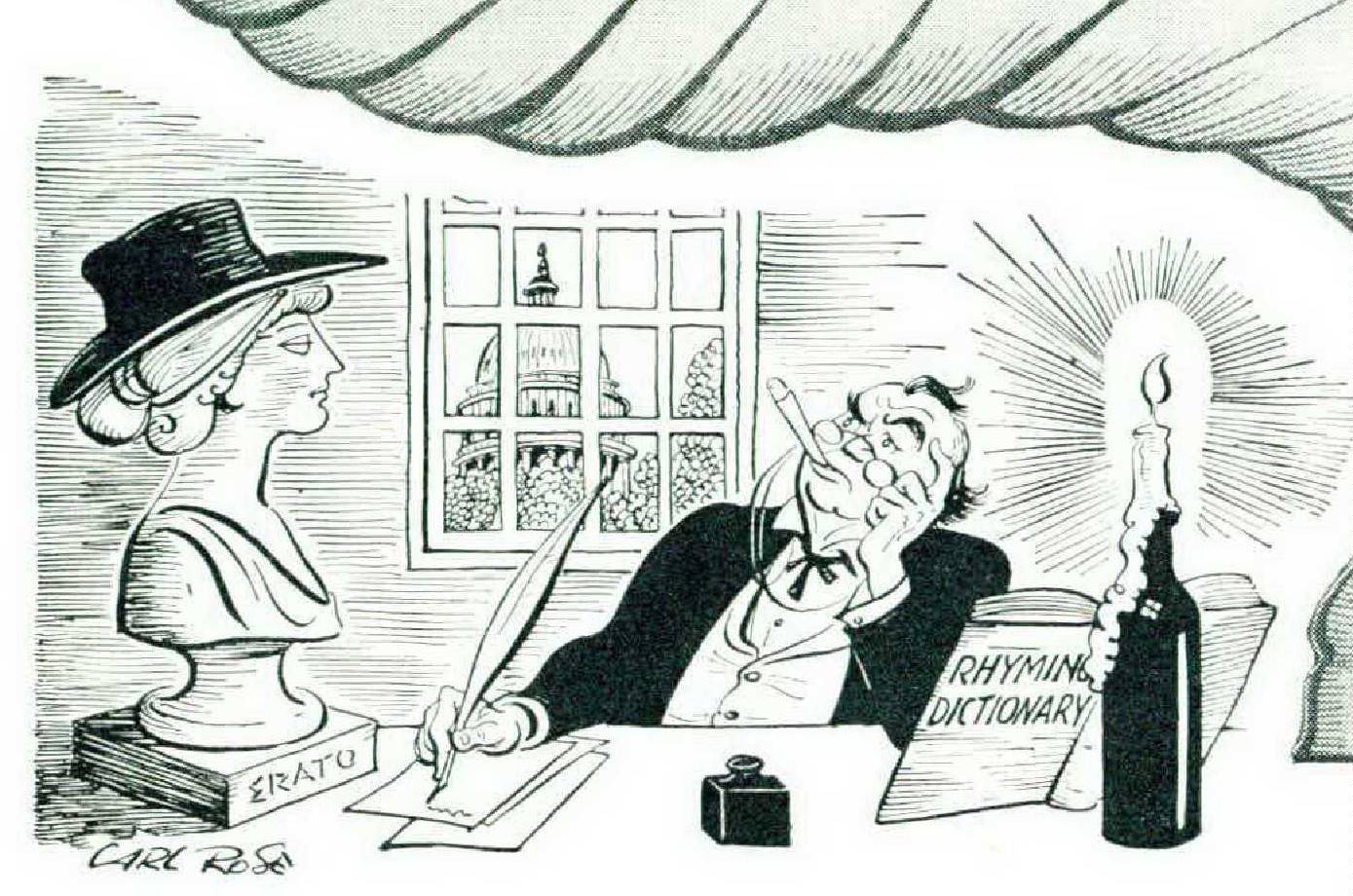
WHAT the country needs is a poet laureate of Congress. This is the sense of a bill recently introduced by Representative W. C. Cole(R., Mo.) and now in the hands of the House Library Committee for consideration. The bill proposes as first laureate Mr. Horace C. Carlisle of Troy, Alabama, an employee of the Capitol architect’s office. A better selection could scarcely have been made, for not only is bis name rich in literary connotations but he is demonstrably an excellent poet who now quite properly gives his work a patriotic slant. This, for example, is a stanza from Mr. Carlisle’s stirring poem Uncle Sam’s Ware:
That’s escaped with his life,
Will come home to his Wave,
And make her his wife.
And throughout, the long years
That are likely to come.
Free from sorrow and tears,
They will sing “Home, Sweet Home.”
The use of the word “methinks" shows that the poet is as familiar with verse forms as you are with the old picket fence on Sycamore Street: yet there are surly critics in this country who will say that Mr. Carlisle is not a poet at all. These are the people who have got American poetry off the beam, and Congress, recognizing the damage that has been done, is trying to get it on again. Mr. Carlisle’s verse takes us back to the simplicities of our forefathers, and anybody who does not want to return to the simplicities of his forefathers is at best a poltroon and at worst a traitor. For what do we find even in the liltle stanza which we have quoted? A celebration of the very things for which this country was founded and which we are now lighting to preserve: the right of a brave to marry a Wave and spend the rest of their lives singing “Home, Sweet Home.”
Congressmen, whatever their aesthetic blind spots, have passionate convictions about the uses and beauties of poetry; to them poetry is not, as it is to so many of us, an empty hodge-podge of words about larks, long-winded Greeks, and plowmen breaking the stubborn glebe. They regard it as a tool of their profession and even the prosiest orator breaks his oration every now and then, coats his tongue with honey or with fire as the case may be, and lets fly — “as the poet said.” This does something to popularize poetry among their still rude constituents and bears out their contention that it has practical angles.
Congressmen, moreover, are so enamored of verse that they ratified the appointment of Archibald MacLeish, a practicing poet of great ability, as Librarian of Congress. And although Mr. MacLeish is less often quoted by Congressmen than is Eddie Guest and his standards are by no means those of the proposed laureate, Horace Carlisle, the fact that he presides over the great Library is indicative of the trend.
These are obviously important contributions to the development of the neglected and but little understood art of poetry; yet they are as nothing by comparison with the fact that Congress gives every American the opportunity to become a poet. If he does not become one, it is his own fault. No one knows how many hearts have been broken, or how much poetry has been lost to the nation, simply because poets have to submit their contributions to editors who, nine times in ten, do not know a good poem when they see one. Thus — as the poet says — the bowl is broken at the fountain. It is here that great-hearted Congress lifts up the fallen singer and tells him: “Send us your poem and we will publish it.”
All that the obscure genius (and voter) then has to do is to staid his verses to his Congressman, who, with the unanimous consent of his colleagues, will publish them in the Congressional Record Appendix where they will become forever a part of the annals of the country. No other country in the world performs a similar service for its artists, and as proof that the money is well spent we may now turn to the Record itself.
Here amid other contributions such as Sweden Celebrates One-Hundredth Anniversary of Cooperation; Tribute to Senator Overton; Leave T. V.A., Alone; and Analysis of the Operation of Petroleum Administrative Orderst 1 and 5 and Directive 59, we find the delightful song Bless ’Em All.
It was published in the Record at the behest of the Honorable Emanuel Celler, of New York, who introduced it to the nation and to immortality in t hese words: —
“Mr. Speaker, Bless ’Em All, a tribute to its ballplayers in the armed forces, was sung by the entire audience at the dinner of the New York chapter of the Baseball Writers’ Association of America, held in the grand ballroom of the Hotel Commodore. . . . It is a splendid tribute to its baseball heroes.”
Limitations of space make it impossible to give the reader more than a tantalizing glimpse of this “splendid tribute” in verse intricately contrived, but a single stanza will convey some notion of the quality of the whole.
It goes like this:-
The humble, the short and tall,
Arnovich, Mulligan, Pesky and Klein.
Reiser, Krakauskus, and young Ganteuhein;
Make your pray’rs echo out in the hall,
They’ll need ‘em with their backs to the wall.
For Pytlake, Sylvestris, the Dusaks, Majeskis,
Let’s whoop it aloud! Bless ‘em all!
Suppose that Congress had not treasured up this fragile verse in the Record for a life beyond life. Would men five hundred years hence have the opportunity of lifting their voices in praise of
Arnovich, Mulligan, Pesky and Klein, Reiser, Krakauskas, and young Gantenbein?
Sometimes poetry, in the hands of a man who knows how to handle it, may affect the fate of the nation. Recently, Mr. Hoch of Pennsylvania, arguing in the House for a Federal soldiers’ ballot, said:
“The situation reminds me of a farmer in my county. . . . He had a field that failed to yield crops. One day the preacher called and the farmer asked his advice. The preacher said, ‘I recommend that you pray more fervently.’
“Now, a Pennsylvania Dutch farmer arrived on the scene in time to hear the pastoral advice. He said: ‘Gooder rode un beade doods net. Do muss bisht bei.’ (‘Recommendation and prayer will not avail. What is needed is manure.') If this Congress is wise it will discard the ‘great recommendations’ and erect a law to provide the fighting man with ballots.”
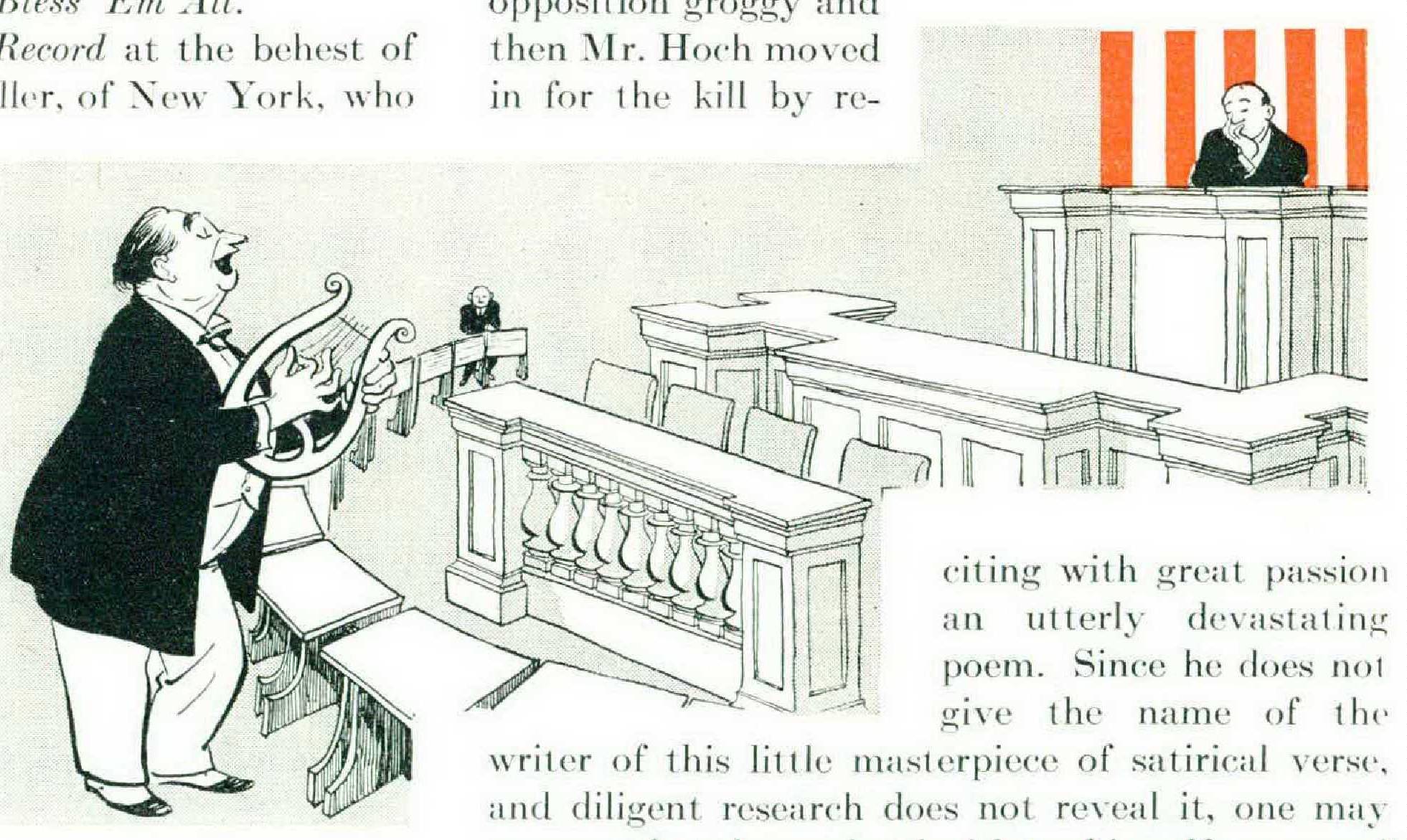
The impact of this stinging anecdote made the opposition groggy and then Mr. Hoch moved in for the kill by reciting with great passion an utterly devastating poem. Since he does not give the name of the writer of this little masterpiece of satirical verso, and diligent research does not reveal it, one may suppose that the modest legislator himself composed the poem which he gave to the nation and to the House on a memorable afternoon of high debate: -
As dejected and sad he sat,
“But Congress said. ‘Oh, we recommend,
You’d not expect more than that,
t couldn’t vote on that, recommend,
Twas a ballot I needed then.
The recommend I couldn t vote,
I wanted to vote for men.
And so election day passed by,
The ballot they failed to send,
But instead I heard the old retrain:
‘Oh, soldier, we recommend.”
A Congress capable itself of producing such a poem ought certainly to have its own laureate. The task of the all-American bard will not be an easy one. He will have a lot of ground to cover, including the forty-eight states, Alaska, Hawaii, Guam, Puerto Rico, and the Good Neighbor policy as long as it lasls. He must be a man quick on his feet and with an ear to the ground; an interpreter of trends, a student of polls, a friend of the farmer, a reader of Time, Life, and Fortune, a man of lofty ideals, and a troubadour rolled into one. He must write, moreover, for the most exacting audience in the United States — the Congress.
It is heartening, then, to record that with unerring good taste our legislators, who move to the contrapuntal music of no sound, have picked the right man in the person of Horace C. Carlisle. He is vouched for by no less an authority than the good gray poetry lover, the Honorable Theodore G. Bilbo (The Man) of Mississippi, who secured consent to publish in the Congressional Record Mr. Carlisle’s poem entitled Brumidi in the District of Columbia Room. Brumidi, let me say for the benefit of those who are lamentably ignorant of the works of art in their nation’s Capitol, is the little-known genius who painted so many of the murals that adorn the Capitol’s walls. The last stanza ends on a note of lofty idealism and intimations of immortality: —
And yet it does, in fact, belong to none— Herein the District laws are planned, but from it emanates
The rule of conduct for none but its own.
The artist, we presume.
Resolved to give this room
The very best that it was his to give —
And, through the coining years, down to the day of doom,
In these, his pictures, will Brumidi live.
If you are a voting poet or essayist, send your contribution to your Congressman and get your rightful, democratic slice of eternal fame.