My Formal Education
SINCE the large part of my formal education was obtained in the public schools of New York City, I suppose it was not really unique or extraordinary. Yet as I look back, I do think there must have been something a little peculiar about it.
While reading the reviews of the Robeson Othello, it suddenly occurred to me that I had never read Othello. or for that matter any Shakespeare to speak of. Shakespeare, as I learned about him in high school, really wasn’t much of a writer. He was always committing atrocities, such as mixed metaphors and anachronisms, which were pointed out to us as examples of things never to do. The examples which we were taught over and over were (1) the clock’s striking, in Julius Caesar (the worst sort of anachronism), and (2) “the slings and arrows of outrageous fortune" (a really first-rate example of the dread mixed metaphor). We were forced to memorize the “To be or not to be" speech, but only, I supposed, so that we would remember this terrible confusion of metaphors.
This all started me thinking about the rest of my education, and I decided to try to remember exactly what I did learn in school, being careful to separate it from what I learned by poking around in the children’s room at the St. Agnes branch of the Public Library.
In kindergarten I learned to carry a small green chair around, and I learned to cut paper with dull scissors.
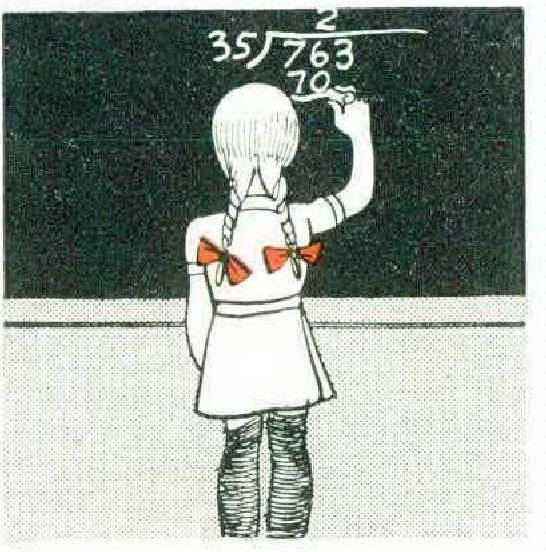
In grade school I learned some arithmetic — that is, I picked up some knowledge of addition, subtraction, and multiplication, but I must have been sick when they taught long division. At any rale, I missed it somehow, and I never learned it in school. One day I discovered that all the other children were able to do a mysterious and complicated process with numbers, called “division,”and I went home crying. My mother made an attempt to teach it to me, but she put the answer out to the right, and in school they put it above, so I was never convinced that what she was teaching me was the right thing.
I learned to bound Manhattan Island, and I learned to bound the United States, and I learned the names of the continents, and I think there were some principal rivers and principal mountains and principal cities in there too.
I read Dickie Dare, and I still remember how it went. “Dickie Dare went to school. On the way he met a cow. ‘Good morning, cow,’ said Dickie Dare. ’Moo moo,’ said the cow.” He also met a duck, and I dare say some other animals, but I no longer remember them. I read “The Lady or the Tiger” at least twenty times, and wrote as many compositions about how I thought it ended. That must have been considered quite the thing for stimulating the little minds in those days. My other work in English consisted in writing compositions entitled “My Vacation,” “My Pet,” “The Greatest Man in the World,” and so on. One teacher told us that an original and interesting ending for a composition was, “Don’t you think so too?” So after that we all ended our compositions with the identical originality and felt quite proud of ourselves.
I learned to parse a sentence, with handsome little diagrams showing how it worked.
I learned to sew, and I got second prize for my graduation dress (although I cheated—I had my mother and my grandmother slaving over the hard parts), but in cooking class all we ever made was cream sauce (but nothing to put the cream sauce on) and once we made gingerbread.
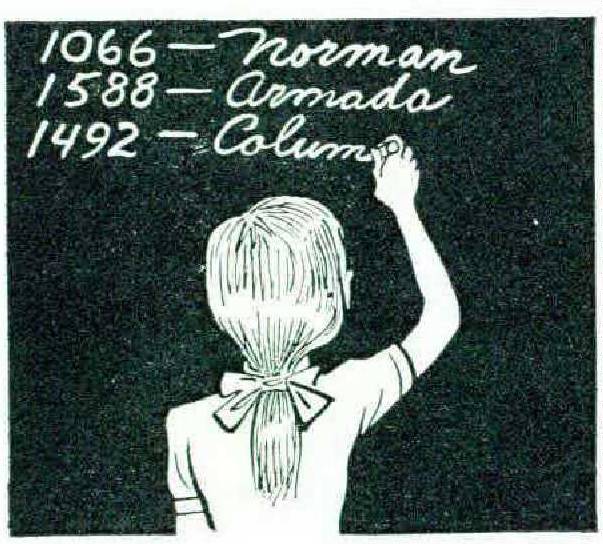
In history I learned several things. I learned that there was something called the American Revolution, and we won because the Hessians got drunk on Christmas Eve. I learned a string of dates which were committed to memory perfectly, but what they were I had no idea. If you gave me the number 1066, out came its correct partner, the Norman Conquest, but who Norman was and whom he conquered were mysteries to me, If you told me the number 1588, I would say, quick as anything, “Drake and the Spanish Armada.” Drake, to me, was a kind of cake, and as for the Spanish Armada, it never occurred to me that it meant anything at all.
I also learned 1492, 1776, 1789, 1865, 1215, and several others, with the right events. It didn’t matter if you didn’t, know them all, because on the examinations you were given the lists of dates and events and you had to match them up, so you always teamed up the leftover dates with the leftover events and had a pretty fair chance of being right.
I learned music appreciation. This consisted in learning the first two bars of the “Danse Macabre,”the “ Dance of the Hours,” “ Rustle of Spring,” and “The Swan,” and the right names to go with them, so that at examination time we could infallibly write down ‘“Rustle of Spring’ by Sinding” after the two opening bars were played.
We were also taught with some care to pronounce Saint-Saëns correctly, which was evidently of great importance.
When I was twelve, and armed with all this knowledge, I went on to high school. In high school I learned many different things.
I learned to climb a rope ladder and to dance the Highland Fling.
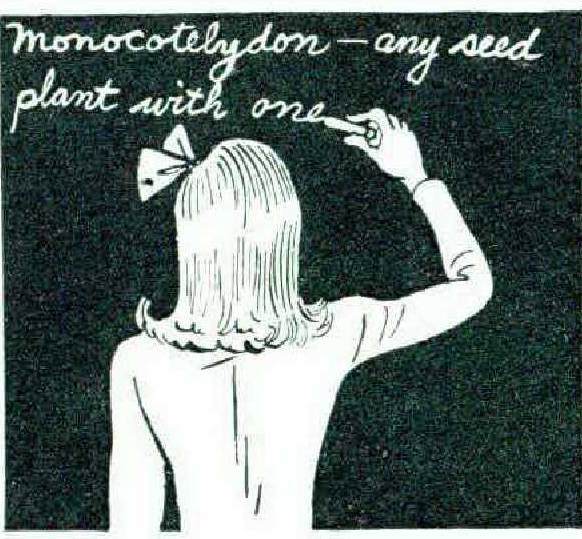
I learned that a bean is either a monocotyledon or a dicotyledon, and I learned that the skin of an onion was made up of cells which could be seen if you looked at it through a microscope, but unfortunately I never got to look through a microscope until last year, when I bought one of my own. I learned that most plants will die unless they get water and sun, and we proved this in experiments in which we denied beans water and sun until they died. I learned to draw a grasshopper, and I learned that some part of a carrot is called the cortex, but I can’t remember which part.
I read some of the Odyssey, but that class came after swimming class, so mostly we just dried our hair on the radiators. Somebody forgot to tell us who Homer was and when he lived, or in fact anything about him, and nobody ever mentioned that the Odyssey had anything to do with Greek literature. Indeed nobody ever mentioned Greece or Rome in my presence all through my entire schooling.
I learned that my voice was denasalized, and I intoned “The brown cow browsed around the brown barn,” and “The man ran along the sand with his hat in his hand,” more times than I care to think about. I don’t know if it did any good or not. I learned that the correct way to breathe is not from the chest, but from the diaphragm, but I was unable to change my breathing habits, and so have continued to breathe in my chest anyway, and I suppose my voice is still denasalized.
I took physics, and I found out that if you heated water long enough, it boiled and gave off steam, and I learned how to hook up an electric bell (though when our doorbell goes out of order I have to call the superintendent because I don’t know where the wires are, and anyway it looks different from the ones in school). And I learned that if you pick up a hot Bunsen burner, it hurts.
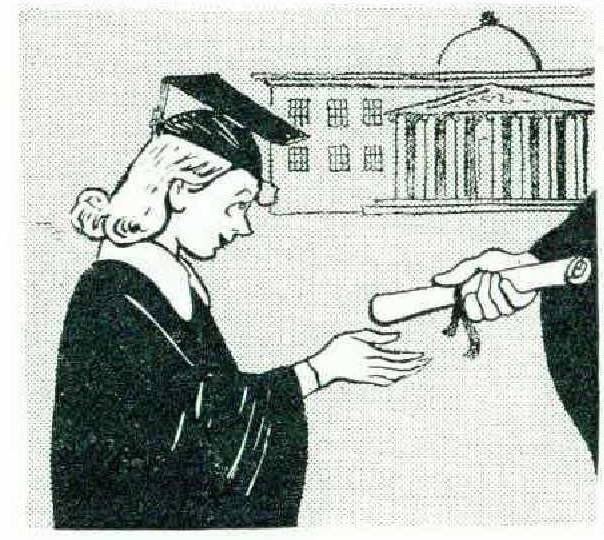
That was all there was to it. Someone in the school system miscalculated the time necessary to learn all these things, and at the end of three years I discovered suddenly that I had passed plenty of Regents’ examinations to get into college, but that alas! I could not graduate from high school because I had only had three years of rope climbing and Highland Fling. This led to all sorts of difficulties, but since I had already been admitted to the university to which I had applied, I simply ignored the difficulties.
At college I learned interpretive dancing (in a short, loose green garment) and I was forced to play tennis until a certain date, regardless of the weather. I learned that if you play tennis in the snow, in a raccoon coat, it is not good for the racket.
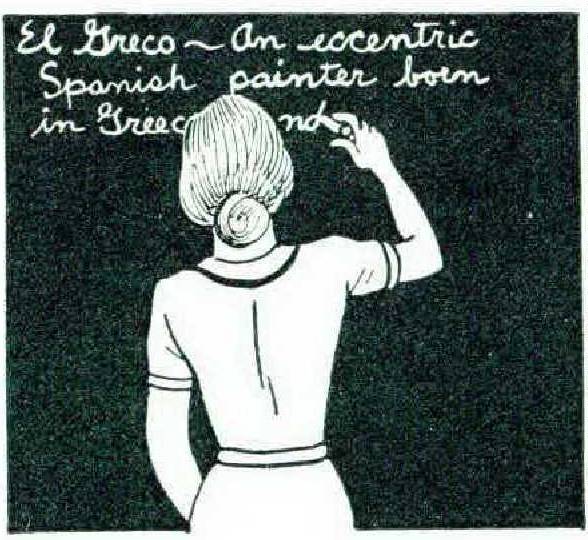
I learned that El Greco was a madman, Picasso worse, and that Leonardo’s “Last Supper” has flaked off considerably because he was so stupid about experimenting with new media.
I wrote daily compositions (only they were called themes at college) and they were all carefully corrected for punctuation. They were always entitled “On” something, and I no longer ended them with a question necessarily, since that was not required in college.
I learned that if you have steam under pressure, and you let it go through a rubber tube that is slightly rotted, the tube will burst and the steam will escape quickly and scald whoever happens to get in the way. I found out that you have to take the whole science of physics on faith, because no demonstration in the lecture hall ever turns out the way it’s supposed to, and that furthermore the experiments don’t turn out any better in the laboratory. Especially when your lab partner is a fluffy blonde who leans over your shoulder at the crucial moment and dips pale blue ribbons and bits of lace ruffle in your crucible. I learned that there are very few nerve endings on the skin of the back of your hand, that you can see better in the daytime than at night, and that if you drop a baby he doesn’t like it.
I learned how to find the volume of a truncated pyramid, but I’ve not used this knowledge lately.
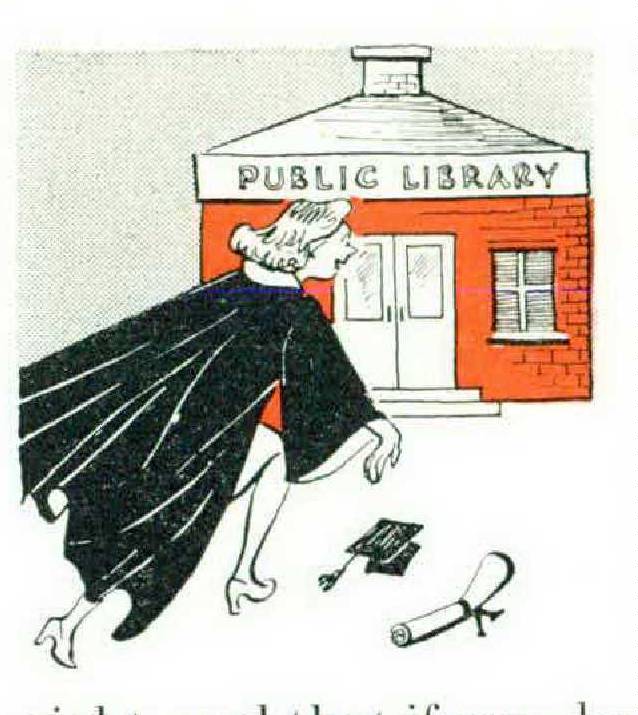
I learned, when I came home after two years, that in the public library they have the most amazing books — all about animals, and psychoanalysis, and fungi, and Greece, and languages, and insects, and Rome, and parasites, and China, and music, and semantics, and India, and revolutions, and spiders, and people, and amoebae, and Persian painting, and fishes, and dead languages, and Toltee sculpture.
I think books are wonderful. Don’t you think so too?