Radio's Sceneshifters
ByROBERT GRAHAM
ON THE major broadcast ing networks today is a select group of performers, each of whom has spent approximately two years’ apprent iceship to learn a highly skilled profession. The work of this group, consisting of not more than one hundred artists, is heard in a million homes daily. None of these artists, however, has ever been accused of citing a controversial issue; there is no record of an adolescent’s having fainted at the sound of any of their voices; and the amount of fan mail they receive is negligible.
These performers are the sound-effects artists, the stage crews of radio. Any one of them can “design, ” “paint,” and “light” an involved setting in a matter of seconds. More efficiently than can possibly be accomplished by narration, dialogue, or music, the sound-effects artist swiftly acquaints the listener with the locale, time, and mood of the scene. His effects can be made so intimate as almost to bridge the gap of the microphone and persuade the listener to feel himself actually living the action. Without a well-designed and accurate sound-effects “accompaniment,” the radio audience would find the most gripping dramatization of the news, or the most hysterically side-splitting cast of comedians, as devitalized as the stream of tape from a stock ticker.
Of the two categories into which sound-effects are divided, manual and recorded, the latter is the less heralded and the more fascinating. A well-stocked sound-effects record library contains roughly four hundred different records. These records are identical in size with the ordinary ten-inch musical recording, but usually they are made on a much more durable base. Since many of the records contain as many as five or six recorded effects, or “cuts,” on each side, the actual number of such items may approximate three thousand or more. Each cut is cross-indexed in a comprehensive file under all applicable headings.
There is also a file of “quickies” — that is, soundcuts made by the sound-artist himself. Frequently no commercial cut can be found which will fit a particular script sequence, and the artist must then find or improvise a sound-source and make a special recording. Recently, while preparing a dramatization of Thurber’s The Secret Life of Walter Mitiy, NBC artists found themselves at such an impasse. In the original story, there is an onomatopoeic phrase, “ pocketa-pocketa-pocketa-queep, pocketaqueep,” with which Thurber describes the faulty motor of the anesthetic machine. Since it is impossible to read the phrase without practically hearing the motor, it was felt necessary to reproduce the effect as accurately as possible. The “pocketa” was finally produced from an obsolete automobile machine by removing two of the “cylinders” and rhythmically starting and stopping the motor. The “queep” was provided by blowing a rising inflection on a small peanut whistle at appropriate intervals. This effect was cut onto an acetate record by a portable recorder. As these “quickie” recordings wear out rapidly from continued use, the initial cutting is retained as a master copy from which others are “dubbed,” or re-recorded, as needed.
Sound-effects records are “played” on a reproducer which is an elaboration of a home record playback. It has three turntables, however, rather than one, and there are usually four tone, or pickup, arms, adjacent pairs of which can be placed simultaneously upon a single turntable. Each tone arm is regulated by a volume control similar in action to that on a home phonograph. The reproducer is further supplied with the familiar “high and low ” controls found on modern radios. Thunder effects, for instance, are more resonant with all the bass frequencies accentuated, while the ricochet of a bullet is more piercing when the high frequencies are amplified. All effects reproduced by this machine are emitted from loud-speakers placed beside it in the studio and are heard by the actors and musicians.
Further to complicate the operation of the reproducer, electromagnetic “spotting” devices are installed on the tone arms. Not infrequently the sound-artist must reproduce an effect which is buried in the content of a sound-cut — or perhaps the soundcues have been inserted into the dialogue with such frequency that it is physically impossible for him to place the tone arms in position on the records in time to execute the effect. In such cases, the operator may resort to the spotting device, which, once set, automatically suspends the tone arm just above any desired spot on the record.
When the cue comes up, the sound-artist operates a control which allows the tone arm to drop, and the needle engages the particular groove on the record where the specific sound is recorded. At the same moment, he opens his volume control to the position already determined during rehearsal, and the effect thus fits in with the actors’ voices at the correct intensity. When the effect ends, the volume control is closed, the tone arm is manually removed, and the record is replaced for the next required in the sequence.
The sound-artist, in these record operations, must be deft and always the precisian. There are usually five components, for example, to a correctly executed airplane take-off — starter and idle, revving the engine, taxiing, the take-off, and flight. While these effects are available in correct sequence on several different records, it is rarely that any one record will fit the dialogue in a script. Since timing is critical in broadcasting, the sound-artist will often have to create this effect from five different records in forty-five seconds.
When the plane lands, four more records are needed — “gunning” the engine while still in the air, the impact on the ground, taxiing, and back to idle. He may also have to provide the effect of wind howling past the plane as it lands, brakes squealing as it turns on the ground, or the final coughing grunt as the engines are killed. The manipulation of possibly twelve records on three or four turntables must be seen to be appreciated. When such a sequence begins, it is not unusual to find the soundartist stacking records three deep on each turntable.
The correct execution of the sound-plot just described may seem difficult enough; but the soundartist must also keep one eye on the producer in the control booth, one ear for the actors’ delivery, the other eye roving between the script and the turntables, and the other ear monitoring the output of his loud-speakers. Meanwhile, his hands operate the reproducer controls purely by reflex action. About two years of daily operation is required before a sound-effects art ist becomes sufficient ly adept to work in the more exacting productions.
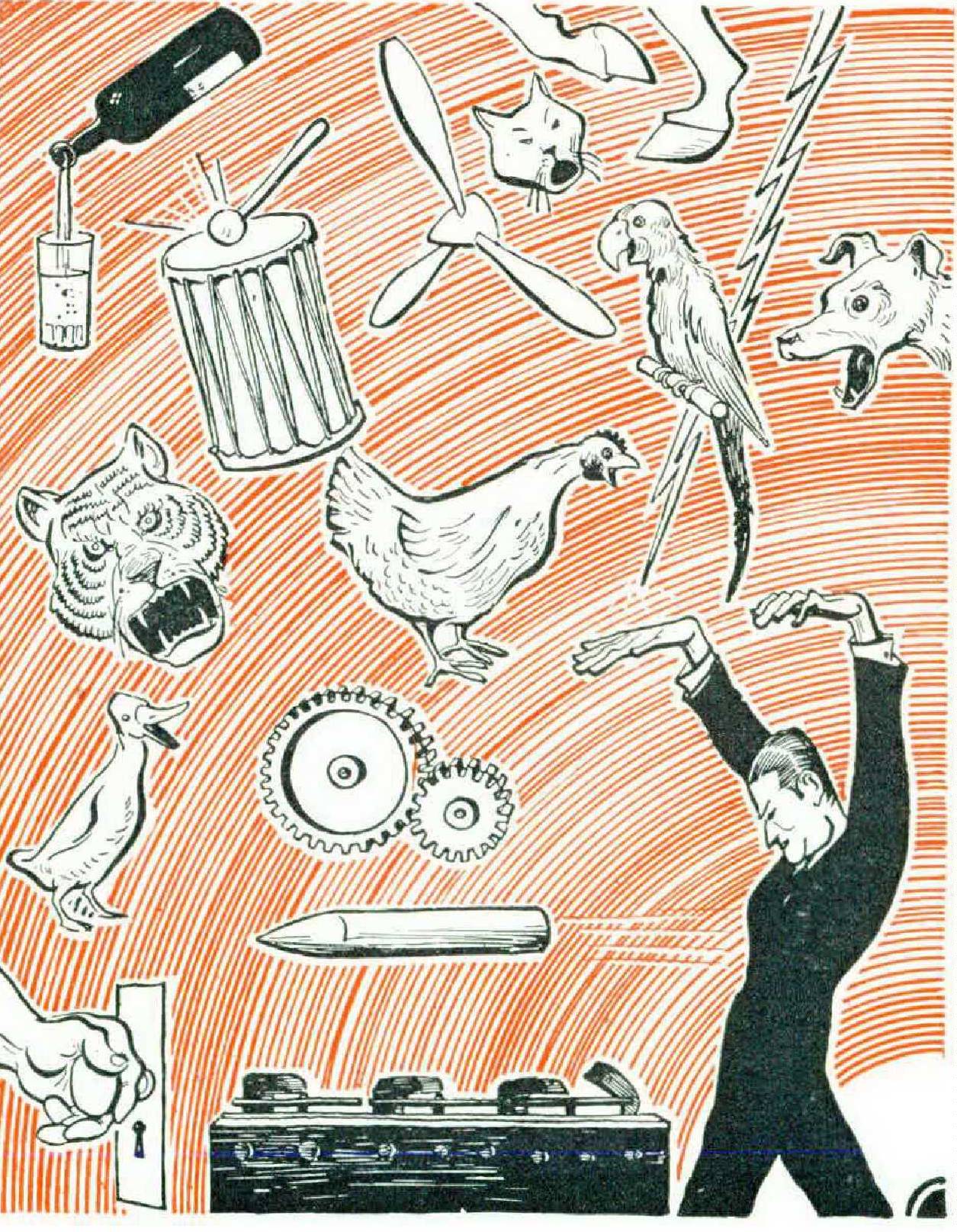
While recorded effects afford general sounds for background, locale, and broad action, the handoperated effects usually provide specific sounds — the small sounds indicative of personal action. Manual devices are limited only by t he ingenuity of the sound-artist who devises them. Among the simplest of these effects is a gadget made of nails and glass which squeals excruciatingly when revolved. Among the more complex is a horse machine consisting of a candy drum and crank, a small slab of cement and a tray of gravel, and four coconut shells and the chassis of a small baby buggy — a complicated device which walks, trots, and gallops.
The radio actor acts with his voice; the soundeffects artist acts with his hands. He must be able at a moment’s notice to articulate any one of a thousand effects in such a manner that it will be exactly in keeping with the rhythm and intensity of the sequence. Without this accurate synchronization, action soon becomes discordant and inharmonious. Everyone has heard a broadcast in which the opening of a door, the timing of footsteps, or the starting of a car has been a fract ion of a second too early or too late. The impression that the actor himself has performed the action fails to ring true. Effects in which the sound-artist physically acts for the actor must be synchronized with the actor’s every pause and inflection. The actor is more at ease in his role when he realizes that the sound-timing is so accurate that he might be performing the action himself. So far, no Madame La Zonga has appeared, with an ability to teach the art of synchronization in six lessons.

- For the past seven years ROBERT GRAHAM has been a soundeffects artist in NBC’s Chicago studios, He is a graduate of the University of Iowa.↩