Just Painting
ByPATHRICK MORGAN
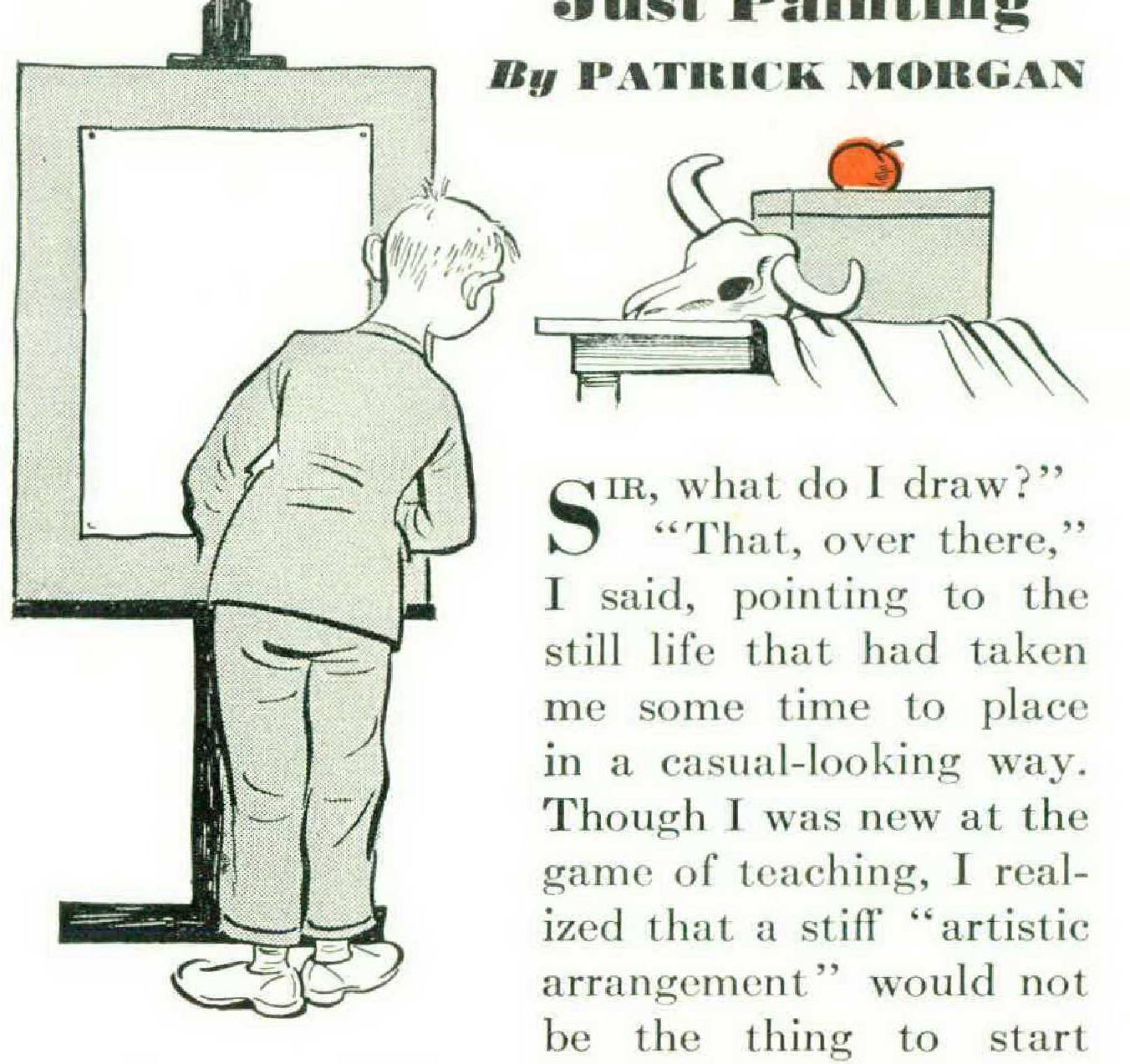
SIR, what do I draw?" “That, over there,” I said, pointing to the still life that had taken me some time to place in a casual-looking way. Though I was new at the game of teaching, I realized that a stiff “artistic arrangement ” would not be the thing to start seventeen-year-old boys off with. I didn’t see why these husky-looking citizens had signed up for the course anyway.
“That?”
“Sure, that,” I answered. “That pile of junk, which henceforth we shall refer to as a still life.”
“Gee, can’t I draw people, sir?”
There it was already, subject matter. Always the question of subject matter. No one asked to paint a red picture or a blue picture. No one cared what pattern he created. All they wanted was to copy an attractive subject.
“No, you cannot draw people yet. Or boats either,” I added, since they all wanted to do one or the other. The boats were preferably their own sailboats, and the people were preferably girls, not necessarily their own. I got so that I divided them automatically into the life-on-the-ocean-wave and the mildly-disturbed-by-sex categories.
What happens to people between the ages of seven and seventeen? Plenty, obviously, but why should it produce such a prosaic point of view? At seven a child uses bis subject matter as a springboard, and his imagination leads him beyond. But at seventeen he prefers to dress, talk, and think like the others, He has grown a protective cover of conventionality that blunts his perceptions. To hack through this crust takes work from within and without.
“No, you can’t draw people. People move. They don’t sit still even when they are posing. That junk which is a still life sits obligingly, even though it’s not pretty.” As I spoke, I gave out charcoal paper and drawing boards to the students who had gathered around. The studio looked enormous when it was empty, but now it had shrunk.
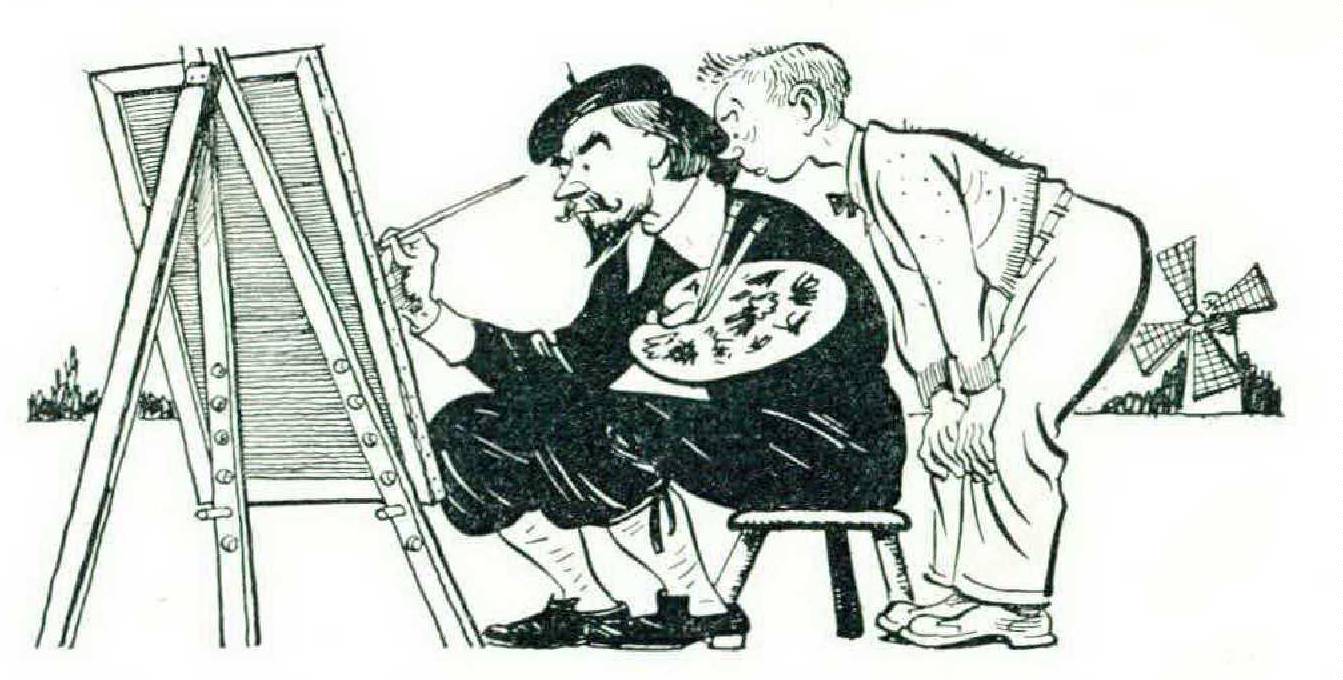
“The thumbtacks are over there. When you have your paper anchored, put t he board on one of these easels.”
“ Is this right, sir?”
“Hey, where did he say the thumbtacks were, Joe?”
“Sir, what do we do next?”
The one they called Joe was in difficulties. “Your paper isn’t flat,” I told him. “ Put the northeast and southwest tacks in first; then smooth out the paper with your hand before putting in the other two. You know, Joe, if a thing is worth doing — ”
“Yes, sir, it’s worth doing well.” He was obviously pleased to hear a familiar fragment in the strange world of art.
“Now for those of you who are ready, here are your weapons.” I gave each a piece of charcoal, a cloth, and an eraser. “All you have to do is to draw that cow’s skull leaning against the blue tin box. It. is simple except for one slight hitch. Over there on the table, those objects have three dimensions, and I have been mean enough to give you a perfectly flat piece of paper, so you have obviously been shortchanged out. of one dimension. Let’s see what you can do about it.”
The majority were frozen by this statement. They had, it seemed, never thought of this, the painter’s handicap. A few went confidently to work, unperturbed by the loss of the depth dimension. They had the courage of the undaunted.
One of the frozen thawed out enough to ask, “But, sir, how can you draw depth if the paper is flat?”
“This is just what has troubled a good many painters for a good many centuries.”
“Then you don’t know how?”
“No,” I said, “I don’t believe I know any one conclusive way. But I know some painters who got pretty good results. A man called Rembrandt could do amazing things with a flat, paper. After you’ve tackled the problem yourselves, we’ll take a look at his work and that of many others.”
“Why not now, sir?” They were still putting off the moment they dreaded to face.
“Because it would discourage some of you from ever starting, and the others would just try to copy the one they liked best without understanding the point.”
“But I don’t know where to begin.”
“ By standing at your easels and watching the still life. While you are doing this I will tell you one essential principle.” The group separated. Once at their easels, each watched the skull intently, as if an act of levitation were expected.
“This principle,” I said, “is balance.” I noticed my words in no way deterred the undaunted. One reason was they had not listened.
“The fact is,” I continued, “that when you look at the work of those painters whom we call great, you notice that it all has one outstanding characteristic — namely, balance. This is true of their pictures no matter how individually they see things or do things. Somehow a perfectly balanced painting holds your eye, and makes you believe in its depth, though tin’s depth may have been created in one of many ways, ranging from sharp observation accurately set down, to dreams imaginatively suggested. But at all times the illusion of depth is most convincing when the painting is balanced.”
As I spoke I looked around, and saw that. I had sounded off on a too high plane. Most of the boys looked bewildered but not bored. They had expected me to show them how to draw the subject of their choice, helpful hints in ten easy lessons, as advertised. Instead, I was talking about balance, something far too intangible for them. They wanted a crutch and were getting a sermon.
“What I am trying to tell you will help you later when you come to draw boats and people, because perfect balance gives a sense of reality to your picture. It keeps the eye in bounds so that it doesn’t, try to compare this world of paint with the real world beyond the frame. The eye recognizes perfect balance and is willing to make allowances for the necessary distortions involved, adjusting itself readily to what it might impatiently reject in an unbalanced picture. So try to juggle the lines of the skull and the box onto your paper, keeping your drawing balanced from the first. Get going, now.”
I wondered how much of what I had said sunk in. Yery little probably; but so far as I could see, they all had begun drawing. All except Joe. He was staring at the still life, tapping out a rhythm with his charcoal against the easel. I tapped his paper.
“No hits, no runs, no errors,” I said.
“No, sir, but I was thinking. Honest I was.”
“But, Joe, your thoughts have to get on the paper. Draw something.”
“I wish I knew the first line to make, sir.”
“I can help you there but not beyond that. Do you think you can get going on your own steam then?”
“Yes, sir, I won’t ask another thing.”
“All right. This is what my teacher taught me. Draw a line right down the middle of the page. This line represents nothing you can see over there. It is an axis of gravity, a plumb line in space by which you could lift your composition without tipping it in any direction. Around this line you balance your entire picture. To visualize its position in space, you must decide first how much of the subject you will include, and that, Joe, is entirely your choice. So it’s your move next.”
“Sir, there’s something else that I —”
“No, you don’t. You said you’d ask nothing more.”
“It’s not a question, sir.”
“Well, all right. What is it?”
“It’s just that my name’s not Joe. It’s Jack.”
“Sir, oh sir, are you busy?”
“No, Jack, just painting. What’s up?” I had been told that I should have time off for my own work. And so I did in the afternoons, but though four months had slipped by, my free time amounted to little. Something like this always happened, for when I was found painting I was considered fair game. It was never counted as working.
“Sir, they all say I’m nuts, but I think I am right.”
“You weren’t nuts when I last saw you in class.”
“No, but then what, happens? After class I go play the piano in the Beanery. Well, while I’m working on t hat new tune of mine, up come a bunch of the boys, and they get to talking about what’s the basis of life. They ask me what I think. Sir, what is the basis of life?”
“I thought you were telling me.”
“No, but what do you think?”
“I don’t know that I have thought. Faith, maybe. But that sounds like a guess. I’ll have to cut all my classes some day and just think about it. That’s a big question.”
“D’you know what I say? I say rhythm and they say I’m nuts.”
“They said you were nuts about rhythm?”
“No, I admit that. That’s why I like swing. Classical is all right, but it hasn’t got the rhythm. Now this little tune I’m working on, well, I’ll tell you about it later. It’s terrific! But they say I’m nuts because I claim rhythm is the basis of life.”
“Sounds all right to me. That’s not being nuts, Jack.”
“I say to them, look, when you are born, it’s vour heart starting to beat that makes you alive. That’s rhythm, isn’t, it? Then when you learn to walk or anything, that takes rhythm, doesn’t it? And they say I’m nuts because they say that’s not true of everything. So I say it’s true of the universe. The earth moves round the sun. There’s rhythm again. The moon round the earth. The stars — do stars move, sir?”
“I think they drift.”
“Well, they must have rhythm if they drift. Everything’s got rhythm, hasn’t it?”
“I don’t know why not if you can find it.”
“Now this is when they said I was nuts. They say take that door frame, that piece of wood has no rhythm. And what do I say? I say a piece of wood has rhythm because you said this morning it had, didn’t you?”
“I did? I mean, did I?”
“Sure, in the still life. Over there you have a log of wood, and you told me to draw the rhythm of it. So I say you say a log of wood has rhythm, but all they say is ‘Quit it,’ so I am here to ask you.”
“Yes, I did say the log has rhythm. In a log or a landscape or in the human form, rhythm is what the painter looks for. A sequence of colors or of shapes can establish a visual beat as noticeable as a sequence of sound to the ear. Yet most people think of rhythm as part of music, but not of painting. They hear it but can’t see it. It seems to me the beauty of a painting depends on the working together of the different objects and spaces. These different rhythms when they are balanced pleasingly give the picture a quality that people can feel as well as see, so that the emotional impact of a painting often transcends its subject matter. That is why, last fall, I started this course by making you draw the spare part of a dead cow. I wanted you to find something in that skull beyond its outward appearance.”
“Yeah, you said draw the skull and make it balance. I thought you were nuts then, sir, for sure.”
“Well, lots of people say painters are.”
“There, sir, there you have it. They can’t see, they can’t hear — so they blame us. We artists ought to stick together. Guess I’ll shove off now and polish up that little number. Thank you, sir, thank you. See you in class tomorrow.”