"Smile for the Gallery, Betty"
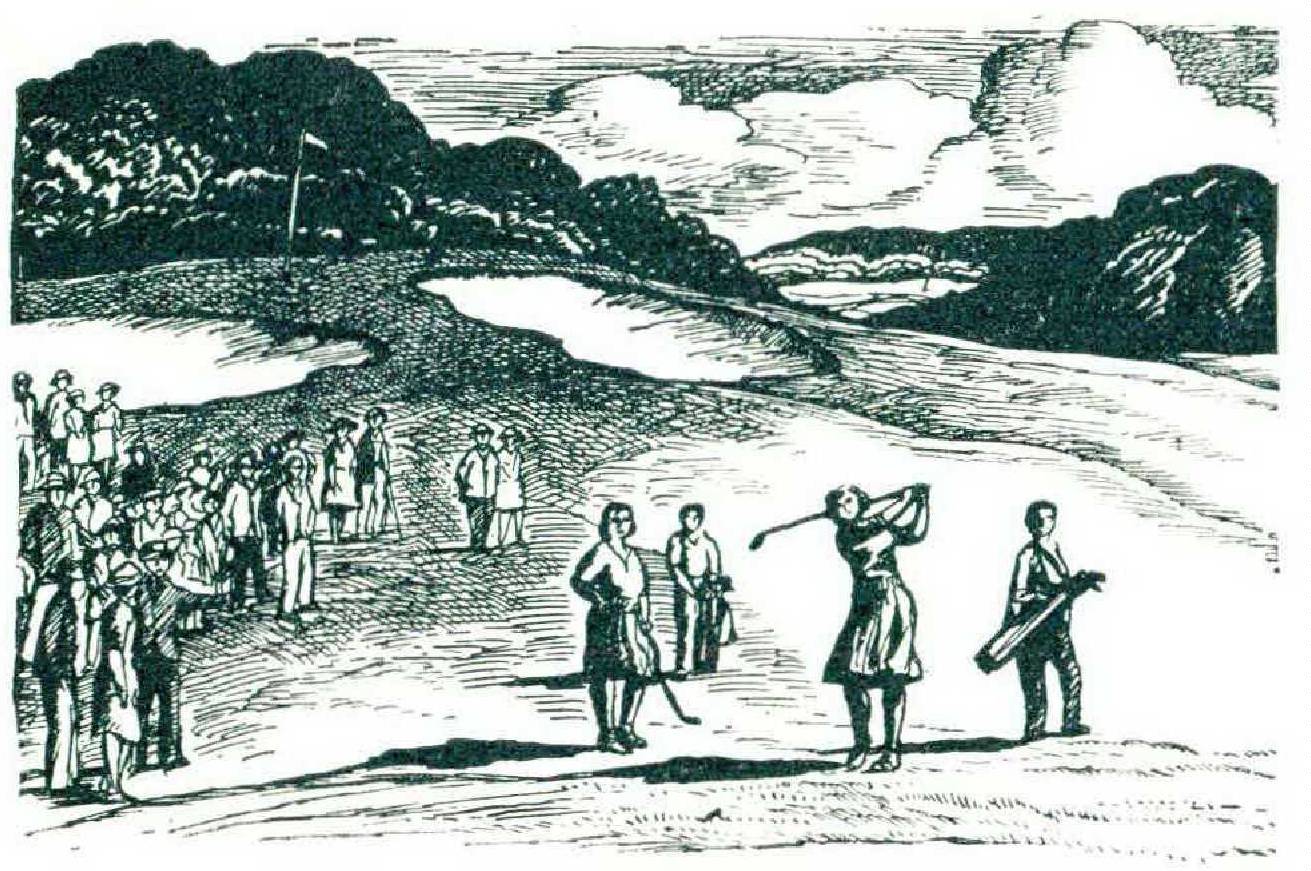
By ELIZABETHHICKS,USCGR(W)
ELIZABETH!” my father said solemnly one spring evening in 1938.
I looked up from the funny papers. “Oh, oh!” thought I, with quivering conscience. “This is it.”
It was. “I’ve been talking to your professors,” he continued.
That did it. Il seemed that my freshman work in college had been rather neglected in my feverish attempt to break 90 on t he golf course. Dad was very concerned over my future.
“Elizabeth,”he said, “you’re flunking English.” “Well — yes,” I replied. “I had to practice my I rap shots.”
“You’re flunking chemistry; you haven’t been to your history class in a month.”
I became engrossed in Dick Tracy again.
“Have I lost your interest ?” The assistant superintendent of the Long Beach City Schools was becoming impatient.
“Oh, no — of course not.”
Dad ran up the white flag. " Do you want to go to college,” he said, “or do you want to use your college money to play tournament golf?”
I tried to be casual. “Why, I’d like to give golf a try, I think.” I was bursting with a desire to kick my heels together, race into the street, and proclaim to all who cared to listen that I was through with the agonies of acquiring an education,
“Perhaps,”was Dad’s last feeble shot, “you’ll gain something of a liberal education from a year or two in golf.”
Little did he know what truth he spoke!
I played tournament golf with fanatic enthusiasm Irom that day until I won the national championship at Brookline in September, 1941. 1 drove 100,000 miles (without a flai lire!) to all four corners of the United States. I met people, from the most, illiterate black boy who ever caddied in Florida to the Duke and Duchess of Windsor. I learned the difference between winning and losing, between glory and obscurity, happiness and heartbreak.
1 was catapulted into a world for which a college education would never have fit ted me. I found it full of inconsistencies beyond my reasoning powers. It laughed at things I did not think funny. It took seriously what I laughed at. If emphasized off-beats and forgot down-beats. I was a four-year-old in her first day at kindergarten.
2
Golf galleries have a privilege of intimacy with players enjoyed by the spectators of no other sport. Many a man has jostled Bob Jones’s elbow during the National Open who wouldn’t have come within drop-kick distance of Red Grange in action.
“Don’t galleries ever hot her you?” is a stock question of st rangers. They ha ve visions of i housands of people rippling over the course and upsetting concentration. But 1 act Miss Strong Nerves and say, “No, the more ihe merrier. Can’t play without a gallery.” I smile when I say it.
Galleries are amusing. I’ve found that a goodly proportion of their components have interests in the competit ion aside from the golf. Galleries, like Gaul, are divided, and 1 here are moments when I wish two parts would stay home. ’There are always those whose chief concern is in the shot-making. I hold a place in my heart for them. There are also those who adore gossiping in whispers. (Golfing etiquette dictates that spectator conversation be whispered.) And there are always the curious, who fall into sand traps and get in the way generally. They sometimes get their pictures in the papers, being carried out on a stretcher after getting konked by the champ’s tee shot off Number Ten.
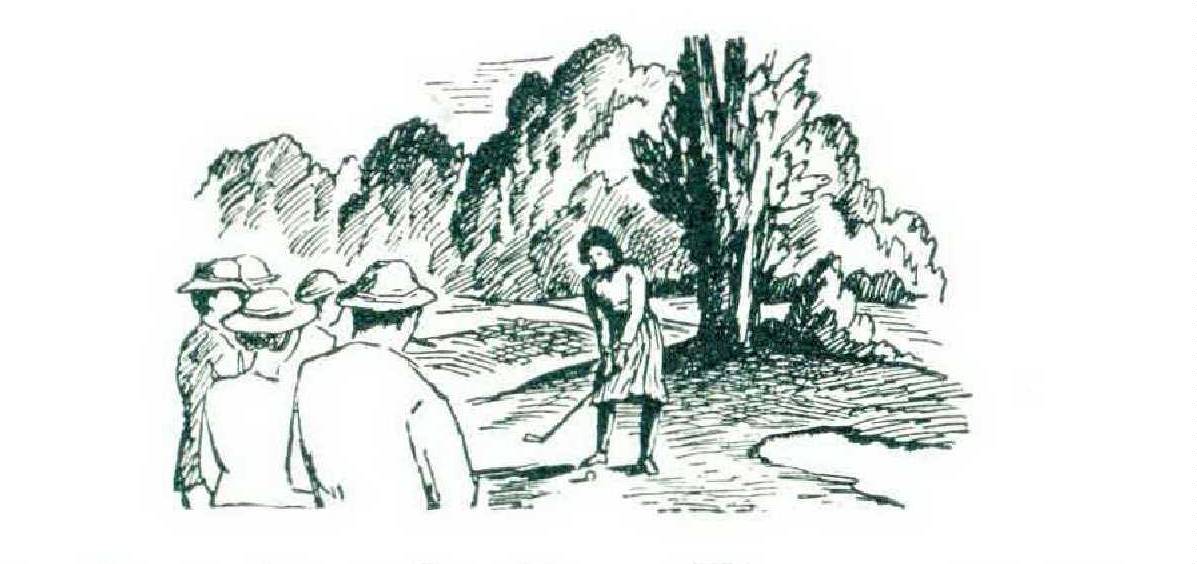
Galleries get the strange impression that walking beside you as you approach that crucial chip shot makes them buddies from ‘way back. “Remember me?” they’ll say on a course in Cleveland in the summer of '43. “T mot you at Palm Beach in '40.”
“Oh, of course,” you reply, trying to avoid that vacant look. “Wasn’t 1 horrible that day against Jameson
“1 saw you play Kirby.” That mixes things up, because I never played Kirby at Palm Beach. So I start talking about the weather and continue avoiding that vacant look. They say Hagen had a wonderful memory for people. The best I can do is to remember the proper procedure when T forget.
The frankness of ihc spectators is appalling. I’ve had some outstanding comments made on my appearance at Palm Beach. Appearance counts more at Palm Beach, I suppose. “You’re falter this year, aren’t you?” said one gracious gentleman to me as I was about to make an important sand-trap shot.
A proud papa whose offspring must have precocity equal to that of Baby Snooks said grinningly to me one day when T was practicing, “You know what my little girl said about you yesterday?”
I anticipated somet hing highly complimentary, so I gave him my best front-page smile. “No,” I said, “what did your little girl say?”
“Well,” he tittered, “she said ‘Daddy, is that, a sourpuss over there?’”
Players are regarded somewhat as museum pieces. It’s rather startling to walk by someone and hear, “I think she looks horrid in that plaid skirt, don’t you?” or “I hear she’s been out with that awful fellow from Kenosha.”
1 was involved in one of those storybook situations in a match in Milwaukee in 1040— the hushed crowd, the important putt! I had just leaned over my ball when some bright-eyed female whispered very audibly to a friend,” I bet she shaves her legs.”
1 gave up the problem of my appearance after that, tending to only the more important details which would be fuel for chat ter. They are: (1) that my slip doesn’t show; (2) that my hair is combed; (3) that my skirt does not cause any immodest exposure; (4) that 1 cannot possibly be classed as a “sweater girl.”
Beyond that I am completely mystified as to how to win a gallery to my side. It’s an unpleasant feeling, having a gallery pull against one.
I say t hat, recalling the long walk 1 had one March day after Dot Trnung had beaten me eight and seven in the Pebble Beach invitational final. I was eighteen then, and so anxious to succeed in golf that if someone had told me Requisite No. 1 was to swim the Catalina Channel with a niblick in my hand 1 would have done it.
So when a Hollywood actor’s agent said to me. “Listen, you want to know how you can capitalize on that frozen puss of yours?” my ears were as big as bunkers.
“I’m in the show business, see,” he said. “ I know what brings out (he crowds. Be mean as hell. Don’t crack that mug as long as you’re on the course. Off the course, swell. After the match be friendly. You’ve already got color. But you can have more.”
I stammered that someone had told me once that it was only a game, bill he reassured me, “You think they don’t like to see you act that way? God, they love it! They’ve got. to have something to talk about.”
So 1 turned tough guy. I learned how to beat clubheads into the ground in disgust. T developed the meanest look in golf. But when \ walked the half mile from the eleventh green, where Traung had finished me, back to the clubhouse, only two people offered me condolences. And they were dutiful relatives.
Somebody told me later that the way to become a gallery darling was to flash that, sweet smile every time I missed a shot. I tried that, too, and very shortly people came to me and said, “What the hell’s wrong with you? Don’t you care whether you win or lose?”
Such inconsistency of the stomping hordes probably prompted the late Marion Miley to utter this despondent paragraph: —
“Some day I’m going to play in a golf tournament whore people won’t accuse me of not trying or of trying too hard, where they won’t say ‘She was up too late last night’ or ‘She drinks too much,’ and
where I can just play for fun, and winning or losing won’t matter. Where will the tournament be? In my own backyard. There’ll be a fence around il and I’ll be playing by myself.”
Despite all this I like galleries. They appeal to my egotism. They make great newsreel shots. They give a tournament life.
In fact, they’re downright indispensable.
- The National Women’s Golf Champion, ELIZABETH HICKS, has parked her clubs for the time being and joined the SPARS of the United States Coast Guard. She is now a seaman second class assigned to the Ninth Coast Guard District in Chicago.↩