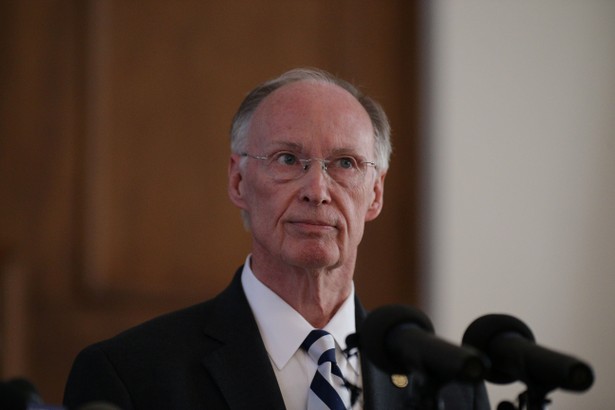
—Alabama Governor Robert Bentley resigned amid allegations he abused power and state resources to conceal an affair. More here
—Two adults and one child are dead in an apparent murder-suicide inside a classroom in San Bernardino, California. More here
—Neil Gorsuch was sworn in as the 113th U.S. Supreme Court justice, returning the court to its full complement of nine judges, as well as to its conservative tilt. More here
—We’re tracking the news stories of the day below. All updates are in Eastern Daylight Time (GMT -4).
Alabama Governor Robert Bentley resigned Monday amid allegations he abused power and state resources to conceal an affair. As The New York Times’s Alan Blinder reports, the second-term Republican governor plead guilty Monday to two misdemeanor charges, including failing to file a major contribution report and converting campaign contributions to personal use—charges for which he was sentenced to 30 days in jail, though the sentence was suspended. Instead, he faces 12 months of probation, 100 hours of community service, and a $7,000 fine. Bentley, whose impeachment hearing began Monday, was confronted last week with allegations of “improper communications” with Rebekah Caldwell Mason, his senior political adviser with whom he is accused of having an affair, as well as abuse of power and violating state ethics and campaign finance laws. Though Bentley asked Alabama residents for forgiveness Friday, he said he had no plans to resign, adding that: “I have done nothing illegal. If the people want to know if I misused state resources, the answer is simply no. I have not.” Alabama Lieutenant Governor Kay Ivey is expected to be sworn in to replace Bentley, but as my colleague David Graham notes, the transition may not be that seamless.
Even with the handwriting so clearly on the wall, Bentley might not choose to leave office gently. His office denied any negotiation on an exit, and Alabama Media Group’s John Archibald wrote, with understated wryness, “It is possible that Bentley, who has changed his mind often during his term, could change his mind.”
Three Dead in Apparent Murder-Suicide at San Bernardino County Elementary School
Grant Hindsley / AP
Updated at 7:15 p.m. ET
Two adults and one child are dead in an apparent murder-suicide inside a classroom at North Park Elementary School, San Bernardino County Police Chief Jared Burguan said today. “We believe the suspect is down and there's no further threat,” Burguan said on Twitter. Lieutenant Mike Madden, a spokesman for the San Bernardino Police Department, said at a news conference that the shooter was Cedric Anderson and his victim was Karen Elaine Smith, a special education teacher. Later Monday, authorities said an 8-year-old boy, Jonathan Martinez, was killed in the gunfire. Madden said the shooter had a handgun and had visited the classroom. He said the injured students were in critical condition, adding they were not targeted; nor were they related to the adults who were killed, he said. Students at North Park Elementary were taken to Cajon High School for safety, Burguan said earlier. The San Bernardino City Unified School District said on Twitter that North Park, Cajon Elementary School, and Hillside Elementary School are on lockdown.
This is a developing story and we’ll update it as we learn more.
Tesla (Briefly) Becomes the Most Valuable U.S. Carmaker
Stephen Lam / Reuters
Tesla became the most valuable carmaker in the U.S. on Monday after its shares rose to about $313 to make it worth $51 billion, enough to edge out General Motors. It didn’t last long, however, and after the crescendo shares dipped slightly, putting General Motors back on top. But it was a clear message that investors are confident Tesla, headed by CEO Elon Musk, will lead the electric-car industry in the future. Last week Tesla passed Ford in value, despite selling a small fraction of what Ford does. In the first three months of the year, Tesla has sold about 25,000 of its Model S and Model X cars, while Ford sold more than 600,000 vehicles; GM sells 690,000. Skeptics say Tesla is overvalued, but Musk has also been venturing into non-car markets, acquiring a solar panel installation company, and debuting a new home solar-panel design. Tesla has been in a crunch to pick up car production, especially after last year, when it debuted the Model 3. At $35,000 the sedan is the company’s cheapest car, and is meant for middle-income buyers. Musk has said he hopes to produce half a million vehicles by 2018.
Neil Gorsuch Is Sworn In as the Newest Supreme Court Justice
Evan Vucci / Reuters
Neil Gorsuch was sworn in on Monday as the 113th U.S. Supreme Court justice, returning the court to its full complement of nine judges, as well as to its conservative tilt. Gorsuch, President Trump’s nominee to fill the vacancy created last year by the death of Justice Antonin Scalia, was confirmed last week by the Senate in a contentious vote that saw Republicans exercise the so-called “nuclear option” so a simple majority of senators could approve him. His appointment brings an end to a yearlong battle that saw Senate Republicans refuse to consider Judge Merrick Garland, President Obama’s nominee for the same seat. The new justice will have an immediate impact, as this week the court will decide which cases to take up in the coming year. At the confirmation ceremony at the White House Rose Garden, the oath was administered by Justice Anthony Kennedy, for whom Gorsuch once clerked. Trump congratulated Gorsuch, and said the justice would rule “not on his personal preferences but based on a fair and objective reading of the law.” The confirmation fulfills Trump’s campaign promise to put a conservative on the bench, and on Monday the president reminded people of that: “I got it done in the first 100 days,” Trump said. “You think that’s easy?”
Video Shows Police Drag Man Off an Overbooked United Airlines Flight
Louis Nastro / Reuters
Updated at 3:38 p.m. ET
A man was forcibly removed from a United Airlines aircraft by police Sunday because the flight was overbooked, according to eyewitnesses. Video of the incident, which took place Sunday on United Flight 3411 at Chicago’s O’Hare International Airport, shows a an unidentified male passenger screaming as three police officers forcibly removed him from his window seat. The man’s screams stopped after one of the officers pulled him to the ground and dragged him down the aisle. One passenger can be heard in the background saying, “Oh my God, look at what you did to him.” The Chicago Police Department said in a statement that the 69-year-old man struck his head on an armrest and was later treated at the Lutheran General Hospital for non-life threatening injuries. Tyler Bridges, a passenger on the plane, told the Washington Post the airline asked four passengers to voluntarily give their seats to stand-by United employees who needed to be in Louisville, Kentucky, where the flight was headed. Bridges said the airline began selecting passengers when no one volunteered and that when the man was asked to leave, he refused, noting he was a doctor and had patients to see the next day. Bridges said the man also accused the airline of choosing him because he is Chinese. Charlie Hobart, a United Airlines spokesman, said in a statement that law enforcement was asked to get involved after no one volunteered to leave the aircraft, adding “we apologize for the overbook situation.” In a separate statement, United Airlines CEO Oscar Munoz said the airline would work with law enforcement to review the incident and apologized “for having to re-accommodate these customers.” The Chicago Department of Aviation said the officer who dragged the man off the flight has been placed on leave.
Wells Fargo Takes Back $75 Million From Top Execs in Sales Scandal
CX Matiash / AP
Wells Fargo said Monday it would take back $75 million from two top executives accused of downplaying and ignoring aggressive policies that prompted thousands of employees to create fake accounts to meet sales goals. The announcement came as the company released a scathing 110-page report that found the bank’s management pressured employees to push unwanted or unneeded products on customers. This led to a wide practice of fraud, and thousands of employees created up to 2 million fake accounts and lines of credit without customer knowledge. Much of the blame for the scandal has been leveled on former CEO John Stumpf, and former head of community banking, Carrie Tolstedt. The report found that when presented with the problem, Stumpf refused to hear the criticism or change practices, and Tolstedt actively worked to downplay the issue. Wells Fargo has already paid $185 million in fines. It also settled a class-action lawsuit for $110 million. Both Stumpf and Tolstedt will have their compensation taken, as well as stock options.
Marine Le Pen Denies France's Role in the Holocaust
Lionel Bonaventure / Reuters
Marine Le Pen, the National Front (FN) presidential candidate, sparked outrage Sunday when she denied France’s responsibility for the wartime deportation of thousands of French Jews to the Nazi concentration camps. “I don’t think France is responsible for the Vel d’Hiv,” the far-right leader said Sunday in reference to France’s round up of more than 13,000 Jews at the Vélodrome d'Hiver indoor cycling track in 1942, adding: “I think that generally speaking if there are people responsible, it's those who were in power at the time. It's not France.” Both President François Hollande and former President Jacques Chirac have apologized for France’s role in the incident, though Le Pen argued the Vichy regime that ruled France during World War II was an “illegal” authority, noting Charles de Gaulle, the leader of the Free French Forces, lived in exile in London at the time. Such comments are not unusual for the FN. Jean-Marie Le Pen, Marine Le Pen’s father and the FN’s founder, has repeatedly dismissed the Holocaust as a minor “detail” of history and defended Vichy government collaborators—rhetoric that prompted the younger Le Pen to expel her father from the FN in 2015 as part of her effort to rebrand the historically fringe party. Le Pen’s comments come less than two weeks ahead of the French presidential election’s first round of voting that polls project her to win.
Egypt's State of Emergency Takes Effect After ISIS Attacks on Coptic Churches
(Mohamed Abd El Ghany / Reuters)
Egypt’s three-month state of emergency went into effect Monday, a day after ISIS claimed responsibility for attacks on two Coptic churches that killed more than 40 people. Egyptian President Abdel-Fattah el-Sisi declared a state of emergency Sunday following the attacks. The Egyptian Cabinet, which must approve the move, did so today. “The state of emergency allows both the armed forces and the police to execute those procedures necessary to combat the threats of terrorism and its financing, maintain security around the country and protect public and private property, as well as preserving the lives of citizens,” the Cabinet said in a statement. Yesterday’s attacks in the northern city of Tanta and in Alexandria targeted worshippers who had gathered for Palm Sunday.
U.S. Steps Up Pressure on Russia Over Its Support of Syria
U.S. Secretary of State Rex Tillerson attends a ceremony at the Sant'Anna di Stazzema memorial, dedicated to the victims of the massacre committed by Nazis in 1944. (Max Rossi / Reuters)
U.S. Secretary of State Rex Tillerson is meeting today with his colleagues from the Group of Seven (G-7) industrialized nations, ahead of a meeting this week with his Russian counterpart. The G-7 is hoping to pressure Russian President Vladimir Putin to end his military and diplomatic support for the regime of Syrian President Bashar al-Assad. Tillerson’s visit to Moscow comes days after the U.S. struck a Syrian airbase following what the U.S. says is Assad’s use of chemical weapons last week in Idlib province. The U.S. strike marked an apparent turning point in the U.S. view toward Assad: Just days ahead of the chemical-weapons attack, U.S. officials, including Tillerson and Nikki Haley, the U.S. envoy to the UN, said Assad’s removal from power was not a U.S. priority. After the strike, however, U.S. officials said they wanted Assad gone—but through a political process. Tillerson, speaking on CBS’s Face the Nation, said: “I think the issue of how Bashar al-Assad’s leadership is sustained, or how he departs, is something that we’ll be working with allies and others in the coalition. But I think with each of those actions, he really undermines his own legitimacy.” Haley, appearing on NBC’s Meet the Press, said: “In no way do we see peace in that area with Russia covering up for Assad. And in no way do we see peace in that area with Assad at the head of the Syrian government.” The U.S. has emphasized though that fighting ISIS remains its priority in Syria.
Thirteen thousand miles. Infinite contenders. One beautiful loaf.
This article was featured in the One Story to Read Today newsletter. Sign up for it here.
Here is the promise you and I must cling to across the thousands of words that follow: At some point within this text, I will reveal to you what—after 555 responses, 13,000 miles of travel, and months of monomaniacal research—I have determined to be the best free restaurant bread in America. I will not attempt to slither to the moral high ground, arguing that best is a meaningless measure, or insisting that all bread is dear in its own way. Even if you attempt to betray me—for instance, by merely scanning the text that follows for the phrase Here it is: the best free restaurant bread in America—I will uphold my end of the bargain.
The president is on a losing streak, and even some of his aides are dismayed by his choices.
This article was featured in the One Story to Read Today newsletter. Sign up for it here.
You’ve heard the joke: The White House is going to start talking about the Epstein files to distract from how badly the Iran war is going.
Except that this reverse “Wag the dog” is based on bizarre truth: First Lady Melania Trump did bring the disgraced financier up, unprompted, late last week in an effort to distance herself from the scandal (in a move that, predictably, only shifted it back into the spotlight once again). Meanwhile, as negotiations with Iran stumble forward, the Strait of Hormuz is still in Tehran’s hands and now President Trump has authorized a risky naval blockade that will likely send prices soaring further. Moreover, Trump’s poll numbers have continued to fall, Republicans worry that both houses of Congress could be lost in November, and the president threw away a remarkable amount of geopolitical capital trying to support his now-defeated illiberal buddy Viktor Orbán of Hungary. Oh, and Trump deeply offended adherents of the world’s two largest religions in one week’s time.
The car industry says it has an answer for drivers wary of going electric.
Two hours into a road trip in my Tesla, I start to get twitchy. By that point, the battery in my 2019 Model 3 has dipped to an uncomfortably low percentage. If I can’t reach the next plug, I’m in trouble. This is the kind of problem that Ram’s electric pickup truck—the first of a new breed of EV to arrive in the United States—is intended to solve. When the range starts to dwindle, the truck automatically fires up a hidden gas engine that refills the giant battery. The “electric” vehicle keeps on chugging down the highway, hour after hour; pit stops are once again decided by the need for bathroom breaks rather than battery range.
The Ram 1500 REV, set to debut later this year, is what’s called an “extended-range electric vehicle,” or EREV. In essence, it is an electric vehicle that burns gas. There’s nothing revolutionary about a half-gas, half-electric car, of course. Hybrids have been a mainstay in the United States since the Toyota Prius broke through two decades ago, and automakers have released more efficient plug-in hybrids—allowing drivers to charge up for about 30 miles of electric driving, just enough to accomplish daily errands without fossil fuels. An extended-range EV is a different kind of beast. The engine burns gasoline for the sole purpose of replenishing the battery—it never actually pushes the wheels. In the Ram, the battery can run for about 150 miles of electric driving, and the whole setup delivers enough range to travel nearly 700 miles between stops.
Is the president’s son-in-law carrying out the public’s business or pursuing his own private interests?
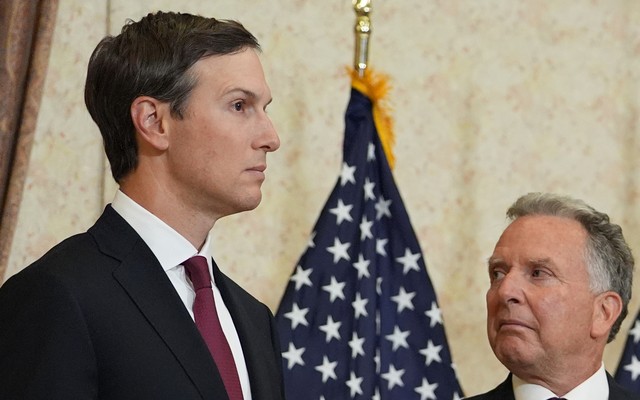
In 2021, shortly after he left his role as a senior White House adviser, Jared Kushner let it be known that he had loved his job but disliked the scrutiny and disclosure that came with being a top U.S. government official. He set up a private-equity firm and took a $2 billion investment from a Saudi fund led by Crown Prince Mohammed bin Salman. He proclaimed that he was embracing private life. “I’m an investor now,” Kushner said in a 2024 interview. If President Trump “calls you on November whatever and says, ‘I’d like you to come back to D.C.,’ you say, ‘Thanks, but I’m good’?” the interviewer, Dan Primack of Axios, pressed. “Yes,” Kushner responded.
But Kushner did come back. Two days before the United States and Israel attacked Iran this past February, he was in Geneva in a negotiation of the highest possible stakes. Over the weekend, he traveled with Vice President Vance to Islamabad to participate in failed peace talks with Iran. Without title or remit or any kind of official designation—only “presidential son-in-law”—Kushner has in the first 14 months of the second Trump administration sat down with world leaders including Vladimir Putin, Benjamin Netanyahu, and Volodymyr Zelensky, along with Saudis and multiple other actors from the Middle East.
A minimally speaking autistic man just wrote a best-selling book. Or did he?
On a recent morning at Rockefeller Center, NBC employees strolled through the crowd with copies of Upward Bound, the latest book-club pick from the Today show co-host Jenna Bush Hager. “It’s deeply heartfelt and moving,” Hager said, after holding up the debut novel from the 28-year-old Woody Brown, “and the reason it’s so authentic is that the author understands autism firsthand.”
That understanding is indeed profound. Brown’s autism is such that he can barely speak, and he communicates mostly by pointing to letters, one by one, on a laminated board. This is also how his novel, which is already a New York Times best seller, came to be. In the recorded interview that followed Hager’s introduction, Brown’s mother, Mary, sat beside him, holding the letter board and reading his tapped-out messages.
The president’s attempts to interfere with the midterms demand vigilance, but a recent flimsy gambit is an argument against despair.
This is an edition of The Atlantic Daily, a newsletter that guides you through the biggest stories of the day, helps you discover new ideas, and recommends the best in culture. Sign up for it here.
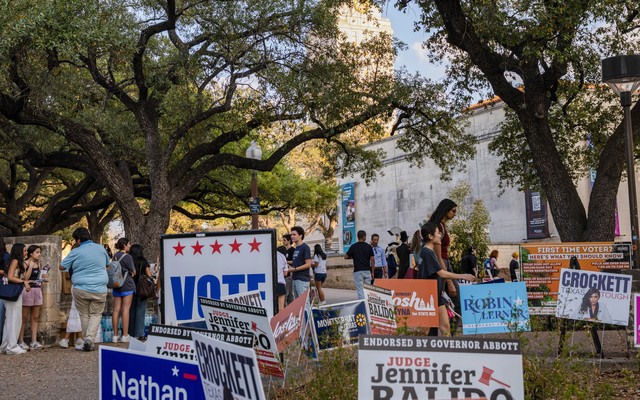
Anxiety among election officials and experts had been building for months before Donald Trump issued his latest executive order purporting to ensure election integrity late last month. When the actual text emerged, the reaction wasn’t relief exactly—but a definite sense that things could have been much worse.
Americans have many reasons to be worried about whether the midterm elections will be free and fair. As I laid out in a cover story last fall, the president’s plan to subvert the 2026 election is multifaceted and already in swing. But last month’s order and the dismissive reaction it’s received from experts—along with this weekend’s decisive defeat of Hungarian Prime Minister Viktor Orbán, which shows how the competitive-authoritarian playbook that Trump has imitated can be beaten—also point to the reasons to resist doomerism.
A phonics-based curriculum is only one part of how Mississippi went from worst to first in education. The other part is much harder to pull off.
Updated at 8:52 p.m. ET on April 9, 2026
This article was featured in the One Story to Read Today newsletter. Sign up for it here.
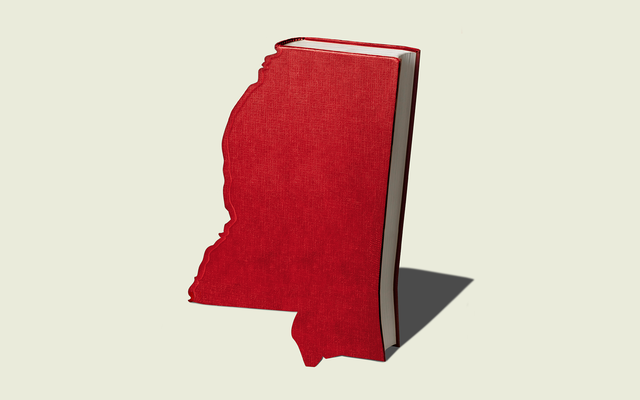
No story has caught the imagination of education reformers this decade quite like the “Mississippi miracle.” From 1998 to 2024, fourth-grade reading and math scores in my home state—the nation’s poorest—rose from among the worst in the country to among the best. When adjusting for demographic factors such as poverty, we’re in first place.
Other states are now trying to emulate what Mississippi did. Those efforts largely revolve around adopting what’s known as the “science of reading”— a set of principles and teaching techniques, including phonics, that are grounded in decades of empirical research. Last fall, for example, the Wall Street Journal editorial board marveled that “even California is now following Mississippi’s lead by returning to phonics” as Governor Gavin Newsom prepared to sign a major new reading bill into law. But what many outsiders fail to understand is that Mississippi changed far more than just how reading is taught. They therefore miss why and how our literacy approach succeeded.
On many recent nights, Donald Trump has been posting obsessively on his Truth Social site into the wee hours. The president, of course, has never been one for a solid night’s sleep—or restrained and temperate commentary on social media—but his emotional state seems to be fraying: This weekend, he attacked Pope Leo XIV, presented himself as Jesus Christ, and then jabbed at his phone until dawn.
Judging from those posts, the commander in chief is in distress. No one can say for sure what is causing the president’s bizarre behavior. Perhaps Trump’s narcissistic insistence that he is always successful in everything he undertakes is feeling the sting and strain of multiple public failures, including the collapse of his campaign to dislodge the Iranian regime, plummeting approval ratings, the decline of the U.S. economy, and, on Sunday, the crushing defeat of one of his favorite fellow authoritarians, Hungary’s Viktor Orbán.
Hungary offers lessons in defeating right-wing populists.
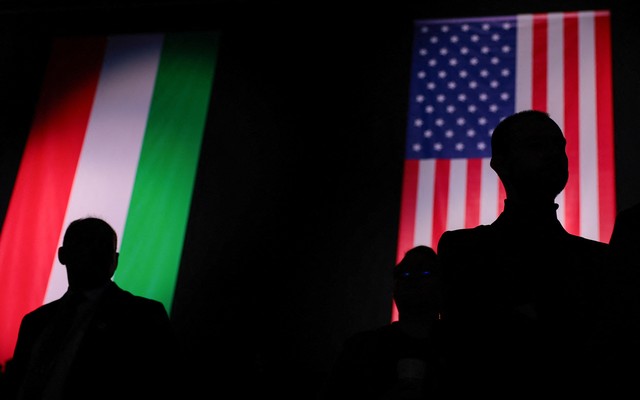
To the outside world, Hungarian Prime Minister Viktor Orbán began his rule as a pariah—an obstreperous, often lone dissenter from European Union policies, especially over migration. Then he became a prophet to new-style “national conservatives”—the anti-immigration, anti-elite right-wing movement that has reshaped the politics of the West. After resoundingly losing national elections held on April 12, Orbán has become a parable for how populism can be defeated.
His political demise was hardly inevitable. It had to be shrewdly engineered by politicians and voters who put aside their ideological differences to defeat him. In politics, there is no natural law of self-correction.
From 2010 until now, Orbán and his Fidesz party transformed Hungary into a new kind of state, which he proudly proclaimed as an “illiberal democracy.” He and his allies rewrote the constitution to entrench his power, centralizing control over civil society and countervailing institutions such as courts and universities. Péter Magyar, the presumptive next prime minister, triumphed against a tilted electoral system—gerrymandered districts, government influence over traditional media and even over the country’s billboards—designed to keep Fidesz in power. Magyar understood that such a regime does not simply collapse under the weight of its own contradictions and mismanagement.
If you are anything like me, you have spent a lot of time over the past few weeks opening letters, finding receipts, requesting PDFs, scanning documents, and going through your credit-card statements line by line. It’s tax season. And in the United States, taxes are a DIY affair.
This is the case even though Washington could probably do your taxes for you. If you earn a salary or an hourly wage, the Internal Revenue Service already knows how much money you make. It likely knows how much you owe or how big your refund should be too. Nine in 10 households take the standard deduction, making their liability easy to glean from payroll and banking data.
Yet Uncle Sam demands that Americans fire up TurboTax, head to a storefront preparer, hire an accountant, or sit down with a sharp pencil and a strong cup of coffee to get their taxes done each spring. The average filer spends 13 hours on their 1040—a time tax that many of our wealthy peer countries have reduced to a couple of minutes, if that. Prepopulated documents and return-free systems are common everywhere but here. Sweden lets residents file by text. Canada prefills paperwork. Japan sends households a document summarizing their tax contributions. If everything looks copacetic, many workers get to do a blissful nothing. Denmark, Estonia, Spain, and Norway have similarly simple processes.