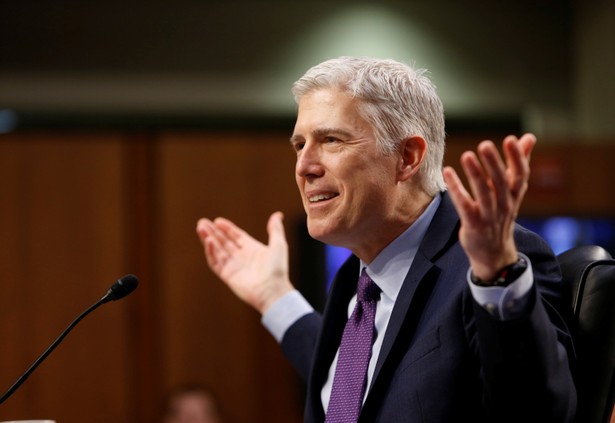
—The Senate Judiciary Committee begins deliberations today on the nomination of Judge Neil Gorsuch to the U.S. Supreme Court. Republicans need five more Democratic votes to overcome a filibuster that Democrats have vowed to mount on the nomination.
—We’re tracking the news stories of the day below. All updates are in Eastern Daylight Time (GMT -4).
Trump Donates His First-Quarter Paycheck to the National Park Service
Carlos Barria / Reuters
President Trump donated his first three months of salary to the National Park Service (NPS) on Monday. The total comes to $78,333.32, which Sean Spicer, the White House spokesman, handed in the form of a check to an NPS employee. During his election campaign, Trump promised to donate his $400,000 annual salary if elected, even asking for the press corps’s help in deciding where to send it. The NPS is overseen by the Department of Interior, which said the money would go toward maintaining historic battlefield sites. At these areas alone, the NPS faces a $229 million budget shortfall. Interior Secretary Ryan Zinke has said the NPS faces an overall maintenance shortfall of $12 billion, and he’s made this one of his top priorities. But it’s unclear how that shortfall will be made up because Trump’s “skinny” budget calls for a 12 percent cut to the Interior Department.
UPDATE: Democrats Have Enough Votes to Filibuster Gorsuch's Nomination; GOP Vows to Press Ahead
(Joshua Roberts / Reuters)
The Senate Judiciary Committee voted 11-9 along party lines Monday to move the nomination of Judge Neil Gorsuch to a full Senate vote. The move comes after Senate Democrats said they have the 41 votes needed to filibuster Gorsuch’s nomination, likely forcing Republicans to use the so-called “nuclear option” and put the Supreme Court nominee’s appointment to a full vote. Gorsuch, President Trump’s nominee to fill the vacancy created by the death last year of Judge Antonin Scalia, has the support of all 52 Republicans in the Senate, as well as of at least three Democrats—Joe Manchin of West Virginia, Heidi Heitkamp of North Dakota, and Joe Donnelly of Indiana—from conservative states that went to Trump. He needed 60 votes—a supermajority—for his nomination to be approved. The “nuclear option” would allow Gorsuch’s nomination to be approved by a simple majority of senators rather than the 60-vote supermajority. Democrats, who are still angry over the Republican refusal to hold hearings for Judge Merrick Garland, whom President Obama nominated to fill Scalia’s spot on the court, insist that if Republicans don’t have 60 votes for Gorsuch, Trump should nominate a judge who can win the support of a supermajority of lawmakers. Despite their opposition, however, Gorsuch is expected to be confirmed.
President Trump meets Egyptian President Abdel Fattah al-Sisi in the Oval Office on April 3, 2017. (Kevin Lamarque / Reuters)
President Trump welcomed Egyptian President Abdel Fattah al-Sisi to the White House Monday, marking the Arab leader’s first visit to Washington since he assumed power following former President Mohamed Morsi’s ouster in 2013. “I just want to let everybody know, in case there was any doubt, that we are very much behind President al-Sisi,” Trump told reporters at the meeting. “He’s done a fantastic job in a very difficult situation. We are very much behind Egypt and the people of Egypt.” Though Egypt has been a longstanding U.S. ally—receiving approximately $1.3 billion in U.S. military aid annually—Sisi was never afforded an invitation to the White House under the Obama administration. Indeed, Obama froze aid to the country for two years after Sisi, then Egypt’s defense minister, led a popular uprising against Morsi’s Muslim Brotherhood-led government, which was elected the previous year. The U.S.-Egyptian relationship was further strained by alleged human-rights abuses by the Sisi government, including mass arrests, enforced disappearances, and extrajudicial executions. Though Trump noted that both countries “have a few things” they do not agree upon, he said the two countries will work together “to fight terrorism and other things.”
Ecuador's New Socialist President Is Good News for Julian Assange
Mariana Bazo / Reuters
Socialist candidate Lenín Moreno narrowly won Ecuador’s presidential election Sunday night, though his opponent has demanded a recount and protesters from both sides took to the streets. Moreno’s win bucked a trend of center-right victories in South America, and was also good news for Julian Assange, whose fate as an asylee in Ecuador’s embassy in London was predicated on the win. Moreno, a former vice president, won 51 percent of the vote over his opponent, Guillermo Lasso. Lasso was a former banker who offered voters a change from leftist economic policies he blamed for the country’s sagging economy. He also promised to kick Assange out of the embassy within 30 days of taking office. At least one respected exit poll had put Lasso ahead Sunday night, so when news of Moreno’s win came later that evening, Lasso denounced it as fraudulent, saying, “We won’t let them cheat us!” His supporters stormed the country’s election headquarters and battled riot police. As oil prices and exports have fallen in the region, countries like Argentina, Peru, and Brazil have turned to center-right leaders who’ve promised fiscal reforms. But by selecting Moreno, Ecuador remains in the company of Socialist-led Bolivia and Venezuela.
Blast Reported at Metro Station in St. Petersburg, Russia
A general view of St. Petersburg, Russia (Maxim Zmeyev / Reuters)
Updated at 9 a.m.
Russian news reports say an explosion in the St. Petersburg metro system has killed at least people. The blast reportedly occurred at the Sennaya Square metro station.
For the richest men on Earth, everything is free and nothing matters.
At the end of Paul Thomas Anderson’s 2007 movie, There Will Be Blood, Daniel Day-Lewis’s oil-baron character, old now and richer than Croesus, beats Paul Dano’s preacher to death with a bowling pin. Dano’s Eli Sunday, a nemesis of Day-Lewis’s Daniel Plainview during his seminal, wealth-building years, has come to sell Plainview the oil-rich land that he once coveted. But Plainview doesn’t need the land anymore, because—as he explains in one of the most famous monologues in modern cinema—he has sucked out all the oil hidden beneath it from an adjoining property, like a milkshake.
Desperate for money, Eli begs for a loan. Instead, Plainview chases him around a bowling alley and murders him with great enthusiasm. Once it’s over, a butler comes to see what all the noise was about. “I’m finished,” Plainview yells.
Kash Patel has alarmed colleagues with episodes of excessive drinking and unexplained absences.
This article was featured in the One Story to Read Today newsletter. Sign up for it here.
On Friday, April 10, as FBI Director Kash Patel was preparing to leave work for the weekend, he struggled to log on to an internal computer system. He quickly became convinced that he had been locked out, and he panicked, frantically calling aides and allies to announce that he had been fired by the White House, according to nine people familiar with his outreach. Two of these people described his behavior as a “freak-out.”
Patel oversees an agency that employs roughly 38,000 people, including many who are trained to investigate and verify information that can be presented under oath in a court of law. News of his emotional outburst ricocheted through the bureau, prompting chatter among officials and, in some corners of the building, expressions of relief. The White House fielded calls from the bureau and from members of Congress asking who was now in charge of the FBI.
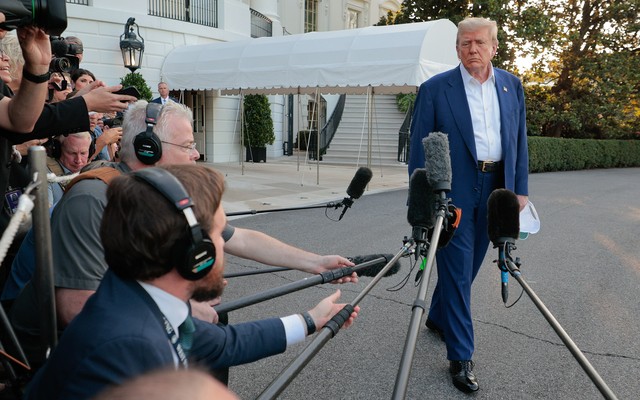
Why is Donald Trump breaking bread with the “enemy of the people”?
Even in the best of times, the annual White House Correspondents’ Dinner is an awkward and ethically fraught affair. Journalists spend the evening partying with the president and administration officials whom they’re supposed to cover rigorously and skeptically. I’ve been to the dinner several times over the years. It’s typically crowded and a little chaotic, and the ratio of non-journalists to journalists is about 10 to 1. The evening is promoted as a celebration of journalism and the First Amendment, but it has always been a bit of an embarrassment.
These aren’t the best of times for White House correspondents or, for that matter, the First Amendment. And this year’s gala figures to be even more awkward and embarrassing than usual.
The world’s richest man is accruing more power than ever before.
If Elon Musk gets his way, space will soon look very different. Through his ownership of SpaceX, the world’s richest man already operates most of the roughly 14,000 active satellites that are orbiting Earth. Now his rocket company is asking the government for permission to launch up to 1 million more. It’s part of Musk’s plan to build data centers in space that can harness the power of the sun for AI. “You’re power-constrained on Earth,” Musk said last month. “Space has the advantage that it’s always sunny.”
Musk has a lot riding on these orbital data centers. To help finance them, he is set to take SpaceX public as early as June, at a reported valuation of $2 trillion. Musk has claimed that data centers in space can “enable self-growing bases on the moon, an entire civilization on Mars, and ultimately expansion to the universe.” It’s all classic Musk, who has a habit of making big promises that he can’t always keep. Data centers in space are an untested technology, and it’s not clear if they’d actually work. (Neither Musk nor SpaceX responded to a request for comment.)
The “disappearing scientists” story is, in its way, a remarkable achievement.
The mystery of the missing scientists began with a Silver Alert. In late February, a retired Air Force major general named Neil McCasland left his house in New Mexico for a walk and never returned. Rumors spread on social media that the elderly former astronautical engineer had been abducted or killed. Forget Nancy Guthrie, they said. Here was a guy who used to run a “UFO-linked” lab. Here was a guy with knowledge of “America’s deepest, darkest secrets.” So where was this guy?
McCasland’s wife did her best with a post on Facebook to address what she called the “misinformation circulating about Neil and his disappearance,” but wild notions only multiplied. Dots were added, then connected: Another scientist—an advanced-materials researcher at NASA’s Jet Propulsion Laboratory (JPL) named Monica Reza—had disappeared while hiking near Los Angeles in June 2025. A physicist at MIT had been murdered in December. “What is going on seems to be an enemy action,” Walter Kirn, the novelist and podcast contrarian, said last month.
The people we were died at the exact moment our child did.
This article was featured in the One Story to Read Today newsletter. Sign up for it here.
My husband, David, hates Valentine’s Day. He once called it “New Year’s Eve with nuclear weapons.” I pretend not to care. Still, when the day passes entirely unremarked on, a woman can’t help but feel overlooked.
On Valentine’s Day 2024, David found a way out. He booked a speech on February 14 that required traveling from our home in Washington, D.C., to Toronto. I couldn’t object—he was getting paid. Anyway, I had my own plans: an “anti–Valentine’s Day” dinner hosted by one of the foreign embassies.
As I got ready, I called our oldest daughter, Miranda. She answered from her Brooklyn bathroom, getting ready for her own party. She propped her phone up beside her sink and laughed when I told her about her father’s strategic Valentine’s Day escape.
More families who can afford it are hiring a house manager, a kind of “chief of staff for the home.”
Here is the promise of a house manager. Hire one, and soon someone else could be doing your laundry, washing your dishes, prepping your meals, and completing those Amazon returns you’ve been meaning to make. They could reorganize the utensil drawer, notice if your kid is outgrowing their shoes and order more, take your car to the repair shop, and be at home to meet the plumber. If your child needs food for a class party, a house manager could make the dish and drop it off; if that child also has a pet lizard, a house manager could buy the crickets to feed it.
House managers are not a nanny or a house cleaner. They’re a “chief of staff for the home,” a “personal assistant for Mom,” and “a clone of myself,” according to the more than a dozen people I spoke with who have either hired one or work as one. They are, in effect, what might have once been called a housekeeper—a person who helps oversee a household’s basic functioning. Middle- and upper-class families used to more commonly employ this kind of position (the title “house manager” dates back to at least the 1830s), but it has become rare enough that a couple of people I spoke with thought they may have come up with the term.
Montana Democrats thought they found a novel way to win control of the U.S. Senate—until the party faithful started fighting back.
Jason Boeshore, a grain-elevator manager on the eastern plains of Montana, fired off a rocket this month to the private Signal chat he shares with the 23 other members of the state Democratic Party executive board. He demanded that leaders make clear in newspapers across the state that the Democratic Party would support only Democratic candidates in the fall elections. The response was swift and not to his liking. Shannon O’Brien, the chair of the party, wrote that her staff, not the board, would set the messaging strategy. Then she addressed the unspoken concerns at the heart of Boeshore’s request. “Listen if ANY of you EVER find yourselves questioning my intentions, please call me,” O’Brien wrote. “I will continue to move forward to get Democrats elected. There’s no hidden agenda.”
Donald Trump’s advisers are treating him like he can’t handle the reality of the war in Iran. They might be right—but that fact is a danger to the constitutional order.
This is an edition of The Atlantic Daily, a newsletter that guides you through the biggest stories of the day, helps you discover new ideas, and recommends the best in culture. Sign up for it here.
Earlier this month, top officials in the Trump administration were facing two problems—one distant and acute, one near and chronic.
The first was that two American airmen were missing inside Iran after their jet had been shot down. Commanders were scrambling to create and execute an operation to rescue both. The second was the president’s temperament. As plans developed and went into effect, The Wall Street Journal reported over the weekend, “aides kept the president out of the room as they got minute-by-minute updates because they believed his impatience wouldn’t be helpful, instead updating him at meaningful moments, a senior administration official said.”
The phrase is even more complicated than it appears.
Earlier this month, a staff writer for The Free Press, Olivia Reingold, asked the Democratic Senate candidate Abdul El-Sayed from Michigan a question: “Does Israel have a right to exist as a Jewish state?”
El-Sayed replied with his own question: “What do you mean by a ‘Jewish state’?” When Reingold went silent, before beginning to stutter out a response, El-Sayed continued, “If you can’t define the question, I’m not going to answer your question.”
A lot of labels and terms get thrown around in arguments over the Israeli-Palestinian conflict, words such as Zionist or anti-Zionist and one state or two states. These terms are not always well defined, and they mean different things to different factions—so it’s important, when discussing such matters, to know what people actually mean.