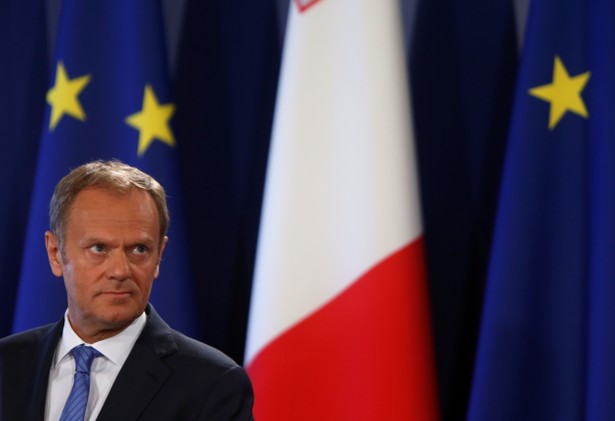
European Council President Donald Tusk discusses Brexit in Valletta, Malta, on March 31.
Darrin Zammit Lupi / Reuters
—The EU’s draft on Brexit talks propose a “phased approach,” suggesting talks on a trade deal with the U.K. can begin once there’s enough progress on a financial settlement.
—Mike Flynn offers to be interviewed in exchange for immunity from prosecution, the Wall Street Journal and other are reporting. More here
—We’re tracking the news stories of the day below. All updates are in Eastern Daylight Time (GMT -4).
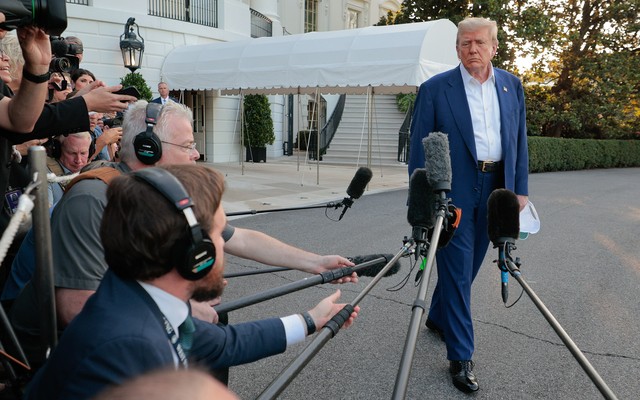
President Trump signed two executive orders on Friday, aimed at assessing the fairness of U.S. trade deals. The move represents a more cautious approach from when Trump, as presidential candidate, promised to scrap the North American Free Trade Agreement (NAFTA), which he called “the worst trade deal ever.” The first order Trump signed calls for a 90-day study to look country-by-country, product-by-product, at abuses that contribute to the U.S. trade deficit. The study would serve as a template for rule- and decision-making when the administration evaluates how to reorganize trade deals. The second order will step up duties collected from countries the U.S. finds to be dumping products at below production costs, often done with heavy subsidies from their governments. The orders come a week ahead of Trump’s meeting with President Xi Jinping of China, which Trump has accused of taking advantage of the U.S. Trump has called the U.S. trade deficit—more than $500 billion last year—a job-killer, and has said he will renegotiate deals like NAFTA to put American interests first. But more so than trade deals, economists have pointed to the increased robotization of factories as the major cause for lost factory jobs. At the signing ceremony Friday, after taking a few questions from the media, Trump abruptly left without actually signing the order. Vice President Mike Pence instead picked up the document and chased after the president.
The meeting next week with China will be a very difficult one in that we can no longer have massive trade deficits...
New York Mayor De Blasio Plans to Close Rikers Island Jail Within 10 Years
Lucas Jackson / Reuters
New York City Mayor Bill de Blasio announced Friday plans to shutter the Rikers Island jail complex within the next decade in a bid to end the era of mass incarceration in the city.
Rikers Island is an expression of a national problem. The mass incarceration era did not begin in New York City but it’s going to end here.
Closing the 85-year-old facility will be a “long and arduous” process, de Blasio said in a statement, adding “our success in reducing crime and reforming our criminal justice system has paved a path off Rikers Island and toward community-based facilities capable of meeting our criminal justice goals.” De Blasio said the project would require cutting the jail’s nearly 10,000-person population in half, as well as constructing several smaller facilities to replace it. The announcement follows the formation last year of an independent panel commissioned to examine the facility, which, as The New York Times reports, recommended the jail be demolished and replaced with new jails built in each of the city’s five boroughs. More details from the commissions findings are expected to be announced Sunday.
A Federal Judge Approves a $25 Million Trump University Settlement
Carlos Barria / Reuters
A federal judge on Friday approved a deal for President Trump to pay $25 million to settle lawsuits against him over Trump University, the defunct real-estate education program created by Trump. The ruling, by U.S. District Court Judge Gonzalo Curiel in the Southern District of California, ends seven years of legal battles, with class-action suits in New York and California. The cases came to national attention during Trump’s election campaign, with plaintiffs saying they’d signed up to learn Trump’s real-estate investment secrets, but instead forked out thousands of dollars for worthless information that could be found free online. Trump had refused to settle the suits, and even promised to reopen the university once he won the court battle. At one point, he complained that Curiel could not possibly oversee the case impartially, because of the Indiana-born judge’s Mexican heritage. Trump later apologized for this comment, reversed his stance on the lawsuit, and after he won the election in November agreed to settle for $25 million. That figure comes to about 90 percent of the money his university took from customers. Not everyone is happy, and there were two plaintiffs who objected to the settlement, one on the grounds that Trump owed them an apology.
Germany Says NATO's Spending Target Neither 'Reachable nor Desirable'
U.S. Secretary of State Rex Tillerson speaks at NATO’s headquarters in Brussels, Belgium on March 31, 2017. (Virginia Mayo / Reuters)
Germany called the 2-percent spending goal for all NATO allies neither “reachable nor desirable” Friday in response to repeated calls by the U.S. for members of the military alliance to meet their financial commitments. “Two percent would mean military expenses of some 70 billion euros,” Sigmar Gabriel, Germany’s foreign minister, said at a NATO meeting in Brussels, where U.S. Secretary of State Rex Tillerson was in attendance. “I don’t know any German politician who would claim that is reachable nor desirable.” His remarks follow repeated demands by the U.S. that NATO members fulfill their treaty obligations and contribute 2 percent of their gross domestic product to defense spending by 2024—a goal that five of the NATO’s 28 members have met. Germany spends about 1.2 percent of its GDP on defense. Tillerson said Friday all allies should by May “either met the pledge guidelines or will have developed plans that clearly articulate how … the pledge will be fulfilled.” He also reaffirmed the U.S. government’s commitment to the alliance—one which President Trump has previously criticized as “obsolete,” having at one point appeared to suggest that U.S. commitment to the body should be predicated upon its members’s defense spending. But Trump reaffirmed his “strong support for NATO” this month during a joint news conference with German Chancellor Angela Merkel, who also reaffirmed support for NATO and Germany’s commitment to the the 2 percent spending target. She said: “Last year we increased our defense spending by 8 percent, and we’re going to work together again and again on this.”
The Wall Street Journal and others reported last night that Mike Flynn, President Trump’s national-security adviser, old the FBI and congressional investigators he is willing to be interviewed in exchange for immunity from prosecution. As Matt Ford wrote: “Why does someone request immunity from prosecution before speaking with federal investigators? That question will likely consume Washington in the weeks ahead after Thursday night’s bombshell...” Robert Kelner, Flynn’s attorney, said: “General Flynn certainly has a story to tell, and he very much wants to tell it, should the circumstances permit.” But The New York Times cited an unnamed congressional official as saying investigators are not willing to broker a deal “until they are further along in their inquiries and they better understand what information Mr. Flynn might offer as part of a deal.” But as Matt wrote last night: “A request for immunity isn’t an admission of guilt or wrongdoing. It may be sought by witnesses who fear that their words could be used against them, as a condition of their testimony. … But the move could also be a purely prophylactic measure.”
The European Union is suggesting a “phased approach” to Brexit in which it will discuss a trade deal with the U.K. only when there’s sufficient progress made on the nature of their separation. The EU’s draft plan, which was released today in Brussels, must now be approved by the bloc’s 27 other members (the U.K. remain the 28th member until its separation from the EU is final; the process is expected to take at least two years). The release of the plan comes two days after the U.K. invoked Article 50 of the Lisbon treaty, the process by which Brexit negotiations formally begin. The U.K. wants talks on its exit and trade relations to be discussed simultaneously. Donald Tusk, the European Council president, said in Malta that “will not happen.” “Only once we have achieved sufficient progress on the withdrawal can we discuss the framework for our future relationship,” he said.
For the richest men on Earth, everything is free and nothing matters.
At the end of Paul Thomas Anderson’s 2007 movie, There Will Be Blood, Daniel Day-Lewis’s oil-baron character, old now and richer than Croesus, beats Paul Dano’s preacher to death with a bowling pin. Dano’s Eli Sunday, a nemesis of Day-Lewis’s Daniel Plainview during his seminal, wealth-building years, has come to sell Plainview the oil-rich land that he once coveted. But Plainview doesn’t need the land anymore, because—as he explains in one of the most famous monologues in modern cinema—he has sucked out all the oil hidden beneath it from an adjoining property, like a milkshake.
Desperate for money, Eli begs for a loan. Instead, Plainview chases him around a bowling alley and murders him with great enthusiasm. Once it’s over, a butler comes to see what all the noise was about. “I’m finished,” Plainview yells.
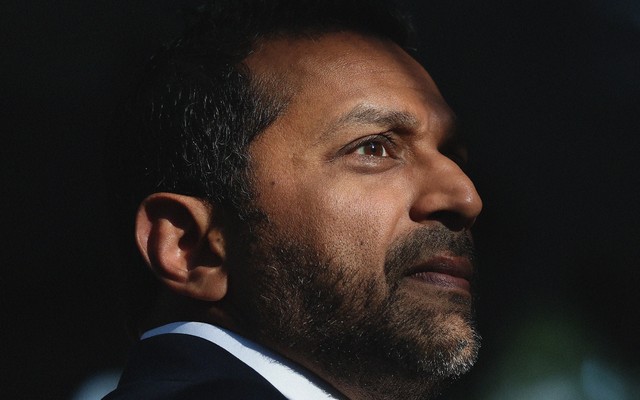
Kash Patel has alarmed colleagues with episodes of excessive drinking and unexplained absences.
This article was featured in the One Story to Read Today newsletter. Sign up for it here.
On Friday, April 10, as FBI Director Kash Patel was preparing to leave work for the weekend, he struggled to log on to an internal computer system. He quickly became convinced that he had been locked out, and he panicked, frantically calling aides and allies to announce that he had been fired by the White House, according to nine people familiar with his outreach. Two of these people described his behavior as a “freak-out.”
Patel oversees an agency that employs roughly 38,000 people, including many who are trained to investigate and verify information that can be presented under oath in a court of law. News of his emotional outburst ricocheted through the bureau, prompting chatter among officials and, in some corners of the building, expressions of relief. The White House fielded calls from the bureau and from members of Congress asking who was now in charge of the FBI.
Why is Donald Trump breaking bread with the “enemy of the people”?
Even in the best of times, the annual White House Correspondents’ Dinner is an awkward and ethically fraught affair. Journalists spend the evening partying with the president and administration officials whom they’re supposed to cover rigorously and skeptically. I’ve been to the dinner several times over the years. It’s typically crowded and a little chaotic, and the ratio of non-journalists to journalists is about 10 to 1. The evening is promoted as a celebration of journalism and the First Amendment, but it has always been a bit of an embarrassment.
These aren’t the best of times for White House correspondents or, for that matter, the First Amendment. And this year’s gala figures to be even more awkward and embarrassing than usual.
The world’s richest man is accruing more power than ever before.
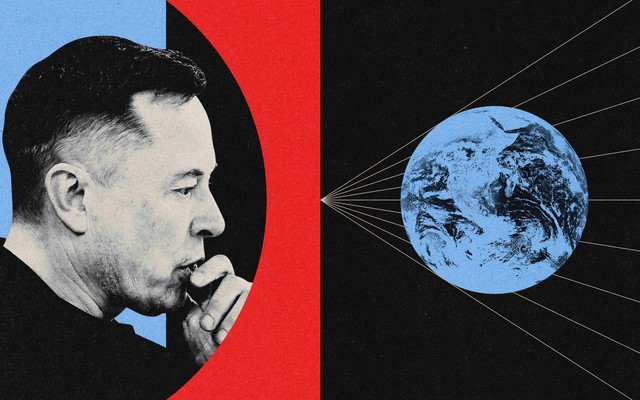
If Elon Musk gets his way, space will soon look very different. Through his ownership of SpaceX, the world’s richest man already operates most of the roughly 14,000 active satellites that are orbiting Earth. Now his rocket company is asking the government for permission to launch up to 1 million more. It’s part of Musk’s plan to build data centers in space that can harness the power of the sun for AI. “You’re power-constrained on Earth,” Musk said last month. “Space has the advantage that it’s always sunny.”
Musk has a lot riding on these orbital data centers. To help finance them, he is set to take SpaceX public as early as June, at a reported valuation of $2 trillion. Musk has claimed that data centers in space can “enable self-growing bases on the moon, an entire civilization on Mars, and ultimately expansion to the universe.” It’s all classic Musk, who has a habit of making big promises that he can’t always keep. Data centers in space are an untested technology, and it’s not clear if they’d actually work. (Neither Musk nor SpaceX responded to a request for comment.)
The “disappearing scientists” story is, in its way, a remarkable achievement.
The mystery of the missing scientists began with a Silver Alert. In late February, a retired Air Force major general named Neil McCasland left his house in New Mexico for a walk and never returned. Rumors spread on social media that the elderly former astronautical engineer had been abducted or killed. Forget Nancy Guthrie, they said. Here was a guy who used to run a “UFO-linked” lab. Here was a guy with knowledge of “America’s deepest, darkest secrets.” So where was this guy?
McCasland’s wife did her best with a post on Facebook to address what she called the “misinformation circulating about Neil and his disappearance,” but wild notions only multiplied. Dots were added, then connected: Another scientist—an advanced-materials researcher at NASA’s Jet Propulsion Laboratory (JPL) named Monica Reza—had disappeared while hiking near Los Angeles in June 2025. A physicist at MIT had been murdered in December. “What is going on seems to be an enemy action,” Walter Kirn, the novelist and podcast contrarian, said last month.
The people we were died at the exact moment our child did.
This article was featured in the One Story to Read Today newsletter. Sign up for it here.
My husband, David, hates Valentine’s Day. He once called it “New Year’s Eve with nuclear weapons.” I pretend not to care. Still, when the day passes entirely unremarked on, a woman can’t help but feel overlooked.
On Valentine’s Day 2024, David found a way out. He booked a speech on February 14 that required traveling from our home in Washington, D.C., to Toronto. I couldn’t object—he was getting paid. Anyway, I had my own plans: an “anti–Valentine’s Day” dinner hosted by one of the foreign embassies.
As I got ready, I called our oldest daughter, Miranda. She answered from her Brooklyn bathroom, getting ready for her own party. She propped her phone up beside her sink and laughed when I told her about her father’s strategic Valentine’s Day escape.
More families who can afford it are hiring a house manager, a kind of “chief of staff for the home.”
Here is the promise of a house manager. Hire one, and soon someone else could be doing your laundry, washing your dishes, prepping your meals, and completing those Amazon returns you’ve been meaning to make. They could reorganize the utensil drawer, notice if your kid is outgrowing their shoes and order more, take your car to the repair shop, and be at home to meet the plumber. If your child needs food for a class party, a house manager could make the dish and drop it off; if that child also has a pet lizard, a house manager could buy the crickets to feed it.
House managers are not a nanny or a house cleaner. They’re a “chief of staff for the home,” a “personal assistant for Mom,” and “a clone of myself,” according to the more than a dozen people I spoke with who have either hired one or work as one. They are, in effect, what might have once been called a housekeeper—a person who helps oversee a household’s basic functioning. Middle- and upper-class families used to more commonly employ this kind of position (the title “house manager” dates back to at least the 1830s), but it has become rare enough that a couple of people I spoke with thought they may have come up with the term.
Montana Democrats thought they found a novel way to win control of the U.S. Senate—until the party faithful started fighting back.
Jason Boeshore, a grain-elevator manager on the eastern plains of Montana, fired off a rocket this month to the private Signal chat he shares with the 23 other members of the state Democratic Party executive board. He demanded that leaders make clear in newspapers across the state that the Democratic Party would support only Democratic candidates in the fall elections. The response was swift and not to his liking. Shannon O’Brien, the chair of the party, wrote that her staff, not the board, would set the messaging strategy. Then she addressed the unspoken concerns at the heart of Boeshore’s request. “Listen if ANY of you EVER find yourselves questioning my intentions, please call me,” O’Brien wrote. “I will continue to move forward to get Democrats elected. There’s no hidden agenda.”
Donald Trump’s advisers are treating him like he can’t handle the reality of the war in Iran. They might be right—but that fact is a danger to the constitutional order.
This is an edition of The Atlantic Daily, a newsletter that guides you through the biggest stories of the day, helps you discover new ideas, and recommends the best in culture. Sign up for it here.
Earlier this month, top officials in the Trump administration were facing two problems—one distant and acute, one near and chronic.
The first was that two American airmen were missing inside Iran after their jet had been shot down. Commanders were scrambling to create and execute an operation to rescue both. The second was the president’s temperament. As plans developed and went into effect, The Wall Street Journal reported over the weekend, “aides kept the president out of the room as they got minute-by-minute updates because they believed his impatience wouldn’t be helpful, instead updating him at meaningful moments, a senior administration official said.”
The phrase is even more complicated than it appears.
Earlier this month, a staff writer for The Free Press, Olivia Reingold, asked the Democratic Senate candidate Abdul El-Sayed from Michigan a question: “Does Israel have a right to exist as a Jewish state?”
El-Sayed replied with his own question: “What do you mean by a ‘Jewish state’?” When Reingold went silent, before beginning to stutter out a response, El-Sayed continued, “If you can’t define the question, I’m not going to answer your question.”
A lot of labels and terms get thrown around in arguments over the Israeli-Palestinian conflict, words such as Zionist or anti-Zionist and one state or two states. These terms are not always well defined, and they mean different things to different factions—so it’s important, when discussing such matters, to know what people actually mean.