Mike Flynn reportedly offers to be interviewed in exchange for immunity, a deal in North Carolina over the “bathroom bill,” and more from the United States and around the world.
Mike Flynn Reportedly Offers to be Interviewed in Exchange for Immunity
(Mike Segar / Reuters)
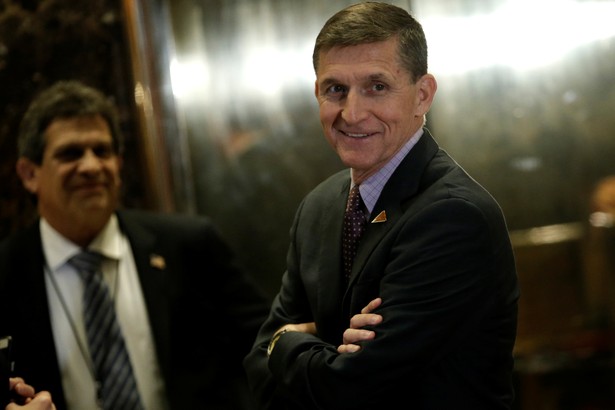
Mike Flynn, President Trump’s former national-security adviser, has told the FBI and congressional investigators he is willing to be interviewed in exchange for immunity from prosecution, the Wall Street Journal reports. The Journal, which cited anonymous officials with knowledge of the matter, said Flynn has so far found no takers for his offer. More from the Journal:
It wasn’t clear if Flynn had offered to talk about specific aspects of his time working for Trump, but the fact that he was seeking immunity suggested Flynn feels he may be in legal jeopardy following his brief stint as the national security adviser, one official said.
Flynn resigned as national-security adviser last month following reports he misled Vice President Mike Pence and other Trump administration officials about the nature of his talks in December with Sergei Kislyak, the Russian ambassador to Washington. His resignation, just 23 days after Trump named him to the post, made him the shortest-serving national-security adviser in history. The FBI and intelligence committees in both the House and Senate are investigating Russian interference in the U.S. presidential election, as well as links between Trump’s top aides and Russian officials. Paul Manafort, Trump’s former campaign chairman, and Jared Kushner, the president’s son-in-law, have both volunteered to be interviewed by the House Intelligence Committee. The Journal’s report comes amid revelations Flynn was paid for speeches made to Russian companies before he joined Trump’s campaign; add to this the spectacular claim, also reported by the Journal, that he’d suggested an extrajudicial extradition to Turkey of Fethullah Gulen, the cleric whom the Turkish leadership regards an enemy; Flynn served as a lobbyist for a client representing Turkey’s interests.
Israel Approves New West Bank Settlement for First Time in Over 20 Years
The Israeli settlement of Efrat in the occupied West Bank on February 7, 2017. (Ammar Awad / Reuters)
Updated at 11:48 a.m. ET
Israel’s security cabinet unanimously approved Thursday a new settlement in the occupied West Bank, marking the first time the country has established a West Bank settlement in more than two decades. It is unclear when construction of the settlement, which will be located near the existing settlement of Shiloh in the northern West Bank, will begin. Haaretz, the Israeli newspaper, reports that the decision stems from a promise Israeli Prime Minister Benjamin Netanyahu made following the eviction last month of settlers from the West Bank outpost of Amona, which the Israeli Supreme Court deemed illegal because it was built on private Palestinian land. The Israeli move will almost certainly draw criticism from Palestinians, who claim the West Bank, Gaza, and East Jerusalem as part of their future state. Though President Trump asked Netanyahu to “hold back on settlements for a little bit” during the Israeli premier’s visit last month, the White House did not condemn the move, noting in a statement that Netanyahu “made a commitment to the Amona settlers prior to President Trump laying out his expectations” and that “going forward ... the Israeli government has made clear that Israel's intent is to adopt a policy regarding settlement activity that takes President Trump's concerns into consideration.”
Ex-South Korean President Park Arrested Over Corruption Scandal
South Korea's ousted leader Park Geun Hye leaves her private house in Seoul, South Korea on March 30, 2017. (Lim Heon Jeong / Reuters)
South Korea’s recently ousted president Park Geun Hye was arrested Thursday over a corruption scandal that resulted in her impeachment. Park, whose ouster last month caused her to lose her immunity from prosecution, is accused of bribery, abuse of authority, coercion, and leaking government secrets—charges the former leader denies. Park is the third South Korean leader to be arrested over criminal allegations, following former Presidents Chun Doo Hwan and Roh Tae Woo in 1995 (though both were later pardoned). State prosecutors now have up to 20 days to formally indict Park. In the meantime, South Korea considers the candidates running to be Park’s successor in an election scheduled for May 9.
U.S. State Department Employee Charged for Concealing Ties With Chinese Officials
Joshua Roberts / Reuters
A U.S. State Department employee has been charged with obstruction of justice and lying to the FBI over her alleged contacts with Chinese foreign intelligence agents, federal prosecutors announced Wednesday. Candace Marie Claiborne, a 60-year-old who began working at the State Department in 1999, is accused of failing to report her contacts with two Chinese agents “who provided her with thousands of dollars of gifts and benefits,” Mary B. McCord, the acting assistant attorney general for national security, said in a statement, adding Claiborne “used her position and her access to sensitive diplomatic data for personal profit.” These gifts, according to the affidavit, included an Apple iPhone and laptop computer, international travel and vacations, tuition at a Chinese fashion school, a fully furnished apartment, and cash wired to Clairborne’s bank account. Prosecutors say Claiborne confided to an unnamed co-conspirator she knew the agents were spies, and that she noted in her journal that she could “generate 20k in 1 year” by working with them. Claiborne pleaded not guilty to the charges Wednesday and, if convicted, faces up to a 20-year sentence for obstruction and a five-year sentence for making false statements to the FBI.
Malaysia Returns Kim Jong Nam's Body to North Korea
Kim Jong Nam arriving at an airport in Beijing on February 11, 2007. (Kyodo / Reuters)
Malaysian Prime Minister Najib Razak announced Thursday the return of the remains of Kim Jong Nam, the half-brother of North Korean leader Kim Jong Un, to North Korea in exchange for nine Malaysian nationals being held in Pyongyang. “I am pleased to announce that the nine Malaysians who had been barred from leaving North Korea have now been allowed to return to Malaysia,” Razak said in a statement. “We will now allow North Koreans to leave Malaysia.” Tensions between the two countries began over the death last month of Kim Jong Nam at Malaysia’s Kuala Lumpur International Airport—an assassination Malaysia accused North Korea of orchestrating, though the North has denied this claim. The dispute led to North Korea barring all Malaysians from leaving the country, and Malaysia soon followed in kind with its own travel ban on North Korean nationals. Though the return of Kim Jong Nam’s body to Pyongyang and the lifting of the travel bans could signal an end in diplomatic tensions between the two countries, Razak reaffirmed that Malaysia’s investigation into Kim Jong Un’s death would continue, adding: “I have instructed for all possible measures to be taken to bring those responsible for this murder to justice.”
Chinese President to Meet With Trump at Mar-a-Lago Next Week
Mar-a-lago, where President Trump and Chinese President Xi Jinping will meet next week (Joe Skipper / Reuters)
The Chinese Foreign Ministry has confirmed that President Xi Jinping will meet with President Trump at Mar-a-Lago, Trump’s estate in Florida, next week—the first meeting between the two leaders since Trump’s election. Trump had complained about China’s trade policies during the campaign trail, and since becoming president he’s added to his litany of grievances against Beijing, citing its military policy in the South China Sea and what he sees as its lack of cooperation on North Korea. The April 6-7 meeting at Mar-a-Lago follows a visit to Beijing this month by Rex Tillerson, the U.S. secretary of state. Although this will be the first meeting between Trump and Xi, the two leaders spoke by telephone shortly after Trump’s inauguration as president. Trump had angered China by accepting a phone call from Taiwan’s leader shortly after he was elected president last November. But in his conversation with Xi in February, Trump reiterated U.S. support for the one-China policy, which states the U.S. recognizes the Chinese government in Beijing and has no formal diplomatic relations with Taiwan.
Hawaii Federal Judge Extends Order Blocking Trump's Travel Order
(Hugh Gentry / Reuters)
A U.S. federal judge in Hawaii extended his nationwide order blocking President Trump’s revised immigration order that temporarily bans the entry of visitors from six Muslim or predominantly Muslim countries and suspends the U.S. refugee program—the latest setback to the White House’s attempt to define who enters the United States. The government’s lawyers argued that Trump’s order fell within the president's power to protect national security, but urged U.S. District Court Judge Derrick Watson to restrict his order only to the ban on travelers—not the restriction on refugees. Watson wasn’t persuaded. He wrote:
National security is unquestionably of vital importance to the public interest. The same is true with respect to affording appropriate deference to the president’s constitutional and statutory responsibilities to set immigration policy and provide for the national defense. Upon careful consideration of the totality of the circumstances, however, the court reaffirms its prior finding that the balance of equities and public interest weigh in favor of maintaining the status quo.
The order comes two weeks after Watson temporarily blocked the order from going into effect, saying Trump’s executive order “violates the Establishment Clause of the First Amendment.” In his order Wednesday, Watson repeated that idea, noting “the entirety of the Executive Order runs afoul of the Establishment Clause, where openly available data support a commonsense conclusion that a religious objective permeated the government's action.’” Trump’s revised executive order was an attempt to find a way around successful legal challenges to the previous version of the order. Here’s what I wrote about it two weeks ago:
The president’s first immigration order was blocked by a federal court in San Francisco. That executive order temporarily blocked the entry of the citizens of seven Muslim or predominantly Muslim countries. But the White House revised the order, dropping Iraq from the list of countries whose citizens were temporarily blocked. The first order also suspended the entry of refugees for 120 days and Syrian refugees indefinitely. The new order no longer blocks Syrian refugees indefinitely.
The case in Hawaii was brought by the state and Ismail Elshikh, the imam of the Muslim Association of Hawaii, whose mother-in-law’s application for an immigrant visa was being processed. Elshikh argued that the new order would ban his mother-in-law from entering the country.
Syrian Refugees Top 5 Million for the First Time, UN Says
Syrian refugees at Al Zaatari camp near Mafraq, Jordan (Ammar Awad / Reuters)
The international community must do more to help those fleeing the civil war in Syria, as their numbers exceed 5 million for the first time, Filippo Grandi, the United Nations High Commissioner for Refugees, said today. His remarks come a year after a meeting on Syria in which the world’s powers pledged to resettle 500,000 refugees; so far, half those places have been made available, the UN said. The Syrian civil war is in its sixth year with President Bashar al-Assad firmly in control of the country. A cease-fire brokered by Russia and Turkey is mostly holding, as Syrian forces and their allies—Russia, Iran, and Hezbollah—as well as those supporting rebel groups—Turkey, the U.S., and other allied countries—turn their attention to ISIS and al-Qaeda-affiliated groups in Syria. The humanitarian crisis created by the civil war caused a political crisis across Europe, where many of the refugees fled, but it also strained the resources of Syria’s neighbors—Turkey, Jordan, Lebanon, and others—where the overwhelming majority of Syrian refugees live.
North Carolina's Lawmakers and Governor Reach a Deal to Repeal H.B. 2
(Jonathan Drake / Reuters)
Updated at 1:43 p.m.
Lawmakers in North Carolina have approved a measure to replace the “bathroom bill” and sent it to Governor Roy Cooper for his signature. Cooper is expected to sign the measure despite opposition from LGBTQ groups that say the replacement retains a key part of the original measure.
Original post at 7:10 a.m.
Lawmakers in North Carolina and the state’s governor have reached a deal to repeal H.B. 2, the state’s controversial “bathroom bill.” Among other things, H.B. 2 dictated that transgender people use the bathroom corresponding to the gender on their birth certificates. The agreement, which has already been criticized by LGBTQ groups, repeals the measure, but keeps a key part of it. Under the deal, the regulation of bathrooms is left to the state; cities and local governments can't pass their own anti-discrimination laws until December 2020, CNN reports. Lawmakers in the GOP-controlled legislature will vote on the measure today. Roy Cooper, the state’s Democratic governor, in a statement late Wednesday said “it’s not a perfect deal, but … it begins to repair our reputation.” Criticism of the bill resulted in businesses, sporting events, and other groups leaving North Carolina, as David Graham wrote in December.
For the richest men on Earth, everything is free and nothing matters.
At the end of Paul Thomas Anderson’s 2007 movie, There Will Be Blood, Daniel Day-Lewis’s oil-baron character, old now and richer than Croesus, beats Paul Dano’s preacher to death with a bowling pin. Dano’s Eli Sunday, a nemesis of Day-Lewis’s Daniel Plainview during his seminal, wealth-building years, has come to sell Plainview the oil-rich land that he once coveted. But Plainview doesn’t need the land anymore, because—as he explains in one of the most famous monologues in modern cinema—he has sucked out all the oil hidden beneath it from an adjoining property, like a milkshake.
Desperate for money, Eli begs for a loan. Instead, Plainview chases him around a bowling alley and murders him with great enthusiasm. Once it’s over, a butler comes to see what all the noise was about. “I’m finished,” Plainview yells.
Kash Patel has alarmed colleagues with episodes of excessive drinking and unexplained absences.
This article was featured in the One Story to Read Today newsletter. Sign up for it here.
On Friday, April 10, as FBI Director Kash Patel was preparing to leave work for the weekend, he struggled to log on to an internal computer system. He quickly became convinced that he had been locked out, and he panicked, frantically calling aides and allies to announce that he had been fired by the White House, according to nine people familiar with his outreach. Two of these people described his behavior as a “freak-out.”
Patel oversees an agency that employs roughly 38,000 people, including many who are trained to investigate and verify information that can be presented under oath in a court of law. News of his emotional outburst ricocheted through the bureau, prompting chatter among officials and, in some corners of the building, expressions of relief. The White House fielded calls from the bureau and from members of Congress asking who was now in charge of the FBI.
Why is Donald Trump breaking bread with the “enemy of the people”?
Even in the best of times, the annual White House Correspondents’ Dinner is an awkward and ethically fraught affair. Journalists spend the evening partying with the president and administration officials whom they’re supposed to cover rigorously and skeptically. I’ve been to the dinner several times over the years. It’s typically crowded and a little chaotic, and the ratio of non-journalists to journalists is about 10 to 1. The evening is promoted as a celebration of journalism and the First Amendment, but it has always been a bit of an embarrassment.
These aren’t the best of times for White House correspondents or, for that matter, the First Amendment. And this year’s gala figures to be even more awkward and embarrassing than usual.
The world’s richest man is accruing more power than ever before.
If Elon Musk gets his way, space will soon look very different. Through his ownership of SpaceX, the world’s richest man already operates most of the roughly 14,000 active satellites that are orbiting Earth. Now his rocket company is asking the government for permission to launch up to 1 million more. It’s part of Musk’s plan to build data centers in space that can harness the power of the sun for AI. “You’re power-constrained on Earth,” Musk said last month. “Space has the advantage that it’s always sunny.”
Musk has a lot riding on these orbital data centers. To help finance them, he is set to take SpaceX public as early as June, at a reported valuation of $2 trillion. Musk has claimed that data centers in space can “enable self-growing bases on the moon, an entire civilization on Mars, and ultimately expansion to the universe.” It’s all classic Musk, who has a habit of making big promises that he can’t always keep. Data centers in space are an untested technology, and it’s not clear if they’d actually work. (Neither Musk nor SpaceX responded to a request for comment.)
The “disappearing scientists” story is, in its way, a remarkable achievement.
The mystery of the missing scientists began with a Silver Alert. In late February, a retired Air Force major general named Neil McCasland left his house in New Mexico for a walk and never returned. Rumors spread on social media that the elderly former astronautical engineer had been abducted or killed. Forget Nancy Guthrie, they said. Here was a guy who used to run a “UFO-linked” lab. Here was a guy with knowledge of “America’s deepest, darkest secrets.” So where was this guy?
McCasland’s wife did her best with a post on Facebook to address what she called the “misinformation circulating about Neil and his disappearance,” but wild notions only multiplied. Dots were added, then connected: Another scientist—an advanced-materials researcher at NASA’s Jet Propulsion Laboratory (JPL) named Monica Reza—had disappeared while hiking near Los Angeles in June 2025. A physicist at MIT had been murdered in December. “What is going on seems to be an enemy action,” Walter Kirn, the novelist and podcast contrarian, said last month.
The people we were died at the exact moment our child did.
This article was featured in the One Story to Read Today newsletter. Sign up for it here.
My husband, David, hates Valentine’s Day. He once called it “New Year’s Eve with nuclear weapons.” I pretend not to care. Still, when the day passes entirely unremarked on, a woman can’t help but feel overlooked.
On Valentine’s Day 2024, David found a way out. He booked a speech on February 14 that required traveling from our home in Washington, D.C., to Toronto. I couldn’t object—he was getting paid. Anyway, I had my own plans: an “anti–Valentine’s Day” dinner hosted by one of the foreign embassies.
As I got ready, I called our oldest daughter, Miranda. She answered from her Brooklyn bathroom, getting ready for her own party. She propped her phone up beside her sink and laughed when I told her about her father’s strategic Valentine’s Day escape.
Montana Democrats thought they found a novel way to win control of the U.S. Senate—until the party faithful started fighting back.
Jason Boeshore, a grain-elevator manager on the eastern plains of Montana, fired off a rocket this month to the private Signal chat he shares with the 23 other members of the state Democratic Party executive board. He demanded that leaders make clear in newspapers across the state that the Democratic Party would support only Democratic candidates in the fall elections. The response was swift and not to his liking. Shannon O’Brien, the chair of the party, wrote that her staff, not the board, would set the messaging strategy. Then she addressed the unspoken concerns at the heart of Boeshore’s request. “Listen if ANY of you EVER find yourselves questioning my intentions, please call me,” O’Brien wrote. “I will continue to move forward to get Democrats elected. There’s no hidden agenda.”
More families who can afford it are hiring a house manager, a kind of “chief of staff for the home.”
Here is the promise of a house manager. Hire one, and soon someone else could be doing your laundry, washing your dishes, prepping your meals, and completing those Amazon returns you’ve been meaning to make. They could reorganize the utensil drawer, notice if your kid is outgrowing their shoes and order more, take your car to the repair shop, and be at home to meet the plumber. If your child needs food for a class party, a house manager could make the dish and drop it off; if that child also has a pet lizard, a house manager could buy the crickets to feed it.
House managers are not a nanny or a house cleaner. They’re a “chief of staff for the home,” a “personal assistant for Mom,” and “a clone of myself,” according to the more than a dozen people I spoke with who have either hired one or work as one. They are, in effect, what might have once been called a housekeeper—a person who helps oversee a household’s basic functioning. Middle- and upper-class families used to more commonly employ this kind of position (the title “house manager” dates back to at least the 1830s), but it has become rare enough that a couple of people I spoke with thought they may have come up with the term.
With the rise of screen culture, all the world has stage fright.
The beta-blocker propranolol has been a mainstay of American medicine since the 1960s, when it was regularly prescribed as a first-line defense against hypertension, arrhythmia, and other cardiovascular problems. Recent years, though, have seen a boom in the medication’s prescription rates—in part because as the drug regulates the heart, it also settles the nerves. Off-label, propranolol is used to calm the assorted storms of stage fright: the sweaty palms, the belly churn, the racing heart. Even professional performers have publicly alluded to using it. Robert Downey Jr., accepting an award at the 2024 Golden Globes, said casually, “I took a beta-blocker, so this is going to be a breeze.” Last fall, a People magazine headline asked, “Why Is Everyone Suddenly Taking the Decades-Old Chill Pill Propranolol?”
The phrase is even more complicated than it appears.
Earlier this month, a staff writer for The Free Press, Olivia Reingold, asked the Democratic Senate candidate Abdul El-Sayed from Michigan a question: “Does Israel have a right to exist as a Jewish state?”
El-Sayed replied with his own question: “What do you mean by a ‘Jewish state’?” When Reingold went silent, before beginning to stutter out a response, El-Sayed continued, “If you can’t define the question, I’m not going to answer your question.”
A lot of labels and terms get thrown around in arguments over the Israeli-Palestinian conflict, words such as Zionist or anti-Zionist and one state or two states. These terms are not always well defined, and they mean different things to different factions—so it’s important, when discussing such matters, to know what people actually mean.