—Mexican drug lord Joaquin “El Chapo” Guzman has been extradited to the United States from a Mexican prison, one day before Donald Trump assumes the presidency. More here
—Police in Washington, D.C. deployed tear gas as hundreds of protesters gathered outside a pro-Trump gala Thursday night. More here
—An avalanche, reportedly triggered by an earthquake, struck a hotel in central Italy; rescue workers say at least 30 people are missing. More here; live blog here
—We’re tracking the news stories of the day below. All updates are in Eastern Standard Time (GMT -5).
D.C. Police Launch Tear Gas at Anti-Trump Protesters
John Minchillo / AP
Police in Washington, D.C. deployed tear gas as hundreds of protesters gathered outside a pro-Trump gala Thursday night. Local media reports that some attendees of the “DeploraBall” were hit by objects and clashed with anti-Trump protesters as they left the National Press Club. Some protesters, blocking the street, called gala attendees “racists” and “Nazis.” Other protesters set fires in trash cans and in the middle of the street. There was also a 15-foot-tall white elephant with a banner labeled “racism” on its side. Police arrested several people.
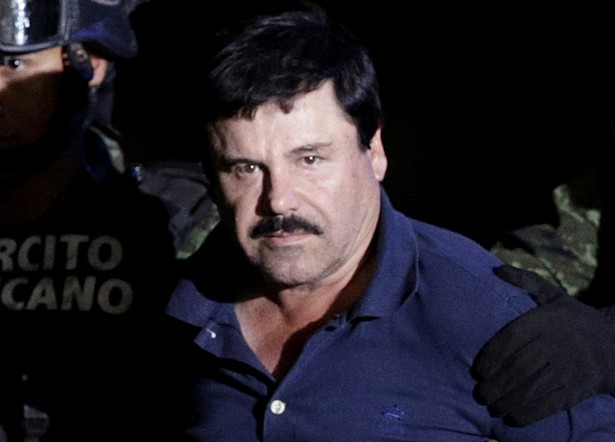
Mexican drug lord Joaquin “El Chapo” Guzman has been extradited to the United States from a Mexican prison, one day before Donald Trump assumes the presidency. Guzman, a notorious cartel kingpin who was arrested by Mexican police in a raid last January, six months after escaping prison, is facing federal indictments in seven courts across the U.S. for distributing narcotics, murder, and organized crime. He landed in New York since the indictment for the Eastern District of New York requires Guzman enter the U.S. through the district to preserve the indictment. He was in a prison in Juarez, near the Texas border. Guzman, who had a net worth of $1 billion, escaped prison in Mexico twice before. In the last prison escape, he vanished through a mile-long tunnel, from a shower to a nearby construction site. The incident was a massive embarrassment for the Mexican government. A top U.S. official told Reuters that the Mexican government did not give the timing of the extradition “a whole lot of thought.”
Brazilian Judge Investigating Political Scandal Dies in Plane Crash
Ueslei Marcelino / Reuters
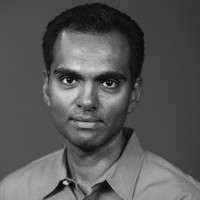
Teori Zavascki, the Brazilian Supreme Court justice who presided over Operation Carwash, a massive scandal that has embroiled politicians from across the political spectrum, has died in a plane crash, his son said on Facebook. The crash occurred outside Paraty, in Rio state, O Globo, the Brazilian newspaper, reported. Bloomberg adds: “Zavascki is the judge overseeing the trials of defendants in the Operation Carwash investigation at the Supreme Court.” The scandal involves corruption at Petrobras, the state-run oil firm. The investigation into the case is led by Sergio Moro, another judge.
Gambia's New President Sworn In as Old President Refuses to Leave
Crowds gather outside the Gambian embassy ahead of President-elect Adama Barrow’s inauguration in Dakar, Senegal on January 19, 2017. (Reuters)
Senegalese troops crossed the border into Gambia Thursday after the UN Security Council voted unanimously in favor of a resolution recognizing Adama Barrow as the West African country’s rightful president. The move comes one day after the troops threatened to “take action” if longtime Gambian leader Yahya Jammeh did not step down, and hours after the swearing in of Barrow as Gambia’s president from the Gambian embassy in neighboring Dakar. Jammeh, who originally conceded to Barrow in the December election only to later reverse his decision, filed an injunction barring Barrow from being sworn in and on Wednesday declared a state of national emergency. Senegal and other West African leaders have threatened to remove Jammeh by force, though the UN reaffirmed in its adoption of the resolution that the transition of power should be pursued “by political means first.”
This is a victory of the Gambian nation. Our national flag will fly high among those of the most democratic nations of the world. #Gambiapic.twitter.com/QRGZg1gzbs
Oakland Raiders File Paperwork to Move to Las Vegas
(Reuters)
The Oakland Raiders have filed paperwork to move the NFL team to Las Vegas, Steve Sisolak, the Clark County, Nevada, Commission Chair said on Twitter Thursday. The move must now be approved the owners of the NFL’s 32 teams. Mark Davis, the Raiders majority owner, needs 24 votes. The Raiders were established in 1960 and have spent much of the time since then in Oakland—though there were 12 years (1982-94) the team played in Los Angeles. Thursday’s announcement comes just days after the Chargers announced they’d leave their longtime home, San Diego, for L.A.
It is official! The @RAIDERS have filed their paperwork to relocate to #LasVegas.
Firefighters Among Dead as Landmark Tehran Building Catches Fire, Collapses
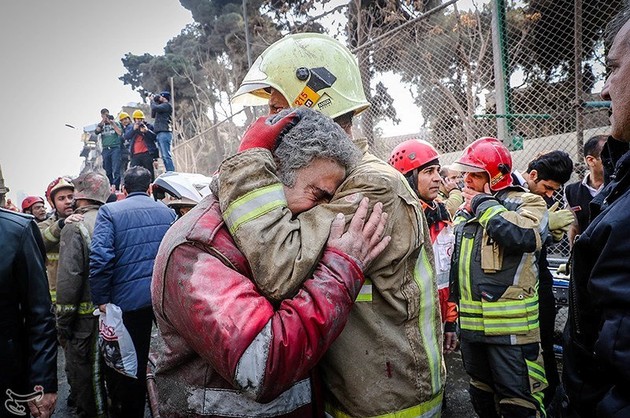
Firefighters grieve at the site of the collapsed high rise in Tehran, Iran, on January 19. (Tasnim News Agency / Reuters)
The 17-story Plasco building, a Tehran landmark, caught fire and collapsed Thursday, killing many firefighters, the state-run Islamic Republic News Agency (IRNA) reported. IRNA, which described the building as “a center for making apparel,” reported the structure was engulfed in a blaze that resulted in the collapse of a wall on its northern side—and the structure’s eventual collapse. Firefighters had been battling the blaze for hours when it collapsed in a matter of seconds—a moment captured on live television. Pir-Hossein Kolivand, the head of the national emergency medical services, said it was unclear how many firemen were killed in the collapse, only that there were many fatalities. About 200 people have been taken to local hospitals, the news agency added.
URGENT: Footage shows the moment of major commercial building collapses in Iran's capital Tehran after hours of severe blaze pic.twitter.com/89GPmRa3GU
Many Are Feared Dead as Avalanche Hits Italian Hotel
(Reuters)
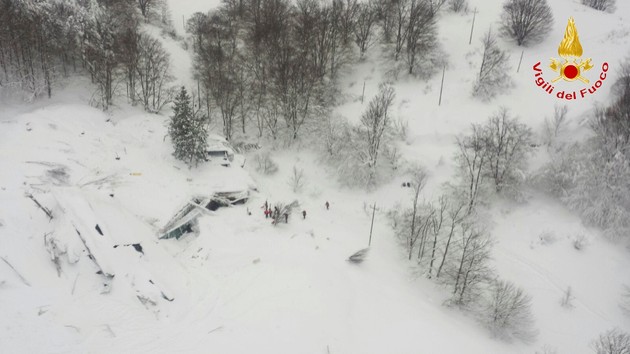
An avalanche triggered Thursday by several earthquakes in central Italy swept away a hotel in the Abruzzo region, leaving “many dead,” ANSA, the Italian news agency, reports. The avalanche struck the Hotel Rigopiano in the region’s Gran Sasso National Park. Rescuers pulled out one victim from the snow; about 30 others are missing. Two people have been rescued, ANSA added. Follow our live blog here
Trump Reportedly Names Sonny Perdue as Choice For USDA
President-elect Donald Trump has reportedly picked Sonny Perdue, the former Georgia governor, as agriculture secretary. Perdue, who served as governor from 2003 to 2011, was the state’s first Republican governor since Reconstruction. The post, which needs Senate confirmation, would put Perdue in charge of a department that has a budget of $150 billion and oversees everything from food safety to food stamps. The nomination is Trump’s last before his inauguration Friday as the 45th president of the United States. His Cabinet would be the first that hasn’t included a Hispanic since President Reagan.
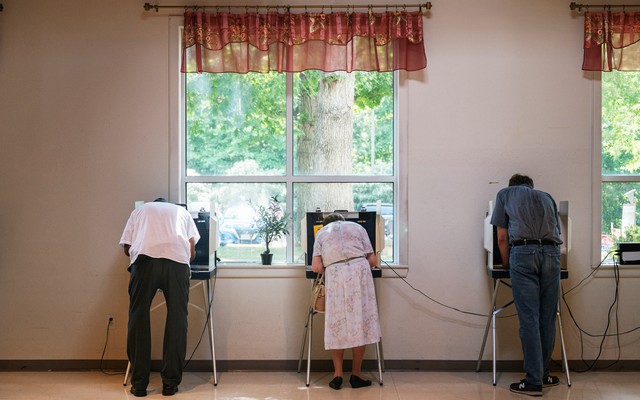
When President Trump last summer implored Republicans to launch a nationwide gerrymandering blitz to pad their narrow House majority, the fight he started did not seem fair. GOP lawmakers had both the will and the power to draw their party new seats, while Democrats were hamstrung by limits of their own making. The question was not whether Republicans could expand their edge in Congress, but by how much.
This morning the landscape looks a lot different, after Virginia voters yesterday approved a lopsided new House map that could hand Democrats an additional four seats that Republicans currently hold. The Democratic redistricting victory is the party’s second in a statewide referendum. When combined with new lines that California voters endorsed in November, Democrats have now succeeded in drawing districts that will likely yield them nine more seats this fall, at least matching what Republicans have been able to achieve in states that they control. By some measures, Democrats have jumped into the redistricting lead, bolstering their chances of winning back the House majority in the midterm elections.
Patients are getting stuck in the emergency department for days while waiting for a spot in an inpatient ward.
In the last months, weeks, and days of his life, “I will not go to the emergency room” became my husband’s mantra. Andrej had esophageal cancer that had spread throughout his body (but not to his ever-willful brain), and, having trained as a doctor, I had jury-rigged a hospital at home, aided by specialists who got me pills to boost blood pressure; to dampen the effects of liver failure; to stem his cough; to help him swallow, wake up, fall asleep.
“I will not go to the emergency room”—emphasis on not—were his first words after passing out, having a seizure, or regurgitating the protein smoothies I made to pass his narrowed esophagus. He said it again and again, even as fluid built up in his lungs, rendering him short of breath and prone to agonizing coughing spells. He had been a big, athletic guy, but now, in the ugly process of dying, he was looking gaunt. Ours was a precarious existence, but I understood his adamant rejection of the emergency department. Most prior visits had morphed into extended trips into a terrifying medical underworld—to a purgatory known as emergency-department boarding.
For the richest men on Earth, everything is free and nothing matters.
At the end of Paul Thomas Anderson’s 2007 movie, There Will Be Blood, Daniel Day-Lewis’s oil-baron character, old now and richer than Croesus, beats Paul Dano’s preacher to death with a bowling pin. Dano’s Eli Sunday, a nemesis of Day-Lewis’s Daniel Plainview during his seminal, wealth-building years, has come to sell Plainview the oil-rich land that he once coveted. But Plainview doesn’t need the land anymore, because—as he explains in one of the most famous monologues in modern cinema—he has sucked out all the oil hidden beneath it from an adjoining property, like a milkshake.
Desperate for money, Eli begs for a loan. Instead, Plainview chases him around a bowling alley and murders him with great enthusiasm. Once it’s over, a butler comes to see what all the noise was about. “I’m finished,” Plainview yells.
This article was featured in the One Story to Read Today newsletter. Sign up for it here.
The mystery of the missing scientists began with a Silver Alert. In late February, a retired Air Force major general named Neil McCasland left his house in New Mexico for a walk and never returned. Rumors spread on social media that the elderly former astronautical engineer had been abducted or killed. Forget Nancy Guthrie, they said. Here was a guy who used to run a “UFO-linked” lab. Here was a guy with knowledge of “America’s deepest, darkest secrets.” So where was this guy?
McCasland’s wife did her best with a post on Facebook to address what she called the “misinformation circulating about Neil and his disappearance,” but wild notions only multiplied. Dots were added, then connected: Another scientist—an advanced-materials researcher at NASA’s Jet Propulsion Laboratory (JPL) named Monica Reza—had disappeared while hiking near Los Angeles in June 2025. A physicist at MIT had been murdered in December. “What is going on seems to be an enemy action,” Walter Kirn, the novelist and podcast contrarian, said last month.
Kash Patel has alarmed colleagues with episodes of excessive drinking and unexplained absences.
This article was featured in the One Story to Read Today newsletter. Sign up for it here.
On Friday, April 10, as FBI Director Kash Patel was preparing to leave work for the weekend, he struggled to log on to an internal computer system. He quickly became convinced that he had been locked out, and he panicked, frantically calling aides and allies to announce that he had been fired by the White House, according to nine people familiar with his outreach. Two of these people described his behavior as a “freak-out.”
Patel oversees an agency that employs roughly 38,000 people, including many who are trained to investigate and verify information that can be presented under oath in a court of law. News of his emotional outburst ricocheted through the bureau, prompting chatter among officials and, in some corners of the building, expressions of relief. The White House fielded calls from the bureau and from members of Congress asking who was now in charge of the FBI.
The people we were died at the exact moment our child did.
This article was featured in the One Story to Read Today newsletter. Sign up for it here.
My husband, David, hates Valentine’s Day. He once called it “New Year’s Eve with nuclear weapons.” I pretend not to care. Still, when the day passes entirely unremarked on, a woman can’t help but feel overlooked.
On Valentine’s Day 2024, David found a way out. He booked a speech on February 14 that required traveling from our home in Washington, D.C., to Toronto. I couldn’t object—he was getting paid. Anyway, I had my own plans: an “anti–Valentine’s Day” dinner hosted by one of the foreign embassies.
As I got ready, I called our oldest daughter, Miranda. She answered from her Brooklyn bathroom, getting ready for her own party. She propped her phone up beside her sink and laughed when I told her about her father’s strategic Valentine’s Day escape.
On Earth Day, I wanted to share images of the incredible resilience of nature: the many ways that plants, animals, and natural processes reclaim abandoned human places and find ways to thrive.
Even in the best of times, the annual White House Correspondents’ Dinner is an awkward and ethically fraught affair. Journalists spend the evening partying with the president and administration officials whom they’re supposed to cover rigorously and skeptically. I’ve been to the dinner several times over the years. It’s typically crowded and a little chaotic, and the ratio of non-journalists to journalists is about 10 to 1. The evening is promoted as a celebration of journalism and the First Amendment, but it has always been a bit of an embarrassment.
These aren’t the best of times for White House correspondents or, for that matter, the First Amendment. And this year’s gala figures to be even more awkward and embarrassing than usual.
Fifteen years after Steve Jobs’s death, the company is a successful, if unexciting, powerhouse.
Tim Cook’s job was to make Apple boring—and he did. Cook, Apple’s chief executive officer, is stepping down after 15 years in the role. He had succeeded Steve Jobs after the visionary co-founder of Apple Computer Company left only months before dying of pancreatic cancer in 2011. Since then, Apple has grown in market value by 2,000 percent. It has also transformed into a staid, if immensely effective, firm that sells people glass rectangles, wireless earbuds, and, sometimes, computers. This legacy is not tragic, but it is somber. The crucible in which the personal computer and the smartphone were forged is just a big company now.
Jobs and Steve “Woz” Wozniak started Apple Computer in 1976 to bring Woz’s design for an early personal computer to market, but Jobs did not serve as CEO until 1997, when he returned after years away. Before then, a series of more ordinary businesspeople had run the company—mostly former semiconductor executives including Michael Scott, Mike Markkula, and Gil Amelio, along with the former PepsiCo CEO John Sculley. But by the mid-2000s, after the iMac, iPod, and iPhone had appeared, Jobs had become the apotheosized Visionary CEO—a model for the technology industry and beyond. His exacting and sometimes unreasonable demands, which dated back to the design of the Macintosh in the early 1980s, had made him a singular and irreplaceable presence: a figure who could bend an organization, an industry, and the public who would be transformed by its products to his will.
Over the past 15 years or so, Democrats have won a lot of races because the opposing party’s primary voters decided to nominate right-wing ideologues (Christine O’Donnell, Todd Akin, Kari Lake) rather than normal Republicans. In all of these races, the Republican establishment warned that nominating an archconservative would undermine their chances of victory, and was proved completely correct.
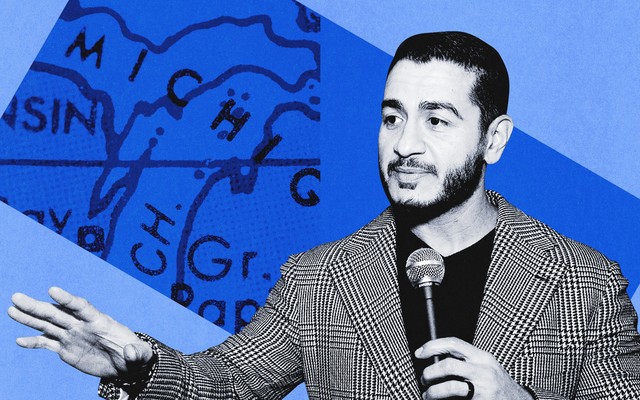
Now Democrats finally have the chance to do the same thing. In Michigan, a purple state that Donald Trump won twice, the physician Abdul El-Sayed is running a competitive race for the party’s Senate nomination. If successful, he would turn a very likely Democratic win into a jump ball.