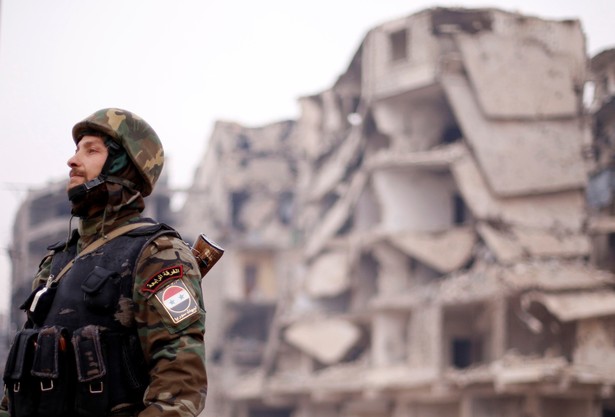
—The negotiated evacuation of citizens in Aleppo’s rebel-held eastern district has been halted, trapping between 50,000 and 100,000 people. More here
—The FBI and the director of national intelligence now agree with the CIA’s assessment that the Russian government intervened in the presidential election to help President-elect Donald Trump win. More here
—A Chinese Navy warship seized an unmanned, underwater glider drone from an American vessel in the South China Sea. More here
—We’re live-blogging the news stories of the day below. All updates are in Eastern Standard Time (GMT -5).
Princeton's Men's Swimming and Diving Team Is the Latest to Be Suspended for Sexist Messages
People walk by Princeton University's Nassau Hall. (Dominick Reuter / Reuters)
Princeton University joined the growing list of academic institutions that have suspended sports teams for exchanging offensive remarks online. The New Jersey school on Thursday announced its decision to suspend the men’s swimming and diving team’s season after discovering content on the team’s mailing list that the university described as “vulgar and offensive, as well as misogynistic and racist in nature.” John Cramer, a Princeton spokesman, told the university’s student newspaper, The DailyPrincetonian, that the specific contents of the emails were being withheld to ensure the privacy of “members of the women’s swimming and diving team,” though he did not confirm whether the women’s team members were the subject of the emails.
Other university sports teams have faced similar allegations resulting in suspensions. Massachusetts’ Amherst College announced Sunday the suspension of its men’s cross-country team after several of the team’s emails published by Amherst’s student magazine, The Indicator, revealed its members used lewd comments about eight of their female peers—including language referring to some of the women as a “meatslab” or a “walking STD”— that the university described as “racist, misogynist, and homophobic.” Harvard University canceled its men’s soccer team’s season last month after it was revealed that the team produced a “scouting report” of the women’s soccer team’s recruits, assigning each one a numerical rating and a hypothetical sexual position. Columbia University also announced last month its decision to suspend members of its wrestling team after eight of its members were revealed to have sent racist and sexually explicit messages in a group text.
Report: FBI Backs CIA Assessment That Russia Intervened to Help Trump
Gary Cameron / Reuters
Multiple news outlets are reporting that the FBI and director of national intelligence now agree with the CIA’s assessment that the Russian government intervened in the presidential election to help President-elect Donald Trump win. TheWashington Post reported Friday that CIA Director John Brennan recently told the agency’s employees that there is a “strong consensus” among himself, FBI Director James Comey, and Director of National Intelligence James Clapper “on the scope, nature, and intent of Russian interference in our presidential election.” According to NBC News, the FBI now believes Russian support for Trump was “one part” of a broader effort to undermine American democratic institutions. News outlets first reported last week that the CIA, which had already deemed Russia the culprit in the hacking, had revised its assessment to conclude the Russian government hoped to clandestinely aid Trump by undermining his Democratic opponent Hillary Clinton. President Obama has ordered all 17 U.S. intelligence agencies to prepare a report on foreign interference in recent presidential elections by January 20, the day Trump takes office.
It was an emotional few days for people in New York City who hoped to save a deer that wandered into Jackie Robinson Park in Harlem. For two weeks the “Harlem Deer” or “Lefty,” as the white-tailed, one-horned buck came to be known, had attracted crowds of excited locals. Meanwhile, city and state officials bickered over its fate. The city, citing state law, said the deer should be euthanized, because its chances of survival were low. Governor Andrew Cuomo, however, wanted to see the deer alive. The battle drew out to the final moment, with the deer’s execution scheduled for Friday. Friday morning, Mayor Bill de Blasio said on The Brian Lehrer Show on WYNYC radio, “If a deer is already in a natural location and you can leave them there, then they have a chance of survival, but if not, you don’t really have another option. It’s a question of is it going to be a quick and merciful death versus potentially a very long painful process.” Still, Cuomo, who has a reputation for inserting himself in city matters, was obstinate. Just before noon, the state Department of Environmental Conservation drove to the East Harlem shelter where the deer was kept and drove it, away heading somewhere beyond the city where it could live safely. Alas, on the way to freedom, the deer died. City officials blamed the stress of captivity.
U.S. Official: Chinese Navy Seized American Drone in South China Sea
An aerial view of Taiping Island, also known as Itu Aba, in the South China Sea on November 29, 2016. (Tyrone Siu / Reuters)
A Chinese Navy warship seized an unmanned, underwater glider drone from an American vessel in the South China Sea, the Department of Defense said Friday in a statement. The Pentagon says the incident took place Thursday in international waters off the coast of the Philippines at noon local time, officials said. A Chinese Navy vessel retrieved the U.S. drone from the water. An official said the USS Bowditch, an oceanographic research vessel, had deployed the drone as part of a survey mission to collect data on ocean and weather patterns. When the Bowditch’s crew asked for the drone back, the Chinese vessel reportedly ignored the request and left. The act prompted the State Department to file a demarche, or formal diplomatic request, asking that the drone be returned. This isn’t the first time the U.S. and China have clashed on the South China Sea. Beijing and Manila have both claimed portions of the area. The Hague-based Permanent Court of Arbitration ruled unanimously in favor of the Philippines in July when it declared that China has no legal rights to the contested waters, but China has rejected the ruling, and the international tribunal cannot enforce it. President-elect Donald Trump has promised to take a more hardline approach to China—and tensions have been heightened since Trump’s recent phone call with President Tsai Ing-wen of Taiwan, marking a departure from U.S. protocol, which treats Taiwan as an ally but does not recognize its independence.
Did Rodrigo Duterte Personally Kill 3 People or Not?
Romeo Ranoco / Reuters
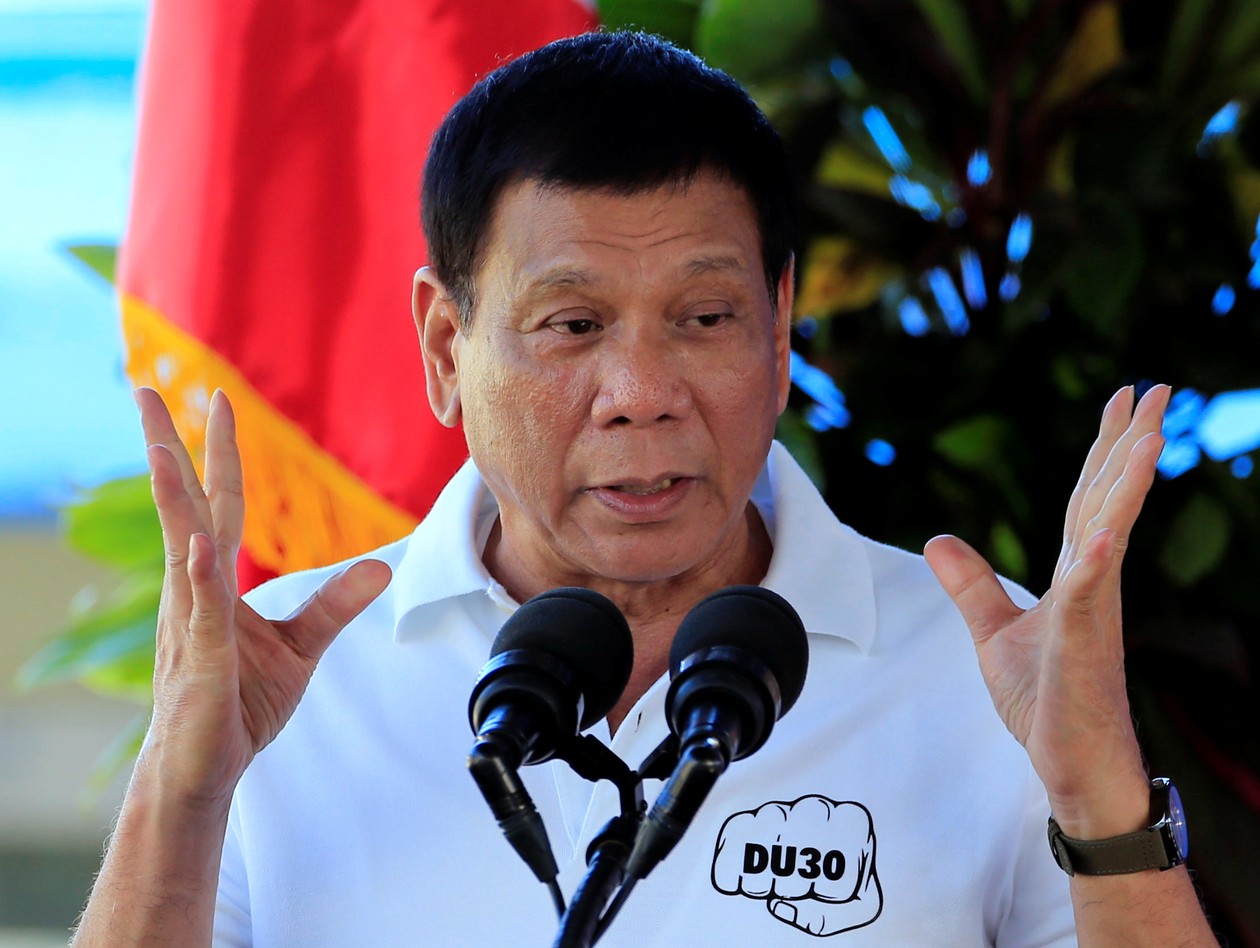
Did Philippines President Rodrigo Duterte shoot and kill three men while he served as mayor of Davao? As of Friday, it would seem so. Since his election this summer, the bellicose president has brought a bloody war on drugs and crime to his country, with the most recent estimates putting the death toll at about 6,000. His idea to purge the Philippines of drug users and pushers was implemented and tested first when Duterte served as mayor of Davao, a once-troubled city on the country’s south, which has since become a financial center. A rumor—perpetuated in part by Duterte himself—has said he oversaw a death squad in Davao, and that he even killed three men personally. On Wednesday, Duterte admitted for the first time to a group of businessmen that he rode the streets of Davao on a motorcycle, “looking for a confrontation so I could kill." But on Thursday Duterte's spokesman chalked that up to the president being flip. Then on Friday, in an interview with BBC, Duterte put it bluntly: "I killed about three of them ... I don't know how many bullets from my gun went inside their bodies. It happened and I cannot lie about it." It’s not clear what repercussion this admission will have for Duterte—if any. He has publicly said he hopes to kill hundreds of thousands of people, and his approval rating as of October was 86 percent.
Cuba Offers to Repay Its Debts to the Czech Republic With Rum
Bottles of rum line the shelves of a store in Havana, Cuba, on October 14, 2016. (Enrique de la Osa / Reuters)
Cuba owes the Czech Republic millions of dollars in Cold War-era debt—an obligation the country has offered to repay with its famous rum. The unusual proposal, which was announced Thursday by the Czech Republic’s finance ministry, would allow Cuba to repay its $276 million debt with its trademark liquor—enough to last the Czechs more than a century, based on their current intake of $2 million of Cuban rum per annum. The Czechs have been amenable to similar requests in the past. In 2010, the central European country considered allowing North Korea to repay a portion of its $10 million debt, which it also dates to the Cold War era, with ginseng. Though the Czech finance ministry said it would prefer that at least part of Cuba’s debt still be paid with cash, it is still weighing the offer, according to the Associated Press. We’ll drink to that. Na zdravi!
The negotiated evacuation of citizens in Aleppo’s rebel-held eastern district has been halted, trapping between 50,000 and 100,000 people. The cause of the stoppage was not immediately clear, and all sides blamed one other. The evacuation was brokered by Turkey and Russia to allow civilians to flee as Syrian government forces retake the city from rebels, and it was carried out by the Syrian Arab Red Crescent and the Red Cross. Evacuations began Thursday, and about 8,000 people escaped to rebel-held towns further east. But the column of buses, cars, and ambulances shuttling civilians out ground to a halt Friday morning. A World Health Organization official said Russia, which backs the Syrian government, ordered the evacuation stopped. The Syrian government accused rebels of trying to smuggle out weapons, and the rebels blamed the Syrian government for firing on evacuation buses. The Guardianreported the breakdown came after an al-Qaeda-affiliated group refused to allow the evacuation of wounded Syrian government supporters. In the past week Syrian government troops have swept through the city, which rebels have held since 2012, about a year after the civil war began. The Assad regime, with aid from Russia, has bombed the eastern district into rubble, and the status of the remaining civilian holdouts has become a humanitarian crisis. It is not yet clear when or if the evacuations will resume.
Obama Promises to Take Action Against Russia's Election Meddling
Manuel Balce Ceneta / AP
In an interview with NPR’s Steve Inskeep that aired Friday, President Obama said the U.S. must retaliate for Russia’s cyberattacks during the presidential election. Obama did not say what form this retaliation would take, partly because he’s waiting for a final report on the matter, but he promised to take action “at a time and place of our own choosing. Some of it may be explicit and publicized; some of it may not be." U.S. intelligence officials have concluded hackers working on behalf of Russia broke into the Democratic National Committee's computer network, and the email of John Podesta, a top adviser for Hillary Clinton. The question remains what Russia’s motivation was. Last week, The Washington Post published a secret CIA assessment claiming Russia aimed to help Donald Trump win. Reports this week have directly implicated Russian President Vladimir Putin in the hacks. Trump continues to dispute the intelligence assessments, and Thursday he tweeted:
If Russia, or some other entity, was hacking, why did the White House wait so long to act? Why did they only complain after Hillary lost?
This is not entirely true, however. The director of national intelligence issued a statement blaming Russia for the hacks on October 7, a month before the election.
The economist Adam Posen on the effect of the war in Iran on the world’s economy and the darkening economic outlook for the United States. Plus: A shifting partisan balance of power and Ask Not: The Kennedys and the Women They Destroyed, by Maureen Callahan.
In this episode of The David Frum Show, The Atlantic’s David Frum opens with a discussion of the likelihood that the partisan balance of power will shift from Republicans to Democrats at state-government level.
Then, David is joined by the president of the Peterson Institute for International Economics, Adam Posen, for a conversation about the state of the world’s economy. Frum and Posen discuss the economic effect of the war in Iran, the United States’ reputational hit caused by Trump’s tariffs, and the chance of global recession.
Finally, David ends the episode with a discussion of Ask Not: The Kennedys and the Women They Destroyed, by Maureen Callahan, and reflects on why reactions to the abuse of women by men in power seem to have become a partisan issue.
For the richest men on Earth, everything is free and nothing matters.
At the end of Paul Thomas Anderson’s 2007 movie, There Will Be Blood, Daniel Day-Lewis’s oil-baron character, old now and richer than Croesus, beats Paul Dano’s preacher to death with a bowling pin. Dano’s Eli Sunday, a nemesis of Day-Lewis’s Daniel Plainview during his seminal, wealth-building years, has come to sell Plainview the oil-rich land that he once coveted. But Plainview doesn’t need the land anymore, because—as he explains in one of the most famous monologues in modern cinema—he has sucked out all the oil hidden beneath it from an adjoining property, like a milkshake.
Desperate for money, Eli begs for a loan. Instead, Plainview chases him around a bowling alley and murders him with great enthusiasm. Once it’s over, a butler comes to see what all the noise was about. “I’m finished,” Plainview yells.
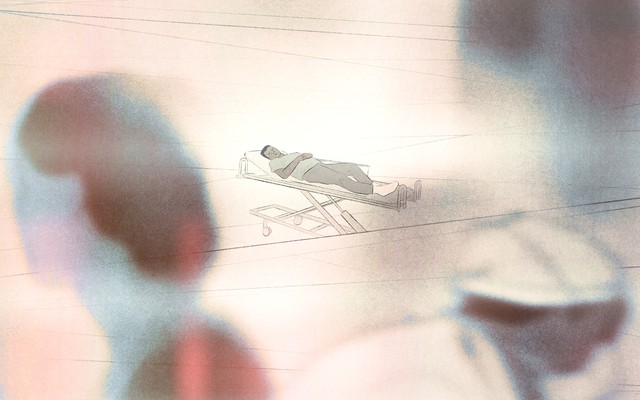
Patients are getting stuck in the emergency department for days while waiting for a spot in an inpatient ward.
In the last months, weeks, and days of his life, “I will not go to the emergency room” became my husband’s mantra. Andrej had esophageal cancer that had spread throughout his body (but not to his ever-willful brain), and, having trained as a doctor, I had jury-rigged a hospital at home, aided by specialists who got me pills to boost blood pressure; to dampen the effects of liver failure; to stem his cough; to help him swallow, wake up, fall asleep.
“I will not go to the emergency room”—emphasis on not—were his first words after passing out, having a seizure, or regurgitating the protein smoothies I made to pass his narrowed esophagus. He said it again and again, even as fluid built up in his lungs, rendering him short of breath and prone to agonizing coughing spells. He had been a big, athletic guy, but now, in the ugly process of dying, he was looking gaunt. Ours was a precarious existence, but I understood his adamant rejection of the emergency department. Most prior visits had morphed into extended trips into a terrifying medical underworld—to a purgatory known as emergency-department boarding.
When President Trump last summer implored Republicans to launch a nationwide gerrymandering blitz to pad their narrow House majority, the fight he started did not seem fair. GOP lawmakers had both the will and the power to draw their party new seats, while Democrats were hamstrung by limits of their own making. The question was not whether Republicans could expand their edge in Congress, but by how much.
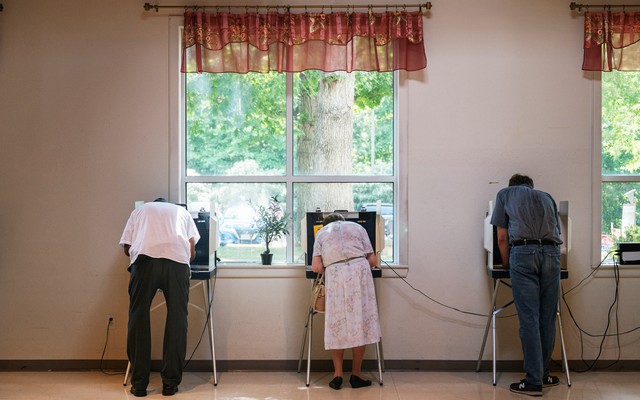
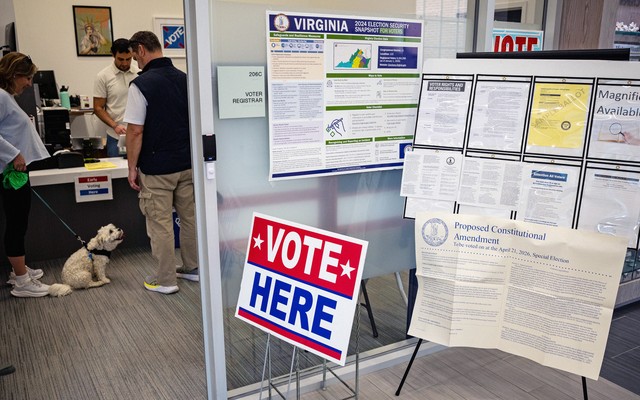
This morning the landscape looks a lot different, after Virginia voters yesterday approved a lopsided new House map that could hand Democrats an additional four seats that Republicans currently hold. The Democratic redistricting victory is the party’s second in a statewide referendum. When combined with new lines that California voters endorsed in November, Democrats have now succeeded in drawing districts that will likely yield them nine more seats this fall, at least matching what Republicans have been able to achieve in states that they control. By some measures, Democrats have jumped into the redistricting lead, bolstering their chances of winning back the House majority in the midterm elections.
Republicans seem to have expected that Democrats would continue to follow rules they had long since enthusiastically abandoned.
Voters in Virginia approved a lopsided congressional map on Tuesday, reducing the expected number of Republican-leaning districts in the Democratic-controlled state from five to one. Republicans have reacted by complaining that conservative-leaning voters in the state have been disenfranchised by gerrymandered maps that reduce the influence of their vote.
And they’re right. That is exactly what the new Virginia map does.
Gerrymandering is an attempt to thwart the will of the voters. It circumvents the vital process of democratic feedback by insulating politicians from political backlash. It should not happen, and yet this latest chapter of the redistricting wars did not begin in Virginia. It did not even begin last year, when Donald Trump openly urged red states to gerrymander their congressional maps so Republicans might retain possession of the House during the midterms. He did so despite the fact that the maps had been drawn after the 2020 census and would normally be expected to last until 2030.
Kash Patel has alarmed colleagues with episodes of excessive drinking and unexplained absences.
This article was featured in the One Story to Read Today newsletter. Sign up for it here.
On Friday, April 10, as FBI Director Kash Patel was preparing to leave work for the weekend, he struggled to log on to an internal computer system. He quickly became convinced that he had been locked out, and he panicked, frantically calling aides and allies to announce that he had been fired by the White House, according to nine people familiar with his outreach. Two of these people described his behavior as a “freak-out.”
Patel oversees an agency that employs roughly 38,000 people, including many who are trained to investigate and verify information that can be presented under oath in a court of law. News of his emotional outburst ricocheted through the bureau, prompting chatter among officials and, in some corners of the building, expressions of relief. The White House fielded calls from the bureau and from members of Congress asking who was now in charge of the FBI.
This article was featured in the One Story to Read Today newsletter. Sign up for it here.
The mystery of the missing scientists began with a Silver Alert. In late February, a retired Air Force major general named Neil McCasland left his house in New Mexico for a walk and never returned. Rumors spread on social media that the elderly former astronautical engineer had been abducted or killed. Forget Nancy Guthrie, they said. Here was a guy who used to run a “UFO-linked” lab. Here was a guy with knowledge of “America’s deepest, darkest secrets.” So where was this guy?
McCasland’s wife did her best with a post on Facebook to address what she called the “misinformation circulating about Neil and his disappearance,” but wild notions only multiplied. Dots were added, then connected: Another scientist—an advanced-materials researcher at NASA’s Jet Propulsion Laboratory (JPL) named Monica Reza—had disappeared while hiking near Los Angeles in June 2025. A physicist at MIT had been murdered in December. “What is going on seems to be an enemy action,” Walter Kirn, the novelist and podcast contrarian, said last month.
Politicians who think health-conscious women could swing the midterms are fooling themselves.
Earlier this month, MAHA moms went to the White House. Several key figures in the “Make America Healthy Again” movement gathered around a table in the Roosevelt Room to speak with Health Secretary Robert F. Kennedy Jr. and other top administration officials. The invitees—who included the health activist Kelly Ryerson, the wellness podcaster Alex Clark, and the nutritionist Courtney Swan—were all women. They’re influential among the loose coalition of Kennedy supporters known as MAHA moms, many of whom are worried about their children’s health. This was a chance for them to air their grievances with the Trump administration—which have grown in recent months. Afterward, they were ushered into the Oval Office to see President Trump, who, according to Ryerson, welcomed them as “my MAHA leaders.”
The people we were died at the exact moment our child did.
This article was featured in the One Story to Read Today newsletter. Sign up for it here.
My husband, David, hates Valentine’s Day. He once called it “New Year’s Eve with nuclear weapons.” I pretend not to care. Still, when the day passes entirely unremarked on, a woman can’t help but feel overlooked.
On Valentine’s Day 2024, David found a way out. He booked a speech on February 14 that required traveling from our home in Washington, D.C., to Toronto. I couldn’t object—he was getting paid. Anyway, I had my own plans: an “anti–Valentine’s Day” dinner hosted by one of the foreign embassies.
As I got ready, I called our oldest daughter, Miranda. She answered from her Brooklyn bathroom, getting ready for her own party. She propped her phone up beside her sink and laughed when I told her about her father’s strategic Valentine’s Day escape.
Each is animated by the author’s love—for their subject, for language, and for pushing the boundaries of what the genre can do.
Literary biography is a cruel genre. The authors of these books—by which I mean not just biographies about literary figures but also those that aspire to writerly excellence—have been described by the writer Janet Malcolm as “professional burglars.” After rifling through a person’s affairs, they must conjure inside their pages a living, breathing human being—and then, inevitably, they’ll have to close the coffin on their resurrected subject. But I like to think the “literary” element can temper the sting of these dastardly deeds, insofar as the author is tasked with perpetrating them in the most humane way possible: with the appropriate amount of reverence, style, and, yes, love. This is, at least, what I tried to do in my own literary biography, Baldwin: A Love Story, about James Baldwin’s life and relationships.