An ambulance rushes from the scene of an attack in Istanbul on January 1. (Halit Onur Sandal / AP)
Updated on January 1 at 12:18 a.m. ET
At least 39 people were killed when at least one gunman opened fire inside a popular Istanbul nightclub during New Year’s Eve celebrations Saturday night, Turkish Interior Minister Suleyman Soylu said. 16 of the fatalities were foreigners and another 69 people were reported injured. The incident took place at the Reina nightclub, a large and popular nightlife hotspot in Turkey’s largest city. The suspected assailant fled the scene shortly after the shooting and is still at large, Soylu told reporters. According to Hurriyet, a Turkish news agency, a police officer is among the fatalities. Further details about the attack are scarce. The Turkish government has imposed a media blackout on coverage of the incident, a common practice during mass shootings and other attacks. No groups have claimed responsibility. In a statement late Saturday night, President Obama condemned the shooting as a “horrific terrorist attack” and offered the United States’ assistance as necessary.
This is a developing story. We’ll update this article with more information as it becomes available.
Turkey Releases Wall Street Journal Reporter As Press Crackdown Widens
Turkish President Recep Tayyip Erdogan makes a speech during the opening ceremony of Eurasia Tunnel in Istanbul. (Murad Sezer / Reuters)
The Turkish government secretly detained Wall Street Journal reporter Dion Nissenbaum for two-and-a-half days this week, the newspaper reported Saturday. According to the Journal, Turkish police seized Nissenbaum from his apartment in Istanbul on Tuesday and released him from jail on Friday morning. He subsequently left the country to return to the United States. Nissenbaum is a 49-year-old American national security reporter based in Washington, D.C., who has extensively covered Turkey, ISIS, and the Syrian civil war. The Journal quoted an unnamed source who said the detention was related to the Turkish government’s ban on publishing photos from ISIS videos, but did not offer details. Nissenbaum’s detention comes amid a sweeping crackdown on Turkish press outlets by President Recep Tayyip Erdogan’s government after a failed coup attempt against in July. International press organizations estimate at least 170 media outlets have been closed by Turkish officials and almost 2,500 journalists have lost their jobs. Hundreds more journalists are on trial or behind bars in what Human Rights Watch termed a “deepening assault on critical media.”
At least 28 people were killed and more than 50 others were wounded when two suicide bombings tore through a major Baghdad marketplace on Saturday morning. The twin blasts struck the popular al-Sinak market in the center of the Iraqi capital. Al-Jazeera reported two suicide bombers detonated belts filled with explosives minutes apart during the morning rush. The bombing is the latest of numerous attacks to strike Baghdad in recent months, causing hundreds of deaths and sparking security fears throughout the city. According to the New York Times, the Islamic State claimed responsibility for the attack through the Amaq news agency, its media affiliate.
The economist Adam Posen on the effect of the war in Iran on the world’s economy and the darkening economic outlook for the United States. Plus: A shifting partisan balance of power and Ask Not: The Kennedys and the Women They Destroyed, by Maureen Callahan.
In this episode of The David Frum Show, The Atlantic’s David Frum opens with a discussion of the likelihood that the partisan balance of power will shift from Republicans to Democrats at state-government level.
Then, David is joined by the president of the Peterson Institute for International Economics, Adam Posen, for a conversation about the state of the world’s economy. Frum and Posen discuss the economic effect of the war in Iran, the United States’ reputational hit caused by Trump’s tariffs, and the chance of global recession.
Finally, David ends the episode with a discussion of Ask Not: The Kennedys and the Women They Destroyed, by Maureen Callahan, and reflects on why reactions to the abuse of women by men in power seem to have become a partisan issue.
When President Trump last summer implored Republicans to launch a nationwide gerrymandering blitz to pad their narrow House majority, the fight he started did not seem fair. GOP lawmakers had both the will and the power to draw their party new seats, while Democrats were hamstrung by limits of their own making. The question was not whether Republicans could expand their edge in Congress, but by how much.
This morning the landscape looks a lot different, after Virginia voters yesterday approved a lopsided new House map that could hand Democrats an additional four seats that Republicans currently hold. The Democratic redistricting victory is the party’s second in a statewide referendum. When combined with new lines that California voters endorsed in November, Democrats have now succeeded in drawing districts that will likely yield them nine more seats this fall, at least matching what Republicans have been able to achieve in states that they control. By some measures, Democrats have jumped into the redistricting lead, bolstering their chances of winning back the House majority in the midterm elections.
For the richest men on Earth, everything is free and nothing matters.
At the end of Paul Thomas Anderson’s 2007 movie, There Will Be Blood, Daniel Day-Lewis’s oil-baron character, old now and richer than Croesus, beats Paul Dano’s preacher to death with a bowling pin. Dano’s Eli Sunday, a nemesis of Day-Lewis’s Daniel Plainview during his seminal, wealth-building years, has come to sell Plainview the oil-rich land that he once coveted. But Plainview doesn’t need the land anymore, because—as he explains in one of the most famous monologues in modern cinema—he has sucked out all the oil hidden beneath it from an adjoining property, like a milkshake.
Desperate for money, Eli begs for a loan. Instead, Plainview chases him around a bowling alley and murders him with great enthusiasm. Once it’s over, a butler comes to see what all the noise was about. “I’m finished,” Plainview yells.
Patients are getting stuck in the emergency department for days while waiting for a spot in an inpatient ward.
In the last months, weeks, and days of his life, “I will not go to the emergency room” became my husband’s mantra. Andrej had esophageal cancer that had spread throughout his body (but not to his ever-willful brain), and, having trained as a doctor, I had jury-rigged a hospital at home, aided by specialists who got me pills to boost blood pressure; to dampen the effects of liver failure; to stem his cough; to help him swallow, wake up, fall asleep.
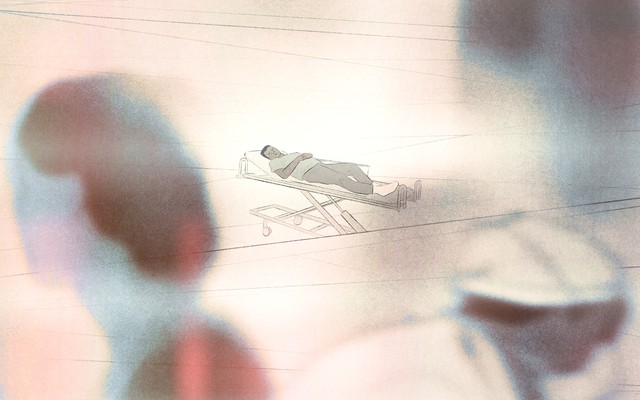
“I will not go to the emergency room”—emphasis on not—were his first words after passing out, having a seizure, or regurgitating the protein smoothies I made to pass his narrowed esophagus. He said it again and again, even as fluid built up in his lungs, rendering him short of breath and prone to agonizing coughing spells. He had been a big, athletic guy, but now, in the ugly process of dying, he was looking gaunt. Ours was a precarious existence, but I understood his adamant rejection of the emergency department. Most prior visits had morphed into extended trips into a terrifying medical underworld—to a purgatory known as emergency-department boarding.
Republicans seem to have expected that Democrats would continue to follow rules they had long since enthusiastically abandoned.
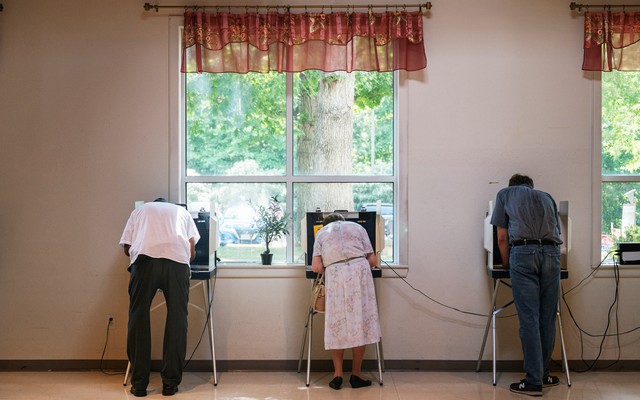
Voters in Virginia approved a lopsided congressional map on Tuesday, reducing the expected number of Republican-leaning districts in the Democratic-controlled state from five to one. Republicans have reacted by complaining that conservative-leaning voters in the state have been disenfranchised by gerrymandered maps that reduce the influence of their vote.
And they’re right. That is exactly what the new Virginia map does.
Gerrymandering is an attempt to thwart the will of the voters. It circumvents the vital process of democratic feedback by insulating politicians from political backlash. It should not happen, and yet this latest chapter of the redistricting wars did not begin in Virginia. It did not even begin last year, when Donald Trump openly urged red states to gerrymander their congressional maps so Republicans might retain possession of the House during the midterms. He did so despite the fact that the maps had been drawn after the 2020 census and would normally be expected to last until 2030.
Kash Patel has alarmed colleagues with episodes of excessive drinking and unexplained absences.
This article was featured in the One Story to Read Today newsletter. Sign up for it here.
On Friday, April 10, as FBI Director Kash Patel was preparing to leave work for the weekend, he struggled to log on to an internal computer system. He quickly became convinced that he had been locked out, and he panicked, frantically calling aides and allies to announce that he had been fired by the White House, according to nine people familiar with his outreach. Two of these people described his behavior as a “freak-out.”
Patel oversees an agency that employs roughly 38,000 people, including many who are trained to investigate and verify information that can be presented under oath in a court of law. News of his emotional outburst ricocheted through the bureau, prompting chatter among officials and, in some corners of the building, expressions of relief. The White House fielded calls from the bureau and from members of Congress asking who was now in charge of the FBI.
This article was featured in the One Story to Read Today newsletter. Sign up for it here.
The mystery of the missing scientists began with a Silver Alert. In late February, a retired Air Force major general named Neil McCasland left his house in New Mexico for a walk and never returned. Rumors spread on social media that the elderly former astronautical engineer had been abducted or killed. Forget Nancy Guthrie, they said. Here was a guy who used to run a “UFO-linked” lab. Here was a guy with knowledge of “America’s deepest, darkest secrets.” So where was this guy?
McCasland’s wife did her best with a post on Facebook to address what she called the “misinformation circulating about Neil and his disappearance,” but wild notions only multiplied. Dots were added, then connected: Another scientist—an advanced-materials researcher at NASA’s Jet Propulsion Laboratory (JPL) named Monica Reza—had disappeared while hiking near Los Angeles in June 2025. A physicist at MIT had been murdered in December. “What is going on seems to be an enemy action,” Walter Kirn, the novelist and podcast contrarian, said last month.
Politicians who think health-conscious women could swing the midterms are fooling themselves.
Earlier this month, MAHA moms went to the White House. Several key figures in the “Make America Healthy Again” movement gathered around a table in the Roosevelt Room to speak with Health Secretary Robert F. Kennedy Jr. and other top administration officials. The invitees—who included the health activist Kelly Ryerson, the wellness podcaster Alex Clark, and the nutritionist Courtney Swan—were all women. They’re influential among the loose coalition of Kennedy supporters known as MAHA moms, many of whom are worried about their children’s health. This was a chance for them to air their grievances with the Trump administration—which have grown in recent months. Afterward, they were ushered into the Oval Office to see President Trump, who, according to Ryerson, welcomed them as “my MAHA leaders.”
The people we were died at the exact moment our child did.
This article was featured in the One Story to Read Today newsletter. Sign up for it here.
My husband, David, hates Valentine’s Day. He once called it “New Year’s Eve with nuclear weapons.” I pretend not to care. Still, when the day passes entirely unremarked on, a woman can’t help but feel overlooked.
On Valentine’s Day 2024, David found a way out. He booked a speech on February 14 that required traveling from our home in Washington, D.C., to Toronto. I couldn’t object—he was getting paid. Anyway, I had my own plans: an “anti–Valentine’s Day” dinner hosted by one of the foreign embassies.
As I got ready, I called our oldest daughter, Miranda. She answered from her Brooklyn bathroom, getting ready for her own party. She propped her phone up beside her sink and laughed when I told her about her father’s strategic Valentine’s Day escape.
Fifteen years after Steve Jobs’s death, the company is a successful, if unexciting, powerhouse.
Tim Cook’s job was to make Apple boring—and he did. Cook, Apple’s chief executive officer, is stepping down after 15 years in the role. He had succeeded Steve Jobs after the visionary co-founder of Apple Computer Company left only months before dying of pancreatic cancer in 2011. Since then, Apple has grown in market value by 2,000 percent. It has also transformed into a staid, if immensely effective, firm that sells people glass rectangles, wireless earbuds, and, sometimes, computers. This legacy is not tragic, but it is somber. The crucible in which the personal computer and the smartphone were forged is just a big company now.
Jobs and Steve “Woz” Wozniak started Apple Computer in 1976 to bring Woz’s design for an early personal computer to market, but Jobs did not serve as CEO until 1997, when he returned after years away. Before then, a series of more ordinary businesspeople had run the company—mostly former semiconductor executives including Michael Scott, Mike Markkula, and Gil Amelio, along with the former PepsiCo CEO John Sculley. But by the mid-2000s, after the iMac, iPod, and iPhone had appeared, Jobs had become the apotheosized Visionary CEO—a model for the technology industry and beyond. His exacting and sometimes unreasonable demands, which dated back to the design of the Macintosh in the early 1980s, had made him a singular and irreplaceable presence: a figure who could bend an organization, an industry, and the public who would be transformed by its products to his will.