An attacker at Ohio State University, an order to evacuate North Dakota pipeline protesters, Zika in Texas, and more from the United States and around the world.
Wildfires Threaten Great Smoky Mountains National Park
John Bazemore / AP
Officials have had to close large sections of Great Smoky Mountains National Park, as the area braces for potentially disastrous wildfires raging nearby. Air quality is already at hazardous levels. As the Southeast faces its worst drought in years and winds blow as strong as 70 mph, firefighters are struggling to quell 14 fires near Gatlinburg, Tennessee, where some residents have been forced to evacuate. “We’ve had trees coming down, limbs coming down, and the fire is continuing to grow,” one National Park Service spokesperson said Monday. In recent weeks, wildfires have spread across the South, boosted by strong winds in Tennessee, Virginia, and north Carolina. Rain, though, is forecasted for the area in the coming days.
Due to continued erratic winds, the fires are very unpredictable and more fire growth is expected. pic.twitter.com/BYd9ANQeT4
North Dakota Pipeline Protesters Ordered to Evacuate
Andrew Cullen / Reuters
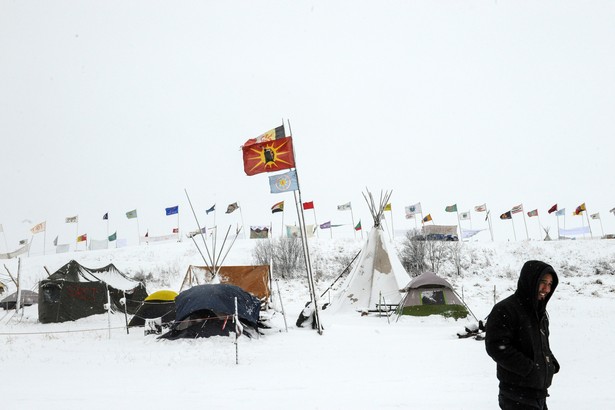
The governor of North Dakota has ordered an emergency evacuation of all pipeline protesters camping on U.S. Army Corps of Engineers land. All demonstrators protesting the Dakota Access Pipeline, which they say goes through sacred Standing Rock Sioux land and could harm water sources, must leave their camps because of dangerous winter weather, Governor Jack Dalrymple said in the order signed Monday. A spokesman for the governor’s office told The West Fargo Pioneer, though, that the state would not forcibly remove people from the land, putting the burden on the federal government. The Corps said Friday that all protesters must leave the land north of the Cannonball River by December 5. The tribe, though, says it still plans to block the pipeline’s construction on reservation lands.
Texas Reports First Local Transmission of Zika Virus
Aedes aegypti mosquitoes, the carriers of the Zika virus (Paulo Whitaker / Reuters)
The Zika virus has been transmitted by a mosquito in Texas for the first time, state health officials said Monday. The infected individual lives in Cameron County and has not traveled recently to countries where local transmission of the virus is common and well documented, officials said. She is also not pregnant. The Zika virus is most dangerous to pregnant women, and can cause a condition called microcephaly in babies born to infected women that results in smaller-than-normal heads. Officials say the virus was detected in the woman's urine and not her blood, which means the virus can no longer be spread through mosquito bites. Zika is primarily transmitted through Aedesaegypti mosquitoes, which thrive in warm climates, like in Texas and in South America, where the virus has led to thousands of cases of microcephaly since last year.
San Francisco's Transit System Is Back to Normal After a Ransomware Hack
Robert Galbraith / Reuters
San Francisco’s transit system returned to normal late Sunday after hackers hijacked its computer network over the weekend and granted tens of thousands of free fares. On Friday, San Francisco Municipal Transportation Agency (Muni) payment screens read “OUT OF ORDER” in subway stations across the city. In agents’ booths the screens read: “You Hacked, ALL Data Encrypted.” The attackers, who were anonymous, also demanded through their message that Muni pay 100 Bitcoin, or about $73,000, to restore access to its software. The attack did not affect transit service other than rendering Muni’s payment system useless, so for much of Friday, Saturday, and Sunday, Muni was free. This type of hack is caused by ransomeware, in which hackers encrypt data until the owner pays a requested fee. Ransomware hacks have become increasingly common, and this past year several hospital computer systems were breached in similar attacks. Although Muni service had been restored, Hoodline, a local news site, reported that the hackers responsible claim to have accessed vital agency functions, like payroll, and are still demanding money.
Protesters rally Monday in central Delhi against the Indian government's decision to withdraw 500- and 1,000-rupee banknotes from circulation. (Cathal McNaughton / Reuters)
Thousands of protesters demonstrated Monday against the Indian government’s decision to scrap 500-rupee and 1,000-rupee banknotes, the BBC reports. Indian Prime Minister Narendra Modi, who made the announcement earlier this month, said the move is an effort to fight corruption and to remove fraudulent notes from circulation. He added those still using the denominations would have until the end of the year to deposit them into banks. But critics say the move caused a “financial emergency” by removing 86 percent of the country’s cash overnight. Modi, meanwhile, has called on people to embrace digital, cashless forms of payment. More than 90 percent of India’s transactions are in cash.
German Court Upholds Former Nazi Guard's Conviction
AP
A German federal court on Monday upheld the conviction of a former Nazi guard at the Auschwitz death camp. Oskar Gröning, now 95 years old, was convicted in July 2015 of being an accessory to the murder of 300,000 Jews. He appealed the ruling because he said he was only responsible for gathering and sorting valuables at Auschwitz, and was not involved in any crimes. The decision sets a precedent for prosecuting Nazi criminals; the ruling marks the first time an appeals court has determined that helping a concentration camp operate—or as the judge put it, participating in the “machinery of death”—is enough to be convicted, even if prosecutors lack evidence of specific killings. Deutsche Wellereports that the decision could affect several other pending Nazi wartime cases.
Dylann Roof Can Represent Himself at His Death-Penalty Trial
Reuters
A federal judge in South Carolina ruled Monday that Dylann Roof, who is charged in the killing of nine black churchgoers last year, can represent himself in his death-penalty trial. Judge Richard Gergel of the Federal District Court in Charleston, speaking directly to Roof, called the decision “strategically unwise” but that “it is a decision you have the right to make." Roof made the last-minute request Monday morning as jury selection in his case was set to begin. Roof is accused of shooting and killing nine people at Emanuel AME church in June 2015. Federal authorities say he targeted the individuals because they were black. Roof offered to plead guilty last week in exchange for a life sentence, but prosecutors refused the deal. If Roof does represent himself, it will allow the self-avowed white supremacist to interview witnesses and family members called to testify.
At least 11 people were injured in an attack at the Ohio State University Monday morning. The suspect was shot and killed by police. Nine people sustained stab wounds wounds. One person is in critical condition. Earlier, OSU said there’s an active shooter on campus, and urged students to shelter in place—but it’s unclear if a gun was used in the attacks.
Buckeye Alert: Active Shooter on campus. Run Hide Fight. Watts Hall. 19th and College.
Japanese Amusement Park Shuts Down Its Ice Rink Filled With Thousands of Frozen Fish
Space World / Facebook
A Japanese theme park was closed Sunday after widespread complaints about its new ice-skating rink, an attraction that featured thousands of dead fish frozen in ice. The rink in the southwest city of Kitakyushu opened two weeks ago and advertised its “Freezing Port” as a world first. It featured about 5,000 dead mackerel, sprats, crabs, and other fish bought from a local market entombed in the ice, some with their mouths open. CNN reported that a Facebook ad for the park featured photos of the frozen fish with caption: “I am d... d... drowning, s ... s... suffocating" (the post has since been deleted). Space World’s manager told CNN the park would unfreeze the fish and hold an “appropriate religious service"; then reuse them as fertilizer.
Syrian Government Troops Take a Key Rebel-Held Part of Aleppo
Syrians who evacuated the eastern districts of Aleppo are gathered in a government-held part of the city in this picture provided by the state-run Syrian Arab News Agency on Sunday. (Sana / Reuters)
Syrian government troops have captured Sakhour, a district in the rebel-controlled portion of Aleppo, effectively dividing the city in two, according to state media and the U.K.-based Syrian Observatory for Human Rights, a monitoring group. Russian state-run news sources say the government now controls 40 percent of eastern Aleppo, the last major rebel stronghold; the BBC puts that figures at about one-third. The development is a boost to President Bashar al-Assad, who with the help of Russia, Iran, and Hezbollah, now appears more firmly in charge of Syria than at any point since the civil war began more than five years ago. About 250,000 civilians live in rebel-held eastern Aleppo; the Syrian government’s assault on the divided city has been criticized by human-rights groups who have called it a war crime.
President-elect Donald Trump is expected to reveal more members of his Cabinet this week. Among those positions likely to be announced is secretary of state. Mitt Romney—the former Massachusetts governor, 2012 GOP presidential nominee, and leading Republican critic of Trump—is said to be a contender, though Kellyanne Conway, a Trump adviser, appeared to dismiss that idea on ABC. Separately, responding to efforts by Jill Stein, the Green Party nominee, to seek a recount in several states Trump won, the president-elect, in a series of tweets, suggested—with no evidence—that voter fraud had denied him the popular vote, which Hillary Clinton, his Democratic rival, is leading by about 2 million votes. As my colleague Adam Serwer noted this morning: “The source of Trump’s claim that ‘millions’ of votes were cast illegally appears to be a report from the conspiracy theory website InfoWars, itself based on a tweet from an anti-vote fraud activist who provided no evidence for his claim.” Separately, Trump said Monday: “If Cuba is unwilling to make a better deal for the Cuban people, the Cuban/American people and the U.S. as a whole, I will terminate deal.”
Paul Nuttall has been elected the new leader of the U.K. Independence Party. He takes over from Nigel Farage, who had stepped in as interim leader after Diane James, the previous winner, quit the post after 18 days on the job. Nuttall, 39, was UKIP’s deputy leader. He defeated Suzanne Evans, a former deputy chair of the party, and John Rees-Evans. “We must hold the government’s feet to the fire on leaving the EU,” Nuttall said after his victory. “Brexit must mean Brexit.” Although UKIP wasn’t an official part of the “Leave” campaign, the far-right party championed the U.K.’s exit from the EU.
When President Trump last summer implored Republicans to launch a nationwide gerrymandering blitz to pad their narrow House majority, the fight he started did not seem fair. GOP lawmakers had both the will and the power to draw their party new seats, while Democrats were hamstrung by limits of their own making. The question was not whether Republicans could expand their edge in Congress, but by how much.
This morning the landscape looks a lot different, after Virginia voters yesterday approved a lopsided new House map that could hand Democrats an additional four seats that Republicans currently hold. The Democratic redistricting victory is the party’s second in a statewide referendum. When combined with new lines that California voters endorsed in November, Democrats have now succeeded in drawing districts that will likely yield them nine more seats this fall, at least matching what Republicans have been able to achieve in states that they control. By some measures, Democrats have jumped into the redistricting lead, bolstering their chances of winning back the House majority in the midterm elections.
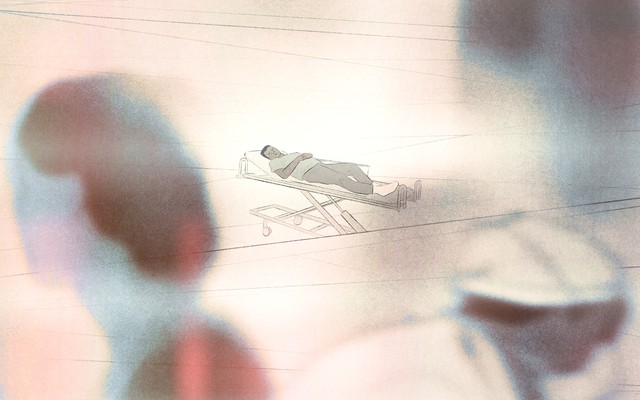
Patients are getting stuck in the emergency department for days while waiting for a spot in an inpatient ward.
In the last months, weeks, and days of his life, “I will not go to the emergency room” became my husband’s mantra. Andrej had esophageal cancer that had spread throughout his body (but not to his ever-willful brain), and, having trained as a doctor, I had jury-rigged a hospital at home, aided by specialists who got me pills to boost blood pressure; to dampen the effects of liver failure; to stem his cough; to help him swallow, wake up, fall asleep.
“I will not go to the emergency room”—emphasis on not—were his first words after passing out, having a seizure, or regurgitating the protein smoothies I made to pass his narrowed esophagus. He said it again and again, even as fluid built up in his lungs, rendering him short of breath and prone to agonizing coughing spells. He had been a big, athletic guy, but now, in the ugly process of dying, he was looking gaunt. Ours was a precarious existence, but I understood his adamant rejection of the emergency department. Most prior visits had morphed into extended trips into a terrifying medical underworld—to a purgatory known as emergency-department boarding.
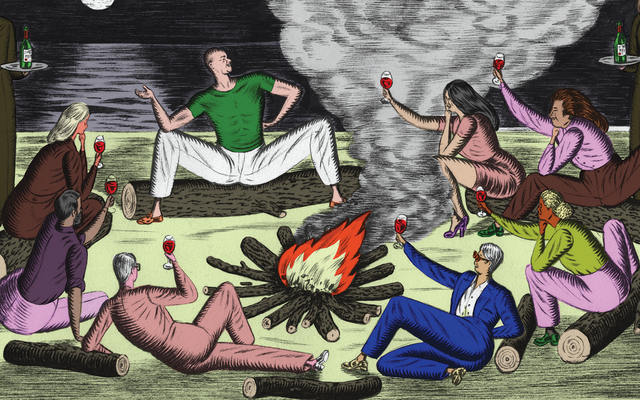
For the richest men on Earth, everything is free and nothing matters.
At the end of Paul Thomas Anderson’s 2007 movie, There Will Be Blood, Daniel Day-Lewis’s oil-baron character, old now and richer than Croesus, beats Paul Dano’s preacher to death with a bowling pin. Dano’s Eli Sunday, a nemesis of Day-Lewis’s Daniel Plainview during his seminal, wealth-building years, has come to sell Plainview the oil-rich land that he once coveted. But Plainview doesn’t need the land anymore, because—as he explains in one of the most famous monologues in modern cinema—he has sucked out all the oil hidden beneath it from an adjoining property, like a milkshake.
Desperate for money, Eli begs for a loan. Instead, Plainview chases him around a bowling alley and murders him with great enthusiasm. Once it’s over, a butler comes to see what all the noise was about. “I’m finished,” Plainview yells.
The economist Adam Posen on the effect of the war in Iran on the world’s economy and the darkening economic outlook for the United States. Plus: A shifting partisan balance of power and Ask Not: The Kennedys and the Women They Destroyed, by Maureen Callahan.
In this episode of The David Frum Show, The Atlantic’s David Frum opens with a discussion of the likelihood that the partisan balance of power will shift from Republicans to Democrats at state-government level.
Then, David is joined by the president of the Peterson Institute for International Economics, Adam Posen, for a conversation about the state of the world’s economy. Frum and Posen discuss the economic effect of the war in Iran, the United States’ reputational hit caused by Trump’s tariffs, and the chance of global recession.
Finally, David ends the episode with a discussion of Ask Not: The Kennedys and the Women They Destroyed, by Maureen Callahan, and reflects on why reactions to the abuse of women by men in power seem to have become a partisan issue.
This article was featured in the One Story to Read Today newsletter. Sign up for it here.
The mystery of the missing scientists began with a Silver Alert. In late February, a retired Air Force major general named Neil McCasland left his house in New Mexico for a walk and never returned. Rumors spread on social media that the elderly former astronautical engineer had been abducted or killed. Forget Nancy Guthrie, they said. Here was a guy who used to run a “UFO-linked” lab. Here was a guy with knowledge of “America’s deepest, darkest secrets.” So where was this guy?
McCasland’s wife did her best with a post on Facebook to address what she called the “misinformation circulating about Neil and his disappearance,” but wild notions only multiplied. Dots were added, then connected: Another scientist—an advanced-materials researcher at NASA’s Jet Propulsion Laboratory (JPL) named Monica Reza—had disappeared while hiking near Los Angeles in June 2025. A physicist at MIT had been murdered in December. “What is going on seems to be an enemy action,” Walter Kirn, the novelist and podcast contrarian, said last month.
Kash Patel has alarmed colleagues with episodes of excessive drinking and unexplained absences.
This article was featured in the One Story to Read Today newsletter. Sign up for it here.
On Friday, April 10, as FBI Director Kash Patel was preparing to leave work for the weekend, he struggled to log on to an internal computer system. He quickly became convinced that he had been locked out, and he panicked, frantically calling aides and allies to announce that he had been fired by the White House, according to nine people familiar with his outreach. Two of these people described his behavior as a “freak-out.”
Patel oversees an agency that employs roughly 38,000 people, including many who are trained to investigate and verify information that can be presented under oath in a court of law. News of his emotional outburst ricocheted through the bureau, prompting chatter among officials and, in some corners of the building, expressions of relief. The White House fielded calls from the bureau and from members of Congress asking who was now in charge of the FBI.
Republicans seem to have expected that Democrats would continue to follow rules they had long since enthusiastically abandoned.
Voters in Virginia approved a lopsided congressional map on Tuesday, reducing the expected number of Republican-leaning districts in the Democratic-controlled state from five to one. Republicans have reacted by complaining that conservative-leaning voters in the state have been disenfranchised by gerrymandered maps that reduce the influence of their vote.
And they’re right. That is exactly what the new Virginia map does.
Gerrymandering is an attempt to thwart the will of the voters. It circumvents the vital process of democratic feedback by insulating politicians from political backlash. It should not happen, and yet this latest chapter of the redistricting wars did not begin in Virginia. It did not even begin last year, when Donald Trump openly urged red states to gerrymander their congressional maps so Republicans might retain possession of the House during the midterms. He did so despite the fact that the maps had been drawn after the 2020 census and would normally be expected to last until 2030.
Each is animated by the author’s love—for their subject, for language, and for pushing the boundaries of what the genre can do.
Literary biography is a cruel genre. The authors of these books—by which I mean not just biographies about literary figures but also those that aspire to writerly excellence—have been described by the writer Janet Malcolm as “professional burglars.” After rifling through a person’s affairs, they must conjure inside their pages a living, breathing human being—and then, inevitably, they’ll have to close the coffin on their resurrected subject. But I like to think the “literary” element can temper the sting of these dastardly deeds, insofar as the author is tasked with perpetrating them in the most humane way possible: with the appropriate amount of reverence, style, and, yes, love. This is, at least, what I tried to do in my own literary biography, Baldwin: A Love Story, about James Baldwin’s life and relationships.
The people we were died at the exact moment our child did.
This article was featured in the One Story to Read Today newsletter. Sign up for it here.
My husband, David, hates Valentine’s Day. He once called it “New Year’s Eve with nuclear weapons.” I pretend not to care. Still, when the day passes entirely unremarked on, a woman can’t help but feel overlooked.
On Valentine’s Day 2024, David found a way out. He booked a speech on February 14 that required traveling from our home in Washington, D.C., to Toronto. I couldn’t object—he was getting paid. Anyway, I had my own plans: an “anti–Valentine’s Day” dinner hosted by one of the foreign embassies.
As I got ready, I called our oldest daughter, Miranda. She answered from her Brooklyn bathroom, getting ready for her own party. She propped her phone up beside her sink and laughed when I told her about her father’s strategic Valentine’s Day escape.
WAR-FIGHTERS! As a step to making sure we are ready for warfare at all times, we have decided to ELIMINATE THE MANDATORY FLU SHOT! Nothing says “we are ready for war” like “we all have the flu.”
Get your hot-water bottles! Get your ibuprofen! Not Tylenol, though! It knows what it did. Because we are bringing FLU to the war-fighters! Are you ready to have a RUNNY NOSE and an ITCHY THROAT? Are you ready to get REALLY SERIOUSLY DEHYDRATED AND NEED MEDICAL ATTENTION? Hoo-RAH!
We will terrify the enemy by coming in hot! And when I say hot I mean our temperatures! We will need COUGH DROPS, and we will knock those back, CRUNCH CRUNCH CRUNCH, with a sound more frightening than gunfire. This will strike fear into the hearts of the enemy. They will say things like “Do you need a tissue?” and “Are you okay?,” and when they are offering us that tissue, we will strike. And then we will go back to bed and lie under a tactical pile of war-fighting blankets. Peak performance is when you have a terrible headache and want to be asleep, and whenever you open your mouth you sound like someone took lawn shears to your vocal cords. YEAH!