—A Southwest airline employee was shot and killed in a shooting Tuesday at the Will Rogers World Airport in Oklahoma City.
—Russia detained Alexei Ulyukayev, its economy minister, Tuesday after he was caught in a sting taking a $2 million bribe in exchange for approving the sale of a state-run oil producer.
—We’re live-blogging the news stories of the day below. All updates are in Eastern Standard Time (GMT -5).
Winchester, 52, was shot in an airport parking lot and was transported to a nearby hospital, where he was pronounced dead, said Oklahoma City Police Captain Paco Balderrama at a press conference Tuesday afternoon.
Police previously said there were reports of a second victim, but Balderrama did not mention this person during the latest press conference. The suspect was later found dead from an apparent self-inflicted gunshot wound. The motive is still unclear.
Police evacuated everyone from the airport, where all arriving and departing flights were suspended. Several hours later, operations resumed. Around 30 flights were canceled because of the shooting.
A group of international swimmers swam across the Dead Sea for seven hours Tuesday to raise awareness about the hyper-saline lake’s shrinking water levels.
The swimmers made the 16-kilometer (10-mile) trip from Jordan to Israel in masks and snorkels to protect them from the water's high salt concentration. The swim was the first of its kind in the lake, which, at 423 meters (1,388 feet) below sea level, is the lowest point on Earth. The swim’s organizers say the Dead Sea’s water level has dropped by more than 25 meters (82 feet) in the past 30 years.
“Oh, it's absolutely crazy,” Jackie Cobell, an English long-distance swimmer, told the AP Tuesday about the crossing. But “this is really important, because it's disappearing fast.”
The swim was open only to open-water marathon swimmers. Participants—from Israel, South Africa, New Zealand Denmark, the Palestinian territories, among other places—were followed by boats carrying medical supplies and food. They were instructed to take water breaks every 30 minutes and apply Vaseline to skin to protect against the chafing caused by the salty water. The water is painful if it gets into the eyes, and can be deadly if swallowed. All but three of the swimmers finished the crossing.
The lake depends on a steady flow of freshwater to replenish the water that evaporates. In the 1960s, Israel built a pumping station on the shores of the Sea of Galilee, diverting the lake’s main source of freshwater into a pipeline system for the country, Joshua Hammer explained in Smithsonian magazine in 2005. A decade later, Jordan and Syria diverted another important inlet. The extraction of minerals from the lake has also contributed to its decline. Environmentalists have lobbied Jordan, Israel, and the Palestinian Authority for years to nominate the Dead Sea as a United Nations World Heritage site, which would provide certain protections.
U.K. Signs Off on Extradition of Alleged FBI Hacker Lauri Love
Lauri Love leaves his extradition hearing at Westminster Magistrates' Court in London on September 16, 2016. (Peter Nicholls / Reuters)
U.K. Home Secretary Amber Rudd approved Monday the extradition of Lauri Love to the United States, where he faces nearly a century in prison for allegedly hacking into federal government computers.
Rudd said she “carefully considered all relevant matters” before signing off on Love’s extradition, noting the serious charges the 32-year-old Suffolk native was facing, The Guardian reports. In September, a British court approved Love’s extradition for his alleged involvement in a series of Anonymous-affiliated hacks into several U.S. government agencies including the FBI, the U.S. Army, the Missile Defense Agency, and the Federal Reserve—hacks the U.S. said resulted in the release of confidential information and caused millions of dollars in damage. Love faces charges in three different jurisdictions and up to 99 years in prison if convicted.
Love, who has Asperger’s syndrome, told the court being sent to a U.S. prison would endanger his mental health and pose a high risk of him committing suicide. He argued that his extradition should be blocked on the grounds it would violate his human rights. Such a move is not without precedent— that very exception was made by then-Home Secretary Theresa May in 2012 for Gary McKinnon, an alleged hacker with Asperger’s syndrome who was accused of hacking U.S. military computers.
Rudd acknowledged Love’s “physical and mental health issues,” but said she believed the U.S. facilities were adequate enough to address them.
Love’s father, Alexander, told the BBC they would appeal the decision.
South Korean Opposition Vows National Campaign to Oust President Park
Protesters in Seoul, South Korea, call for President Park Geun-hye to quit on November 12. (Kim Hong-Ji / Reuters)
South Korea’s opposition leaders vowed to launch a national campaign to oust Park Geun-hye, whose recent scandal involving a political confidante has gripped the country and embroiled her presidency, Yonhap News Agency reports.
Moon Jae-in, a former Democratic Party leader and a potential contender for the South Korean presidency in next year’s election, pledged to spearhead a “a nationwide campaign” pushing for Park’s resignation. Other opposition leaders, including Seoul’s mayor, echoed Moon’s calls for Park to step down. Here’s a photo of Moon joining protesters calling for Park’s resignation:
Yoo Yeong-ha, Park’s attorney, requested Tuesday that Park be given more time to prepare for the investigation into Park’s relationship with Choi Soon-sil, a long-time friend of the president who has been charged with attempted fraud and abuse of authority. Yoo said the investigation should be conducted in a way that minimizes any impact on Park’s presidential duties, noting “the investigation or trial of the president, while he or she is still in office, could paralyze state affairs and divide public opinion.”
The scandal has indeed proved to be the worst crisis of Park’s political career, sending her approval rating to 5 percent—the lowest for any leader of the country in nearly 70 years.
What Do the Corruption Charges Against a Top Russian Official Mean?
Reuters
Russia detained Alexei Ulyukayev, its economy minister, Tuesday after he was caught in a sting taking a $2 million bribe in exchange for approving the sale of a state-run oil producer. It is the highest-profile corruption case in Vladimir Putin’s 16-year rule in a country where government corruption is common, and it likely represents tension in the Russian president’s inner circle.
Investigators wiretapped Ulyukayev’s phone for months after learning he threatened operators of Rosneft that he’d “create impediments” in their bid to buy Bashneft, a smaller state-run oil producer. He is the first economy minister since the Stalin era to be arrested while in office. Some politicians pointed to it as evidence of Russia’s desire to rid the government of corruption.
“Everyone is equal before the law,” said the speaker of the lower house of parliament, Vyacheslav Volodin.
Inside the Kremlin, however, the story seems different. Igor Sechin, Rosneft’s top official, a friend to Putin and one of the most powerful men in the country, wanted to purchase Bashneft, while Russia’s prime minister thought it should go to a private company. Ulyukayev is in charge of selling state-owned companies, and he had originally sided with the prime minister. He eventually came around to the idea of selling to Rosneft at market price—$5 billion. The storyline has raised several questions, like why Ulyukayev would try to bribe one of the country’s most powerful men, someone so close to Putin? And why he would even seek a bribe for the market-price transfer of a state-owned company to another state-owned company?
Some experts believe it’s the beginning of an internal purge against liberals in the government, or score-settling.
Hong Kong Bars Pro-Independence Lawmakers From Office
Yau Wai-ching and Sixtus Leung address journalists Tuesday outside Hong Kong’s High Court after being disqualified from taking office as lawmakers. (Bobby Yip / Reuters)
A Hong Kong court ruled Tuesday that two pro-independence lawmakers are disqualified from taking their seats in the city’s legislature after a controversy erupted following their refusal to pledge allegiance to China.
Judge Thomas Au Hing-cheung said in his judgement that Yau Wai-ching, 25, and Sixtus Leung, 30, did not “faithfully and truthfully” perform the legislative oath required of them to serve in Hong Kong as required by the Chinese territory’s Basic Law. He also ruled they could not be given a chance to retake their oaths.
The judge was referring to a swearing-in ceremony last month, during which the politicians—both of whom advocate for independence from China—altered the words of their oaths to pledge allegiance to the “Hong Kong nation” instead of China, which they referred to instead using a derogatory term and other vulgar language. Beijing last week prevented them from taking office, a decision that prompted street protests.
Leung told the South China Morning Post he intends to appeal the decision—one Yau said was made due to Beijing’s influence.
Under the one-country-two-systems formula that has governed relations between Beijing and Hong Kong since the 1997 handover, the territory enjoys wide-ranging autonomy, but Beijing still has final say over how the Basic Law, Hong Kong’s mini constitution, is interpreted.
Twitter says it has taken action to combat the increased “abuse, bullying, and harassment we've seen across the Internet … over the past few years.”
The company said it is expanding its “mute” function to include “keywords, phrases, and even entire conversations you don't want to see notifications about.” It’s also giving users a more direct way to report “hateful conduct” against people “on the basis of race, ethnicity, national origin, sexual orientation, gender, gender identity, religious affiliation, age, disability, or disease.” And, it said, it has “retrained all of our support teams on our policies … in order to deal more effectively with this conduct when it's reported to us.”
The announcement Tuesday comes after months of criticism against the type of speech for which Twitter has become infamous. BuzzFeed Newsadds: “The company’s failure to curb abuse has turned the platform into a primary destination for trolls and hate groups — a reputation that reportedly drove away potential buyers, including Salesforce and Disney this summer.”
Russia Resumes Aleppo Offensive Hours After Putin and Trump Talk
Reuters
Russia resumed its offensive on Tuesday in rebel-held Aleppo after a weeks-long pause, dropping barrel bombs from helicopters and firing missiles at targets. The strikes were paused three weeks ago to allow for civilians to leave the area, but Russian President Vladimir Putin resumed bombing just hours after speaking with U.S. President-elect Donald Trump.
The Kremlin said Tuesday the two leaders shared the view it was necessary to work together in Syria to fight “the common enemy number one: international terrorism and extremism.” Putin’s spokesman did not say if the two discussed Aleppo specifically, only that they shared a “phenomenally similar” outlook on foreign policy.
Russia’s missiles struck targets in the north of the city, where rebels, some of whom receive U.S. aid, have dug in to fight Syrian President Bashar al-Assad. Russia backs the Syrian government, and Tuesday’s assault had nothing to do with fighting ISIS, which is not present in Aleppo. Some of the missiles were directed from Admiral Kuznetsov, the Russian aircraft carrier stationed last month on the shores of Syria. The bombs struck rebel weapons depots and training camps in the Idlib province, as well as three neighborhoods in Aleppo. Casualties were not reported yet.
Egyptian Court Overturns Mohammed Morsi's Death Sentence
(Asmaa Waguih / Reuters)
Egypt’s Court of Cassation, the country’s highest court, overturned Tuesday the death sentence against Mohammed Morsi, the Islamist president who was ousted by the military in 2013, and ordered a retrial in the prison-break case for which he received the sentence.
Morsi faces charges in three other cases: One related to espionage for which he was sentenced to life in prison (25 years), plus 15 years. A hearing on his appeal is set for November 27. He and other Muslim Brotherhood leaders were also sentenced to life in prison in a separate espionage case; Mosri is appealing that ruling. He and others are also being tried on charges of insulting the judiciary. A hearing is set for December 10.
The court, in its ruling Tuesday, overturned the death penalties against Mohamed Badie, the Muslim Brotherhood leader, and other members of the group.
Morsi was elected president in 2012 after massive protests during the Arab Spring saw the ouster of Hosni Mubarak, the longtime Egyptian leader. But public sentiment, and the military, quickly turned against Morsi, and mass protests against his rule resulted in his ouster in 2013.
Germany Bans Muslim Group; Raids Mosques, Apartments in 10 Cities
(Pawel Kopczynski / Reuters)
German authorities banned True Religion, a Muslim group perhaps best known for distributing translated Qurans, for its alleged recruitment of militants to fight for ISIS in Iraq and Syria, and police conducted raids on mosques, apartments, and offices in several states.
Deutsche Welleadds: “Some 65 raids were carried out in the state of Hesse, 15 of them in the city of Frankfurt alone. Every one of the searches took place in Berlin or the former West.”
Thomas de Maizière, the German interior minister, said True Religion was a Salafist group and its translations of the Quran was used to “spread messages of hate and anti-constitutional ideologies.” He said more than 140 youths had read the group’s translations and traveled to Syria. Deutsche Welle quoted a tweet purportedly sent by True Religion that said: The Quran has been banned in Germany. … We have delivered Allah’s message.”
Germany has intensified its crackdown on ISIS and Islamist sympathizers following several terrorist attacks over the summer. Last week, it arrested five alleged ISIS members, including one described as a senior recruiter for the group. True Religion is the sixth Islamist group to be outlawed in Germany since 2012.
Patients are getting stuck in the emergency department for days while waiting for a spot in an inpatient ward.
In the last months, weeks, and days of his life, “I will not go to the emergency room” became my husband’s mantra. Andrej had esophageal cancer that had spread throughout his body (but not to his ever-willful brain), and, having trained as a doctor, I had jury-rigged a hospital at home, aided by specialists who got me pills to boost blood pressure; to dampen the effects of liver failure; to stem his cough; to help him swallow, wake up, fall asleep.
“I will not go to the emergency room”—emphasis on not—were his first words after passing out, having a seizure, or regurgitating the protein smoothies I made to pass his narrowed esophagus. He said it again and again, even as fluid built up in his lungs, rendering him short of breath and prone to agonizing coughing spells. He had been a big, athletic guy, but now, in the ugly process of dying, he was looking gaunt. Ours was a precarious existence, but I understood his adamant rejection of the emergency department. Most prior visits had morphed into extended trips into a terrifying medical underworld—to a purgatory known as emergency-department boarding.
When President Trump last summer implored Republicans to launch a nationwide gerrymandering blitz to pad their narrow House majority, the fight he started did not seem fair. GOP lawmakers had both the will and the power to draw their party new seats, while Democrats were hamstrung by limits of their own making. The question was not whether Republicans could expand their edge in Congress, but by how much.
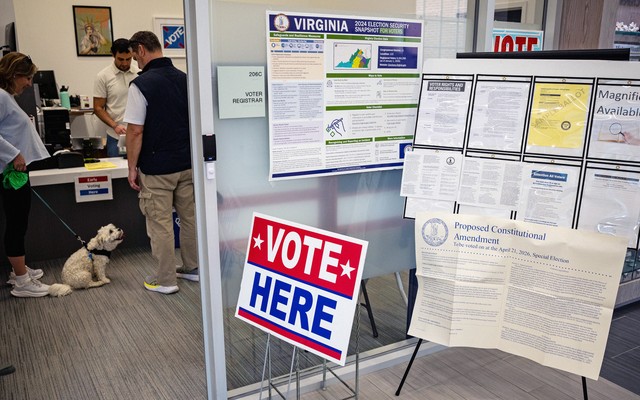
This morning the landscape looks a lot different, after Virginia voters yesterday approved a lopsided new House map that could hand Democrats an additional four seats that Republicans currently hold. The Democratic redistricting victory is the party’s second in a statewide referendum. When combined with new lines that California voters endorsed in November, Democrats have now succeeded in drawing districts that will likely yield them nine more seats this fall, at least matching what Republicans have been able to achieve in states that they control. By some measures, Democrats have jumped into the redistricting lead, bolstering their chances of winning back the House majority in the midterm elections.
For the richest men on Earth, everything is free and nothing matters.
At the end of Paul Thomas Anderson’s 2007 movie, There Will Be Blood, Daniel Day-Lewis’s oil-baron character, old now and richer than Croesus, beats Paul Dano’s preacher to death with a bowling pin. Dano’s Eli Sunday, a nemesis of Day-Lewis’s Daniel Plainview during his seminal, wealth-building years, has come to sell Plainview the oil-rich land that he once coveted. But Plainview doesn’t need the land anymore, because—as he explains in one of the most famous monologues in modern cinema—he has sucked out all the oil hidden beneath it from an adjoining property, like a milkshake.
Desperate for money, Eli begs for a loan. Instead, Plainview chases him around a bowling alley and murders him with great enthusiasm. Once it’s over, a butler comes to see what all the noise was about. “I’m finished,” Plainview yells.
The economist Adam Posen on the effect of the war in Iran on the world’s economy and the darkening economic outlook for the United States. Plus: A shifting partisan balance of power and Ask Not: The Kennedys and the Women They Destroyed, by Maureen Callahan.
In this episode of The David Frum Show, The Atlantic’s David Frum opens with a discussion of the likelihood that the partisan balance of power will shift from Republicans to Democrats at state-government level.
Then, David is joined by the president of the Peterson Institute for International Economics, Adam Posen, for a conversation about the state of the world’s economy. Frum and Posen discuss the economic effect of the war in Iran, the United States’ reputational hit caused by Trump’s tariffs, and the chance of global recession.
Finally, David ends the episode with a discussion of Ask Not: The Kennedys and the Women They Destroyed, by Maureen Callahan, and reflects on why reactions to the abuse of women by men in power seem to have become a partisan issue.
This article was featured in the One Story to Read Today newsletter. Sign up for it here.
The mystery of the missing scientists began with a Silver Alert. In late February, a retired Air Force major general named Neil McCasland left his house in New Mexico for a walk and never returned. Rumors spread on social media that the elderly former astronautical engineer had been abducted or killed. Forget Nancy Guthrie, they said. Here was a guy who used to run a “UFO-linked” lab. Here was a guy with knowledge of “America’s deepest, darkest secrets.” So where was this guy?
McCasland’s wife did her best with a post on Facebook to address what she called the “misinformation circulating about Neil and his disappearance,” but wild notions only multiplied. Dots were added, then connected: Another scientist—an advanced-materials researcher at NASA’s Jet Propulsion Laboratory (JPL) named Monica Reza—had disappeared while hiking near Los Angeles in June 2025. A physicist at MIT had been murdered in December. “What is going on seems to be an enemy action,” Walter Kirn, the novelist and podcast contrarian, said last month.
Kash Patel has alarmed colleagues with episodes of excessive drinking and unexplained absences.
This article was featured in the One Story to Read Today newsletter. Sign up for it here.
On Friday, April 10, as FBI Director Kash Patel was preparing to leave work for the weekend, he struggled to log on to an internal computer system. He quickly became convinced that he had been locked out, and he panicked, frantically calling aides and allies to announce that he had been fired by the White House, according to nine people familiar with his outreach. Two of these people described his behavior as a “freak-out.”
Patel oversees an agency that employs roughly 38,000 people, including many who are trained to investigate and verify information that can be presented under oath in a court of law. News of his emotional outburst ricocheted through the bureau, prompting chatter among officials and, in some corners of the building, expressions of relief. The White House fielded calls from the bureau and from members of Congress asking who was now in charge of the FBI.
The people we were died at the exact moment our child did.
This article was featured in the One Story to Read Today newsletter. Sign up for it here.
My husband, David, hates Valentine’s Day. He once called it “New Year’s Eve with nuclear weapons.” I pretend not to care. Still, when the day passes entirely unremarked on, a woman can’t help but feel overlooked.
On Valentine’s Day 2024, David found a way out. He booked a speech on February 14 that required traveling from our home in Washington, D.C., to Toronto. I couldn’t object—he was getting paid. Anyway, I had my own plans: an “anti–Valentine’s Day” dinner hosted by one of the foreign embassies.
As I got ready, I called our oldest daughter, Miranda. She answered from her Brooklyn bathroom, getting ready for her own party. She propped her phone up beside her sink and laughed when I told her about her father’s strategic Valentine’s Day escape.
Republicans seem to have expected that Democrats would continue to follow rules they had long since enthusiastically abandoned.
Voters in Virginia approved a lopsided congressional map on Tuesday, reducing the expected number of Republican-leaning districts in the Democratic-controlled state from five to one. Republicans have reacted by complaining that conservative-leaning voters in the state have been disenfranchised by gerrymandered maps that reduce the influence of their vote.
And they’re right. That is exactly what the new Virginia map does.
Gerrymandering is an attempt to thwart the will of the voters. It circumvents the vital process of democratic feedback by insulating politicians from political backlash. It should not happen, and yet this latest chapter of the redistricting wars did not begin in Virginia. It did not even begin last year, when Donald Trump openly urged red states to gerrymander their congressional maps so Republicans might retain possession of the House during the midterms. He did so despite the fact that the maps had been drawn after the 2020 census and would normally be expected to last until 2030.
Each is animated by the author’s love—for their subject, for language, and for pushing the boundaries of what the genre can do.
Literary biography is a cruel genre. The authors of these books—by which I mean not just biographies about literary figures but also those that aspire to writerly excellence—have been described by the writer Janet Malcolm as “professional burglars.” After rifling through a person’s affairs, they must conjure inside their pages a living, breathing human being—and then, inevitably, they’ll have to close the coffin on their resurrected subject. But I like to think the “literary” element can temper the sting of these dastardly deeds, insofar as the author is tasked with perpetrating them in the most humane way possible: with the appropriate amount of reverence, style, and, yes, love. This is, at least, what I tried to do in my own literary biography, Baldwin: A Love Story, about James Baldwin’s life and relationships.
Politicians who think health-conscious women could swing the midterms are fooling themselves.
Earlier this month, MAHA moms went to the White House. Several key figures in the “Make America Healthy Again” movement gathered around a table in the Roosevelt Room to speak with Health Secretary Robert F. Kennedy Jr. and other top administration officials. The invitees—who included the health activist Kelly Ryerson, the wellness podcaster Alex Clark, and the nutritionist Courtney Swan—were all women. They’re influential among the loose coalition of Kennedy supporters known as MAHA moms, many of whom are worried about their children’s health. This was a chance for them to air their grievances with the Trump administration—which have grown in recent months. Afterward, they were ushered into the Oval Office to see President Trump, who, according to Ryerson, welcomed them as “my MAHA leaders.”