



Twenty-First Century Writer
An e-mail exchange with Ralph Lombreglia
More on Digital Culture in Atlantic Unbound
If It Works, Use It
Musings of a Twenty-First Century Writer
 One of the central debates in our literary culture today
is how -- or whether -- new technologies will affect the age-old activities
of writing and reading. In this excerpt from a new essay, to appear in the
forthcoming anthology Tolstoy's Dictaphone: Technology and the Muse,
edited by Sven Birkerts, the author Ralph Lombreglia envisions a course
between the extremes of technophiles and technophobes, cyberenthusiasts
and cyberskeptics.
One of the central debates in our literary culture today
is how -- or whether -- new technologies will affect the age-old activities
of writing and reading. In this excerpt from a new essay, to appear in the
forthcoming anthology Tolstoy's Dictaphone: Technology and the Muse,
edited by Sven Birkerts, the author Ralph Lombreglia envisions a course
between the extremes of technophiles and technophobes, cyberenthusiasts
and cyberskeptics.
From "Humanity's Humanity in the Digital Twenty-First"
by Ralph LombregliaI NEVER could write -- compose prose, create good sentences -- on a typewriter. The grossly mechanical apparatus was an ever-present hostility. The loud racket of metal type slamming paper-covered platen obliterated the shapes and rhythms of the language formulating itself in my head. The machine was damaging my ability to think, because a writer's thoughts scarcely exist independent of those milky phrasings struggling to be born. And then one was always dimly aware that one's piece of paper would come to an end, though one didn't know precisely when; many times, engrossed in a passage, I typed one, two, three precious lines of prose onto a senseless rubber spindle before perceiving that page-bottom had come and gone.
Long before personal computers, I complained about all this to my many writer-friends who composed on typewriters. They didn't understand my problem. And unlike our present-day controversies about computers (which usually require that one join a kind of religion), it didn't matter that they didn't understand it. Artists do whatever works, and we are famously fickle; we use whatever combination of locale, stimuli, and devices it takes to make our art happen. So, I wrote on legal pads with pencils and typed it up later, and whatever virtues or failings my work may have had relative to that of my typewriting friends, none of us would have thought to credit or blame our tools.
Today, even the clackiest personal-computer keyboard is vastly quieter than a mechanical typewriter; and on a computer, a writer's workspace is not chopped into small physical chunks that must be rolled in and out of a machine. Those differences were more than enough for me; I could make prose on one of those wonderful gizmos, and I started to. But I don't do so always, even today. In fact, at least half the words in any piece of mine -- the phrases as well as their arrangement in the larger structure -- are done with a pencil or pen on paper. I'm doing it right this minute.
The point is simply this: to make my own literary work, I use a blend of old and new methods that gives me everything I want. Human beings are organisms, after all (though I wonder if this is so obvious to all of us), and we weary of any single, undifferentiated experience after a while. The desire for variety is not a character flaw. When I grow tired of the keyboard and the screen, I can go to my pen and paper. And then I can go back. I enjoy the mix. I feel refreshed by it. Organisms like to be refreshed.
Now, since countless other writers doubtless use word-processing in the very same way, why am I bothering to stress this simple-minded point? Because this common-as-dirt use of computers for writing -- moving smoothly into the future without tossing out the baby with the bath water -- seems to represent a sane, common-sensical balance, a moderate openness that might profitably characterize our attitude toward, and popular discussion of, digital technology in general, and its effects on people and society.
As opposed to terror and holy war.
I've written fiction with a computer for almost fifteen years, and I've been logging on to electronic networks for half that time. I must have been one of the first "literary" fiction writers in America to "publish on-line" (for The Atlantic Monthly), and to this day I'm the only fiction writer I know who maintains writerly notebooks in a personal computer database -- something I undertook not to be "first" but because it made sense; I still can't understand why most other writers think of their computers as only electronic typewriters.
I've been at the front, but recently I ventured well into the combat zone. Just before writing this essay I spent a year and a half co-producing (with my wife, Kate Bernhardt) a commercial CD-ROM co-funded and distributed by a major book publisher. I did this partly to fulfill a long-standing interest of mine, and partly to make a living. It was as deep an immersion in the digital world as anybody could be expected to make -- deeper, indeed, than I had bargained for. (The project, about Jack Kerouac, was conceived by our client, not by me, and its subject was chosen for the necessary blend of literary interest and market potential.) As producers we were asked to "set the standard for literary multimedia," circa 1995, and I think we did that, or at least we came close. . . .
No one can envision the specific applications of digital technology that will occur even in the five years remaining in this millennium (I'm writing this in 1995). The recent explosion of the World Wide Web -- which simply puts a graphical, mouse-clickable interface on the same old Internet we've had for decades -- illustrates this perfectly. . . .
Though we can see only the general outlines of what's in store, I predict that the most hardened skeptics will soon be hard-pressed to conceal their delight and their desire to work with the wonderful tools that are coming. If we genuinely care about our connection to the past, we should welcome the ability to represent information digitally. It means that we will have more copious and intelligent access to historical materials than would ever have been possible otherwise. If we really want to be fully human, computer technology offers us extraordinary power to get work done and share our work with humanity. It offers unprecedented ability to collaborate with the other people of the planet rather than fighting with them.
Few critics of digital technology have criticized it in the right spirit, and for the right reasons. Where they say that "information" is not enough, no matter how much of it there is, they are quite correct. We need poetry -- all our traditional poetries of text and image and music, and new poetries, too, heretofore unexpected creations made possible by new tools and new occasions. There will be, eventually, a "new media" Fellini. There will be a digital Kafka.
The bad news is that computer-based tools and information systems -- like feather quills, three-by-five cards, and typewriters before them -- cannot, in and of themselves, give us poetry. The good news isŠwell, it's the same as the bad news. Machines can't take the poetry away. Only we can do that.
In the end, it all comes down to your attitude, your mentality -- those invisible, monumental things. You choose how to look at it, what aspects of your consciousness to project into electronic technology. Some people fear that it will kill life's poetry -- the manifestations of spirit, of God. For me, it is poetry, it is one of the manifestations. Sven Birkerts closes The Gutenberg Elegies by saying of digital computing, "Refuse it." I say, "Use it," but I close with the observation that he and I are friends regardless.
And that's the spirit.
Ralph Lombreglia is the author of two story collections, Men Under Water (paperback ed., Washington Square Press, 1991) and Make Me Work (paperback ed., Penguin, 1995), and has been a regular contributor of short stories to The Atlantic Monthly and The New Yorker, among other magazines. His fiction has also appeared in many anthologies, including The Best American Short Stories 1987 & 1988, The Vintage Book of Contemporary American Short Stories, American Stories II: Fiction from The Atlantic Monthly and Prize Stories 1996: The O. Henry Awards.
Mr. Lombreglia lives in the Boston area with his wife and daughter. He is a 1996 recipient of a Guggenheim Fellowship and is at work on a novel and a new collection of short stories.
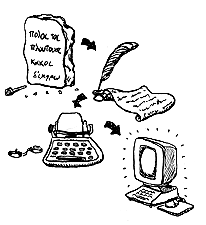
Illustration by Sage Stossel
Copyright © 1996 by Ralph Lombreglia. All rights reserved. Used by permission.
The complete text of this essay appears in Tolstoy's Dictaphone: Technology and the Muse (Graywolf Forum One), edited by Sven Birkerts. Minneapolis, MN: Graywolf Press, 1996. ISBN: 1-55597-248-9. Tel: 612-641-0077
 |
 |
 |
 |
 |
 |