


Return to this issue's Table of Contents.
M A R C H 1 9 9 9
 MERICA'S war against Germany, like its war against Japan, began at sea, and began just as badly for the poorly prepared United States. The Battle of the Atlantic, which had pitted Britain against Germany since 1939, was a contest for supremacy on the ocean highway across which all American supplies and troops must flow to Europe. Everything depended on keeping that highway open. Dwight Eisenhower, newly promoted to brigadier general and freshly installed as chief of the Army's War Plans Division, submitted a penetrating assessment of the importance of the North Atlantic sea-lanes to George Marshall on February 28, 1942. "Maximum safety of these lines of communication is a 'must' in our military effort, no matter what else we attempt to do," Eisenhower emphasized. Shipping, he presciently added, "will remain the bottleneck of our effective effort," a statement that echoed repeated pronouncements by both Churchill and Roosevelt that the struggle with Hitler would be won or lost at sea.
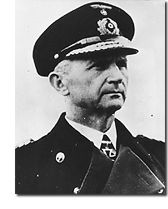 |
| Karl Dönitz (Photo courtesy of The National Archives) |
U-Boat.net: The U-Boat War 1939-1945
Photos, maps, descriptions of battles, profiles of commanders, and more.
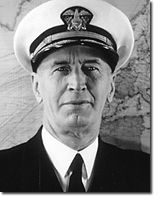 |
| Ernest J. King (Photo courtesy of The National Archives) |
To counter the U-boat menace King could at first do little. In Roosevelt's quaint phrase, there was simply a "lack of naval butter to cover the bread." The U.S. Atlantic Fleet was already hard pressed to shoulder its modest share of the burden of escorting North Atlantic convoys, and the sudden flaring of the Pacific war consumed virtually all new naval construction. The entire anti-submarine force available to the Eastern Sea Frontier command when the German sub offensive began consisted of three 110-foot wooden sub-chasers, two 173-foot patrol craft, a handful of First World War-vintage picket ships and Coast Guard cutters, and 103 antiquated short-range aircraft, almost none of them equipped with submarine-seeking radar. For a time this puny fleet was supplemented by the Coastal Picket Patrol, or "Hooligan Navy," a motley flotilla organized by private yachtsmen (including a pistol-and-grenade-toting Ernest Hemingway at the helm of his sport-fishing boat Pilar). They formed a swashbuckling but decidedly amateurish patrol line some fifty miles offshore, reporting countless false submarine sightings that caused further dissipation of the Eastern Sea Frontier's desperately scant resources.
In an ironic reversal of the Lend-Lease help that America had extended to Britain a year earlier, the Royal Navy transferred ten escort vessels and two dozen anti-submarine trawlers to the Americans for coastal defense, along with two squadrons of aircraft. In a compound irony, the planes had originally been built in the United States. But even as the Eastern Sea Frontier began to accumulate the rudiments of an anti-submarine force, King persisted in deploying it badly. Contrary to all the hard-won lessons of the North Atlantic naval war, King clung to the belief that inadequately escorted convoys were worse than none, because they made for concentrated targets, only thinly protected. In consequence, merchant ships continued to sail independently, making easy prey for single submarines, while the handful of vessels that the Eastern Sea Frontier could muster to protect coastal shipping were dispatched together in futile pursuit of frequently phantom sightings. King's stubbornness infuriated his colleagues. King was "the antithesis of cooperation, a deliberately rude person ... a mental bully," Eisenhower noted in his diary. "One thing that might help win this war is to get someone to shoot King."
When King finally relented and in May organized a convoy system along the Atlantic coast, the results were dramatic. Just fourteen ships went down in the Eastern Sea Frontier that month, a sharp decline from the winter's disastrous rates of loss. Dönitz's boats continued to prey on Caribbean shipping for another two months, but by the summer of 1942 the Interlocking Convoy System protected coastwise sailings from Brazil to Newfoundland. At the end of July, Dönitz withdrew his last two U-boats from North American waters. Paukenschlag was ended. It had dealt a grievous blow to American shipping and measurably slowed American mobilization, not to mention wounding the pride of the U.S. Navy, but it had been stopped short of catastrophe. The Eastern Sea Frontier was secure.
If Dönitz had retired from the American coastline, it was merely to concentrate his forces in the mid-ocean zone where the Battle of the Atlantic was now most fiercely joined. After re-allocating the last of the U-boats from the Paukenschlag, Dönitz had well over 200 submarines available for deployment in the broad Atlantic. German boatyards were adding at least fifteen new submarines to his fleet every month. Against those growing numbers Dönitz tallied his estimates of Allied carrying capacity and replacement rates. If he could sink 700,000 tons of Allied merchant shipping a month, he calculated, victory would be his: Britain would face starvation, Russia defeat, and America permanent isolation on the far side of the Atlantic. By mid-1942 success seemed to be at hand, as worldwide Allied shipping losses exceeded 800,000 tons a month. Despite frantic round-the-clock construction in both British and American shipyards, new Allied shipbuilding could not offset deficits on that scale. For 1942 as a whole, the Germans sank more than eight million tons of U.S. and British shipping, a loss that threatened to rob the Allies of their war-making power if not soon reversed. "The U-boat attack was our worst evil," Churchill later wrote, "the only thing that ever really frightened me during the war."
Cruising in packs of a dozen or more, the U-boats inflicted damage that only grew more costly as 1942 unfolded. The Allied convoys were typically composed of ten columns totaling about sixty vessels, mostly American merchantmen carrying mostly American cargoes. They slogged eastward at eight or nine knots, loosely jacketed by as many as a dozen warships, almost all of them British or Canadian, weaving warily around their flanks. (The U.S. Navy provided just two percent of the escorts in the North Atlantic.) When aided by aerial reconnaissance, the escorts had a fighting chance of harassing the U-boats away from the convoy's path. But once a submerged wolf pack had closed undetected to torpedo range, it could wreak wholesale destruction on convoy and escorts alike. The U-boats naturally concentrated, therefore, in those ocean areas out of range of Allied aircraft. There they could steam with impunity on the surface, diving only for the final attack. They especially favored two locations: the Norwegian Sea, the far northern passage to the Russian ports of Murmansk and Archangel; and the "air gap" southeast of Greenland, through which all convoys to both Britain and Russia had to pass. One combined surface, undersea, and air attack on the Russia-bound convoy PQ17 in the Norwegian Sea in July forced the escorting warships to separate from the convoy, and then scattered and sank twenty-two of the thirty-three merchantmen, an especially large loss. In August and September, U-boats attacked seven convoys in the Greenland air gap and sank forty-three ships. In November total Allied losses again topped 800,000 tons, 729,000 of which fell to the U-boats.
Nature added to the Allies' woes in the man-and-ship-eating North Atlantic. Blast-force winds, towering green seas, snow squalls, and ice storms claimed nearly a hundred ships during the winter of 1942-1943. In March of 1943 a screaming gale slammed two convoys together, chaotically scrambling their sailing columns and wreaking wild confusion among their escorts. Dönitz capitalized on the disruption by dispatching several wolf packs to feed on the havoc. At a cost of just one U-boat lost, twenty-two merchantmen were sunk out of the ninety that had set sail from New York a few days earlier, along with one of the escort vessels.
At these rates of loss the Atlantic lifeline might soon have been permanently severed. In fact, the disaster of PQ17 contributed to the Western Allies' decision to suspend all North Atlantic convoys to the Russians for the remainder of 1942, triggering bitter complaints from Stalin. (The alternate but much-lower-capacity supply route to Russia, through the Persian Gulf and overland from Iran, remained open.) As for Britain, the sinkings in the Atlantic had by year's end cut its civilian oil reserves to a three-month supply, and imports of all kinds had withered to two thirds of pre-war levels.
The online version of this article appears in five parts. Click here to go to part one, part two, part three, part five.
David M. Kennedy is the Donald J. McLachlan Professor of History at Stanford University. His article in this issue will appear, in slightly different form, in his book Freedom From Fear: The American People in Depression and War, 1929-1945, to be published by Oxford in May.
Illustrations by Laszlo Kubinyi
Copyright © 1999 by The Atlantic Monthly Company. All rights reserved.
The Atlantic Monthly; March 1999; Victory At Sea; Volume 283, No. 3; pages 51-76.
 |
 |
 |
 |
 |
 |