


Return to this issue's Table of Contents.
M A R C H 1 9 9 9
 DMIRAL Chester W. Nimitz wasted no time in using Rochefort's information, which proved to be the single most valuable intelligence contribution to the entire Pacific war. A descendant of German colonists who had settled the west-Texas Pedernales River country early in the nineteenth century, Nimitz was a quiet, scholarly man, fluent in his ancestral tongue. He sought relaxation by firing his pistol on a target range. He had arrived in Hawaii to take up the position of commander in chief of the Pacific Fleet on Christmas morning, 1941. The whaleboat ferrying him from his seaplane to shore had passed the devastated hulks along Battleship Row and threaded through small craft that were still retrieving surfacing bodies from the sunken ships. As much as any man in the Navy, Nimitz burned to retaliate for December 7. But in what his naval-academy class book described as his "calm and steady Dutch way," he was determined to do it methodically, with a minimum of risk and more than a fair chance of success. Rochefort's cryptanalysts had now handed this careful, deliberate man a priceless opportunity.
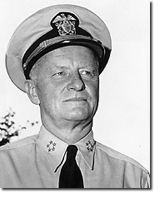 |
| Chester W. Nimitz (Photo courtesy of The Naval Historical Center) |
While the three American carriers stealthily moved to their stations northeast of Midway, Nagumo approached from the northwest. The Japanese commander had good reason to assume that only the Enterprise and the Hornet remained afloat in the U.S. Pacific fleet, and he believed them to be in the South Pacific, where they had been spotted on May 15. As dawn approached on June 4, Nagumo had no inkling that Fletcher and Spruance awaited him beyond Midway, over the eastern horizon. All his attention focused on Midway Island, from which B-17s and Catalina flying boats had ineffectually bombed his troop transports during the preceding afternoon and night.
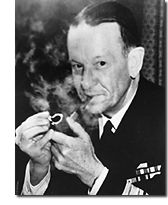 |
| Frank Jack Fletcher (Photo courtesy of The Naval Historical Center) |
Even as Nagumo's perspiring sailors set about their task, Spruance, still to the northeast of Midway, was ordering full deckloads of bombers and torpedo planes on the Enterprise and the Hornet to lift off and strike the Japanese carriers. Nagumo's seamen toiled about the decks of his giant carriers, shuffling bomb-racks and hurriedly stacking torpedoes. Then, in the midst of the complicated rearmament operation, the Japanese cruiser Tone's scout plane reported at 7:28 that ten enemy ships were in sight. Their position was within range of carrier-based aircraft, but the initial report did not identify the types of ships. Nagumo nevertheless decided as a precaution to halt the rearmament process. Meanwhile, he implored the reconnaissance plane to ascertain the ship types.
Nagumo's skull must have throbbed with the agonies of decision and command. He was still under attack from Midway-based aircraft; his own returning assault planes were beginning to appear overhead; his decks were stacked with bombs of all types; and an unexpected American fleet had been spotted. Ominously, the Tone's patrol plane next radioed that the enemy flotilla was turning into the wind -- the position from which carriers launch their aircraft. Apprehension gripped the surprised Japanese, only to be allayed moments later by a report that the enemy flotilla consisted of five cruisers and five destroyers -- and then to be revived by a message minutes afterward that the rising dawn had revealed a carrier in the rear of the American formation.
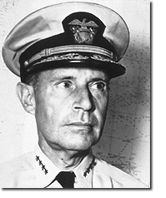 |
| Raymond A. Spruance (Photo courtesy of The Naval Historical Center) |
Emboldened by such thoughts, the Japanese now saw the American carrier less as a threat than as an opportunity for inflicting additional punishment on the inept Americans. The battle thus far had emphatically confirmed Japanese combat superiority. Apprehension gave way to resolve -- and to a fatal relaxation of the sense of urgency. Nagumo, confident that he held the upper hand, calmly waited to recover all his Midway bombers and fighters before magisterially turning to meet the American flotilla, still believing that only a single carrier confronted him. Meanwhile, he reversed his earlier rearmament order and directed his planes to be fitted with anti-ship weapons once again, adding to the confusion and the piles of explosive ordnance strewn about his flight decks.
Shortly after 9:00 A.M. Nagumo executed his change of course to close with the American fleet, perhaps even to force the decisive battle that was the stuff of the Japanese navy's dreams. What followed was decisive, all right, but for Japan and the imperial navy it was a nightmare.
Nagumo's several armament changes and his delay in seizing the initiative contributed powerfully to his undoing, but for the moment his change of course proved advantageous. Many of the American planes launched from the Hornet and the Enterprise, along with some from the Yorktown, which had put its airmen aloft at around 8:30, never found him. Flying at the limits of their operational range, they arrived at the sector where the Japanese were supposed to be, only to look out over empty seas. Many wandering American aircraft fell from the sky for want of fuel. Those who did locate the Japanese fleet tried in vain to penetrate the curtain of anti-aircraft fire and the swarming Zeros to reach the Japanese carriers. Shortly after 10:00 A.M. a clutch of Zeros almost completely annihilated a torpedo-bombing squadron from the Yorktown as it came in low to launch its weapons. By 10:24 Nagumo appeared to have beaten off the last of the attacks. His proud fleet was still unscratched and was poised to loft a counterattack against the American fleet. For a brief moment Japan seemed to have won the Battle of Midway, and perhaps the war.
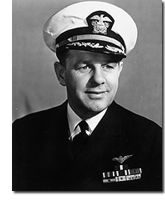 |
| Wade McCluskey (Photo courtesy of The Naval Historical Center) |
In five minutes the dive bombers, no less miraculously scoring the first American hits of the day, mortally wounded three Japanese carriers. Roaring gasoline-fed fires raged through all three ships. The Kaga and the Soryu sank before sunset. The Akagi was scuttled during the night. Of the First Air Fleet's magnificent flotilla of carriers, only the Hiryu remained to strike a counterblow against Fletcher's flagship, the battered Yorktown, which the sea enveloped at last at dawn on June 7. The Hiryu itself was overtaken by American fliers in the afternoon of June 4, and sank the next morning. Nagumo had lost four of the six carriers with which he had attacked Pearl Harbor just half a year earlier. Spruance wisely refrained from pursuing the remaining Japanese vessels, which were retreating to the west, where he would have collided with Yamamoto's battleships -- swift, powerful, night-trained, and thirsty for vengeance -- just as darkness fell.
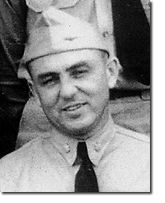 |
| Maxwell Leslie (Photo courtesy of The National Museum of Naval Aviation) |
The online version of this article appears in five parts. Click here to go to part one, part two, part four, part five.
David M. Kennedy is the Donald J. McLachlan Professor of History at Stanford University. His article in this issue will appear, in slightly different form, in his book Freedom From Fear: The American People in Depression and War, 1929-1945, to be published by Oxford in May.
Illustrations by Laszlo Kubinyi
Copyright © 1999 by The Atlantic Monthly Company. All rights reserved.
The Atlantic Monthly; March 1999; Victory At Sea; Volume 283, No. 3; pages 51-76.
 |
 |
 |
 |
 |
 |