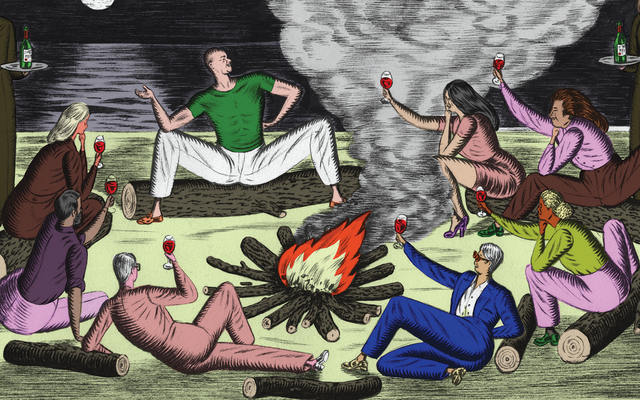
Everyone always talks about how being intoxicated is a boon to creativity. That tough language exam, passed more easily with a booze-loosened tongue; that extra 1000 words of writing, jammed out in a whirl of key strokes after a couple glasses of wine. I’ve always been skeptical; no matter what college seniors and xkcd say, it seems to me that substance use is a straightforward path to stupidity.
Not so, says Sam Lewis, a Nashville artist who performed at Music City Roots in Franklin, Tennessee, last week. “I was coming off of mushrooms about two and a half years ago,” he explained in the middle of his set,
... And I was hanging out with a real good friend of mine, a neighbor at the time, and I had gone on a physical trip prior to that one, a few days before, and he had asked me where I'd been and I told him, as best as I could, where I had gone, before where I was then, which I'm still trying to figure out, where I was at that time, where I was when I was telling him... You following me, right?
Lewis, with his Avett Brothers-style beard and mountain-man hair, easily pulled off this straight-faced joke in a room full of Tennessee grandmas. Props. He continued:
Well I must have said something, because he told me I needed to write that down. And he had to teach me how to write again all over, but we got it down. Found it a couple of weeks later in a pair of jeans. And I had to look at it, the piece of paper, in the mirror, because it was, of course, written backwards. But I had some words on it, and I had been digging pretty hard on Willie Nelson's ‘Red-Headed Stranger’ at the time, and this is what came out the other side.
For a song that was almost lost to the laundry, “Never Again” is impressive. And Lewis might be messing around, anyways—it’s not nearly as trippy as you might think.
We don’t tend to think of the latter months of the year as a time of renewal—save that for January, just maintain your personal status quo for now.
But in late 2008, Britney Spears was in the midst of her rise from the hair-clumped ashes. On this very day, Spears released the track for “Circus,” the second single off her album of the same name, adding to the momentum of “Womanizer” just a couple months before.
The album’s premiere had prompted high hopes from a disappointed fanbase that their pop queen was back—no, for real this time. Look no further than the “If Britney can survive 2007, then you can make it through this day” meme (get the gist of it here) for evidence of the depths to which Spears had fallen from grace.
Her previous comeback attempt in late 2007 was, well, kind of sad. Oh man, the gross hair extensions and fake tattoos in the “Gimme More” video (though let’s be clear, the song itself remains a workout jam), the utter mess of her VMA performance? Woof—tragic for those of us who reached peak screaming fanaticism—a period known as “middle school”—at the time of her late-’90s debut.
With the new tracks off Circus, it was a relief to see Spears in a more glamorous light, sparkling and actually dancing like the modern Mickey Mouse Club veteran she is. Knowing ol’ Brit Brit (sorry) was doing better gave us space to once again revel in her trademark vulgar lip-synching—with graphic tongue use for maximum seduction, I guess? We need to talk about those “L”s.
On World AIDS Day, and from a list of 15 songs about the disease:
The Pet Shop Boys might be the pop-music act with the most (and earliest) nods to the ravages of AIDS in their songs. “Dreaming of the Queen,” which Neil Tennant called “an anxiety dream” about the disease, stands out for its lush orchestral backing and sad hook sung in the guise of Princess Diana: “There were no more lovers left alive/And that’s why love had died.”
John Byrne wrote an excellent essay for us today about his experience testing positive while on PrEP—but his story has an unexpected turn and is worth reading in full. One reader criticizes the implied assumption that “sexually active Americans should be prescribed a preventive medication that costs $18,000/yr, for no other reason than that they want to enjoy sexual gratification with multiple partners without constraint.” Another rightly retorts:
It’s not “for no other reason.” It’s to stop HIV transmissions, which cost the U.S. and the world much more in lost wages, increased medical costs, and general human misery. Taking PrEP is responsible behavior. It’s near perfect at preventing HIV transmissions. The mandatory quarterly STI checks to obtain PrEP identify and treat other infections should they occur, thus preventing any further transmission.
Your thoughts, or personal experience, on PrEP? Drop me an email.
Never, ever say 66-year-olds can’t jam. Jimmy Hall, the lead singer of the 1970s Southern rock band Wet Willie, has been working the Nashville music business for more than four decades. He’s toured with Hank Williams Jr., won a Grammy nomination, and is now playing with the band Jimmy Hall & Friends. In the track above, “That’s the Truth,” he shows off his incredible harmonica skills, along with some sassy microphone-cord dance moves and a head-shake-inducing musical range. Hank needs to be watching—if this is his back-up band, he’s going to have to step up his game.
I really love this song because I completely understand the concept of a “winter slide,” it happens to me every year, most poignantly last year. I can really relate to “this side of me that wants to grab the yoke from the pilot and just fly the whole mess into the sea.” Sometimes I am scared by a dangerous, harmful part of myself, too.
Says another:
According to James Mercer, this song is about being optimistic and not overanalyzing. Look at this interview: “The album title is taken from the fourth track, ‘Young Pilgrims’, James explains that the underlying theme of this record is about, ‘how your own thought processes can needlessly get you down when you should just learn techniques to fucking get over it.’”
Have a track to recommend for the feature? Drop us an email. The archive is here.
Spurred by Megan’s new piece on the political dissent imbued in the song “Edelweiss,” a reader writes:
I had the privilege of interviewing Theodore Bikel [the actor and folk singer who played Captain von Trapp in the Broadway version of “The Sound of Music”] for a half hour last February. He still had a strong voice (and strong opinions) at age 90, sang and played the guitar beautifully, and seemed to be in possession of all of his faculties … I never would have guessed that he would be dead less than six months later.
He told me the story of how “Edelweiss” was written especially for him to take advantage of his folk-singing talents, and it was introduced into the show less than two weeks prior to its Broadway opening. (It’s such a crime that he wasn’t cast in the movie, especially since Christopher Plummer detested the song and wanted it cut.) I have a feeling Bikel would have approved of this characterization of the song, since he was a fierce champion for human rights and frequently sang as a form of social protest. He was jailed both for marching in Alabama with Dr. King while singing “We Shall Overcome” and for singing Yiddish and Russian songs in front of the then-Soviet Embassy to protest the USSR’s treatment of Jews. (Of course, he also played Tevye in Fiddler on the Roof, Worf’s adopted father on Star Trek, the German officer who questions Humphrey Bogart and Katherine Hepburn at the end of The African Queen, and many many other roles.)
He told me the story of how one fan greeted him at the stage door saying “I love that song Edelweiss—of course I only know it in the original German.” I will never forget Bikel’s Yiddish-inflected facepalm as he told me that.
Here’s a rough recording of Bikel singing “Edelweiss” as an old man. Above is a more upbeat performance of him singing “Kretchma,” a boisterous Russian drinking song.
Have a track to recommend for the feature? Drop us an email. The archive is here.
Shifting bassline cadences pulled from the P-Funk playbook, a spaced-out Gospel choir, triumphant modal guitar solos—“One," the latest from Esperanza Spalding, is unlike anything the singer/bassist has put together before. It’s a prismatic blast of neo-soul, played by a virtuosic power trio that’s informed by jazz yet transcends it.
Have a track to recommend for the feature? Drop us an email. The archive is here.
Regarding Sophie’s review of Enya’s first album in seven years, a reader confesses:
I like Enya. There, I’ve said it. Back in the ‘90s and early 2000s, when my daughter was little and my now-frail mother was still able to travel, we found that Enya was one of the few current recording artists we could all agree on, and thus she became the soundtrack to some wonderful road trips. I associate her soothing music with some wonderful memories.
Another reader:
Enya isn’t aiming for the higher cognitive centers of our minds. She found a knob for turning down the old animal parts of us where panic and anxiety and fear and anger are generated. Enya is selling musical Prozac. The good news it’s effective, cheap, nonaddictive, and possesses the mildest of side-effects. When we snap out of it after listening to their music for a while, we realize how simplistic and contrived it is. But we like it anyway because our brain stems are soothed.
A superfan delves deep:
Before starting, let me warn that this may lead to confusion.
When I write Enya, I refer to the Aigle Trio, the creative triumvirate behind the concept of Enya; and when I write Eithne, I refer to the person, to the singer-songwriter (as that is her actual name, without phonetic adaptations:)
The real issue is that people tend to think that Enya’s music is meant to be played during moments relaxation and yoga sessions because the melodies that Eithne herself composes and plays have that mystical aura, giving boost to the “soothing” effect that many claim to like in the music she creates, along with Nicky and Roma Ryan. This is plain wrong, in my opinion.
As someone who has been faithfully following her musical record since her breakthrough album Watermark, I have learned two important lessons: prepare myself to patiently wait between releases (taking said time to analyse to death every song they have done up to that point, in order to gladly categorize myself as an Enya fan) and to never give a judgement on a song from the Aigle Trio before having listened to it at least 50 times.
When I have hit the 50 listenings mark, I can elaborate a full-fledged opinion on a track. There are exceptions, clearly. The track “Diamonds On The Water,” from Dark Sky Island, hit me directly in the center of my grown heart as soon as I heard it start, as if the Enya equivalent of Cupid shot an arrow!
The music that we know as Enya’s is just timeless. As I listen repeatedly to “The Celts” today, many will listen to “Echoes In Rain” in, say, 50 years. Why? Because there are still people who are able to properly understand what Eithne, Nicky, and Roma are trying to express and what feelings they want to convey. Enya’s music is so complex compared to any other artist out there. I have bought Adele’s new album and I enjoyed it, but I just cannot compare the work that has been done on 25 to the work that has been done on Dark Sky Island. Three people, working intensely for three long years to deliver such a polished and shiny product ... the music we call Enya is simply too difficult for many to grasp, because of the melodic, lyrical, vocal, instrumental, thematic complexity that this kind of music involves.
You may hear songs about love, others that flow around nature, more that refer to ancient times and cultures, other that engage in reminiscences of the past. It is not something similar to what we hear today, and we did not even hear something like that in the past. In a world were constant up-tempo and wearily repetitive songs about heartbreak (and other topics such as drugs, sex, parties) are considered music, Enya’s music is a breath of fresh air.
And no, it is not because the music is relaxing and soothing, but because it makes us sit down, slow down, stop doing anything we are doing then and reflect. Enya's music is about reflection. Reflection on ourselves, on our emotions and feelings, on our past, present and future, on our journeys, on the people who surround us.
It is not New Age music; it is a style on its own. Inimitable and unique. Even though many will always state that her music is repetitive, it is a problem of those who do not want to listen and see how different each track is. There are differences and a great evolution, but not noticeable for those who only seek easy-to-listen music.
Have a nice everyone! :)
One more reader:
Enya fans might also enjoy Cecile Corbel and Mari Pokinen. Both of those have the added benefit of being in languages Enya fans won’t understand.
A reader recommends a recent track from Old Man Luedecke, “the recording name of two-time Juno Award-winning Canadian singer-songwriter and banjo player Chris Luedecke of Chester, Nova Scotia.” It’s a sweet, soothing song for a lazy Sunday.
A reader plugs a new performance from “the Austin-based throwback soul nine-piece band The Nightowls”:
It’s off their latest album Fame Sessions, which they recorded at the legendary Muscle Shoals-based Fame Studios, which has previously been home to landmark records by a large number of Southern soul icons including Aretha Franklin and Wilson Pickett. The pilgrimage from Texas to Alabama to record the album also fueled and inspired the sound and some of the songs too.
Have a track to recommend for the feature? Drop us an email. The archive is here.
I was talking to a friend about Chicago-style hot dogs the other day—about their glory, about their enigma.
If you happen to be unversed in American Regional Frankfurter, please know: Chicago-style dogs are a magnificent foodstuff. Yet their paradox is that their obvious salivary splendor arises from an ingredient list that is, and I think this is universally agreed upon, super gross. Like it’s just hideous. Every Chicago dog comes topped with yellow mustard the color of HAZMAT suits; with uranium-green sweet pickle relish; with “sport peppers,” which are a type of vegetable that comes in jars and is the same color as khakis; with an entire pickle (?!); and with a dash of celery salt.
I don’t know where you get celery salt—perhaps it magically appears as you begin to craft a Chicago dog. I don’t even know whether sport peppers or celery salt exist as comestibles beyond northeastern Illinois. But on a hot dog, and combined with the alchemy of those other ingredients, they’re resplendent.
So it is with this Carly Rae Jepsen cover. Tingly drum machines, a smoky alto saxophone intro, and the singular songwriting skills of 1985-era George Michael—I mean, normally I wouldn’t be particularly into it. But put them all together into this new cover of “Last Christmas” and it’s something else. And those Haim guitars!