Reporter's Notebook

Sage, Ink
Show Newer Notes

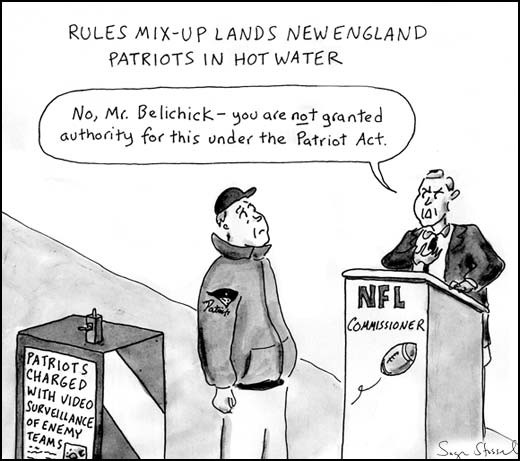
This cartoon was originally posted in October 2013 as Boehner faced the dilemma of reopening the government and avoiding default on the national debt (thereby risking his speakership) or appeasing hard-line GOP lawmakers in the House and safely preserving his role.
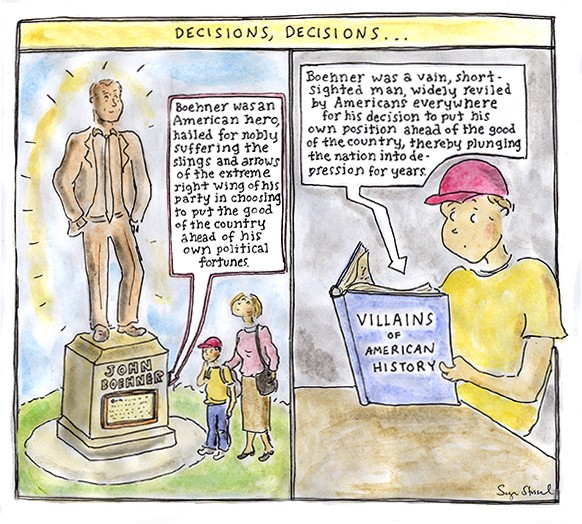
Two years later, it again seems relevant as Boehner yields his position and negotiates a bipartisan budget deal on his way out, thereby avoiding a government shutdown and raising the debt ceiling until 2017—allowing his successor Paul Ryan to take over with, as Boehner puts it, “a clean barn.” Russell has more:

The budget deal that John Boehner struck in his final days as House speaker is certainly a political gift to Paul Ryan, but you’ll have to forgive Ryan for showing a lack of appreciation. “I think this process stinks,” the speaker-in-waiting reportedly harrumphed as he walked into a meeting where Republicans were briefed about the 11th-hour agreement. “Under new management, we are not going to run the House this way.”

Well played, congressman. Ryan offered no opinion on the substance of the two-year pact, which increases federal spending by $80 billion and raises the debt ceiling, but his harsh assessment of how it came together was a necessary bit of political theater aimed at the group of conservatives [House Freedom Caucus] who have been most wary of his ascension to the speakership.

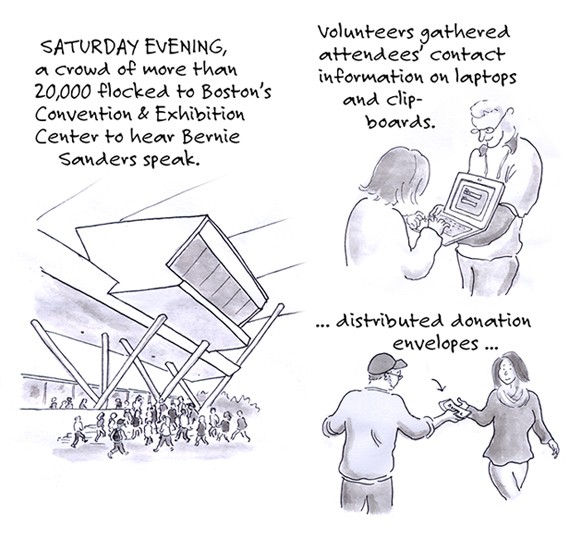
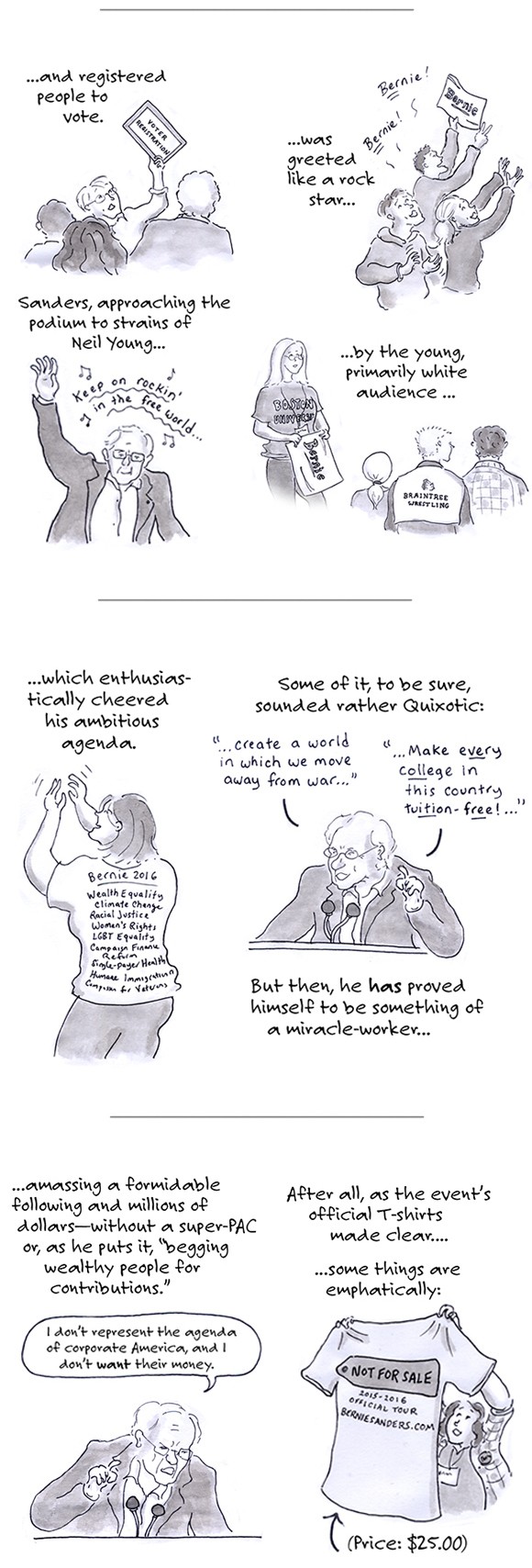
This weekend, having just read about Sanders’ impressive fundraising figures and heard that he was coming to Boston, I decided to make my way over to the rally to get a look at the candidate and his supporters:

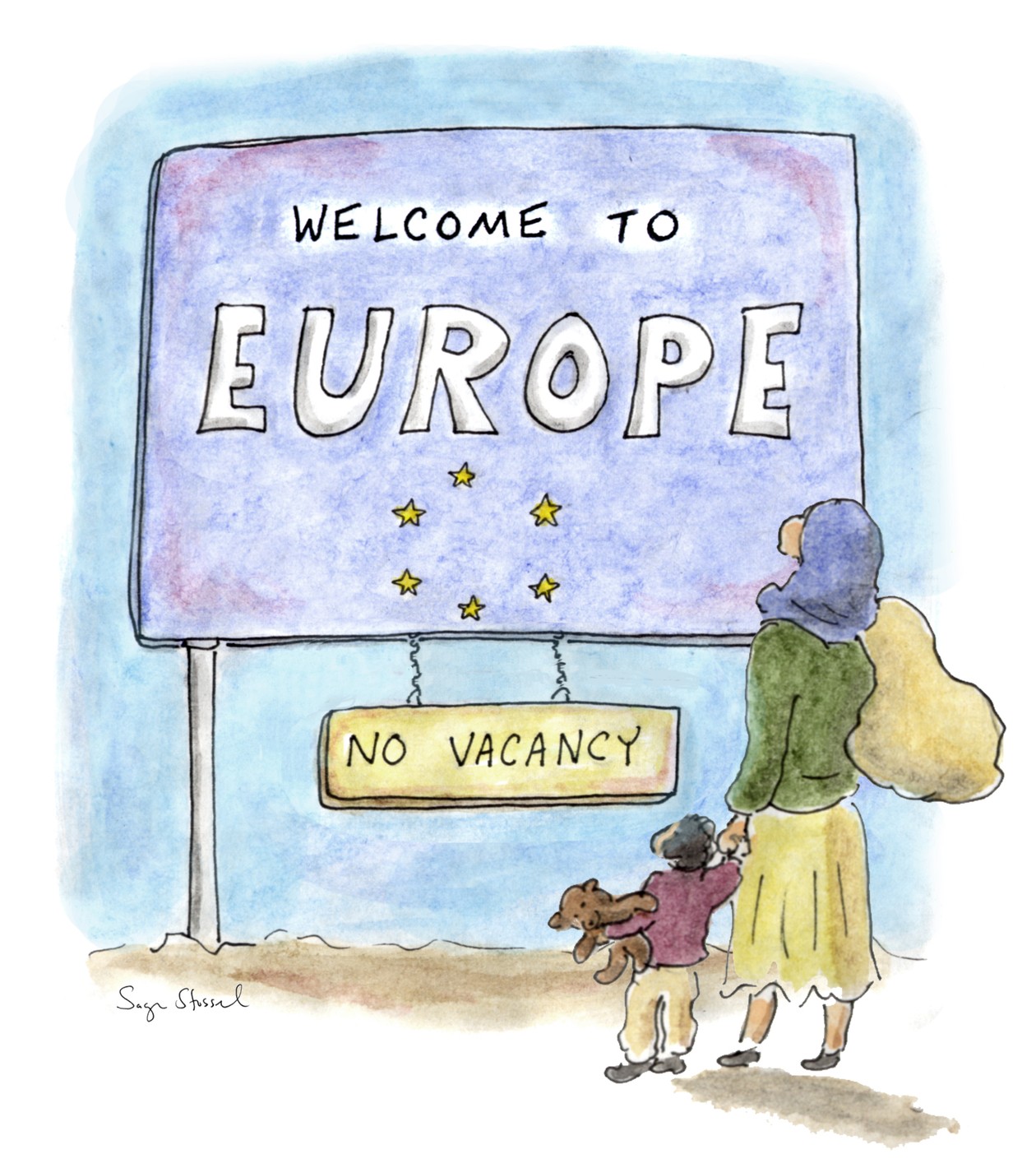
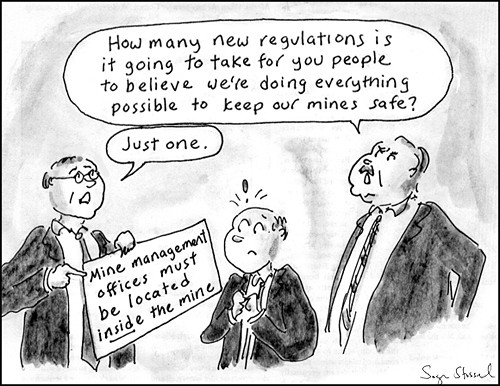
One of my favorite things about our nascent Notes section is its ability to feature more work from Sage Stossel, our long-time contributing editor and resident cartoonist. Her watercolors and clever wit bring real character to Notes as it slowly gels. Here’s Sage’s latest:

Speaking of Boehner, check out Marina’s writeup of his appearance on Face the Nation yesterday, in which he talks about yoga, among other matters. And many readers are discussing Boehner’s political eulogy written by Molly. One insists that he “always had an alternative”:

Boehner could have chosen to be the Speaker of the entire House, instead of what amounted to a leader of a hopelessly divided party. Had he done so he could have passed compromise legislation on a raft of issues with bi-partisan votes and left his lunatic fringe out there the stomp and scream by themselves. Instead, by sticking to a “majority of majority” framework, he allowed his extremist members to dominate the business of the people's house.

Another reader agrees:

Yeah, the failure of this article to mention the Hastert rule is surprising.

(Basically, it's an internal rule the Republicans adopted that says a majority of the GOP legislators have to approve something before it goes up for a vote.) So there were plenty of times Boehner could have passed budgets, but only with some Democratic votes.

But of course, if he did that, he would have lost his Speaker chair long ago. You have to dance with them who brought you, and as head of the Republicans in the House, he had to dance with the crazies.

Another reader doesn’t see as much of a separation:

Although Boehner actually wanted the place to function, he was still very conservative. Not an insane idiot like other members of his caucus, but still very conservative. For instance, he made sure there were zero votes for the stimulus—during the greatest economic crash since 1929.

This reader circles back to the first one:

Actually Boehner often did craft compromise legislation and utilized Democratic lawmakers to get need-to-pass bills through over the bloody-murder screams of much of his party. Hence why every right-winger in America is jumping with glee right now. I had tremendous respect and sympathy for the man, given what he was working with. He did the best he possibly could while leading a half-mad caucus, short of switching parties.

If you’re a Democrat, you weren’t likely to think highly of him anyway. But as a moderate Republican who is well-acquainted with the echo chamber crowd, I have to say he didn’t do all that bad.

For more on Boehner’s struggle with the right wing of his party, check out Norm Ornstein’s new piece.

Hajj stampede: More than 200 people have been killed and another 450 injured in a stampede near Mecca, Saudi officials say. Millions of Muslims are participating in the pilgrimage to Islam’s holiest city. Today’s incident comes just weeks after a crane collapse at Mecca’s Grand Mosque killed 109 people and injured about 400 others. Update: More here.

Migrant crisis: EU leaders meeting in an emergency summit have failed to agree on a common policy to deal with Europe’s worst migrant crisis since World War II. But they did agree to give U.N. agencies who work with Syrian refugees about $1.1 billion. UNHCR welcomed the money, but expressed disappointment that “no further measures have been proposed to create more legal pathways for refugees to reach safety in Europe.” Update: More here.

Papal visit: Pope Francis will become the first pontiff to addresses Congress today. He then heads to lunch with the homeless organized by Catholic Charities outside Washington’s St. Patrick’s Catholic Church. Francis leaves the nation’s capital this evening and heads to New York.

VW’s CEO is out: Martin Winterkorn said he was unaware of the emissions scandal involving 11 million diesel cars, but was stepping down for the good of the company.

The pope is in: Speaking at the White House, he touched on immigration and called for more to be done on climate change. Priscilla has more on how Francis was welcomed while David noted the political aspects of the pontiff’s remarks.

Hack estimate is up: The Office of Personnel Management says it underestimated the number of people whose fingerprints were stolen in a data breach. The federal agency’s new number, as Marina points out, is 5.6 million—up from 1.1 million.  

This week, the European Union settled on a deal to handle the largest refugee crisis the continent has faced in the last century. There’s a big difference, though, between outlining a plan to accommodate 120,000 people fleeing their countries, and actually putting it into practice.

So far in covering this story, we’ve looked at economic elements, as well as the scale of the crisis and human voices involved.

What else would you like to know? What can The Atlantic dig into to help you understand the complexities at play?

Tell us here.

* * *

Here’s what we’ve answered so far: Is the European Union doing anything to take in more refugees? What’s the U.S.’s role? Why aren’t we taking in more refugees? What’s the impact on employment in receiving countries?

More Notes From The Atlantic
  • Notes Home