Reporter's Notebook

America by Air
Show Newer Notes
Jeff Goudy

Our reader Jeff captures the transition to summer:

I’ve really enjoyed your America by Air series and thought I’d share this shot from my flight into Denver [on Saturday]. Longs Peak is a very significant mountain in Rocky Mountain National Park, in the Front Range of Colorado, and to anyone who enjoys the beauty of 14,000 ft. mountains. It isn’t as prominent in the shot as it is when viewed from Denver, but its famous East Face is clearly visible.

We don’t have much about Rocky Mountain National Park in our archives, but a little passage popped out at me from an October 1998 piece from Erika Krouse on being single at weddings:

Sam visited me in September, and I drove him to Rocky Mountain National Park. Sam wanted pictures of elk, bighorn sheep; he wanted a mountain lion. I pulled the car over for every herd of animals. Sam jumped out with his point-and-shoot every time. He paused. The elk stared right at him. The bighorn sheep tossed its big head in Sam’s face. One after another, the animals stood still and then finally leaped away, disgusted, as Sam lowered his camera. “Missed it.”

But Jeff didn’t miss that mountain goat on the tip of the wing. Previous animals on planes here. Update from Jeff:

I wish I could say that view of the mountain goat was clever and intentional. It’s just a happy accident. Ironically, mountain goats aren’t native to Colorado. They were introduced to some of the ranges here in the ‘60s. As a non-native species, the ones that roam into Rocky Mountain National now and then are tranquilized and relocated elsewhere. So that’s the best view of Longs Peak that a mountain goat has probably ever seen!

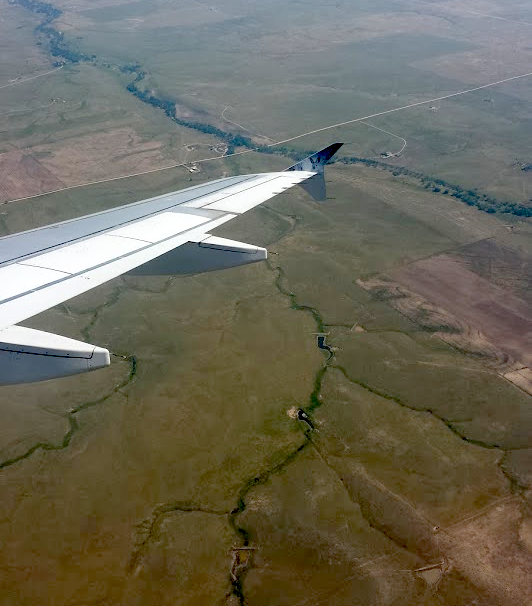
Activity into and out of Dodge City, Kansas, yesterday afternoon, out the right side of the plane looking west as we neared a landing on runway 14 on a boiling hot day. (Deborah Fallows)

My wife Deb and I have started out on the road again—northern Texas recently, now western Kansas, with a diversion to Colorado and then far southern Texas once again. Reports on substance are in the pipeline. This is a brief but meant-to-be-emphatic report on tone.

If you live in the world of national politics and especially of the presidential race, you feel bad. If you’re a Republican, you feel bad because feeling bad is the campaign theme. Donald Trump last week: “We’re not going to have a country anymore.” If you’re a Democrat, you feel bad because of the possibility that a man like Trump might win. If you’re in the media, this is your world. If it’s your world, you feel bad — as I have both documented and exhibited in my “Trump Time Capsule” and “Trump Nation” threads.

All those things do matter. One lesson of American history is that the values, the personality, the associates, the experience, and other traits of a president have consequences. So five-plus months from now, when tens of millions of Americans go to the polls, their choices for president — and Congress, and governorships, and state legislatures — will have a big effect.

But another lesson of American history is that for the great majority of the citizens outside the media or professional-politicians’ world, elections really don’t command attention until the fall. And even then, they are part of life, not the thing itself. As I mentioned in my Atlantic story three months ago, even while Deb and I were visiting areas very heavily affected by immigration over these past few years, we never encountered talk about “building a wall,” or reference to other “burning” issues in national politics at all. Conceivably this was because people felt powerless to affect national events. But more often the reason seemed to be the gap between the practical-minded possibilities of local-level compromises and solutions rather than the ritualized, hostile, zero-sum standoff that is much of national-level politics and national-level political media as well.

I’m reminded of this because right now we’re in a place — Dodge City, Kansas — that is thriving by some measures, with an unemployment level of just over 3%, yet that has serious challenges like any other city’s plus those added by the budget contortions of Kansas as a whole. But the discussions we’ve had so far, which are just beginning, have again been about the practical and the positive: what has worked, what might work better, what are the resources the community might bring to bear, what is the long-term plan.

We barely talk this way at the national level any more. But in many component parts of the country, it’s the way people still behave. As Deb and I are reminded yet again.*

Scene in the window of what was once a school, then was a municipal building, and is now the home of the new “farm to bottle” Boot Hill Distillery on Boot Hill in Dodge City. (James Fallows)

* … which makes an uplifting way to observe our wedding anniversary!

The twists of the White River, namesake of Whitewater, in Arkansas (James Fallows)

In one way or another, all Clinton-era “scandals” trace back to Whitewater. That was the late-1970s Arkansas real estate deal that prompted an investigative crusade by the NYT during Bill Clinton’s presidential run in 1992 and well into his first term. Congressional and special-prosecutor investigations followed. Whitewater was one of the matters Deputy White House Counsel Vince Foster was dealing with at the time of his suicide. It was how special prosecutor Kenneth Starr first got onto the Clintons’ trail. The strongest case that it was all a misbegotten and cynical anti-Clinton effort was made by Gene Lyons and Joe Conason in their 2001 book The Hunting of the President: The Ten-Year Campaign to Destroy Bill and Hillary Clinton. I find their argument convincing; judge for yourself.

But if you were ever wondering, where did this all happen?, I am here to help. The scene above is of a serpentine portion of the White River in central Arkansas, namesake of Whitewater, as it appeared yesterday on a steamy June afternoon, looking southward out the left window from an altitude of 4,500 feet. This part of the river, in the vicinity of Searcy, is about 100 miles south of the hillier and more wooded area where the actual Whitewater development was located. Still: White(River)water!

***

Similarly on the rivers-from-above theme, here is the mighty Mississippi, looking toward to the north yesterday out the right window. This bend is near the corner where Kentucky, Tennessee, and Missouri come together, with Arkansas not far  to the south and the southern tip of Illinois at Cairo just to the north:

Bends and sandbars in the Mississippi

And looking south toward the Red River. The area on the near side of the river is Oklahoma; on the other side, Texas.

The Oklahoma panhandle in the foreground; then the Red River; then Texas. (The light area in the lower right is a reflection from inside the plane.)

While I’m at it, a non-riverine view of Arkansas farm land, south of Jonesboro.

Looking south, near Jonesboro, Arkansas

That is all. This is in preparation for upcoming reports from Texas and Kansas.

(America by Air archive here. Submission guidelines here.)

A reader in New Jersey, Roger Zaruba, recently emailed a submission for our aerial series:

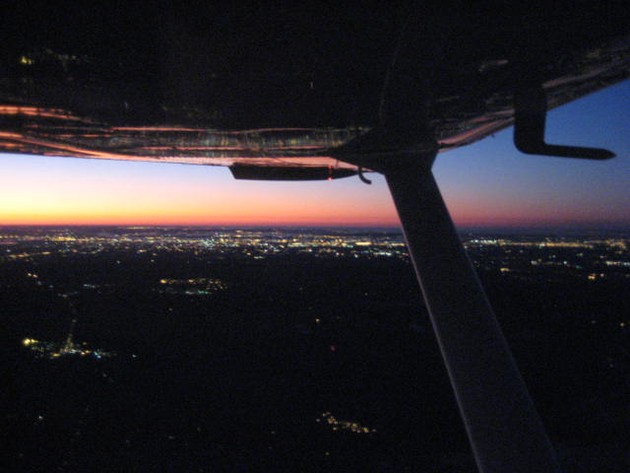
Here’s a photo taken on a sunrise trip for fuel from Essex County Airport to Central Jersey Airport in New Jersey. The view is south of Newark looking east over New York Bay and Sandy Hook out to the Atlantic Ocean from about 10 miles inland. Altitude was 2500 feet in a Cessna 182.

Unfortunately the file size for that evening shot was too small to properly post, so I asked Roger if he has a larger version. Today he replied in spades:

I went out this morning to do a little air-work and take some new pictures with my Galaxy S4. The shots are about ten times the size of the other one and I hope they are usable.

Very usable, so I sequenced several of Roger’s fantastic photos with his flight details:

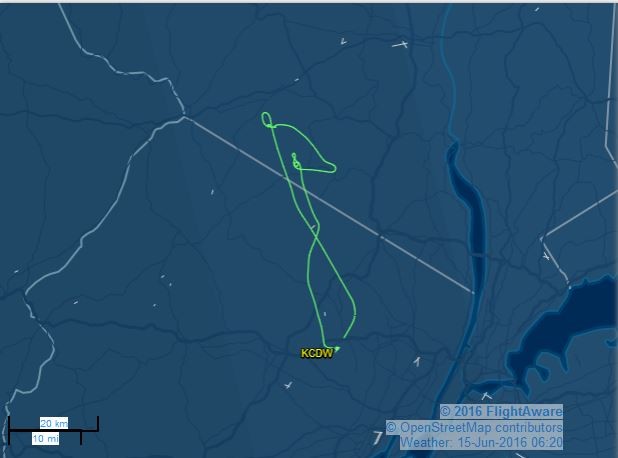
I took off from Essex County (KCDW) a hair after 0600 and headed northwest towards Greenwood Lake Airport and Greenwood Lake on the NJ/NYS border between 2500 and 3000 feet MSL.

Pinecliff Lake, just southwest of Greenwood Lake

Then I headed northwest to the onion fields, a rather well-known farming area at the NW corner of NJ going into NYS. You can see NY, NJ, and well into PA.

Onion Fields

Then I headed back home and took the shots looking SE towards NYC, and finally some contrail shots from my tie-down.

Greenwood Lake Airport

Roger adds, “I took a clip of my ADS-B flight path on FlightAware so you could see where I went”:

It kinda looks like a guy hiking with a walking stick. If you have any flight patterns of your own, accompanied with some aerial shots, please send them our way: [email protected].

Jake Wittman

Reader Jake delivers:

Hello! I saw your request for a picture from Minnesota and was excited because I was getting on a plane later. The attached photo is of the Minnesota River looking southwest towards East Bloomington and Burnsville. The Minnesota River splits from the Mississippi River a few miles northeast of this photo. You can see highway 77 crossing the river, and the smokestack in the middle is an Xcel energy plant. Closer to the plane (near 6 o’clock in the photo) you can see a water treatment plant.

A less industrial view above Minnesota comes from Luke:

Luke Timmons

I took this photo coming into land in the Twin Cities last October. It was a weekend trip from Scotland to surprise the girl who is now my wife on her birthday. I’m glad I remembered I had a photo from this flight, since it was by far the most pleasant flight journey I’ve ever taken, right down to the joy brought about by the Delta crew.  

It’s not a bird, and no, not a plane ...

Bill Ruch

The attendant informed me the jackrabbit on the wingtip is named Jake. I don’t know exactly why she felt that was important information for a 26 year old, traveling in business clothes and poring over meeting notes, but I’m glad she told me.

Bill says he captured the photo “somewhere over Nebraska,” so that makes 27 states covered in our America by Air series so far. Do you have an aerial photo from neighboring Kansas, or Kentucky, or Minnesota, or maybe Montana? Vermont—maybe from someone flying home from the Bernie campaign? West Virginia, with some country roads? From lil’ Rhode Island? Please send your photos our way and help us get to 50: [email protected]. Submission guidelines here.

Update from a reader, Dan, who makes a reference to something I thought of while posting this photo of a rabbit on the wing: the episode of The Twilight Zone when an airline passenger played by William Shatner keeps seeing a human-like creature on the wing at 20,000 feet and starts to go insane when no one else sees it. A YouTube compilation is here. Here’s the entirety of Dan’s email:

Far more terrifying than the original.

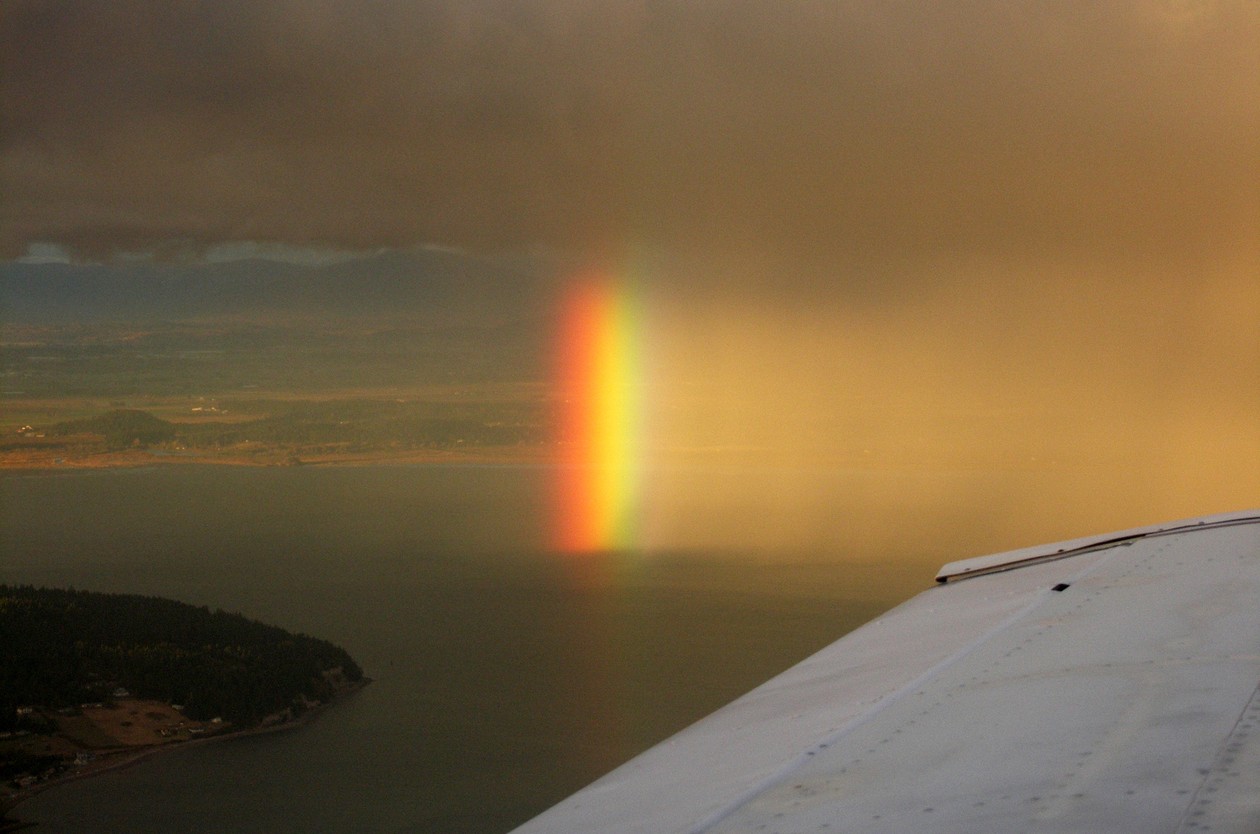
One can imagine a UFO lurking in the clouds:

Ed May

The image comes from a reader in Friday Harbor, Washington: “It’s a late-afternoon rainbow amid a rain shower while flying in the Class C airspace of Whidbey Island NAS, on Whidbey Island, WA.”

Betsy Andrews

A reader writes:

Fun series! This is actually an old photo from March 2008 flying into Barrow, Alaska. I’m a contractor/scientist at NOAA and am super lucky that I get to travel to lots of cool (and often cold) places to do maintenance on atmospheric instruments—for example, at their baseline observatory just outside the town of Barrow.

Barrow is on the north coast of Alaska, and while there’s open water in the summer, when I took this picture it was all frozen. The sea ice is the bumpy-looking snow between the wing of the plane and the town, while the snow-covered tundra is smooth.  

A previous view above the airport in Barrow is here, along with an explanation of why the area is under environmental threat. Less ominously, since May 10, Barrow has been covered in sunlight around the clock; the sun doesn’t set for three months during the summer:

Kevin Grambley

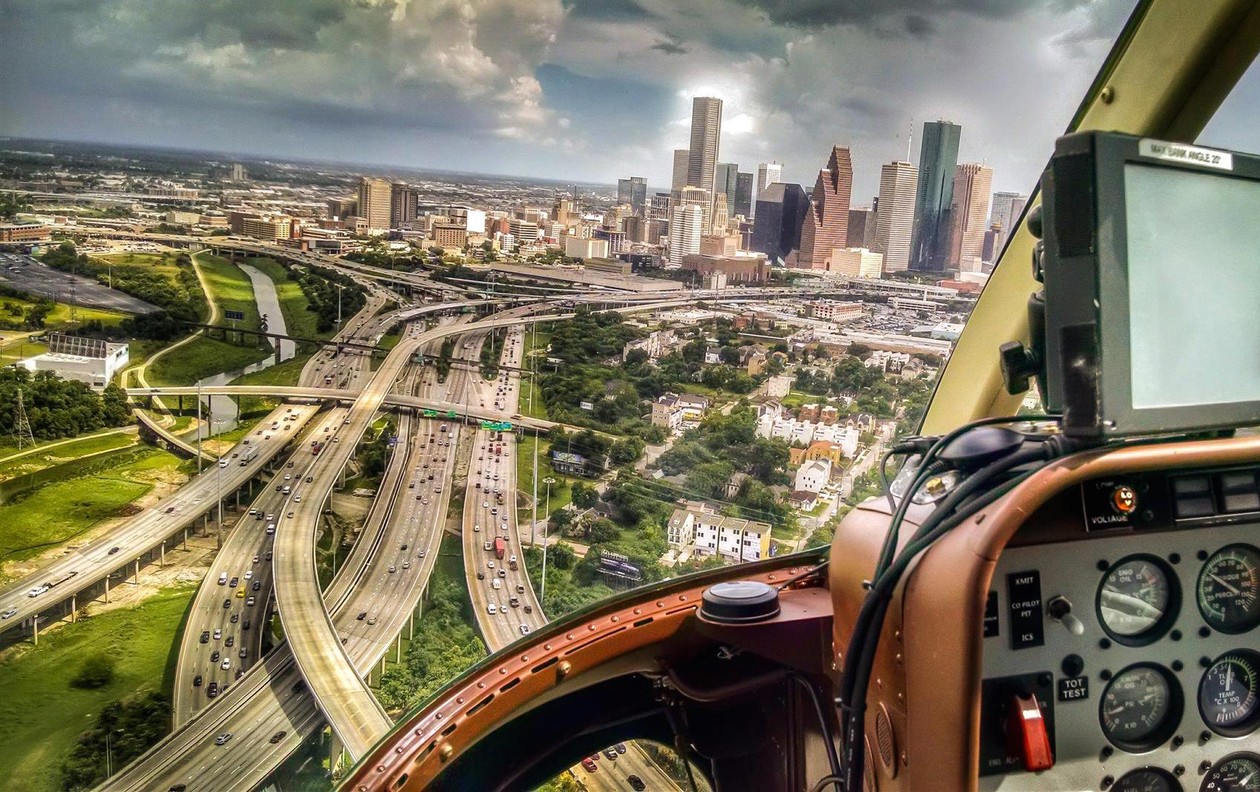
An absolutely stunning shot from reader Kevin, who doesn’t have to worry about traffic jams:

I love your “America By Air” series. I am an aerial surveyor by trade and hobby … and have amassed tons of photos over my 15+ years in the business. My office is currently a Bell 206B JetRanger Helicopter. I’ve worked in many different aircraft over the years and absolutely love the vantage point that flying gives. Combine that with a child-like love of aviation and geography and that’s me in a nutshell.

It was just on your latest edition that I saw the link to submit photos and thought I’d send a few your way. If you’re interested in more, I have plenty and I’d love to share.

Yes please. And if you have your own photo to share, even if we’ve already posted one, drop us a line: [email protected]. Submission guidelines are here, for increased chance of posting, along with some context on how this aerial series got started. Your photos just keep getting better.

Cristiano Valli

A reader sends the second photo from a blimp we’ve received so far (and the latest in our sub-series of shadow views):

So, this company decided to offer tours of San Francisco with zeppelins. They invited me and a bunch of journalists for the inauguration trip. But here’s the thing: Are you familiar with all the stuff they say about San Francisco and the wind? Those stories are true … the inaugural trip had been postponed for three months, on a daily basis—you know, wind—and the €600 tickets for the general public were refunded in full and the company went out of business in six months. Pictures were cool, tho.

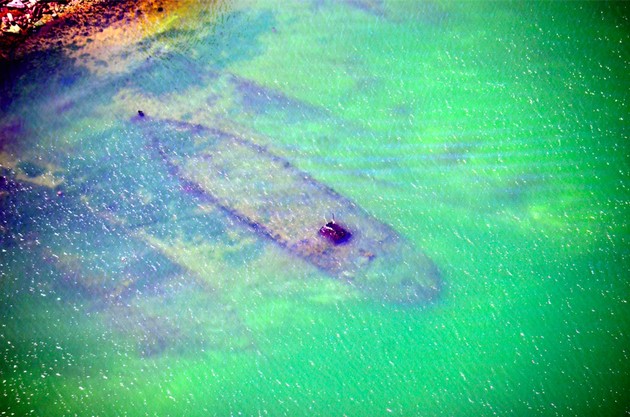
I love this one of a scuttled ship, especially when juxtaposed with the shadow of the airship above:

Cristiano Valli

When I asked Cristiano about the vessels, he replied:

The bay is shallow, so there’s a lot of sunken ships, but they’re just too expensive to recover, especially around Alameda Island. I don’t think there’s any historical value, just life happens in the bay ...

If you have an aerial photo of your own and an anecdote to share, we’d love to post: [email protected]. Submission guidelines here.

A lush and colorful scene from reader Brian Burk:

Brian Burk

This photo was taken leaning out the open side window of a Cessna 172. The date is July 15, 2013, and I was participating in a “day in the life of Oregon” photography project called Project Dayshoot+30. Thirty years to the day before this shot was taken, a group of photographers had captured images from around Oregon on July 15, 1983, and a reprise of the project was organized in 2013 to commemorate the original venture.

This is a photo of a tree and plant nursery near the town of Monmouth, in the Willamette Valley south of Portland. The time is approximately 8:15 PM, and the midsummer sun is finally starting to set, nicely capturing the spray of irrigation spigots on the colorful plants.

This shot is special to me for many reasons. It reminds me of the natural beauty of my home state of Oregon and of the importance of the Willamette Valley to the history of the U.S. It is also special because of the wonderful day my father and I had shooting photos of Oregon from the air. Dad was in the back seat of the airplane, and my friend Jill Smith was next to me in the co-pilot seat. We finished our journey after dark at Troutdale Airport, my home field, just outside of Portland, where we had begun before dawn that morning. We were exhausted but joyful.

Margaux Fisher

Have a good aerial photo to share? Please send our way. The latest from a reader:

Hi! I’m submitting an aerial photograph of the Twin Span Bridge, which stretches across Lake Pontchartrain, connecting New Orleans and the neighboring town of Slidell. I took this on my first (and only, so far) flying lesson a few months ago. We flew out of the New Orleans Lakefront Airport, which was built in the 1930s on top of a manmade peninsula overlooking the lake.

The bridge gets a mention in the piece Susannah Breslin wrote for us about her PTSD following Hurricane Katrina:

I drove across the eastbound span of the Twin Span Bridge over Lake Pontchartrain, and parts of the westbound span of the bridge were simply gone. I drove an hour through a destroyed forest, and when I looked up in the sky, I tried to imagine a thing so big that it could destroy so much.

More Notes From The Atlantic
  • Notes Home