This Week in Books: My 10-Year-Old Adores The Iliad
A new translation of the epic poem plunges us into the world of the ancient Greeks.

This is an edition of the revamped Books Briefing, our editors’ weekly guide to the best in books. Sign up for it here.
At my small liberal-arts college, the freshmen were taught on the first day to chant in ancient Greek the opening line of The Iliad. A few hundred awkward new students, shifting in their lecture-hall seats, slowly belted out, “Menin aeide thea …” This was the late 1990s, so there was little concern among us about our unabashed immersion in Western civilization: The required Humanities 110 course took us through Greece in the fall, Rome in the spring (I should add that Hum 110 at Reed College, where I went, has since become the subject of protest for its Eurocentrism, which at one point shut down the course entirely). Personally, I loved the class, and that first-day ritual was indicative of the spirit of it: We chanted in unison so that we could recapture, in some small way, a sense of the communal and oral origins of the epic poem. This impulse to connect somehow with the ancient world in which The Iliad was written—a violent, honor-bound society—is at the center of Graeme Wood’s brilliant assessment of Emily Wilson’s new translation of the poem in our November issue. I’ve actually been thinking a lot lately about the attractions and limits of reentering that Homeric universe, because my 10-year-old daughter has herself become obsessed with The Iliad.
First, here are five new stories from The Atlantic’s Books section:
Wood writes about how Wilson has translated The Iliad with an eye toward returning to its immediacy and simplicity, sometimes clouded over by the poetic reaches of previous translators. Because of our remove from the ancient Greek, he writes, “the next best thing is to make the text flow, to make the story proceed, and to conserve as much as possible of the direct, savage beauty of Homer.” And that’s mostly what Wilson does. As a side effect, we get a lot more unprettified blood and guts. This is a good thing, Wood thinks, because The Iliad in his estimation has been Disney-fied, “replaced in the popular imagination by a child’s storybook version of the Trojan War.” He also issues a challenge of sorts: “If they taught the rape- and gorefest that is the actual Iliad, I daresay parents would complain.”
Well, I’m a parent, my daughter adores The Iliad, and the version she has been reading and rereading is a graphic novel by Gareth Hinds published in 2019 (he also did The Odyssey, equally loved in my house) that is indeed very gory; his rendering of the ancient world does not at all shy away from its violence. Hinds uses bright colors and a style that most closely resembles superhero comic books from an earlier, less finely brushed era—the pages are kinetic, full of onomatopoeia such as “KLANG!” and “THUD.” And the story is … the story. Women are described as “prizes” and “spoils of war” (“What woman shall be offered up to satisfy your pride, Agamemnon?” asks Achilles). Blood is everywhere. Spears pierce through helmets and into soldiers’ faces. Skulls are bashed in with rocks. The scene of Hector’s body being desecrated as it is dragged behind a chariot looks like it could have been directed by Mel Gibson.
Should I be worried that this is appealing to a tween? When I asked her if she found the story and the depiction too unsettling, she told me that the fact that these were drawings about something that would have taken place thousands of years ago lessened their bite. But at the same time, this is no storybook version, airbrushed with predictably happy endings, as Wood suggested modern depictions of the epic are. I actually think that what she likes about it, and why she keeps returning to it, is its alien quality. In the world of The Iliad, emotions such as rage can lead to full-scale wars. Love can launch ships. It is an upside-down reality for my daughter because it lacks the niceties and ease that, thankfully, characterize her own life. But it’s also elemental, primal, built on sensations that lie in each of our hearts, even a dear little 10-year-old one. This makes the story attractive and repellent, and attractive because it’s repellent.
I highly recommend reading Wood’s piece, because he captures so well this feeling of unbridgeable distance between us and them, those ancient Greeks—as well as the irresistible need to peer across that enormous chasm to try to see them.
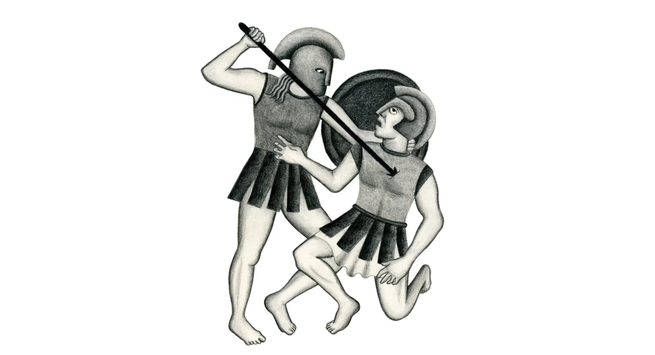
What Emily Wilson’s Iliad Misses
What to Read
Aliss at the Fire, by Jon Fosse, translated by Damion Searls
Dreamlike is a word often applied to Fosse, a Norwegian novelist and playwright, and in Aliss at the Fire, he is at his most surreal and circuitous. Unfolding in what basically amounts to one long, swirling sentence, the novel is a classic Scandinavian story—which is to say, it is about a family and a fjord. Fosse is often compared to Henrik Ibsen, since he is best known as a playwright and is very depressing. But in Aliss at the Fire, he’s more reminiscent of William Faulkner—who, unlike Ibsen, won the Nobel Prize. Like Faulkner’s best works, Aliss at the Fire is about the inescapability of the past and how history reverberates mysteriously across generations. Through voices and narratives that are constantly interrupting and interfering with one another, Fosse captures the grief—and love—that can never be put into words. — Alex Shephard
From our list: Five authors we thought might win the Nobel in 2022—including one who did
Out Next Week
📚 Madonna: A Rebel Life, by Mary Gabriel
Your Weekend Read

The Greatest Invention in the History of Humanity
If you can’t successfully deliver live offspring, or survive childbirth, your lineage is headed for extinction. And yet, somehow, there are 8 billion Homo sapiens on the planet right now. I propose that the only reason we got to that number is that our ancestors, over time, applied their deep sociality and general cognitive abilities to our biggest obstacle: Hominins had to invent gynecology. Lucy probably had a midwife. Habilis likely had even more fertility workarounds, and erectus more after her. Slowly but surely, our foremothers would have started regularly helping one another give birth and directly manipulating their fertility patterns in real time: not just at the moment of birth, but in the long on-ramp of fertility prior and the hideously long off-ramp of postpartum survival. None of our accomplishments would have been possible without it.
Last night, Ayad Akhtar and Imani Perry were in conversation with Adrienne LaFrance and discussed the dangers of book banning and limits on freedom of expression. Watch the recording here.
When you buy a book using a link in this newsletter, we receive a commission. Thank you for supporting The Atlantic.