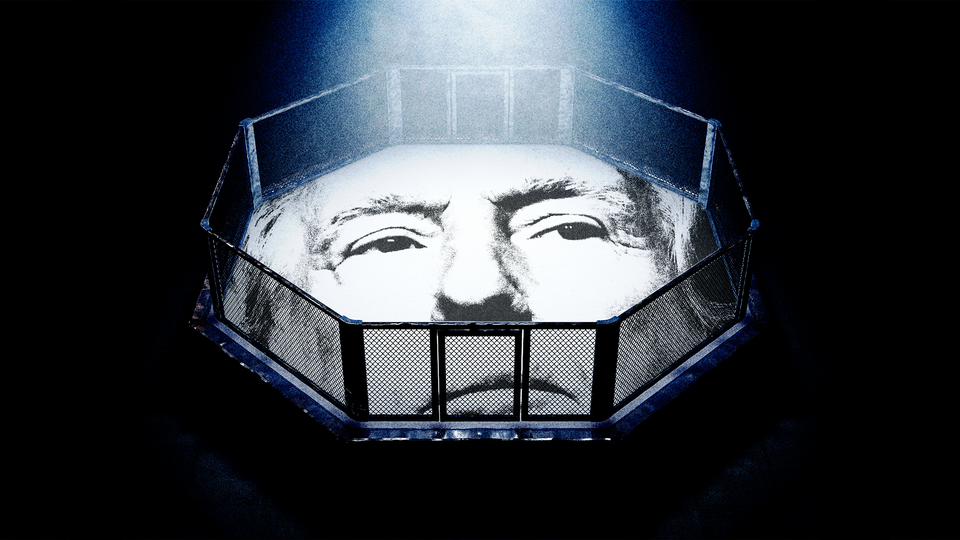
With the news last month that the Ultimate Fighting Championship (brand: authentic, highly skilled violence) has merged, in a deal worth billions upon billions, with World Wrestling Entertainment (brand: fabulously stylized, highly skilled violence), it appears to be time to reset the reality levels. Again. What new form of narrative, what gory amalgam of truth and spectacle, what double-talking rough beast approaches? In other words: Are you ready to rumble?
If you doubt the importance of this bit of business, consider that braided into the corporate histories of both the UFC and WWE, and into their respective anthropologies (we’ll be coming back to this), is the rise of Donald Trump. Trumpism has expressed and explored itself through both of these entities. And as they coalesce, and as Trumpism itself further coalesces, we are surely heading into—as the great New Hampshire metal band Scissorfight once put it—the “high tide of the big grotesque.”
For a primer on the UFC side of things, you won’t do better than Michael Thomsen’s new book, Cage Kings: How an Unlikely Group of Moguls, Champions & Hustlers Transformed the UFC Into a $10 Billion Industry. A fine writer and a very good reporter, Thomsen tracks in detail the journey from the primal chaos of the promotion’s first event—1993’s UFC 1, where grapplers fought thumpers, bone-breakers fought chokers, and a Dutch kickboxer, with a blow of his foot, sent a Samoan sumo wrestler’s tooth flying into the crowd—to the streamlined pay-per-view mercilessness of today’s UFC.
The rise of the UFC is checkered but, in hindsight, unstoppable. Along the way, as if by accident, in response to the pressures brought to bear by various regulatory bodies, the converging impulses and skill sets of the fighters themselves, the demands of a just-discovered audience, and an ambient societal sense of what might be gotten away with, a new style of fighting was was invented: mixed martial arts (MMA). The rules were hammered out at a multiparty meeting in April 2001, with consulting physicians in attendance, where (as Thomsen writes) “soccer kicks, head butts, knees to the head of a grounded opponent” were outlawed.
And then there's pro wrestling. The UFC exerts a grim, surface-level fascination, but pro wrestling is deep. Ringmaster: Vince McMahon and the Unmaking of America, by Abraham Josephine Riesman, published earlier this year, will help you get your mind around it. And you need help. Pro wrestling is a thunderdome of images, the human comedy at near-celestial scale. Its lingo, its carny slang, expresses some kind of hierarchy of awareness, but where wrestling begins and where it ends, no one can say. If you’re a “mark,” you’re way down there: You’re taken in by the “kayfabe,” the fakery, and you think it’s all real. If you’re a “smart,” you’re higher up the great chain: You know what’s going on, you can tell a “work” (something prefabricated) from a “shoot” (an improvisation), and you can take an ironist’s or an aesthete’s pleasure in the pageantry and the bombast and the medieval moral drama.
But is anybody really a mark? And is anybody really a smart? “When you start to think about it,” Riesman muses, “the existence of marks in great numbers starts to seem unlikely. It’s possible that the majority of wrestling fans may have always been smarts. It’s possible that the illusion at the heart of wrestling was not that fans believed wrestling was real, but that wrestlers believed that fans believed it.” (This is an irresistible idea: the puffed and strutting wrestlers, maintained in their dreamworld by the gallantry of the fans.)
Both books have a focal strongman character. For Thomsen, it’s Dana White, once a penniless personal trainer who listened to Tony Robbins for inspiration, now the UFC’s abrasively charismatic caudillo and defining personality. For Riesman, it’s Vince McMahon, the demonically transformative former chairman and CEO of WWE (previously the World Wrestling Federation.) White bought the UFC in 2000, with his partners and moneymen the Fertitta brothers, when the promotion was at a low ebb. McMahon inherited the WWF from his father, Vince Sr. But in some respects—on a business level, at least—the story is the same: the aggressive absorption of smaller fighting promoters; the wooing of legislatures and athletic commissions; the territorial expansions and TV deals; the escalation of hubris, razzmatazz, blood.
Where the two men differ is in their nature. White is a farseeing brawler-businessman. McMahon, unclassifiably but undeniably, is an artist—a creator/destroyer. And in 1998, having “booked”—that is, written narratives—for WWF for years, building up and blowing down characters according to his own uniquely despotic dramaturgical whim, Vince McMahon, at the age of 52, wildly entered his own creation. He became a character. As pumped and glistening as any of his “boys,” with a proper wrestler’s physique and carriage—he’d been building muscle, under those baggy suits, for years—he climbed into the ring as “Mr. McMahon.” A villain. A heel. What Riesman calls, in another context, a “sizzling” heel. “He’s a horrible human being,” says McMahon of this version of himself, “uncaring, a powermonger, manipulative, very manipulative.” “Ass-hole! Ass-hole!” chants the delirious crowd. Mr. McMahon’s antics, over the succeeding years, will include making out with the wrestler Trish Stratus as his wife, Linda, watches on, and peeing himself with fear while “Stone Cold” Steve Austin holds a gun to his head. (“Mr. McMahon looked up,” Riesman writes rather beautifully. “He saw what the viewers saw: his own tear-stained visage. His face looked like a kabuki mask of weeping terror.”)
Over both of these books, and both of these organizations, looms—I was going to write “the shadow of Trump,” but Trump has no shadow. No secret darkness, no buried awareness: Every inch of him is lit up. Better perhaps to say that the Trumpiness of all this is baked in. The story of the world as told by the UFC and WWE—it’s not exactly a liberal’s vision. Booming characters preen and dominate; nuance is banished. This is heavy-metal America. Trump is a longtime wrestling fan, and playing himself (who else?) he feuded publicly with Mr. McMahon, at one point shaving the character’s head at ringside. Much of Trump’s most appalling public behavior—say, that impression of a disabled reporter—is in the repertoire of a classic heel: To loudly deplore it, to boo and hiss, only reassures his fans. He was also an early supporter of the UFC, and Dana White has repaid him with many loud pledges of fealty, most notably in a speech at the 2016 Republican National Convention: “Let me tell you something! I’ve been in the fight business my whole life. I know fighters. Ladies and gentlemen, Donald Trump is a fighter, and I know he will fight for this country!” Always close to the McMahons, Trump in 2017 appointed Linda McMahon as the head of the Small Business Administration.
So now what? High theater, high narrative, has merged with what Kipling called “the undoctored incident.” The kayfabe has merged with the fist in the face. Is some kind of grotesque UFC-WWE blend in the cards? White has pooh-poohed the idea: “If you look at the WWE,” he said last week, “they have an entertainment value, and they have these guys that are incredible athletes that go in there and do their thing. It’s well known that it’s scripted. When you look at the UFC, this is as real as it gets. That’s our tagline.” But there’s life after the UFC: Former MMA stars such as Ronda Rousey and Brock Lesnar have already found that they can cash in as wrestlers for WWE. Will this process, this pipeline of talent, now be accelerated? Conor McGregor—the most wrestlerlike, in his self-presentation, of all the UFC champions—is surely watching these developments carefully. As are, from the stands, the howling wrestling fans, the bloodthirsty UFC fans, and the rest of us with an interest in the American evolution.
When you buy a book using a link on this page, we receive a commission. Thank you for supporting The Atlantic.