What Trump’s Court Filing Could Mean for 2024
The former president's lawyers are attempting to use his presidential candidacy to delay prosecution.
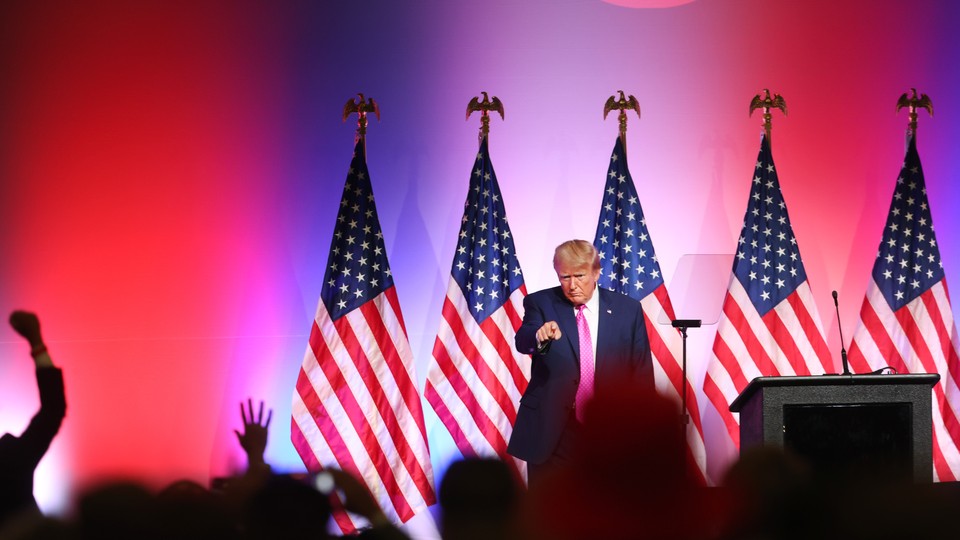
This week, Donald Trump’s lawyers submitted a court filing that confirmed a theory that Trump critics have been spreading for years. I called my colleague David Graham to talk about the surprises of the latest filing, and how Trump is scrambling the traditional relationship between law and politics.
First, here are four new stories from The Atlantic:
Impossible to Separate
Isabel Fattal: You wrote yesterday that Trump’s lawyers have just confirmed a liberal conspiracy theory. How so?
David A. Graham: For years now we’ve heard liberal commentators say, Trump is just running for president so he can avoid prosecution—because presidents are generally not subject to federal criminal prosecution, and a president can presumably try to shut down a federal case against him.
This is the sort of thing that can seem like a conspiracy theory. And so I was pretty amazed reading a new filing from Trump’s lawyers in which they say, We need an indefinite extension in this case because he’s running for president. He doesn’t have time for that. This would move the timing of the case past the election, and if he wins, then presumably Trump would say, Well, I’m too busy to be involved in the case as president, or he could shut down the case himself.
Isabel: Trump’s situation is fairly unprecedented in American history. What kinds of legal precedent do we have for a federal case against a presidential candidate?
David: We really don’t have much. We train prosecutors to not pay attention to politics (sort of: Most local prosecutors are elected, but federal prosecutors are not). There’s guidance inside the Department of Justice to avoid new charges and public comment in the period just before an election. But this is a case where there’s no way to separate things, because as Trump’s lawyers say, he is the leading Republican candidate for president, and we’re talking about alleged crimes that are tied to his conduct as president. It’s a situation that the Framers of our laws didn’t anticipate and probably would be very worried about.
Isabel: Do you think Trump’s lawyers are correct in their estimation that the outcome of this case would affect the outcome of the 2024 election?
David: If this case is being litigated during the election, it will almost certainly affect the outcome of the election. If Trump is found guilty, that is going to affect the way people view him. We like to talk about how voter impressions of Trump are already baked in. And to a great extent, that’s true. But we know that Trump lost voters between 2016 and 2020, and we know that when these things come up, it tends to hurt Republicans. We saw that in the midterms. When people in a general election are reminded of the circus around Trump, they tend to not like it.
If he were acquitted, that would also probably help him, because he’d be able to say there was this political prosecution against him.
Isabel: What else are you keeping an eye on this summer with Trump’s multiple legal troubles?
David: There’s a funny line in the documents-case filing: When the lawyers say Trump is not going to have time to do these hearings, they also say, He has other legal matters that we’re already embroiled in.
We don’t expect to have movement in the New York case for some months, but something could happen there. This week, grand jurors are being impaneled in Fulton County, Georgia, for the grand juries that we expect will decide on charges against Trump or other people related to 2020-election subversion. And we’ve also seen some movement from Special Counsel Jack Smith on other cases in the past couple of weeks, separate from the documents—investigations and testimony related to January 6 in particular.
We don’t know where that’s going or what charges Smith might bring, but it’s a good reminder that he is not just focused on the documents, and that’s still a live case. So we could see more federal charges, and we expect to see these Georgia charges. There’s a lot to still keep our eye on in addition to the documents trial.
Related:
Today’s News
- Ukrainian President Volodymyr Zelensky stated that his meeting with President Joe Biden at the NATO summit was “very good,” despite earlier frustration over the organization’s refusal to set a timeline for Ukraine’s membership.
- FBI Director Christopher Wray faced critical questions from House Republicans today over allegations that federal law-enforcement agencies have been “weaponized” against the right.
- In a special session, Iowa’s Republican-controlled legislature advanced a six-week abortion ban that Governor Kim Reynolds is expected to sign into law.
Evening Read

‘Where Are Your Parents?’
By Jeffrey Ruoff
When I was born, my parents planted a tree for me—a corkscrew willow—alongside a stream that cut through the yard of our home in Ithaca, New York. That tree, once a sapling, grew to 30 feet tall. I remember climbing up the trunk at 8 years old and then sliding down its gangly limbs, trying to avoid a plunge into the rocky stream. Later, in my 30s, I witnessed a slow war of attrition between the tree and the brook as the streambed ate away at the bank where the corkscrew willow had set down its roots.
Memory is fickle. It defines who we are and who we think we are. It helps us create coherent narratives of our incoherent lives. And then our memories fade. I retain other, painful memories of my childhood and of my mother. But as she got old and I got older, I realized that some memories need to be squeezed, like oranges, until only the love remains.
More From The Atlantic
Culture Break

Read. Beyond the Story: 10-Year Record of BTS manages to layer an emotional history on top of the professional rise of the world’s biggest band.
Watch. Insidious: The Red Door (in theaters now) is a PG-13 horror franchise with the legs to last.
Katherine Hu contributed to this newsletter.