April 1953
In This Issue
Explore the April 1953 print edition below. Or to discover more writing from the pages of The Atlantic, browse the full archive.
Articles
India
Soviet Education
African Federation
Who Wants Progressive Education? The Influence of John Dewey on the Public Schools
That John Dewey was one of the foremost philosophers of our time is a fact, but the influence of his thinking and that of his disciples upon the public schools has been a subject of sharper and sharper questioning in recent years. One of the most articulate critics of Deweyism is ALBERT LYND,who is serving his second term on the School Board of Sharon, Massachusetts. Mr. Lynd is a Boston businessman who had seven years of teaching experience at Harvard College and Stanford University. His book on modern education, Quackery in the Public Schools, will be published this autumn under the Atlantic-Little, Brown imprint.
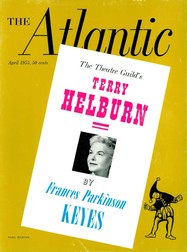
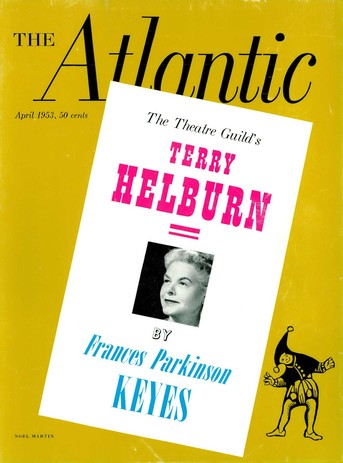
Terry Helburn
The friendship between Theresa Helburn of the Theatre Guild and FRANCES PARKINSON KEYES began in Miss Winsor’s School, Boston, where they were members of the same class. Over the years as Mrs. Keyes was raising her family and writing her novels, she was sharing vicariously in the career of her friend Terry, who had begun as a poet, was one of the founders of the Theatre Guild, and later became its Executive Director. Here is the story of a friendship and of a woman who has achieved a unique place in the American theatre.
The Atlantic Report on the World Today: Washington
A New Look at Formosa
GEORGE E. TAYLOR,historian and political scientist, who was with the Office of War Information from 1942 to 1945, and who since 1946 has been Director of the Far Eastern Institute at the University of Washington, has been contributing articles about the Orient to the Atlantic for more than a decade. In 1952 he made an extended tour of the Far East, and in his stay at Hong Kong and Formosa gathered material for this survey.
Moses on Canal Street
The scales of IRA WOLFER’S career have tipped alternately between creative fiction and journalism. A newspaperman at fifteen, Wolfert rose through the ranks from copy boy to war correspondent, and in 1943 he was awarded the Pulitzer Prize for Battle of the Solomons, based on his coverage of the Guadalcanal action. That same year appeared his first novel, Tucker’s People. ”Moses on Canal Street" is an excerpt from Mr. Wolfert’s new novel. Married Men, to be published this autumn by Simon & Schuster. The event described here occurs in the early nineties, during the honeymoon of Married Men’s protagonist, Wes Olmstead.
The April Rain: For Connie Guion
The Douglas Fir
One of the best loved of American naturalists, DONALD CULROSS PEATTIE will be remembered for his essays on the Elm, the Maple, and the Beech-which later became chapters in his standard work on the trees of eastern North America. From Mr. Peattie’s new book, A Natural History of Western Trees, to be published this month by Houghton Mifflin, we have drawn this portrait of one of the great sentinels of the Northwest.
I & My Parents' Son
E. E. CUMMINGS, the American poet and painter who holds the Charles Eliot Norton Chair at Harvard for the current year, began his first talk by saying: “Let me cordially warn you, at the opening of these socalled lectures, that I haven’t the remotest intention of posing as a lecturer. Lecturing is presumably a form of teaching; and presumably a teacher is somebody who knows. I never did, and still don’t, know. What has always fascinated me is not teaching, but learning; and I assure you that if the acceptance of a Charles Eliot Norton professorship hadn’t rapidly entangled itself with the expectation of learning a very great deal, I should now be somewhere else.”Mr. Cummings’s six nonlectures, of which the Atlantic will publish two, are appearing in book form this autumn with the title i, under the imprint of the Harvard University Press.
The Imperfect Foreigners
Reverse English is a precise term in billiards but harder to define when applied to writing. It is what the wilier writer achieves when he disparages a proposition by praising it — for the wrong reasons or when he endorses it by a bogus attack. An exacting form, its practitioners are few, and foremost among them is H. F. ELLIS, distinguished not only as Literary Editor of Punch, but also for his book The Vexations of A. J. Wentworth, the self-satisfied memoirs of a bonehead British schoolmaster.
Santayana's Last Year
In his eighty-seventh year, George Santayana. the poet and philosopher. brought to completion his last major work, Dominations and Powers, a manuscript on which he had been working ever since Hitler turnedEurope into an armed camp. Santayana found sanctuary in the Convent of the Blue Nuns in Rome; and here after the liberation of Italy he was joined by Daniel Cory, an American scholar who since 1930 had been serving first as his secretary and then as his confidant. Mr. Cory, now Santayana’s literary executor, describes the philosopher’s reappraisal of his own work, which occupied him in the months before his death.
Beyond Adolescence
With the publication of The Flowering of New England, VAN WYCK BROOKS,critic and biographer, embarked upon his magnum opus, a study of American authors from 1815 to 1915. The big trilogy was completed in 1951, and Mr. Brooks then turned his thoughts to contemporary writers and to the New Criticism, which sometimes illuminates and sometimes obscures our understanding. The essay which follows is drawn from his non book. The Writer in America, to be published by Dutton this month.
The Peripatetic Reviewer
Accent on Living
I Was an Easter Bunny
Greetings, Sincerely
The Novelist
Record Reviews
Pleasures and Places: Side Roads in Spain
Though Spain ‘s low prices tend to go up in response to the increase in tourist trade, the less celebrated places, off the main routes, are still uncluttered and inexpensive. And if the roads arc rough, why hurry? DIGGORY VENN is the author of “ The Porto Game" in the December, 1951, Atlantic.