March 1953
In This Issue
Explore the March 1953 print edition below. Or to discover more writing from the pages of The Atlantic, browse the full archive.
Articles
The Artist Views the Critic
For the playwright
The Atlantic Report on the World Today: Washington
The Soviet Peasant
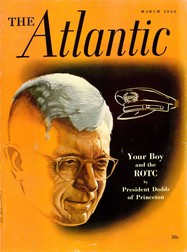
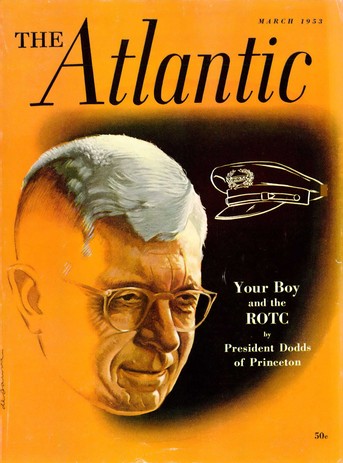
Your Boy and the Rotc
HAROLD W. DODDS,who has been President of Princeton University since June, 1933, has closely observed the effect of the ROTC, program upon undergraduates and the faculty. Now that military training can no longer be regarded as an emergency measure, but must be accepted as something to live with, he believes that it is imperative to make the ROTC instruction an integrated part of the college course. He believes it can take less time and be better taught, and here are his recommendations.
A Psychiatrist of One's Own
An American novelist who is note living and writing in Rome, MARTHA GELLHORN wrote her first novel in Paris at the age of twenty-three. As a correspondent she covered the Civil War in Spain; Munich; Czechoslovakia; Finland; and the war in China before Pearl Harbor. During World War II, she reported from England, Italy, France, Holland,and Germany. The story which follows will form part of a new book to be published this year.
The Meaning of Civilization
SIR RICHARD LIVINGSTONE has been pre-eminent in Britain as a teacher, as a classicist, and as an Oxford don who has emphasized the necessity of adult education for the well-being of a democracy. President of Corpus Christi College from 1933 to 1950 and Vice-Chancellor of Oxford University from 1944 to 1947, Sir Richard has also found appreciative listeners on many an American campus. The essay which follows teas delivered last autumn when he was Visiting Professor in the Department of English and History at Massachusetts Institute of Technology.
Japan
A Tale of Love and Sorrow
Government in Medicine
Government in the United States, DR. JAMES HOWARD MEANS points out, is today paying twice as much of the nation’s total health bill as it did in 1929. This is partly the result of the development of our program for Public Health but chiefly the result of the ever increasing expense of caring for the wounded and the sick of the two World Wars. With medical aid being proffered on three different levels — Federal, state, and local — is it not time for as to follow an integrated program rather than one of expensive duplication?
Evening Journey
Straws in the German Wind
A graduate in science of the University of Rome who was born in Italy and who became a naturalized American in 1945, GIORGIO DF SANTILLANA is now Associate Professor of the History of Philosophy and Science at Massachusetts Institute of Technology. He was the Atlantic correspondent in Italy in the years immediately following its liberation, and on his annual visit abroad last summer spent a considerable time in West Germany gathering these impressions of the German people.
Nationalism and Raw Materials
A Harvard economist, EDWARD S. MASON has hern Dean of the Graduate School of Public Administration since 1947. In addition to his teaching, he was on call as an economic consultant to the State Department in 1946 and 1947; and more recently has served as Chairman of the Research Advisory Board of the C.E.D. and as a member of the Materials Policy Commission, which made an exhaustive survey of raw materials the world over and of what nationalism is doing to the free, flow of these raw materials in the free world.
The Behavior of Mr. Frumkin
The daily visitors to a publisher s office include those who are curious, friendly, and hopeful, but the routine is occasionally interrupted, as HONOR TRACY reminds us in this story, by the arrival of a mysterious stranger whose designs and whose manuscript are not easily disposed of. Everyone who has ever worked in the editorial sanctum will testify that her story, which comes to us from London, has the true ring of experience.
Because You Live..
Beethoven: The Last Phase
Music critic of the London Sunday Times and Britain’s outstanding musicologist, ERNEST NEWMAN is well known for his studies of Beethoven, Richard Strauss, and Liszt and for his definitive life of Richard Wagner. This paper in which he describes the sublimation of Beethoven’s technique in its final phase is the sixth in our series of biographical essays dealing with the turning points in the lives of famous men.
The Peripatetic Reviewer
Books: The Editors Like
Reader's Choice
Bouquet De France
New World Writing
Hadrian the Seventh
Accent on Living
Hannibal Visited
They Come in Threes
The Mule
Record Reviews
Swiss Hotel
Crossing