They Come in Threes
by DAVID MAGEE
DAVID MAGEE was born in Yorkshire, England, and entered the export business in London after leaving school. He mored to the United States some twenty years ago and note owns a bookshop in San Francisco.
I DON’T understand it. My hands and feet are correctly endowed — at least they have the usual number of digits; they are not overlarge, nor do they twitch from St. Vitus’s dance or any other form of nervous disorder; and while I cannot attribute to my movements the grace of a gazelle, I am able to push a girl around a crowded dance floor without reducing her toes to pulp or otherwise behaving like a runaway bulldozer. In short, I possess, so I like to believe, the average male’s sense of balance and coördination. Yet since childhood I have been waging an endless and distressing battle with certain objects that are called—quite erroneously — inanimate.
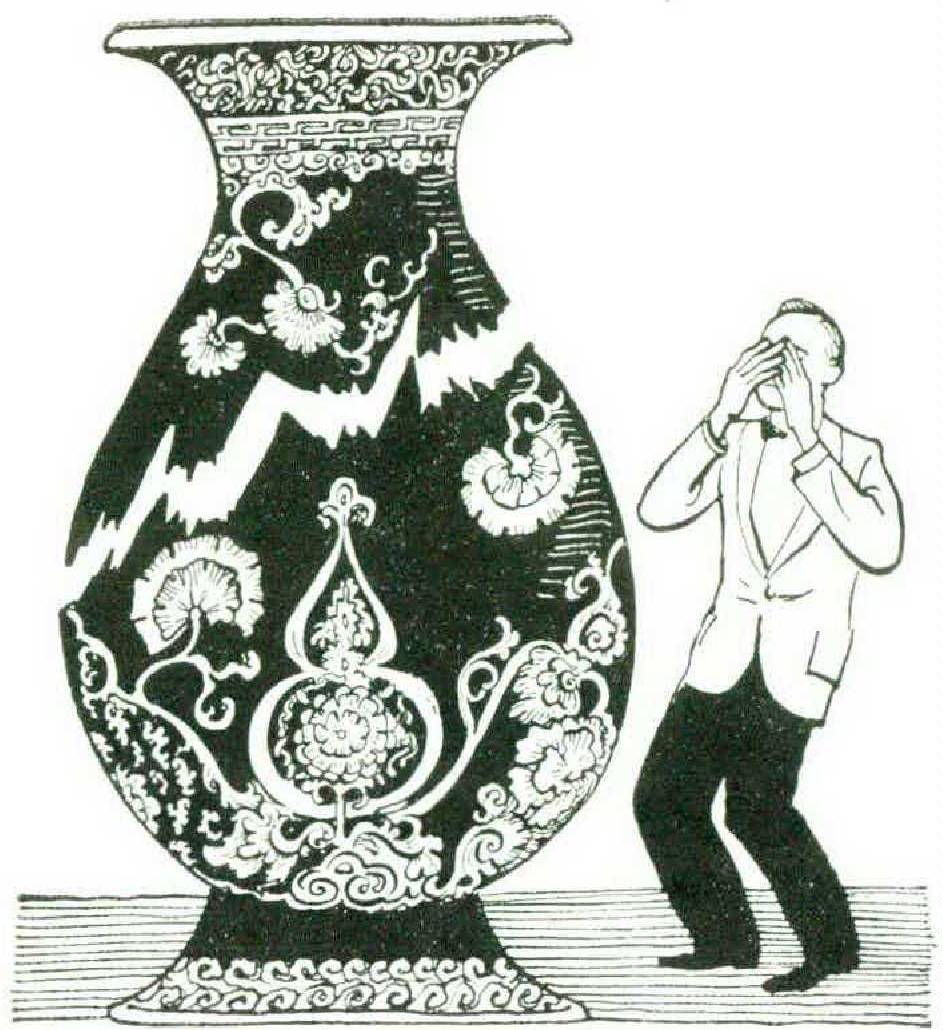
Now, I am not referring to such perverse things as nails that tear great holes in the plaster, window shades of pullman compartments, or garden implements that rise suddenly and strike you in the face. These are adversaries common to all mankind. Mine are on a much higher social level. It is the art treasure, the heirloom, the priceless porcelain which should be in a museum (and why isn’t it?) that is my enemy. Put me within five feet of a vase (Ming) and it has leaped from its pedestal and dashed itself into a thousand pieces on the floor. Let one of those terra cotta Pereherons (Tang) catch sight of me and it has pranced off the whatnot to break all four legs at the starting post.
It is most embarrassing, this passion of the old and rare to commit suicide in my presence. It happens all the time. Only a few weeks ago my wife and I were invited to dine with a couple whom we had met on our vacation. I shall call them the Bodleys. Had I realized that their house was a walking museum — and I mean walking — I would have known enough to stay home among my own worthless, and therefore truly inanimate, bric-a-brac.
It started out to be a very pleasant evening. The food was good, the wine vintage, the company gay, and there was no Ming, no Tang, in sight. Towards the end of dinner I told a story. It was a good story and the laughter of the Bodleys and their guests emboldened me to essay another. To give the punch line of this one the full treatment I leaned back — a trifle sharply perhaps. . . . For the next few minutes I was too busy trying to piece together the back of my chair to notice if the story got over. I don’t think it did—at least not with my hostess. Hut she was charming and did her best to put me at ease. “ Don’t give it a thought,”she said graciously. “It was just one of an old set —Chippendale, I believe — that Bob and I picked up in London last year.”The butler was less magnanimous. He brought me a new chair, as sturdy as a coronation throne, and carried away the broken one as if cradling in his arms the lifeless form of some favorite nephew.
When we joined the ladies after our coffee and liqueurs, I thought Bob Bodley made rather a point of leading me to the heaviest and most overstuffed chair in the living room; but perhaps I was being a bit sensitive. His wife, at any rate, could not have been more charming. She sat beside me for a while, chatting of this and that. Soon she drifted away to her other guests, leaving me to sip my highball in a considerably more cheerful state of mind. A little later she sat down on a sofa opposite me and raised her glass in my direction. “Happy days,”she said as if she really meant it. Then she added: “Oh, Mr. Magee, would you mind throwing me my handbag? I left it beside you.”
I picked up the bag, which had one of those large golden knobs for a clasp, and tossed it over to her. . . . I suppose I shouldn’t take people literally, but it was only a matter of a few feet, and how was I to know that she was going to turn at that moment to speak to the man beside her? Anyway, women should not be allowed to own handbags that require an outsize doorknob to open them.
I knelt in a lit ter of broken glass and ice and mopped furiously with my handkerchief at the ruined dress. I heard Mrs. Bodley say, “Be careful you don’t cut yourself with that broken glass, Mr. Magee.” But I am quite sure at that point she would not have cared in the least if a splinter of what was no doubt once a peerless Florentine goblet had pierced me mortally. “It’s just an old rag,”she said gaily, but her laughter came to me like a wind over a winter pond. “It was Bob’s grandmother’s wedding gown,”she went on. “He told me I was foolish to have it made over. It doesn’t pay to be sentimental over old things, does it?” And she gave me one of those wooden smiles that mothers reserve for the willful antics of other people’s children.
When the butler came in with what I considered an unnecessarily large broom and dustpan, I tried to hide behind the other guests; but he spotted me right away. Your experienced hunter can always pick the rogue elephant from the rest of the herd.
I did not dare look at my wife, but when the time came for us to leave — and it was none too soon for me — I was aware of an overelaborate display of good will in her voice which managed somehow to convey at once a gracious thank-you for the evening and an apology for the oaf she had married. There was also, I felt, a certain finality about that farewell.
“Why didn’t you bring an axe with you?” she muttered to me in the hall, and swept off to powder her nose and get her things.
I wandered aimlessly about the hall, waiting for her. The furniture here was of oak — Tudor, I judged, and as solid as Henry the Eighth himself. But I was taking no chances. I drifted over to the front door, anxious to be gone. There was a barometer hanging there. From force of habit I tapped it. The bottom fell out. . . .
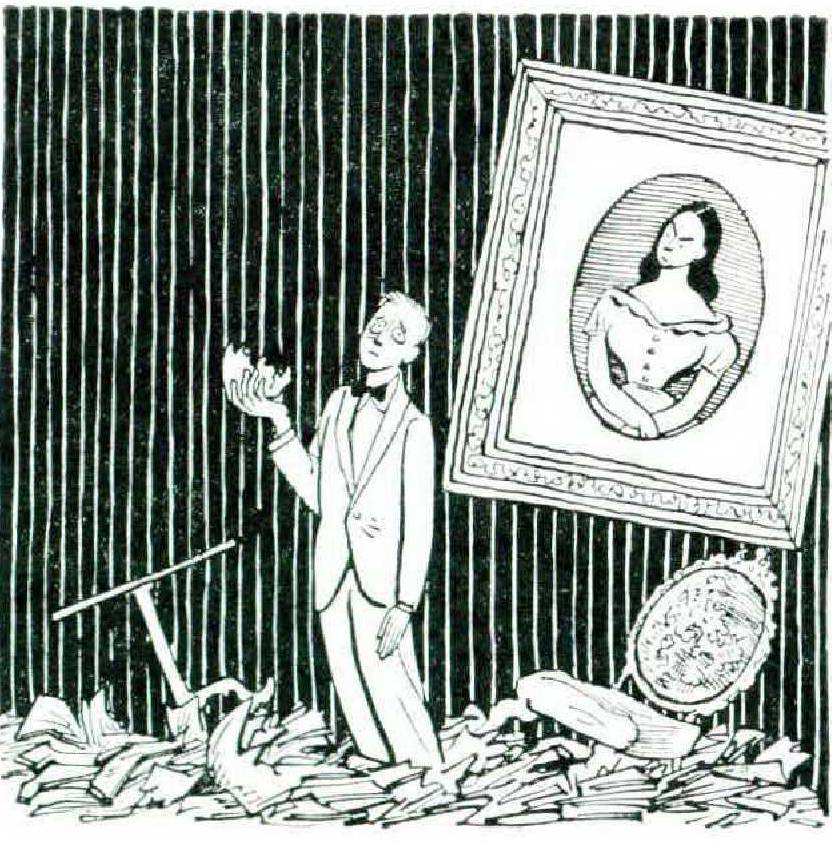
Since this dreadful evening my wife has dined out with considerable success on what she is pleased to call my triple play. But not, I need scarcely say, at the Bodleys’.