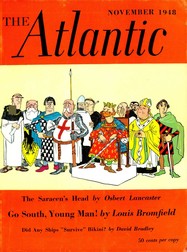
November 1948
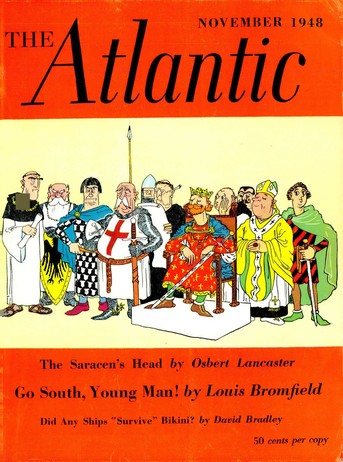
In This Issue
Explore the November 1948 print edition below. Or to discover more writing from the pages of The Atlantic, browse the full archive.
Articles
The Peripatetic Reviewer
Readn's Choice
The Sculpture of Ivan Mestrovic
Nobody's Fool
Atomic Energy
The Life and Times of Prosper Mérimée
Every Child to His Taste
Jenny's First Party
Creeper's Jeep
Sue Ann's Busy Day
Azor
Doctor Dolittle and the Secret Lake
Alice's Family
The Rocky Summer
The Bewitched Caverns
Roommates
France
Betsy and Joe
Highpockets
The Daredevil
Beany Malone
Spooks of the Valley
Mountain Laurel
This Month
Fruit Salad
The Story of the Bible
Among the Patronesses..
u.s.a. Retasted
Ignorance Preferred
After Eighty
Washington
How Dense Is the Mass?
Practitioner as well as critic of popular entertainments, GILBERT SELDESproclaimed himself their champion with the publication in 1921 of his trenchant book, The Seven Lively Arts. In the 1930’s he wrote for the Atlantic a pair of prophetic articles on the errors of television, which led to his being appointed Director of television Programs for the Columbia Broadcasting System. After considerable work in radio, and a brief spell in Hollywood, he is now working on a book dealing with those popular entertainments knoum as “mass media.”
No Place to Hide: Did Any Ships "Survived" Bikinis Underwater Bomb?
Photographs of the U.S.S. Pennsylvania in a recant issue of the Naval Institute Proceedings carried the caption that this grand old veteran of the seas “survived hath atom bomb tests at Bikini and finally went down off Kwajalein more from the after effects of war damage at Okinawa than from atom bomb DAMAGEDAY ID BRADLEY, M.D., one of the team of medicos who were sent to Bikini “to see that no one got hurt,”wrote down in his Log testimony of a very different sort, for he and his fellow scientists detected with their Geiger counters that not only the warships at Bikini but the fish in the atoll, the oil flecks washed ashore, even the water itself, were contaminated with radioactivity as a direct result of the underwriter bomb. How deadly was this contamination will be seen in the pages that follow. This is the second of three articles drawn from Dr. Bradley’s forthcoming book.
Is It Really That Dark?
CANON BERNARD IDDINGS BELL,one of the most trenchant spokesmen in the Episcopal Church, is today representing his Church as Consultant on Higher Education and Religion at the University of Chicago. Dr. Bell is one of the many readers of the Atlantic who have risen to the challenge of W. T. Since’s article, “Man Against Darkness,”in our September issue. He is the first of four writers to join in the following rebuttal.
The Principle of God
How Can We Deny God?
The Quest for Basic Values
Get Out and Get Under: Motoring Fifty Years Ago
An Englishman who was taught to drive by Charles Rolls of the Rolls-Royce, who owned his first car in 1898, and who built his first car, a “Simplex,”in 1901, JOHN E. HUTTON was one of the pioneer motorists in Europe, a gentleman who drove for pleasure and who in road races hit sixty miles an hour years before Barney Oldfield. In over half a century Mr. Hutton has driven more than a million miles without an accident. This is the first of two wonderfully nostalgic articles: the second will follow in December.
The Little Farm
The School, the State, and the Church
With her Lutheran upbringing and her firm belief in the democratic institutions of this country, AGNES E. MEYER, a graduate of Barnard, has been alert to detect the unhealthy symptoms in our working philosophy. Her war studies of twenty-eight major industrial centers were published under the title Journey Through Chaos. Since the war she has continued to report on those acute social problems in education, health, welfare, and community reorganization, many of her arlules appearing m the Washington Post, which her husband, Eugene Meyer, has published since 1933.