Fruit Salad
FACTS
JOHN CIARDI had completed fourteen missions over Japan as a T-Sgt Gunner on a when he was shifted to the Headquarters tasks described below. He is a well-known poet, now teaching English at Harvard.
by JOHN CIARDI
AMONG other signs of the limes, I recently saw a Distinguished Flying Cross in a pawnshop window. It puzzled me. Box and all it couldn’t have cost the government over seventy cents — how much can you raise on that in a pawnshop? The proprietor didn’t know, “Came in with box other stufl, he said. “ A ours fa doll’ ’n’ quota.”
Three years ago I was quoted another price for it. It was v-J Day overseas and I was standing in the Mess Hall line in front of a pair of replacement gunners a few months in from the States. One of them at least wasn’t too happy that the war was over. “Three more missions,” he said, “an’ I’d haxe had my DFC.”
WeWell, values change. Even my five-year-old nephew, once avid for all insignia and baubles, no longer wears the sweater he had his mother fix up with my shoulder patch, stripes, wings, ribbons, buttons, hash marks, gravy stains, and so forth.
That’s all old stuff. He wears a Buck Rogers Atom Bomb Raiders’ helmet and sweater now. Like everyone but the powers of government, he knows World War II is obsolete. He probably suspects me of being obsolete along with it.
He may be right. I certainly can’t compete with Buck Rogers and the Atom Bomb Raiders. Still, not so long ago I was one step up from a hero: I was a hero-maker. For the last six mont hs of one man’s xxar I sat at a Headquarters desk under a sign that said AWARDS AND DECORATIONS, and occupied my time supplying the adjectives for over twenty thousand citations.
Medals, you see, are not simply pulled, out of a general’s pocket and pinned on passing heroes. They require usually six triplicate pages of a form letter, a citation, supporting documents, eight or ten endorsements from lower commands to higher commands and back again, deliberation by the Award and Decorations Board of the highest echelon, and if approved, publication in General Orders. Only when the award has been published are the heroes ordered to wash their faces, put on a shirt, and report to a parade formation for presentation.
You will note also that the Awards and Decorations Board that makes the award is not observing an action but deliberating the evidence of an action presented on various pieces of paper. It was my job to make those pieces of paper look good. I was in effect attorney for the plaintiff.
My business was to win cases. And in the course of things I won some shaky ones. Many a Colonel is parading today with medals of my concoction, trophies more of my legalism than of his valor.
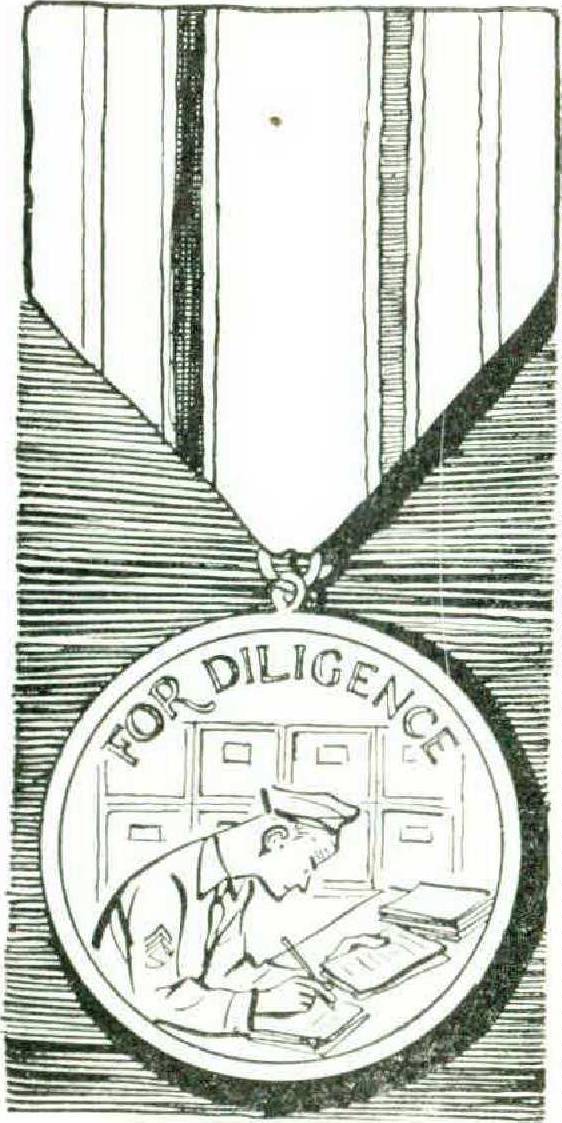
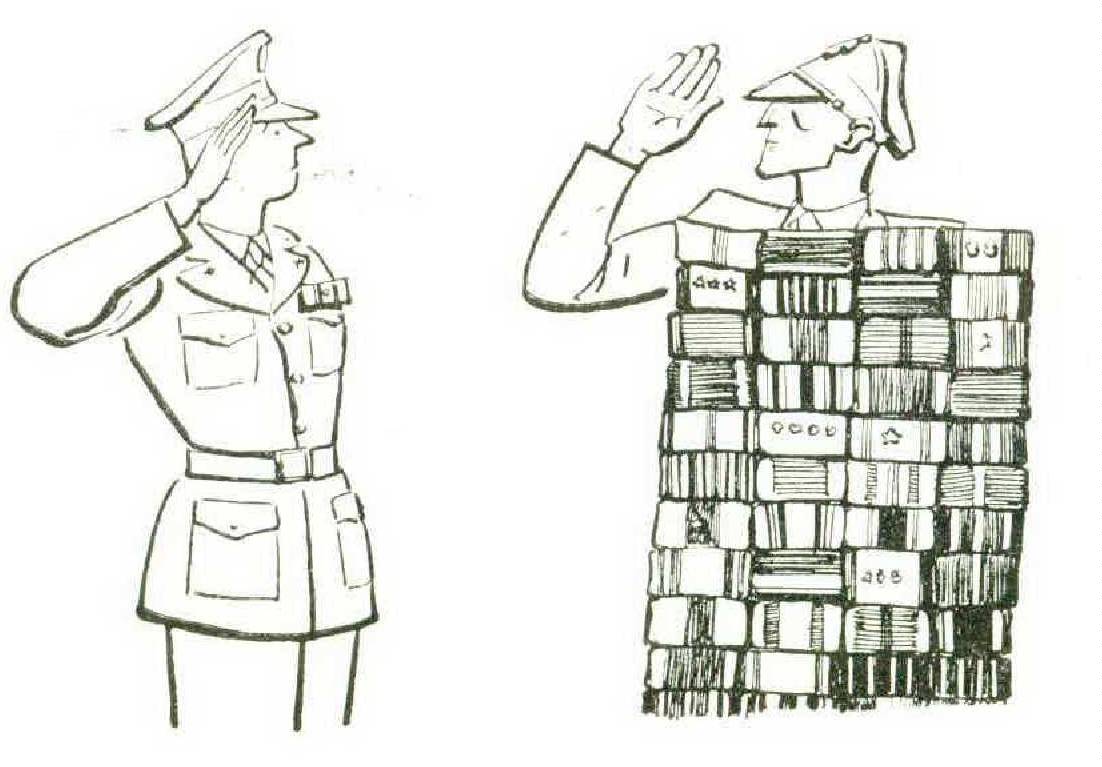
Twenty thousand modals for one Wing (the equivalent of a regiment) for one year of combat is a lot of fruit salad. We were a technicolor-minded army. Had the total been forty thousand, however,
I would still be completely convinced that most of those medals were earned and well earned. A crewman who flies thirty-five missions when the statistician has him written down for dead at sixteen and a half, deserves all the posies and watch fobs a grateful army cares to hang on him. For the bulk of those men I was not a hero-maker but only one more former air crewman at a Headquarters desk grinding out routine papers and grafting my flight pay.
But what I could not be to the lower classes, I more than made up for among the aristocracies of rank. There I was a power and a function. I was not only in the fruit salad business, but I was in the manufacturing end of it — manufacturing and canning.
My first really obvious manufacture was in a small way — a Bronze Star. Before it, I had only handled awards that seemed clearly well earned. Then one morning I arrived at Wing and found on my desk a buck slip (memo) from the Colonel, concerning a request from the Chief of Staff: —
Major Blank returning stateside. C/S wants BS for him. Dig up some poop.
I dug up some poop. Major Blank as sanitation officer had signed countless requisition slips for DDT at considerable hazard of a sprained wrist, and despite constant attack by tropical flies and other local vermin had personally conducted an intensive topographic survey of the island to determine the type of latrine best suited to the terrain.
His selfless devotion to duty under living conditions only several times as good as those available to a pfc, and his vast technological resourcefulness in installing showers in the officers’ area, clearly demonstrated meritorious achievement in connection with combat operations. He went back to the States pooped up with his BS.
At that time, I recall, a flier needed five missions for an Air Medal, and eight more for a cluster. The cases of several crews shot down on the fifth or thirteenth mission came up. Did they qualify? It was ruled that they did not: all missions for tour of duty decorations had to be completed. Dead crewmen could not be pooped up.
Major Blank’s Bronze Star was only a beginning. As time went on I became more and more skilled at pooping them up. Once I even pooped up a Distinguished Service Cross, the next highest award to the Congressional Medal. That was high pooping indeed and it, too, began with a buck slip. This one read: —
Col. Brass has seven missions. Check Intelligence for best one not previously cited and make draft for DSC.
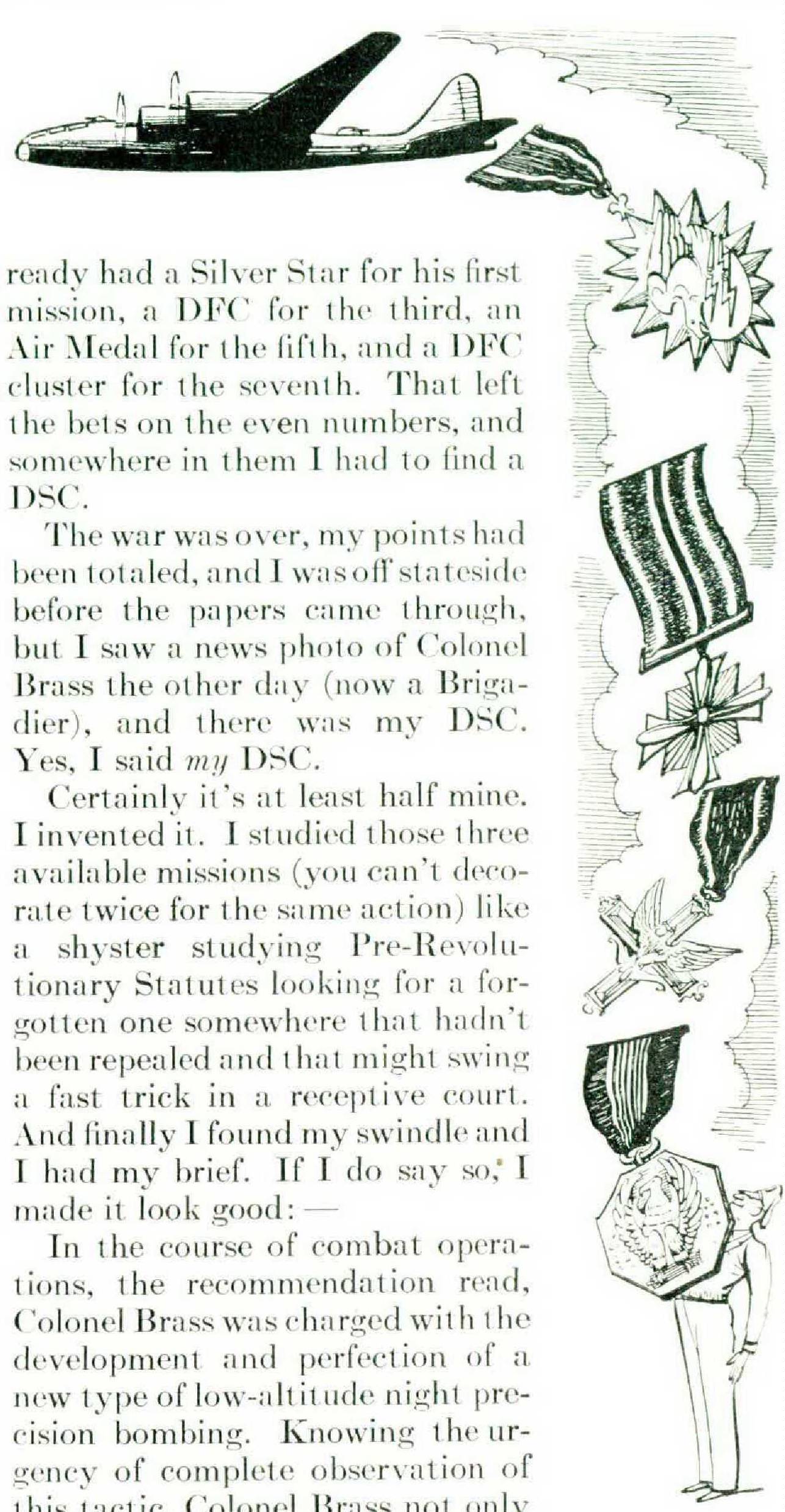
This one was a real problem. Colonel Brass already had a Silver Star for his first mission, a DFC for the third, an Air Medal for the fifth, and a DFC cluster for the seventh. That left the bets on the even numbers, and somewhere in them I had to find a DSC.
The war was over, my points had been totale led, and I was off’stateside before the papers came through, but I saw a news photo of Colonel Brass the other day (now a Brigadier), and there was my DSC.
Yes, I said my DSC.
Certainly it’s at least half mine.
I invented it. I studied those three available missions (you can’t decorate twice for the same action) like a shyster studying Pre-Revolutionary Statutes looking for a forgotten one somewhere that hadn’t been repealed and that might swing a fast trick in a receptive court.
And finally I found my swindle and I had my brief. If I do say so, I made it look good:—
In the course of combat operations, the recommendation read,
Colonel Brass was charged with the development and perfection of a new type of low-altitude night precision bombing. Knowing the urgency of complete observation of this tactic, Colonel Brass not only led the mission himself but remained over the target circling for two hours while element after element completed its bombing. In order to secure the extra flight time required for such observation, Colonel Brass undertook the mission in an aircraft that had
been stripped of all armor and armament, and flew the entire mission without gunners, employing the weight thus saved to carry extra fuel. His extraordinary devotion to duty in remaining undefended above a target under heavy attack made possible observations of great value. His cool disregard of personal safety is in the highest tradition of something or other and reflects great credit upon this, that, and the Armed Services.
And there is valorous Colonel Brass, circling undefended above the heart of Tojo’s empire. But it’s still half my DSC. I was the one who forgot to mention that while the bombing crews went in at 5000 feet, valorous Colonel Brass did his undefended circling at 32,000 about 500 feet below the North Star as far as anything Tojo could send up at night was concerned.
That was the highest my pooping-up went, but not the funniest. I think of Lieutenant Colonel Blank’s DFC as the true climax of my career in valor. It was a Wing ruling at one time that the Wing Air Commander in charge of any mission that dropped over 50 per cent of its bombs within 1000 feet of the briefed aiming point be recommended for a Silver Star. This was a convenient way of distributing Silver Stars to top personnel, and all the HQ Colonels took turns at flying as Air Commander. After a while the HQ graph of decorations began to bulge a bit in the Silver Star Department and it became necessary to cut the prize down to a DFC. By that time, however, the high eagles had had their innings and the Lieutenant Colonels were beginning to come to bat. Colonel Blank was one Lieutenant Colonel among many.
Long before he arrived in the morning mail I had acquired two pfc’s, a corporal, a cynical eye, and a routine. Part of both the cynicism and the routine was a desk drawer full of prefabricated blank citations for Air Commanders. When a mission came in, we filled in the blanks, buck-slipped the papers to our own Colonel for endorsement to higher echelon, and took the afternoon off.
When Colonel Blank’s mission came in, I pulled a dummy out of the desk, gave it to the corporal, and sent him to Intelligence for details. After a blank for name, rank, and serial number, the dummy read: —
For extraordinary achievement in aerial warfare as Air Commander of a Very Heavy Bombardment Wing on a demolition raid against industrial targets on the mainland of Japan. Gathering the formations under his command at the assigned rendezvous point-proceeded to the briefed primary target and in the face of —— enemy fighter attacks and —— anti-aircraft fire, led his units with such skilled airmanship and courageous devotion to duty that over——per cent of all bombs dropped within 1000 feet of the briefed aiming point, thereby practically demolishing a vital enemy industrial center. —’s total disregard of personal safety in the performance of duty is in the highest tradition of the Army Air Forces and reflects great credit upon himself and the service.
It took a long time to come back from Bomber Command, and when it did — with something more than routine violence— it nearly ended my career as hero-maker. The corporal had taken the information Intelligence gave him, and, his mind probably on last night ‘s crap game, had filled in the blanks with all the precision of a sleepwalker. When the recommendation reached Bomber Comrmand the heroic blanks had read: —
... in the face of no enemy tfghter attacks and meager ■inaccurate anti-aircraft fire, lled his units with such skilled airmanship and courageous devotion to duty that over 3 per cent of all bombs dropped within 1000 feet of the briefed aiming point, thereby practically demolishing . . .
A few days later, luckily, I was flying home for discharge. We landed in Sacramento and spent a few days looking at civilians. In those days civilians were still curious about what the ribbons meant. That was a long time ago. If you’re still interested you can find a color chart in an encyclopedia. But memorize these rules first: —
1. If you see a medal on an enlisted man, you may be practically certain he earned it.
2. If you see a medal on an officer below the rank of major, you may be fairly sure he earned it .
3. If you see a medal on any higher brass, go ahead and believe anything you want to, but you have a right to doubt it.