A Country Killing
Albro was messed up, a snake eating its tail. He couldn’t think of anything but her hot, ringless hand, the big haunches under her dress
by E. ANNIE PROULX
TWO Jehovah’s Witnesses, suffering in hot clothes, found the bodies a little before the cloudburst. They got out of their car, the man thin and sallow from some long trouble, and stood a minute under the saw-edged trees, looking at the clouds coming up dark as plums and at the trailer in the clearing. The man, an arrowhead of sweat on the back of his suit jacket, straightened his necktie and followed the woman up the path. The woman had experience. They had told him to stay in the background, watch how it was done.
The woman knocked at the door, the man behind her, holding his sun-heated Bible against his leg, breathing air as heavy as wet velvet. The woman shaded her eyes with a plain hand, nails cut blunt; she looked through the glass of the door and saw Rose lying face-up in front of the stove, saw a grimy brassiere in some huge triple-X size, and Rose’s face with its raccoon’s mask of bloody pulp. Warren was farther back, red foot and shin showing, the rest of him hidden by the stove. He had fallen against shelves crammed with empty jars, folded paper bags, spindles of binder twine. The smell of roasting chicken greased the humid air. The woman had to look at the stove, saw the oven knob set at 350. The man stared at Rose’s pale pubic hair.
“Hello?" the woman said. “Are you all right?”
“They’re dead. They look dead as mackerels.”
The woman whirled and jumped past him down the steps, almost falling to her knees with the force of the leap, but she rose up again with the man limping after her, slapping his thigh for the car keys but still clenching the Bible and some badly printed pages describing the future of the world and those in it. Lightning hair jolted from the thunderheads.
The car swayed over the road, and before they entered the hairpin, raindrops the size of wild birds’ eggs hit the windshield and the trees roared over them, casting off twigs and whole branches. The man drove through bursting rain and luminous blue hail that sounded like an avalanche of gravel, and the woman’s praying voice burrowed under the drumming and thundercrack.
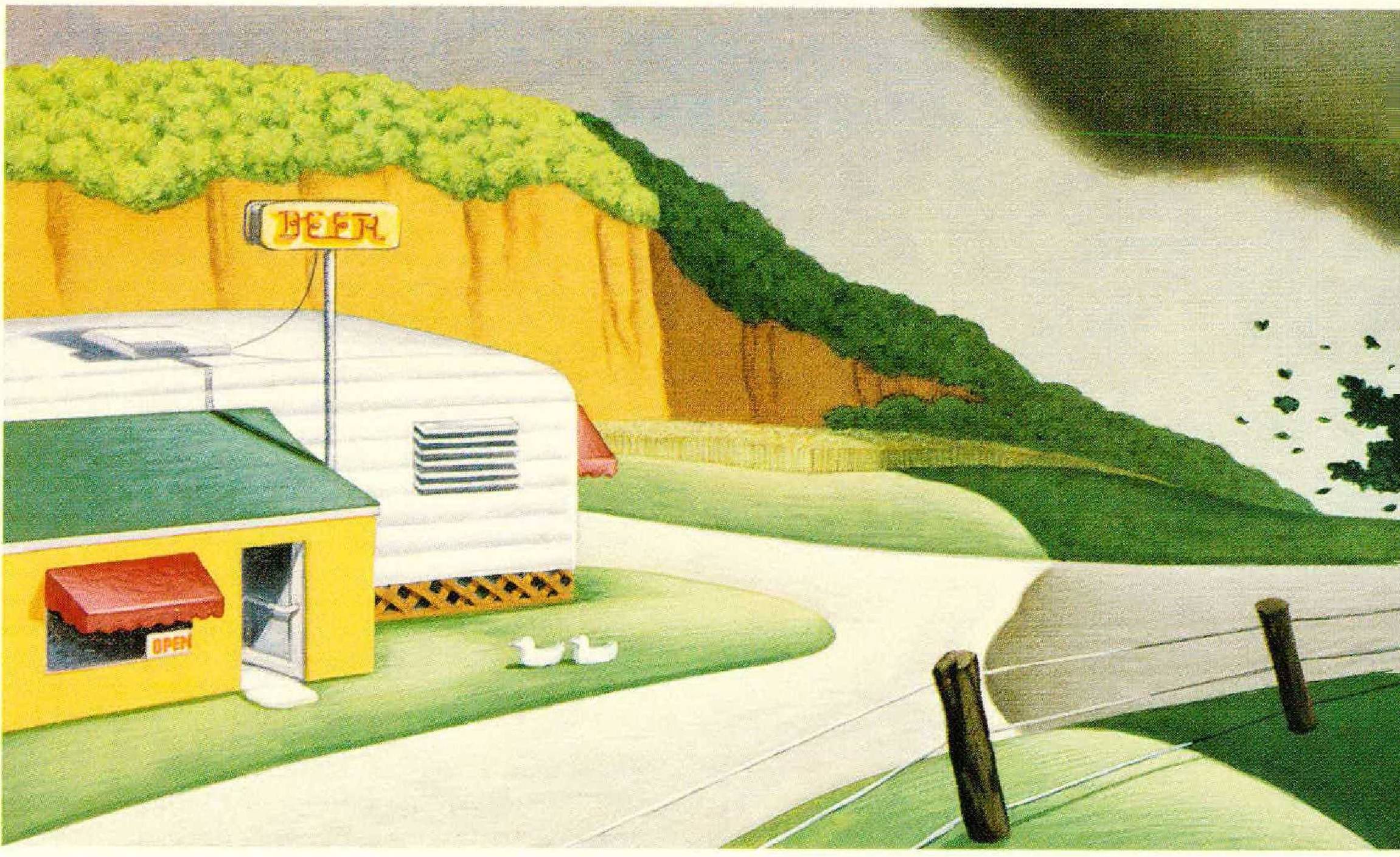
At the main road a washout cut them off from the blacktop. On the other side they could see Sweet’s Country Store. The fogged windshield glowed like a television screen; rods of hail and rain struck the macadam and rebounded in perpendicular strokes; across the way the trembling letters that spelled out BEER faded as the electricity died in the store. Suddenly the man trod on the gas pedal and the car launched into the washout, making it onto the blacktop before it stalled.
“We ought to get off the highway.”
He got out and pushed the car, and the woman pushed too, the roadway water over the tops of their shoes, the woman’s hair twisting into snakelets, and the smell of dye coming out of their drenched clothes. The red-coaled images of what they had seen were already taking on ashy crusts, cooling into memory. They ran for the store, splashing halos of water.
Inside, the woman shouted excitedly at Simone Sweet, who stood at the counter pumping up a gas lantern.
“Phone the police. People dead up there. In a trailer. Up that road.”
She spoke from the distance of the door, water draining from her saturated hem. The overhead light dickered; the beer sign glowed again. Simone pointed. The woman thought she meant for them to go outside with their wet clothes, but, turning, she saw the pay phone and the man fumbling for a coin.
THE store was in a river valley among scrolled corn fields that broke green against sudden cliffs. The road ran along the river, into the northern spruce, to Quebec. Because it went to Canada, the road had a blue mood of lonely distances and night travel.
A spring ice jam had forced the river onto the road. The water, charged with branches and dead leaves, got into the store, gleaming like brilliant wax, and ruined bags of potatoes, melted the labels off cans on the bottom shelves. For a few days farmers parked at the edge of the flood and sat in the cabs of their trucks, smoking and drinking beer, watching the slurring current. Someone said a drowned hog might have plugged a culvert. Finally a high school kid drove through the water, arm braced in the window, rooster tails spurting from the tires. One by one the watchers left, marking the macadam with muddy arcs as they turned around. The fogged cliffs buried their heads in rain; the dripping woods were as ill-defined as a grainy newspaper photograph.
THE Sweets lived in a double-wide with awnings and a picture window, set off by a scribble of fence and two plywood ducks. Their kitchen opened into the store. The side lawn was brown from close mowing. Albro rode the machine up and down every day, as though it were a horse that needed frequent exercise. At the center of the lawn were five boulders and an upended bathtub painted the bitter blue of a Noxema jar. A Madonna stood under the curve of the tub rim. In winter her crusted chin rested on snow and the boulders became humped penitents.
Simone, arms like dowels, a frizz of tea-colored hair, worked all hours in the store under the droning neons, surrounded by potato chips, candy, toilet paper, dry gas, adventure videos, the lottery machine. She made the brownies herself. A smell like that of the devil’s hooves came from the coffee pot beside the cash register. Under the counter she had a metal box of rolled quarters and a nail puller with a broken claw.
“What good’ll that do you?” Albro said.
“You wouldn’t care to get clipped behind the ear with it.”
Albro’s good looks had slipped over thirty-odd years. He had a shock of steel-colored hair, a congealed expression, oily hands picking over a strew of metal parts. A silvery scar the size of a beer cap marked one thigh, from the time when he was married to his first wife and had fallen raving drunk into a barbwire fence after a jealous fight because she knewhe was cheating with other women. That supple, hot-blooded self was still stored in his stiffening body, though long unused.
He was a night driver. A hundred times a year he eased open the door of the back room where he slept—the office, they called it: a desk buried in bills and receipts, a cot, a tumble of blankets—while Simone lay in the double bed in the front bedroom in the bleed of the yard light, her shoes crooked on the rug in front of the bureau like dead fish on a sandbar.
Sometimes he was out until morning light. Simone would hear the loose rumble of the wrecker pulling in and get up to start the coffee. Albro, stinking of cigarettes, would lean his elbow on the table and tell her what he’d seen as he crawled on the sweet note of second gear over the moonlit roads, pitted and obscure under the wheels.
“I seen two bobcats fighting or fucking in a ditch, one, don’t know which, anyway, blood on the fur.”
Wailing songs on the radio. In the rainy headlights the side roads glistered like roof flashing. He came upon disabled cars wallowing in snow or drunks passed out on their steering wheels. If they wanted a tow, he charged thirty-five dollars. Once, he caught a glint in the roadside alders that turned out to be a ring hanging on a twig, a ring set with chip diamonds. And, years back, that car with Arizona plates in a snowplow turnaround, nose pointed into the woods and the windows frosted on the inside with condensed breath, the dead man dimly visible through the pearly scrim of his past exhalations. Fragments of teeth across his jacket like red crumbs.
“Come all that way to do it,” Albro said.
Simone listened, spreading newspaper on the concrete floor, down on her knees to jab into the vending machine with a straightened coat hanger.
“Supposed to be rodent-proof, but there’s a mouse in there. Must weigh three pound now off the candy. You ought to stay away from a car pulled off the road. Get mixed up in it. You don’t know who’s in it. You ought to be taking care of the mice and rats eating us up.”
“Could be somebody needed a tow.”
“Ask me, you need a tow.”
How many times had he driven up Trussel Hill, the road bent like a folded straw before it went nowhere, seven or eight miles of uphill woods ending in Warren Trussel’s yard with its chalky, rake-ended trailer up on blocks, the thirdhand kind from the back of the lot. the kind with a space heater between the bedroom and the door? The mobile-home salesmen, laughing in their plywood office, called them roaster ovens. Through the trees Warren’s roaster oven resembled a sinking boat. Sometimes, when Albro pulled in, a mealy face loomed at the door, a flashlight ray stuttered over the lumber piles. Albro took his time turning around.
The trailer swam in a sea of junk auto parts, mildewed hay bales, cable spools, broken shovels and tractor seats, logging chains, the front half of a bus without windows or engine, a late-model wreck folded like a wallet. Plywood steps atilt, aluminum door decorated with a curlicued B in stamped metal, .22-shot into a twist.
“Prob’ly Warren done that,” he told Simone. “Fed up to see that B every time he opens the door. B for bum. B for deadbeat. He made them half-assed steps. Only trailer in the world without a dog. B for sonofabitch.”
“Don’t know how anybody can live that way.” Simone wiped the table and looked in Albro’s coffee cup to see if he was done yet.
She knew Warren. When she opened the store Friday mornings, he was there, as tall as a hen-yard post, wearing brown canvas overalls that stood away from his legs like tarpaper rolls, nodding his big panhead with its greasy cap. Down for the mystery bins and his lottery ticket. Sore-looking eyes. He pawed through the boxes of cans without labels and the frozen microwave dinners in mangled containers.
“How can you tell how long to heat up them microwaves, Warren?” Simone said in her pitched storekeeper’s voice. “No way to tell how long to cook them when the labels is half off.”
“Guess at it. Can’t tell what you get until you get it. Beans. Soup. Chinese shit. Cans is better. Know what the best ones is? Some a that dog food. That is kangaroo. That is good meat. Too good for goddamn dogs.” Heavy mouth with its frieze of cold sores, stubble over the jaw and down the neck into a fester of ingrown hairs.
He logged in winter if somebody came up with a short crew, in summer stacked boards at the lumber mill and picked up roadside bottles in company with Archie Noury. Sometimes he had a horse up by the woods for a few weeks, keeping it for somebody.
“Horses?" A farmer looked at Simone, his thick yellow hand on the counter a little in front of the quart of ice cream, three blackening bananas, a canister of ersatz cream. “Let me tell you something about Warren and horses. You know that old Dodge he drives? Thing hangs down so low its tits drag on the ground. You could put your fist through the side of the door. Somebody didn’t know no better give him two kids’ ponies to keep while they went off. He went to pick them up. He’s got this business rigged up there, a pole in the back to separate the ponies. Gets them in and takes off. On the interstate, doing fifty at most. Paper trucks on the way up to Quebec, semis going past him, sixty-five, seventy miles an hour. The ponies see them big tandems eighteen inches away. Warren gets to the bridge, they are over the water there, the ponies see the railing. A couple of trailer trucks pass Warren. He claims one of them hit the air horn. The ponies lose it, rear up, and one kicks the tailgate. Tailgate falls off and the ponies go out on the road. At fifty miles an hour, hitting the concrete and the trucks coming up fast behind them. That happened three years ago. And that’s Warren and horses.”
“Oh, my God,” said Simone, who had heard the story many times. “Was they hurt?”
“Hurt! I guess they was hurt. Killed. They was killed. Guts and blood all over the road. Traffic piled up. State trooper had to shoot ‘em to put ‘em out of their misery.”
“Guess I know somebody’s going to have banana splits after supper,” she said. Knew something else about him too—that he’d been seen coming out of a restaurant men’s room in another town, naked to the waist and blushing scarlet from belt-line to scalp. Shirt rolled up under his arm. Who could say what that was about?
ON Father’s Day, Albro went to see his sons by his first wife, Arsenio and Oland, twenty-eight and twenty-six years old and still living in the Homer B. Bake Training Home. They would never be trained for anything but raking leaves or sweeping the long, shining corridors, their hairy arms scything away the years.
Arsenio never knew him, but Oland said “Dad, Dad, Dad” like a mourning dove, whacking his pliant hands together in counterpoint. Unless it was raining, they stood on the lawn. Wooden benches faced each other like wrestlers. Arsenio’s waxy fingers clenched his broom. Albro stood alone and to the side.
“Well, here’s your dad again come to say hello and see how you’re gettin’ along,” he said. Arsenio’s face clenched like someone listening to a loudspeaker test. He began to sweep the sidewalk, and Oland, without a broom, swept with him. Albro walked beside them in the grass, doggedly reciting the year’s news.
“There was a break-in at the store and at first we thought nothing was took. But a day or so later Simone seen the shoelaces was all out. Somebody robbed the shoelaces. Imagine that. And there was a flood. Foot deep in the store. Elgood Peckox—you remember him, Oland, he give you apples when you was little—well, he died. Seventy-two years old. Cancer of the bowels.”
“Papple,” Oland muttered.
At the end of half an hour Albro handed each of the men who were his sons a two-pound box of chocolates, shrinkwrapped in red plastic. Arsenio, gripped by the passion of sweeping, let his box fall, but Oland tore the crimson covering and crammed the dark candies into his mouth. His eyes closed and a kind of ruined beauty shuddered over his face like the hide of a horse disturbed by flies. Although he tried to cramp it back, hopeless affection fluttered in Albro like a tic.
BEFORE Rose came to live with Warren Trussel, he went around with Archie Noury. Simone often saw them driving past in Warren’s old truck, heading out to pick up cans and bottles along the roadside for the deposit money.
“Can’t be much of a business,” Simone said. “They get, what, twelve, fourteen dollars’ worth of cans, if they’re lucky, for a full day of fooling around. Have to buy more gas for what they use up; that takes most of the money. They get two six-packs, get a pack of them generic cigarettes, and that’s it. Six beers and ten cigarettes for a day’s work. Reminds me, you ought to get at them potholes in the parking lot, ‘stead of fooling around with the mower.”
“Don’t know how somebody can live like that,” Albro mumbled.
One of the Nourys was a pastry chef, another the principal of an elementary school in Massachusetts, but the others were brawlers, knifers, crazy log-truck drivers known for taking corners too fast, rolling the load, and leaping clear, unhurt.
“That’s a rat’s nest of Nourys up in the Eastern Townships,” a farmer said. “You look in your graveyards both sides of the border, you’ll find plenty of Nourys. Most of them got there the hard way.”
Archie Noury had ginger hair, bloodshot eyes, and a scar down the middle of his nose that made him say, “What are you starin’ at?” He was greasily handsome, despite the scar, and bad-tempered. He glanced in windows and mirrors not out of vanity but to see whom he resembled, for his parentage was uncertain. A locket on a tarnished chain hung around his neck, tangled in his chest hair. No one knew what pictures were inside. Maybe Rose, maybe she knew.
IN the thick summer darkness, window cranked down for the cool, Albro pulled into Warren’s yard to turn around, to begin his homeward run. A parked truck blocked the way. He looked it over in the moth-shot headlight glare: an old bucket with a varnished board sign in the back window, CHEVY, the letters fashioned from popsicle sticks; a rack of maple poles with the bark still on; and two bumper stickers—on the driver’s side HIS, on the passenger side HERS. Then somebody came up beside him and pressed the mouth of a side-by-side 12-gauge into the soft flesh of his neck. He smelled vanilla, and swiveled his eyes to see a huge woman with hair billowing around her head like crimped silk.
“You’re the booger turns around in the driveway. Warren don’t want you to do it. So you better get out of here. This is private prop’ty.”A creeping flashlight beam came out of the trailer door and slid over them, lighting up her yellow flaring hair and Albro’s surprised hands gripping the steering wheel. He couldn’t say a word at first, but got his voice back when she lowered the gun.
“Hell, I didn’t know nobody lived up here, thought the trailer was empty. He should of said something. End of the town road, no place to turn around.”
“Is now. He cleared out over there.” She pointed across the road with her chin.
Albro backed across into a slot of stumps and rocks that chewed his tires, turned, and passed the trailer. She was up on the steps, Warren holding the aluminum door open for her with his foot, his flashlight twitching. The bumper stickers on the Chevy truck blazed, and he saw where she’d tried to scrape HIS off.
A mile or two down the hill he pulled onto a logging road, drove into the ash whips, stopped, turned off the motor, and lit a cigarette. His hands trembled. He couldn’t stop seeing the purple mouth like melted crayon, the yellow hair; he still felt the shotgun’s hard snout.
At first light he was drinking coffee in the kitchen, and Simone was mixing brownies for the store. The window fitted around a sky like milk. She tilted a bottle; a fragrance rose from the bowl.
“What’s that?”
“Vanilla, same as I always put in.”
She looked at him. “When you gonna do something about Robichaud’s garden tiller? Been settin’ there for weeks, and they come by twice, see if it was ready.”
FRIDAY morning Albro rode his mower around the lawn in wet heat, starting from a central point known only to him and working outward in a spiral. The river lay between its banks like molten lead; the cornfields were as flat as wallpaper. A farm truck dragged past in a hot clatter. Around eleven the Chevy truck with the pole rack pulled in.
Warren Trussel jumped down from the passenger side and went into the store. The fat woman followed him, hair like cascading heat over her magenta dress, a huge bell of fabric. Two laps of the lawn, the mower vibrating under his buttocks, and Albro saw them come out, Warren with his box of mystery cans. The woman said something and he went back in. She stepped onto Albro’s lawn and waited at the edge for him to come around.
He stopped the mower but kept it running. The engine’s tremors shook his flesh. She came up to the machine. The smell of vanilla mingled with exhaust. He stared at the lawn as if his interest were grass. Warren came out of the store again, got in the truck, and bent forward to drink from a can.
“Didn’t know you was the storekeeper’s husband; thought you was some troublemaker. Warren says it’s okay if you turn around in the yard. Says it’s okay, do whatever you want.”
From the corner of his eye he saw Warren drain the can and turn toward them, his head framed in the passenger window. Albro cleared his throat. Quickly the woman’s hot, ringless hand went to his groin, squeezed. She walked back to the truck, her sheet of hair flashing in the sun like signals. He threw the mower in gear and finished the lawn before he went in the store. Simone was wiping out the refrigerator case.
“How do you like that?”
“What?” Albro said.
“Who Warren had with him. I seen her over there talking to you. You know who she is, do you?”
“No. She wanted to know what time it was.”He held up his left arm with its stainless-steel watch.
“She’s Archie Noury’s wife. Rose Noury. Left Archie, come to live with Warren. For how long, who knows? What I call leaving the frying pan for the fire. There’ll be trouble over it. Archie Noury will make trouble. I remember Rose at school, big fat thing even then, a big fat slob. Wish it would rain and cool things off.”
“Sooner or later.” he said. He fished in his pocket, came up with a dollar and a quarter, and laid it on the counter. He took a brownie. For the smell of the vanilla. It was not enough. Later he sneaked a small bottle off the shelf and slipped it in his pocket.
MILES away Archie Noury was sharpening an umbrella spoke, whetting the points of his hunting arrows, throwing his deer rifle up to his shoulder and dry-firing, flinging a knife at a post, punching at his mirror image, whirling to hit the surprised air.
“Nobody pulls nothin’ on Archie Noury!" he shouted. “You like that?” he yelled at the gouged post.
HOT, listless days went by. There was thunder in the night, but no rain. Albro fooled with the garden, got the lawn down to stubble. He stayed home, watched the late programs with Simone, slept or didn’t sleep in the back room.
Wednesday the white air shuddered with heat and the hazy cornfields undulated. Simone had a fan going, the wash of hot air riffling the real-estate guides on the counter. Albro was in and out between the store and the garage. He was messed up. a snake eating its tail. He couldn’t think of anything but the hot, ringless hand, the big haunches under the dress. He couldn’t stand the waiting, until night and its coolness.
After the late news Simone went to bed, where she lay listening to the wawl of trucks on the road, the sound of water running into the bathtub. She was awake when he drove out of the yard.
HE turned in the stump-pocked cut, drifted past the trailer, and there was Rose, leaning against a pile of boards. His wet hands slid on the steering wheel. His chin was smooth, hair still damp; he wore clean underwear, the pastel-yellow boxer shorts that Simone bought at Ames, three to a package. Rose was walking to him through the darkness.
“Hey, ain’t it hot? What took you so long? Thought I was gonna see you before this.” She was in the seat beside him, the interior light briefly on her face, the huge arm shawled in bright hair.
“Where you want to go?” He listened to the engine beating and turning.
“Nowhere. Just pull in behind my Chevy.”
“Here?” He was appalled. “What about Warren?”
“Warren! He don’t have nothing to do with it. Just park there, it’s okay.”
But he wanted to go to the old logging road, get in behind the ash saplings. No, sir, he said, he wasn’t going to park in Warren’s yard. In the trash and the dirt.
“C’mon,” she coaxed. “It’ll only take a minute.”
A minute wasn’t what he had in mind either. He said nothing.
“Well, then, I’m goin’ back inside,” she said. The event, which for days he had imagined as a luscious, secret hour behind the leaves, rotted in her purple mouth. Everything was screwed up.
“All right.” He jerked the truck up behind the Chevy. HIS. HERS. He turned off the engine and the lights, trod the emergency-brake pedal. She was at him, agile for such a fat woman. And it did take only a minute, ending with a burst of light, his wide-open eyes seeing a flash that illuminated a pile of logs and some chicken bones
and eggshells raying from a burst garbage bag.
“What was that?” His numb mouth mangled the words.
She laughed. “Oh, prob’ly only Warren, shinin’ his flashlight around. Heat lightnin’.” She was already out of the truck. “Maybe a car comin’ up the hill. Maybe somebody comin’ to turn around in the yard ”
“Maybe Archie Noury,” he said meanly. Seven minutes after he’d pulled up, he drove away. He was sorry he’d wasted the hot water on a bath.
By the time he got to the bottom of the hill, he was sure it had been Warren Trussel crouched on one of the lumber piles with a flashbulb camera he’d stolen somewhere. The thought of Warren made him sick. Dirty trash like that. Warren and Rose. He gagged.
ARCHIE Noury started to drink early the next morning. He began with a dreggy swallow of Old Duke from an almost empty bottle in the stifling outhouse, switched to warm beer at 7:30, found a quarter of a pint of cheap tequila tucked away in the glove compartment of the truck, and then, at noon, drove down to the shopping mall, cashed in his deposit bottles, and bought a fifth of Popov. The bank thermometer read 92°. He drove with the bottle between his legs, the neck sticking up like a glass hard-on. He looked at himself in the rearview. “Bam,” he said. “Bam, bam. Thank you, ma’am.”
ALBRO couldn’t get the motor started. He could hardly breathe the thick air. Around one o’clock he went into the store. “I got to go get a part for the mower,” he said.
“If this heat don’t break soon,” Simone said. She regarded the shimmering road, the distorted shapes of passing cars and trucks. She started to say something else, but Albro was already outside, his hand on the door handle of the truck.
He came back late in the afternoon under knobby blue thunderheads pulsing with lightning. His face was gray and sweaty; he wiped at his mouth as if he’d eaten fried meat.
“What’s the matter,” Simone said, “heat got you?”
“Nothing.”
“Looks like we’re going to get it.”
He went out to the garage to work on the mower.
THE Jehovah’s Witness man could not dial the statepolice number, his hands were shaking so hard. He had thought he had things under control, but this shaking had started. The woman took the quarter out of his hand, dialed, did the talking. After she hung up, she bought a bottle of pop from Simone.
“The police cruiser is coming,” the woman said, and retold what she had seen—the fat naked body, the bloody foot; the roasting chicken, burned up by now; the heat, the washed-out road.
“We ought to pray,” she said, looking at the man, who stood off by himself, gazing into the rain. She put her chin down and folded her hands. “I believe in the love of Jehovah and its power to—come on, pray with me.”
“I believe in love . . .,”the man said.
Simone said she had to run over to the garage for a minute. She held a folded paper bag above her hair, dodging through the downpour.
Albro leaned against the edge of the workbench at the back of the garage, the oily fingers of his right hand pulling the fingers of the left. The bench was littered with tools and empty brown vanilla bottles.
“Well,” Simone said, “there’s two Bible nuts, just come down from Warren Trussel’s place. Say they are both dead on the floor. Called up the police.”
She squinted, and made out the blue bathtub and its Madonna in the streaming rain through the window behind him. “It’s really coming down.” The cotton dress hung damp on her stick bones.
“Um,” he said.
She sighed, walked over to the door, and opened it.
“That’s the cruiser. They got here fast enough.” She held the damp hag over her head, ready to make a run for it. “Now, I’m going to tell you something. You shut up. You hear me? You just shut up,” she said.
He knew that much, anyway.