The Okavango Delta: Where the Elephants Roam, and the Kudu and the Impala Play
by Edward Dolnick

Go TO AFRICA’S most famous game parks and you will see glorious animals, but, in Kenya especially, when you see them you may find yourself parked in a phalanx of mini-vans. The effect is as off-putting as having to fight through the summertime crowds at the Louvre to catch a glimpse of the Mona Lisa.
But Africa still has huge tracts of land that are lush with wildlife and almost devoid of tourists. One of the best is the Okavango Delta, a hybrid of desert and marshland in northern Botswana. In a week or two of game viewing the members of your group might not see another person. And the touring itself has an improvised quality that is rarely possible elsewhere. In much of Africa visitors are obliged to stick to the roads. In Botswana if you spot a family of giraffes or a herd of zebras thirty yards away across a field, you can ease your way up to them.
You can ride in open Land Rovers that have no windshields or doors or sides. Sitting on cushioned benches mounted in the rear of the vehicle, you are often closer to the animals than you would be at a zoo, and there is nothing between you and them. (And nothing between you and the sun. Bring a hat with a big brim.) In many countries tourists are ferried about in closed mini-buses or “pop-top” vans, with a hole in the roof to peek out from.
Botswana is a landlocked country just north of South Africa. It is a parched land (pula, the word for “rain,” is also the name of the unit of currency), with the exception of a swath across its northern edge. That region is flooded annually by the Okavango River, which rises in Angola and flows southeast into Botswana. One of the few major rivers that never reach the ocean, the Okavango peters out in the Kalahari Desert, forming innumerable channels and lakes. Eighty percent of Botswana is desert, and the Okavango Delta is a beckoning oasis, the largest in Africa.
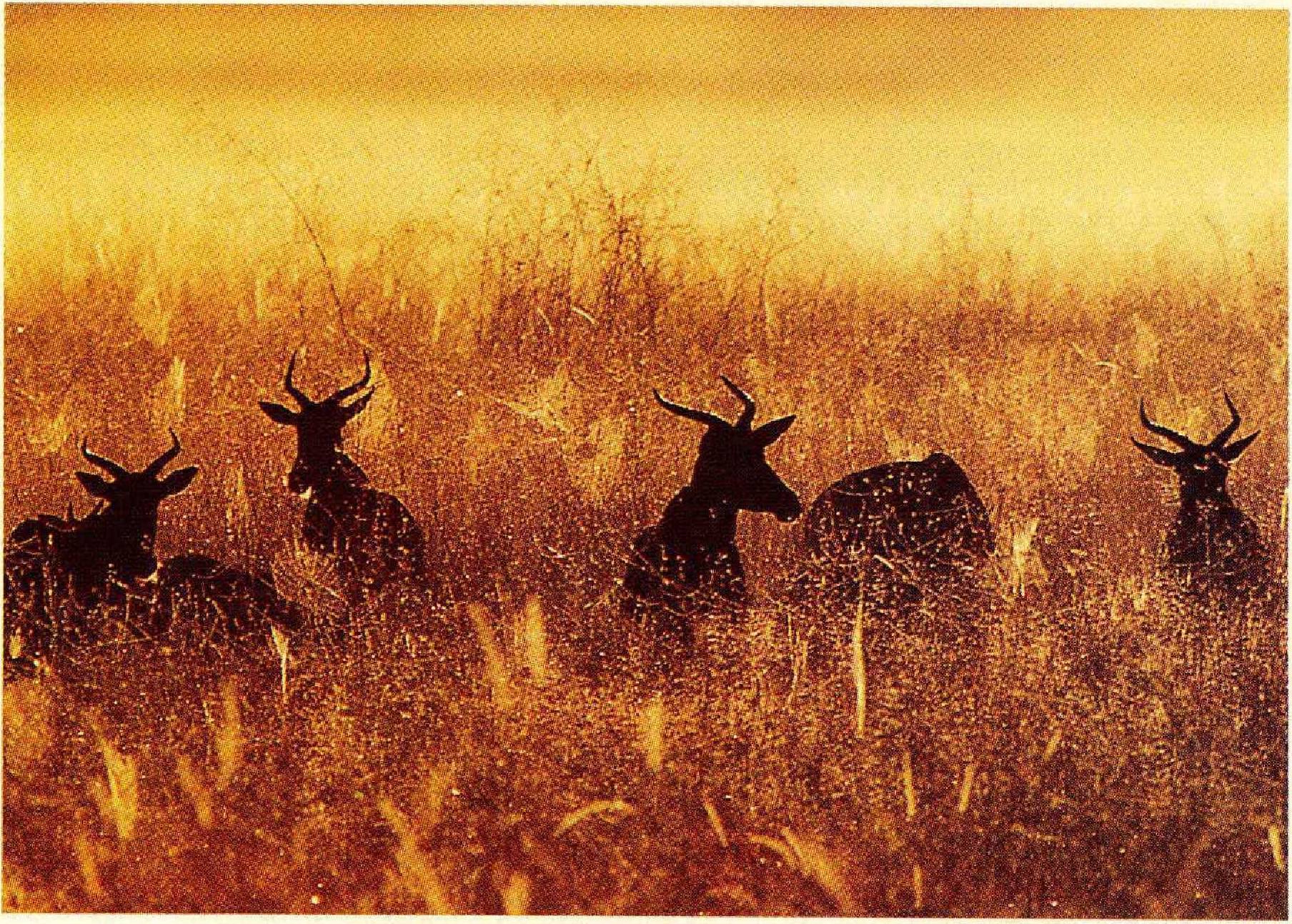
So the delta and its environs teem with game. Antelopes are everywhere —small, graceful impala and timid kudu and gregarious sassaby—and zebras, and the lions who prey on them, and giraffes and wildebeests and Cape buffalo and elephants. Most of these animals are familiar from zoos and television, but in Africa you are in their territory. There’s a magical intensity to the experience when you round a corner and happen on two adolescent elephants roughhousing in a river, or come across a sleepy lion eyeing a nearby warthog and deciding whether to attack. The difference between watching wild animals on TV and discovering them by chance is as great as that between watching a love story and falling in love yourself.
The thrill of never knowing what you will see next comes at a price. There is always a risk that you will not find the animals you’re looking for. During the two weeks I spent in the delta, the group I was with scanned every tree we passed for leopards, but never saw one. The closest we came was an antelope skeleton on a branch about a dozen yards above the ground: leopards like to carry their dinner up a tree so that they can eat in peace.
One of the highlights of our trip came during a slow stretch. Late one afternoon we spotted a giraffe about a hundred yards off, across a field. Veterans of a week in Africa, we were nonchalant until we were about twenty yards away. On the ground lay a baby giraffe, perhaps an hour old, and still wet. It had not yet stood up for the first time. The mother stood guard, impassive and immobile.
The baby barely moved, a compact brown-and-yellow package. Several times, at about five-minute intervals, it unfurled its neck and looked around, blinking, at the world. Then it began trying to stand. Half an hour’s attempts came to nothing, despite our silent encouragement. At last it managed to heave itself high enough to unfold first front legs and then back ones.
Six feet tall and wobbling like a beginner on stilts, the newborn giraffe tried to maneuver close enough to its mother to nurse. First the newborn stumbled against her side, and then it approached her chest rather than her belly. Finally, frustratingly, just as its target came into view, it tumbled over an unseen branch and took a fulllength pratfall back onto the ground.
We would have driven by and missed everything, but for our guide, whose eyes seemed more than a match for our binoculars. He was Botswanan, as was another of our guides. We also spent time with a grizzled Kenyan guide of fifty or so and a chirpy American of about thirty. The Botswanan guides were black, the other two white. Black guides are surprisingly rare, for safari companies seem to believe that their overwhelmingly white clientele prefers white guides. The Botswanan guides had never traveled outside their country and were full of questions about America. “Are there black people in your country?” one asked.
All the guides were vain about their tracking skills. While they drove, they kept a careful eye on the ground to see what animals had been by. Lions are especially easy to follow, for they prefer sandy tire tracks to thorny fields; our guides speculated that the sand is easier on their sensitive paws. And when you do get close to lions, their place atop the African hierarchy is clear. Lions sleep in the open, often on conspicuously raised anthills, as if to flaunt their status.
Two of our four guides had been nearly killed by wounded lions while taking clients hunting. Soren, the Kenyan, had been left with a mangled arm. What saved his life, he said, is that the lion didn’t know what to make of a two-legged victim. A lion kills a 1,500pound Cape buffalo, say, by jumping on its back, putting a paw to its mouth, and pulling back sharply, so that the buffalo breaks its neck as it falls. The lion leaped on Soren from behind a bush, ripping off his left biceps with a swipe of a paw, “He grabbed me by one arm, shaking me in his mouth like a terrier shakes a rat. Then he grabbed the other arm and gave that one the same treatment.”
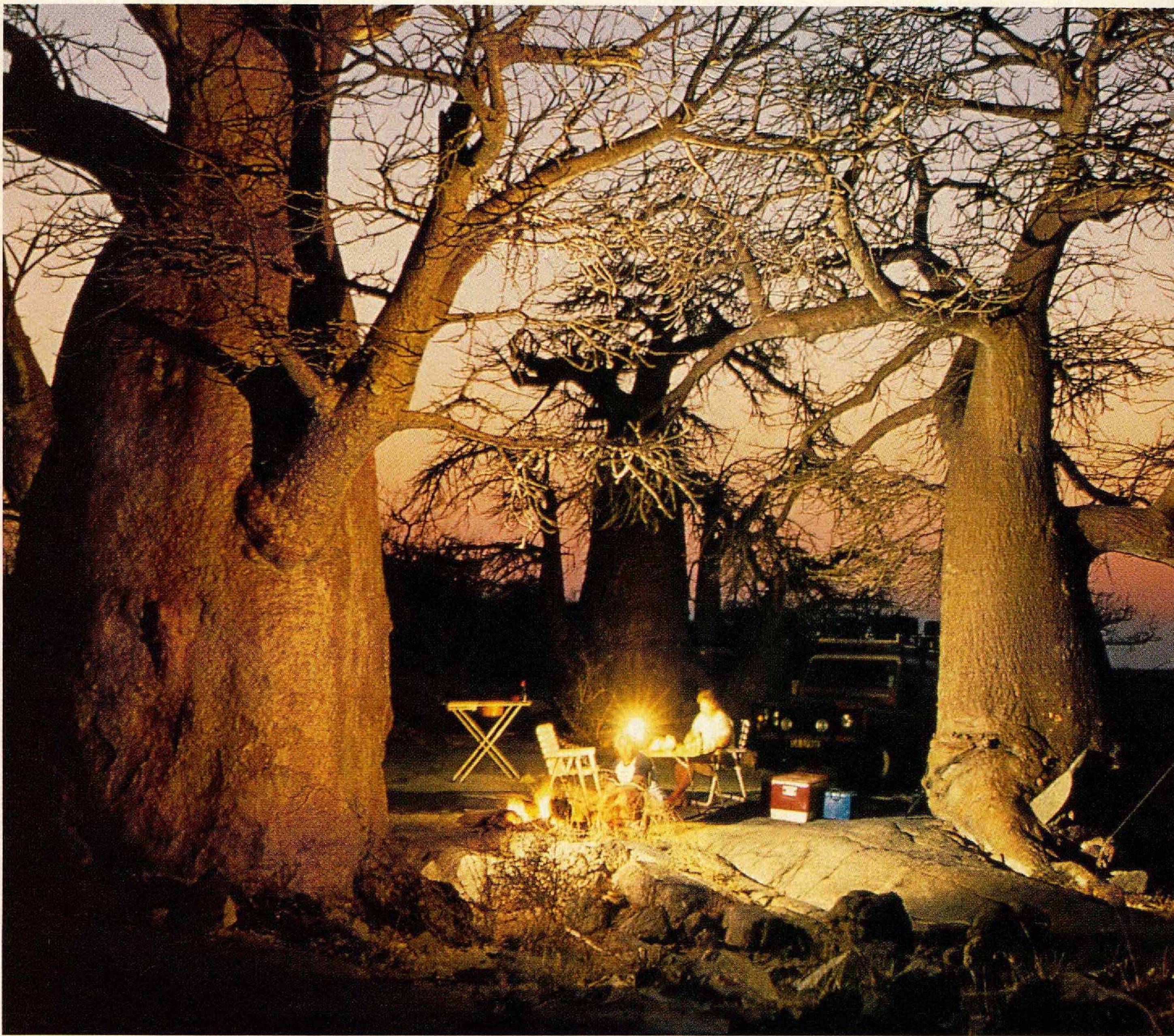
We heard that story round a campfire one evening. Talk spilled out at night, one of the unexpected pleasures of the trip being that days were almost perfectly quiet. Voices spook the animals, so once we had settled in near a herd of elephants, say, and the engine had been turned off, there was no sound but birdsong and the noises the elephants made. But evenings by the campfire were a time for storytelling and brief nature lessons. Hippos bellow like lions with head colds, we learned. Baboons holler “Wahoo! Wahoo!” Reed frogs keep up a steady chiming that sounds like rainfall on a glass roof.
We needed no lessons to identify a lion’s roar. We first heard the sound, which carries a mile or more, just after nightfall, when we were on a drive, equipped with a hand-held searchlight. The guide swept the light back and forth slowly, painting a yellow stripe across a black canvas. Almost at once the light caught eyes gleaming red or blue; the same “eyeshine” turns human eyes red in snapshots.
Within minutes we saw a crocodile, a few Cape buffalo, a fishing owl. Strangely, they seemed oblivious of the light. Then our guide whispered, “Lion!” and veered sharply across a field to get closer. A female was slinking along, a male a few yards behind her. All was blackness outside the beam of light. These lions, our guide whispered in response to someone’s nervous question, were interested not in killing but in mating.
We followed alongside at a distance of about twenty feet. The lions ignored us. Suddenly, still in the blazing spot of light, the female stopped and crouched facing us. We stared anxiously: was she preparing to pounce? No, the guide had been right. While we watched goggle-eyed, the male mounted her. Lions mate for only twenty seconds or so at a time, but do so as often as fifty times in twenty-four hours. These two quickly walked apart, and we followed the male. Annoyed with us now, he stood facing us head-on and snarling. We turned the light away and prepared to drive off. At once the lion was undetectable in the blackness.
ALL OF BOTSWANA’S strong points arise from the same source: the country is so sparsely populated that people and animals are not yet in competition. Botswana’s population is 1.2 million—one fourteenth that of Texas in an area about the same size.
Tourism is only the fourth largest industry. Diamond mining, cattle ranching, and copper mining are all more important. The greatest threat to wildlife comes from domesticated cattle, which outnumber people three to one and need broad expanses of land to graze. In the past, farmers stayed out of the Okavango Delta, because it was infested with tsetse flies, which carry a parasite lethal to human beings and livestock but harmless to wild animals. A spraying program, however, eliminated the tsetse about a decade ago and exposed the Okavango to the threat of development. Conservationists hope that well-managed tourism will provide a cash incentive to keep the delta wild.
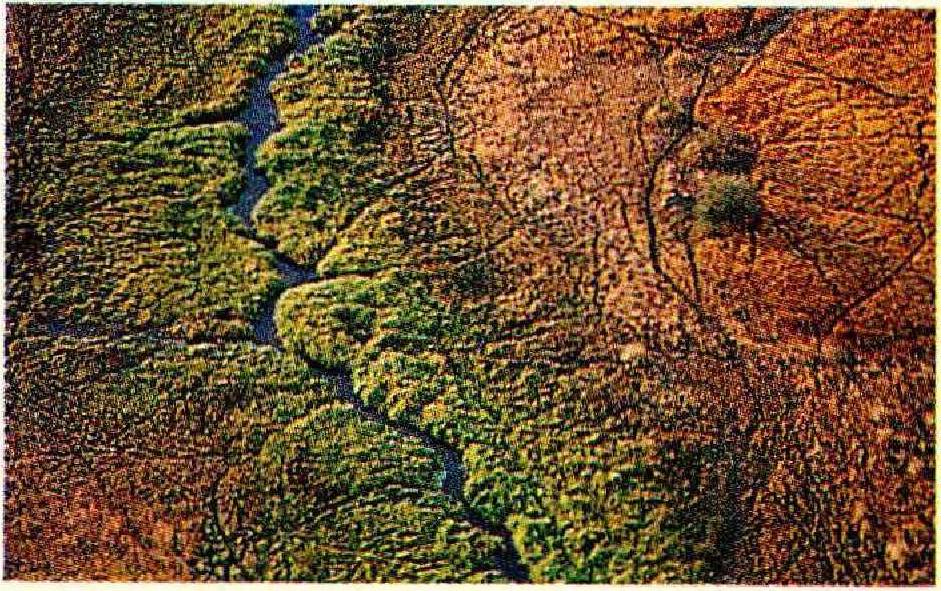
The Okavango has no paved roads, no telephones, no electricity beyond that provided by the generators at some campsites. Fly overhead and you may well see no man-made landmarks at all. The only “buildings” you are bound to see are termite mounds, some rising as high as thirty feet, dotting the landscape like anthills gone mad. You may pass over an occasional village of a dozen or so thatched huts or glimpse an unused road meandering through the trees, but man has not shaped this region.
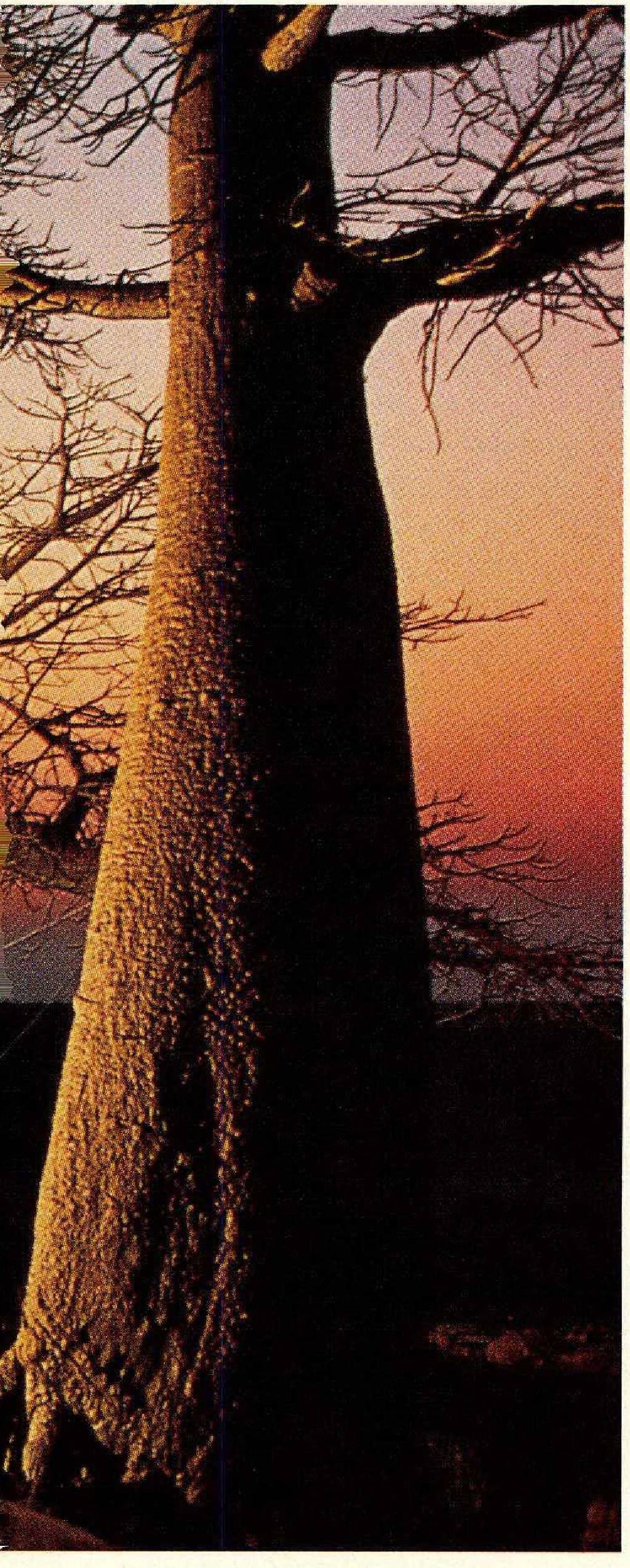
It is a strange, flat, wild-looking land. This is not the Out of Africa scenery of Kenya, with Kilimanjaro rising majestically to the heavens. The landscape has soothing stretches of green, but yellows and tans and grays predominate. The ground is as often salt or sand as grass. Here and there you may happen on a deer-filled meadow seemingly transplanted from the English countryside, but a closer look will reveal that this meadow is sprinkled with acacia bushes and baobab trees, and the deer are really antelope, and there are zebra just behind them and vultures overhead.
Where elephants have been, enormous fields lie devastated. Working with tusks and trunk, an elephant is a relentless bulldozer—and we saw a herd of three hundred. Every tree in a field, hundreds upon hundreds, will have had its leaves devoured, its bark stripped, its branches torn off. The underbrush is gone, the ground pocked with platter-sized footprints. If the battles of the First World War had taken place among baobab trees, this is how the aftermath would have looked.
From the Botswanan perspective, the question of whether the sale of ivory should remain banned is confusing. The number of elephants in East Africa is falling sharply, because of poaching, but Botswana is relatively free of poachers and its elephant population has more than doubled in the past decade. With the sale of ivory banned, our guides insisted, in the eyes of the local people elephants are nothing more than destructive pests—moles on a colossal scale. The guides, and many conservationists in southern Africa, argue that elephants will survive only if they bring money to the local economy. They would like to see the elephant population stabilized at some optimal level and ivory from the “surplus” elephants sold.
Elephants live on the outskirts of the delta. The heart of the Okavango is too marshy for them and for most big game. But the delta’s floodplain has its own attractions. It is beautiful in a postcard way, with endless vistas of tall yellow-green reeds. Gliding slowly and quietly across the water in a dugout canoe, one begins to sightsee on a smaller, finer scale. There is time to notice the purple underside of a lily pad or the brown-and-white swirls of a painted reed frog. When a herd of lechwe—water antelope—gallop across a shallow channel, the roar comes out of the stillness like a locomotive.
The countless channels twisting through the delta are cleared by hippos, eating as they go. They spend their days afloat, islands of gleaming brown with beady eyes and gaping mouths. They do all their eating after dark, each night consuming some ninety pounds of grass apiece. Deep in the delta, untold hours from the nearest lawnmower, every riverbank looks as if a team of gardeners has been painstakingly at work.
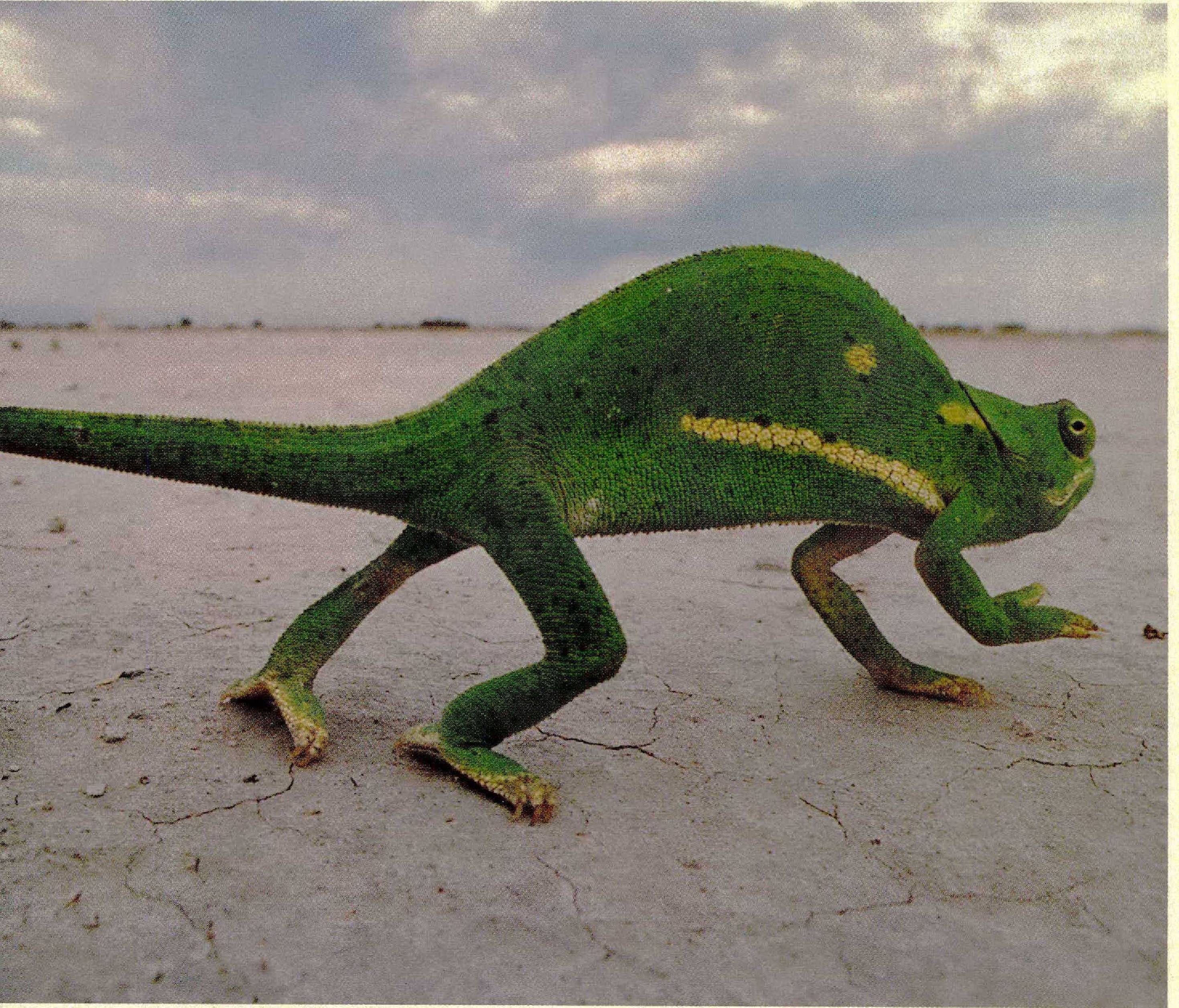
The birdlife throughout the Okavango may be unsurpassed anywhere. African birds are as strange in comparison with American ones as giraffes and zebras are with horses. Two birds that fascinated me were the tiny, gorgeous malachite kingfishers, which preen like models on a runway, showing first one iridescent side and then the other, and the huge, ugly Marabou storks, with pink bald heads and fleshy necks. Countless others fill all the intervening niches of size and attractiveness.
JULY THROUGH September is the best time to visit. Around November the fickle rainy season begins, and the animals disperse and become hard to find. The weather in the dry season is dependably good, though fiercely hot. The temperature falls into the sixties at night but rises into the nineties at midday. As a result, game viewing is generally scheduled from about eight in the morning to noon and again from three in the afternoon to seven. In the middle of the day it is hard to contemplate doing anything more strenuous than sitting in a beach chair in a shallow lagoon, sipping a beer and watching elephants browse on the far shore.
Botswana has relatively few tourist camps and lodges. Those that exist are small, typically with twelve or sixteen beds, as compared with the fifty to 200 that one might find in East Africa. My group consisted of nine friends and relatives, and we had each of the three camps we visited to ourselves.
The camps were good, more tempting than the lodges, and some were almost luxurious. The best consisted of some eight or ten permanent tents— big ones, fifteen by nineteen feet and about eight feet high at the peak—with attached hot showers and flush toilets, and beds with sheets and blankets. Laundry was done daily.
The food was plain but good, eaten communally around a large table. Breakfast, at about seven, was simply coffee and toast or cereal. One day lunch, after several hours of game viewing, was sausage and eggs, and another spaghetti and salad. Dinners were substantial affairs, with plenty of beer and wine. Some of my favorite dishes were bream, after someone had been fishing, T-bone steaks, and beef curry. Soups were given a jolt with a splash of chili ho-ho, a fiery homemade sauce of sherry steeped for weeks in a bottle with an inch or two of garlic cloves and hot peppers. The bread, which was excellent, was baked in a metal box set in the ground and smothered in hot ashes.
A safari that involves staying in such camps costs about $200-$300 per person per night, depending on how much flying between campsites is included. Those who don’t want to pay to be pampered can go on a true tenting safari, pitching camp each night, for about $175 per person.
Make careful plans in advance. This is not a part of the world where amateurs can improvise. Choose a travel agent who specializes in Africa and knows firsthand the specific places you will visit. Deal with an agent who books trips with several tour companies rather than just one, so that the agent has no vested interest in steering you to a particular itinerary. Two good travel agencies are Into Africa (Lynn Glenn, 203-869-8165) and The Africa Adventure Company (Mark Nolting, 800-882-9453). Nolting’s book African Safari is the best comparative guide to game viewing across Africa.
Travelers to Botswana typically arrive via South Africa or Zimbabwe. Consider spending a day unwinding at the Victoria Falls Hotel, a short distance across the Botswanan border in Zimbabwe. A masterpiece of colonial self-congratulation, this grand hotel was built with a view not of the waterfall but of a suspension bridge across the Zambezi River. The falls, a mile of thundering glory, are an easy fifteen-minute walk away.
The falls conjure up thoughts of timeless, enduring Africa. Reality is less romantic. In wildlife-conservation circles, starry-eyed optimists are people who believe that things are getting worse slowly rather than quickly. See Africa before it’s gone. □