An Asian Agenda
Travel
The biggest cities aren’t always the best
by James Fallows
PEOPLE TRAVELING in Asia have a natural tendency to focus on capital cities—Tokyo, Bangkok, Seoul. The international airlines go there; the hotels are modern and the clerks speak English; businesses, universities, and museums are concentrated in one place. In many Asian countries the capital dominates to a degree that no single city has ever dominated the United States. Greater Tokyo is Japan’s equivalent of New York, Washington, Boston, and Los Angeles combined. In the past decade Thailand’s industrial output has soared, but if you exclude businesses based in or near Bangkok it has barely changed.
The imbalance between metropolis and hinterland is a big social problem for Asian societies, as it is for Third World countries in general. Subsistence farmers in Java or rural Thailand know they must go to the capital if they want to educate their children or find a paying job. But the same imbalance also creates opportunities for a “second city” approach to travel. Precisely because so many of the bad (as well as good) effects of modernization have been shunted away from most sites except the capital, the smaller cities in each country can display the nation’s character to advantage.
The “second cities" I have in mind are not always exactly second-ranking in population and economic strength. What matters is that they are large enough to be interesting but don’t suffer the distortions of being No. 1. Kyoto is the classic second city, a showplace of traditional culture— Asia’s counterpart to Florence or Leningrad. The cities in Asian countries can generally be divided into “Tokyo” and “Kyoto” categories. Those in the first category, today’s capitals, are where you go to do your business and realize your ambitions. Those in the second, often yesterday’s capitals, are where you drink in the atmosphere and look around.
Seoul has skyscrapers, a few historic gates and temples, and lots of pollution and traffic jams. Kyongju, in southeast Korea, was, like Kyoto, a capital a thousand years ago and is now a city of temples and shrines. Such bustle as Malaysia has is confined to Kuala Lumpur. Malacca and Penang, Malaysia’s two second cities, would remain recognizable in their torpor to Graham Greene or Somerset Maugham.
My favorite illustrations of the second-city principle are in Southeast Asia. In Thailand, Indonesia, and Burma, travelers who make it beyond the capital will have a much different and more satisfying experience than those who stay on the big-city route.
BANGKOK, Thailand’s No. 1 city in every conceivable way, will someday provide rich material for a writer or film-maker who wants to show, as Dickens did with London in the mid-nineteenth century, how cruel and messy economic growth can be. For the past decade the city has been booming and many people have gotten rich, but daily life for most people seems to have gotten worse. The bus stations disgorge rural migrants who end up sleeping in shanties. The roads are so glutted with cars and the motorized carts called tuktuks that the traffic stops and the air turns brown. Chiang Mai, Thailand’s second city, has fostered enough of a spillover tourist industry that old-timers complain that it, too, is being “ruined.” I think it still has a long way to go.
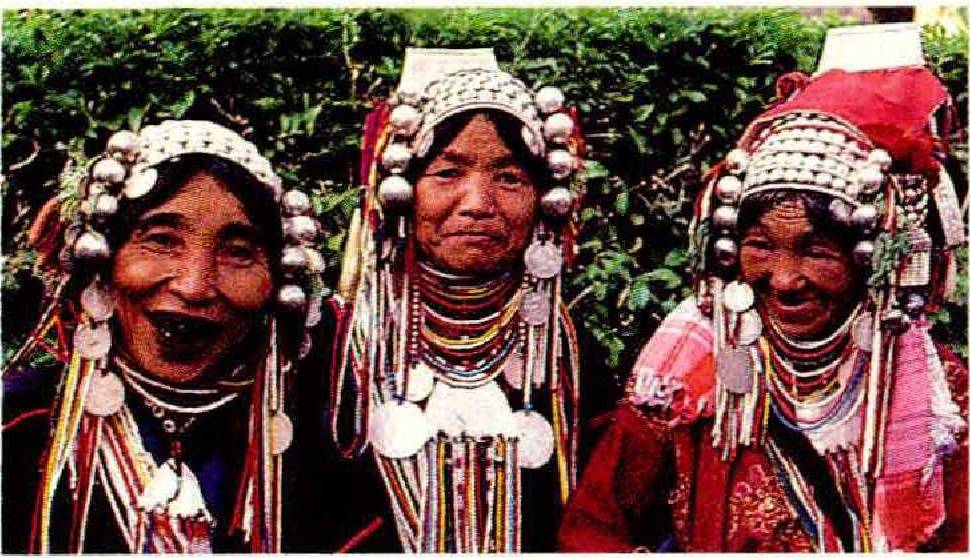
Chiang Mai is near the northern tip of Thailand, in the vast highland zone that spreads across the nearby borders of Burma, Laos, and China’s Yunnan province. This region includes the infamous “Golden Triangle,” where much of the world’s narcotics supply originates. Anthropologists flock here to study the dozen or so hill tribes, such as the Hmong, the Akha, and the Lahu, who move across national borders, practicing slash-and-burn agriculture as they go.
Chiang Mai itself has a fresh-air upland feel after the humidity and dirt of Bangkok. It was the capital of the independent Lanna Thai kingdom 500 years ago, and the old moat is visible below the restored city walls. Just outside the city is the leafy, improbably Wellesley-like campus of Chiang Mai University. Its front gate is dominated by the university seal, which depicts an elephant brandishing the torch of knowledge in its upraised trunk.
The city is distinctly a jumping-off point at the edge of the frontier. Thais are always coming in from the hills with tribal crafts to sell and, of course, with drugs. (If this, unwisely, should be your interest, bear in mind that U.S. Customs pays close attention to travelers who have visited Thailand.) And foreigners are always heading out of Chiang Mai on hill-country treks.
I am sure that anthropologists would deplore the superficiality of these journeys. Even I was depressed by the typical one-day trip that hotels and tour companies offer. As the huge “trek" bus rolls up to each “authentic village,” the gaily costumed tribesmen pop out to their assigned places at souvenir stands. But my wife and I went on a three-day trek toward the Burmese border that was authentic enough for us. It began with a fourhour drive in the back of a pickup truck, then a three-hour trip upriver in a motorized canoe, and then what seemed like a month but was actually two hours in a howdah on the back of an elephant as it swayed and lumbered up steep hills. We traveled the next few days on foot and slept in villages that may not have been “unspoiled” but were certainly unimproved. As we walked on mountain trails overlooking glades full of swaying opium poppies, I speculated that the “supply-side” policy, which would attempt to solve America’s drug problems by cutting off the source, was touchingly ambitious.
You can get to Chiang Mai from Bangkok by taking either an hour-long flight on Thai Air or a relatively comfortable overnight trip (be sure to book a sleeper) on the national railroad. It’s possible to rent a car and make the drive in twelve or so hours, but as in many developing countries, driving is not really safe. Chiang Mai has modern hotels—we stayed at the Chiang Inn Hotel—and numerous hostels.
INDONESIA HAS not been as aggressive or clever as Thailand in promoting tourism, but in a way its artlessness underscores its appeal. Indonesia is the most exotic-seeming place I have ever been: the Indonesians seem to be so wrapped up in their own culture that they don’t much care what outsiders might think of them. When you step out onto a street in Indonesia, you are enveloped by clouds of clove-scented smoke from the local kretek cigarettes. I used to think of this as an obvious but apt symbol for the distinctive “atmosphere” of Indonesia. When you are lucky, you are enveloped as well by clouds of music from gamelan orchestras, with their ethereal bronze or bamboo gongs.
The traditional stronghold of Javanese arts is Jogjakarta, 300 miles southeast of Jakarta, in the center of Java. Jakarta itself, Indonesia’s No. 1 city, is huge and sprawling and ugly. Jogja, as the No. 2 city is called, is small and slow and, even compared with Chiang Mai, unspoiled. It remains the home of the arts that give Indonesia its strong cultural identity: waxing and dying batik cloth; making the leather and wooden puppets that are used in the eerie wayang shadow plays; gamelan music; and Javanese dance, with its fantastic backward manipulation of the fingers. Three times a week dance or gamelan performances are held in an outdoor pavilion at the kraton, the 250year-old palace of the Sultan of Jogjakarta. The courtyard of the kraton is made of hard-packed red dirt. Barefoot court attendants pad across it, carrying special rice to the sultan’s table or bearing batiks to be washed. An extraordinarily beautiful movie called Max Havelaar, made more than a decade ago, depicted Java during the Dutch imperial age. It’s hard to find, but if you ever come across it, you’ll see how little kraton life has changed.
Garuda, the main Indonesian airline, offers an inexpensive hour-long flight from Jakarta to Jogja, which is the easiest way to get there. Another possibility is a special train called the Bima, after a famous figure from the wayang plays. It is a charming combination of squalor and elegance; the table may be dirty, but the waiter spreads a starched white tablecloth over it before you dine. The Bima is, however, comically inconvenient, arriving from Jakarta sometime between midnight and 4:00 A.M. The leading hotel in town, the Ambarrukmo Palace, has a gamelan orchestra in its lobby and a pool outside. Jogja, too, has many hostels.
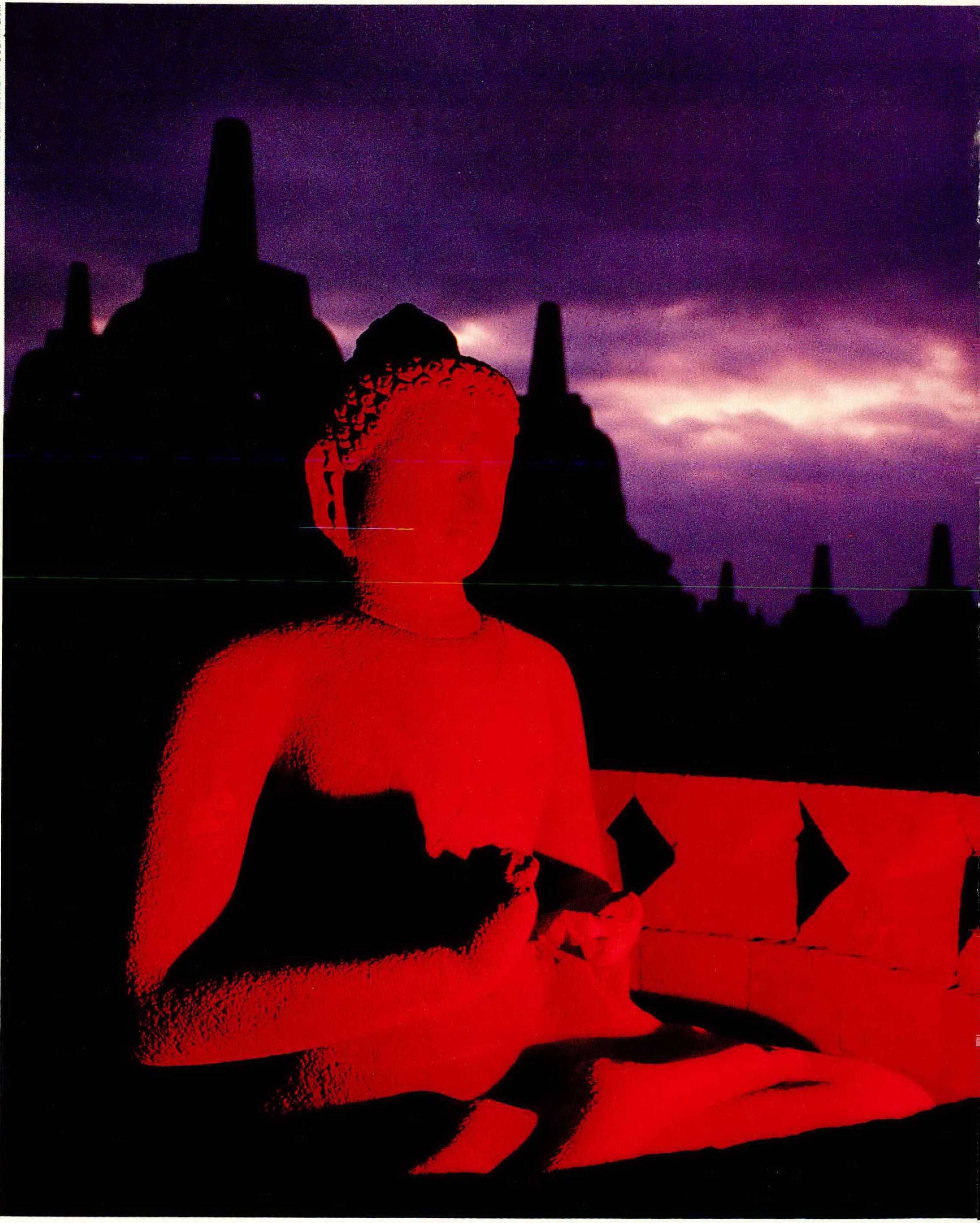
When you tire of Jogja itself, you can drive an hour outside town to the mighty temple of Borobudur. This is a multi-tiered stone monument, as big at its base as one of the Great Pyramids of Egypt. Indonesia’s religious life involves Islam, Buddhism, Hinduism, and animist faiths enmeshed with one another, and Borobudur itself portrays both Hindu and Buddhist deities. The structure, which is covered with hundreds of Buddha figures, has recently been restored in a fifteen-year project sponsored by the United Nations.
It is a chore to climb to the top of the temple, but the result is worthwhile, especially at sunset or dawn. In every direction you see the deep, deep green of rice paddies and palm trees, combining with the red of tile roofs and the orange of the sun, all the colors intense tropical hues. The volcano Mount Merapi, whose eruptions make the region’s soil so fertile, sits smoking in the middle distance. Heavy clouds blow across the sky.
THE ONLY Asian vista I’ve found more evocative is one in Burma’s hinterland. It is awkward even to mention Burma (which its regime now calls Myanmar) in a travel article, since the country is so difficult to get to and is a place of such despair. Apart perhaps from North Korea’s, Burma’s government is the most repressive and benighted in all of Asia, a counterpart to Haiti’s in the days of Papa Doc and the Tonton Macoute. The country’s No. 1 city, Rangoon, is a heartbreaking museum of decay. The buildings the British left behind forty years ago are still there, but now they’re crumbling in the heat and rain.
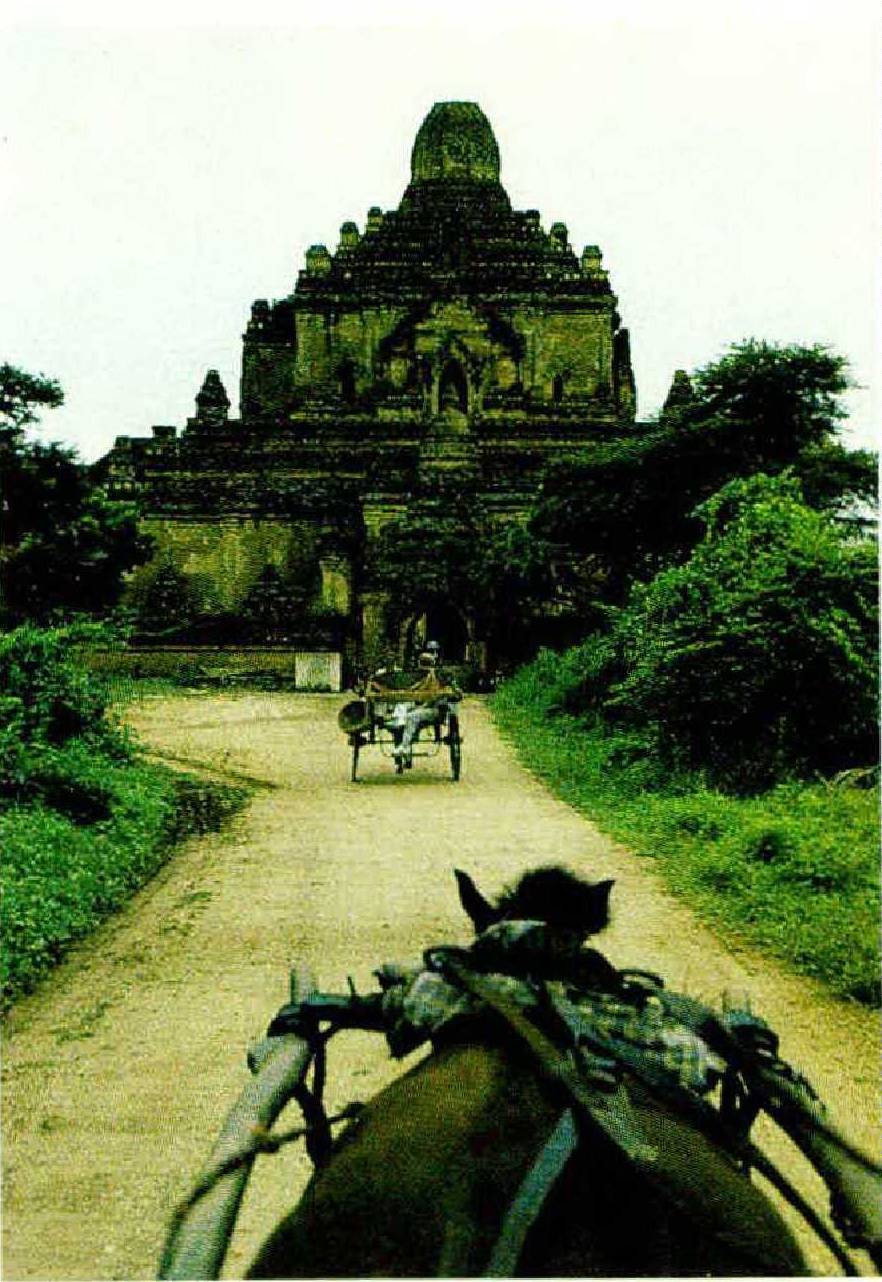
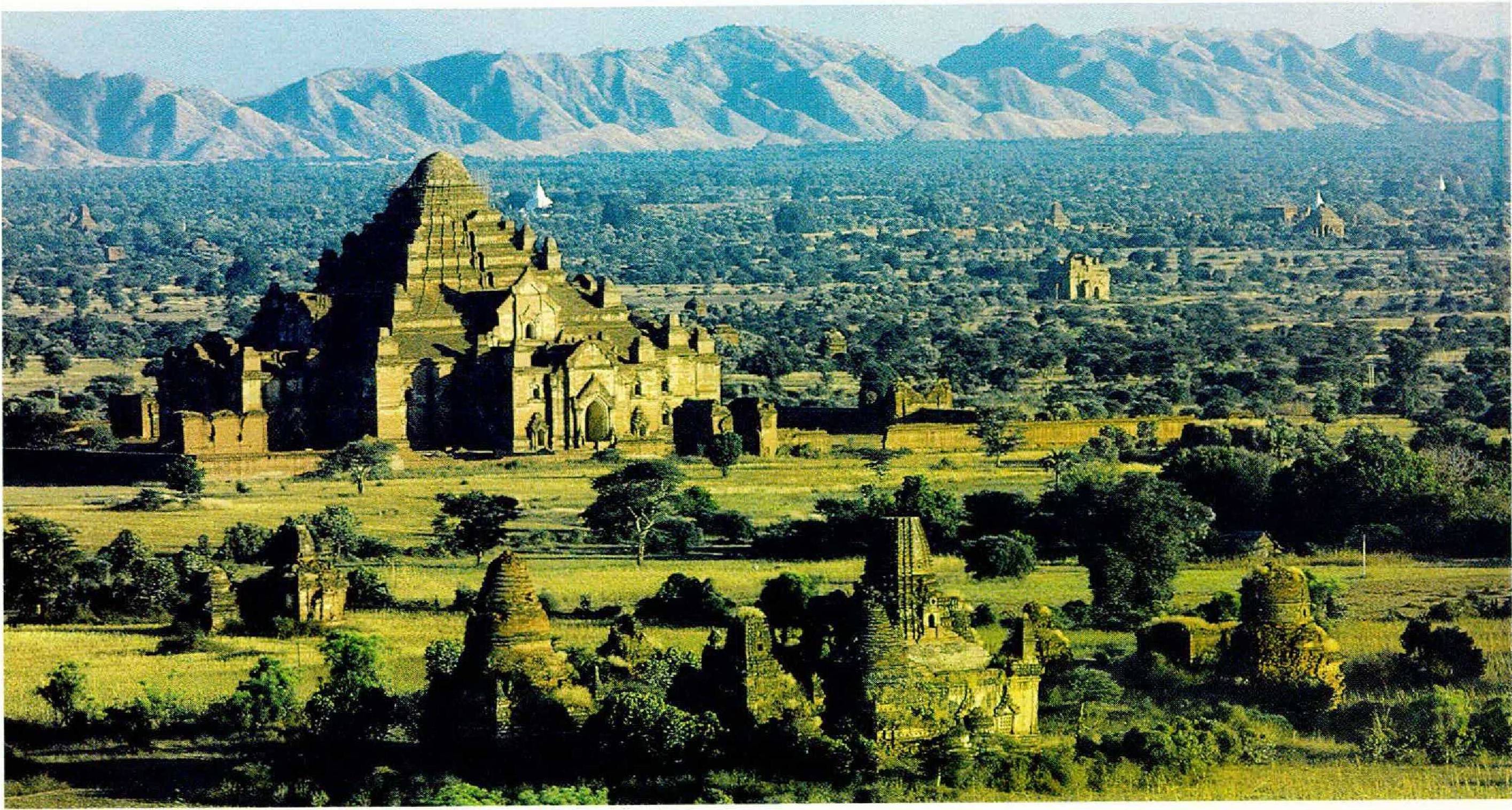
Yet in Burma’s broad central plain, through which runs the Irrawaddy River, is a marvel that should be as famous as the Great Wall of China. Mandalay, Burma’s second city, is more cheerful and bustling than Rangoon; like Chiang Mai, it is an entrepôt for traders and smugglers coming in from the hills. Beyond Mandalay, five or six hours by jeep, is the marvel: Pagan, which was the capital of northern Burma a thousand years ago. During a 200-year burst of religious fervor, Pagan’s rulers built thousands of temples, pagodas, stupas, and other monuments. Then the armies of Kublai Khan stormed in and Pagan was abandoned. As Tony Wheeler, the author of the indispensable Burma: A Travel Survival Kit, wrote, it is “as if all the medieval cathedrals of Europe had been built in one small area, and then deserted, barely touched over the centuries.”
Most of the structures were made of wood, and have vanished. Still, more than 5,000 of them, made of brick and earth, remain, some as large and grandiose as the Victor Emmanuel Monument in Rome, others pup-tent-sized personal shrines. Apart from the temples and pagodas, almost nothing remains in Pagan: a few farmers tending plots of beans or rice among the monuments, a few vendors sitting by trays of thousand-year-old clay pipes or pottery shards. I believe these artifacts to be authentic; as I walked from temple to temple, I saw other relics protruding from the dusty earth. Perversely yet somehow inevitably, the only modernlooking factory I saw in Burma is also located in Pagan, its smokestacks poking up among the spires.
If, just before sunset, you climb to the top of one of the largest temples, such as Thatbyinnyu or Ananda, and look in any direction except toward the chemical plant, you survey an unearthly scene. Dark-ocher temples stand out against the baked red-clay landscape, for miles and miles and miles. The sun starts descending, and all the reds deepen. No sound or glare of city lights intrudes. You think about how big the world still is, and how briefly men live. You will not see these sights or think just these thoughts back home—or in any country’s No. 1 city.