The Middle East: Curses in Verses
Unusual fighting words
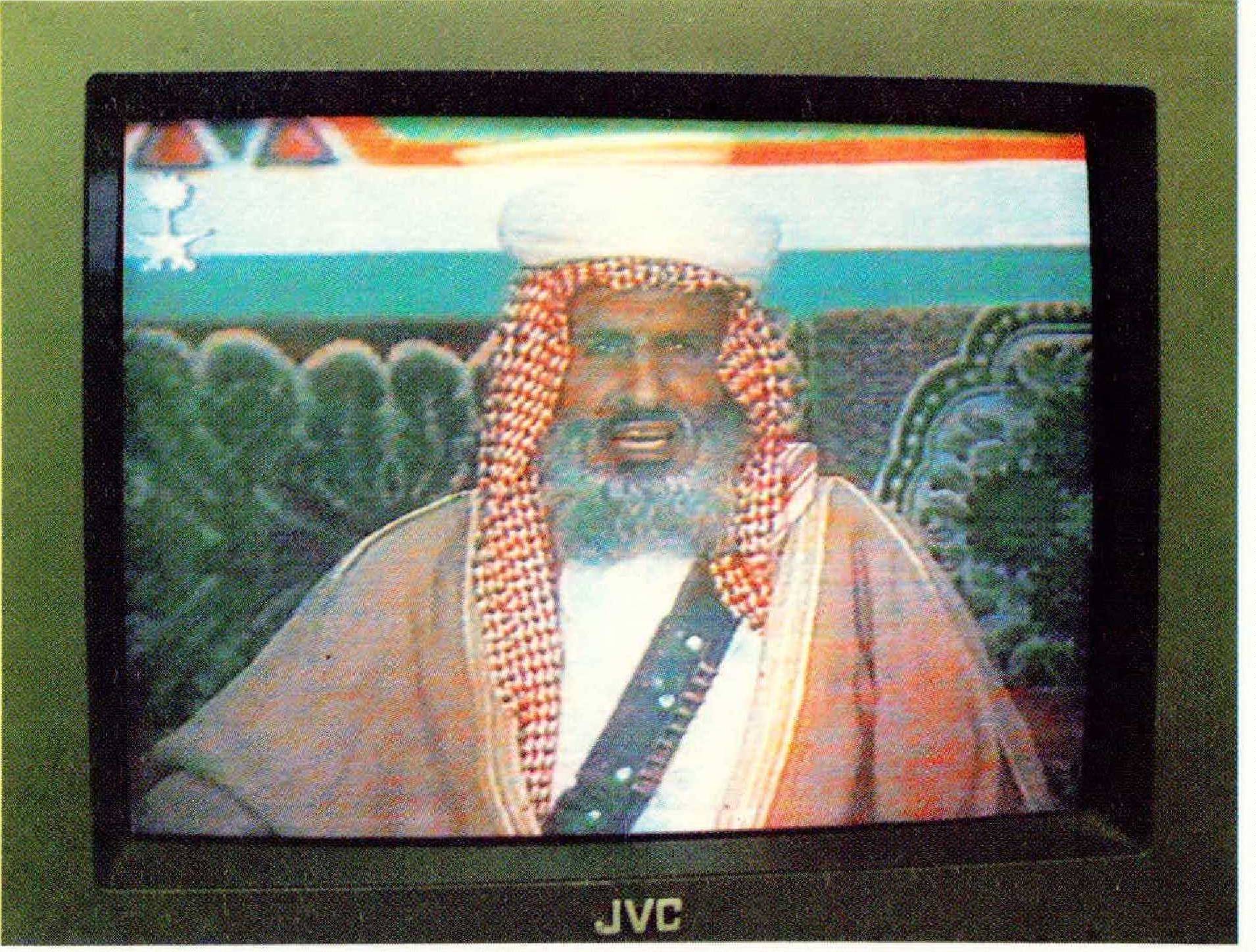
UNBEKNOWN to most people living outside the Persian Gulf region, a war has raged there ever since the Iraqi ruler, Saddam Hussein, dispatched his forces to overrun Kuwait last August. But rather than a conventional hot war, fought with tanks, missiles, and planes, it’s an odd propaganda contest, in which the two Arab camps trade insults over the airwaves in archaic language, following strict rules, and in rhyme.
The essence of this phenomenon is not altogether unfamiliar. Readers of the Bible will recall the scenes in which, on the brink of battle, warriors loudly reviled their enemies and flaunted their own prowess. “Am I a dog, that thou comest to me with staves?” Goliath growled upon first setting eyes on David; then, for good measure, he “cursed David by his gods.” In an earlier era, when the Children of Israel were camped on the plains of Moab, the terrified Moabite king summoned Balaam, a warlock of some repute, and begged him to “curse me this people . . . that we may smite them, and that I may drive them out of the land: for I wot that he whom thou blessest is blessed, and he whom thou cursest is cursed.” That Balaam then accomplished the opposite of his mandate is another matter; what interests us here is the magical power of the imprecation delivered in rhyme—or, to be more precise, the enviable ability to curse in verse.
Thus an ancient Semitic tradition lives on in the culture of Bedouin Arab societies to our very day. For centuries the most adored poets in the canon of Arabic literature have been not the writers of love poems (though there has been no lack of these) but rhymesters like Ta’abatta Sharran (loosely, “He Who Carried a Snake Under His Arm”), who in the sixth century won this colorful epithet with his flair for offense, insult, and scathing doses of verbal venom. He was not alone. In fact, a whole gallery of ancient poets who specialized in the art of cursing and blessing are known to every Arab schoolchild. In a sense these men were the literary ancestors of the wandering troubadours, minstrels of malediction who had been cast out of their tribes and roamed among the courts of the local princes, declaiming their odes in a bid for patronage while subtly threatening to turn their praise into censure if they failed to win a lord’s favors.
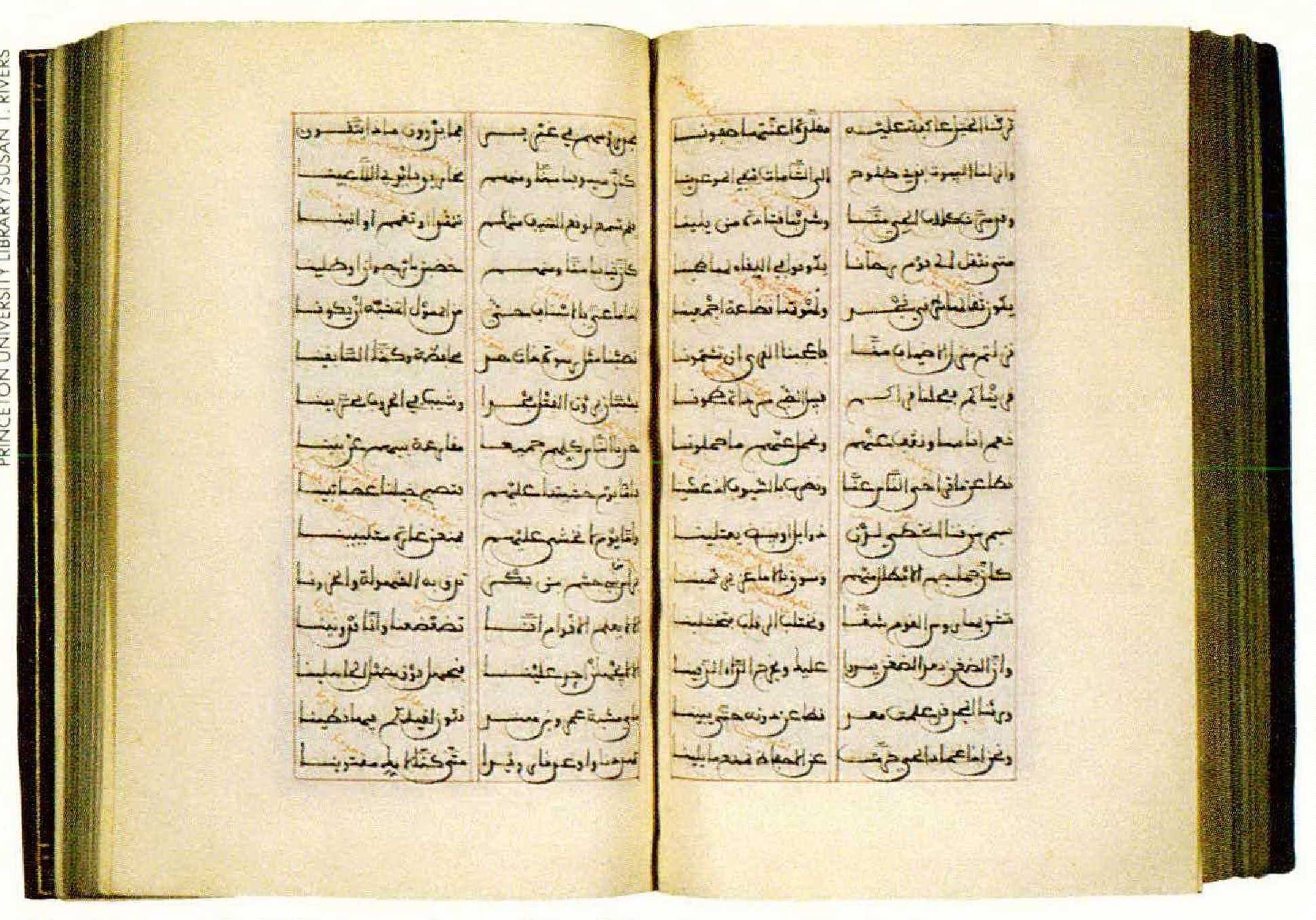
The rhymed pronouncements of these ancient bards—a highly developed genre known as hija’, or execration poetry—were written in a handful of formats with meters and rhyme schemes as rigid as those of a Shakespearean sonnet (neither of which the translations given here attempt to approximate). Strict rules also dictated the order of the narrative. In its classical form, for example, hija’ poetry always begins with a barrage of boasting. One typical and famous opening reads, “Oh, I am the man whose honor has never been soiled, / And each robe I wear is exquisite.”After a few stanzas the poem gets down to the business of vilification. “Lower your eyes, for you come from the tribe of Numire / And will never attain the stature of Kilab" is its warm-up to a stream of abuse.
The entire corpus of hija’ poetry dates from the pre-Islamic era, which Muslims refer to as the Jahiliya, or Age of Ignorance, a term they have come to use as a metaphor for anything crass or boorish in Arab discourse or behavior. After the invasion of Kuwait, however, the peoples in the confrontation states reached back to their earliest cultural roots for a form that would serve thenneeds. The result is the revival of hija’. For hours on end, without a single commercial for relief, Saudi, Iraqi, and Kuwaiti television (in exile) broadcast readings by a curious collection of poets whose métier is the highly stylized put-down. Like Balaam, they have been summoned to curse in rhyme, and their repertory is the pièce de résistance of the propaganda feast served up by the media each day.
WESTERN OBSERVERS have paid little if any attention to this piquant aspect of the Gulf crisis, for a very simple reason: it takes a mastery of medieval Arabic to decipher these poems, especially because one of the basic rules of modern hija’ is to employ words and metaphors that have been out of use for centuries. Even Western scholars who have spent a lifetime steeped in the language can barely muddle through these texts—and then only by constant reference to a dictionary. They also face the problem of ambiguity, for many of the lines can be interpreted in various, and sometimes opposite, ways.
Westerners are not the only ones who have trouble following the daily readings. Most of the Arab consumers of these broadcasts, on both sides of the Kuwaiti border, are unable to appreciate the literal meaning of the poems, to say nothing of the stabs at wordplay. Imagine Lord Haw-Haw spouting doggerel in Chaucerian English—to draw an imperfect parallel— and you get a sense of how these verses are received on a literal level. As such, they appear to violate the first law of propaganda: that it be simple, straightforward, and easy to absorb. Yet on a deeper level the message of the poems comes through, as the audience responds almost viscerally to their rhythms, cadence, and melodies, which conjure up a whole world of heroic associations from the glorious past. Trust both Saddam Hussein and King Fahd to know their constituents. Despite their recourse to modern rhetoric as part of their outward adoption of twentieth-century ideologies and values—socialism in the case of Saddam, welfare in the case of Fahd—when war looms large, they revert to the ancient formulas that strike deep chords in Arab audiences. Just as preachers of the fire-and-brimstone variety retain the ability to chill lapsed churchgoers who thought they had put old-style religion behind them, so these latter-day Balaams have a mesmerizing effect even when their listeners do not fully comprehend them.
One sign of the great response is that the hija’ revival has prompted a musical revival alongside it. The rabab, a kind of primeval guitar, has been tracked down in museums, dusted off, and brought to the television studios to provide accompaniment. Shriveled old geezers from half-forgotten tribes— the only people who still know how to play the instrument—have become television celebrities overnight. But the hija’ programs serve as far more than popular entertainment. Besides having helped audiences to psych up for a shooting war, they have provided channels for a kind of offbeat diplomacy by which more messages are transmitted across the lines than through conventional diplomatic means. Ups and downs in the progress of the crisis can often be better discerned by forgoing the regular news broadcasts, tuning in to these “para-news" programs, and gauging the mood by the strength of the vitriol or by a shift from mocking the enemy’s leaders to exalting one’s own. Saddam Hussein and King Fahd are said to have received daily summaries and “intelligence assessments” of what the other side’s bards have to say.
MORK OFTEN than not, what they’re saying is downright vicious. The poems treat a number of themes, but their rancor is usually aimed directly at the other side’s leader, and Saddam Hussein is often addressed by name. Every possible negative trait and contemptible deed is ascribed to him, but above all he is berated for being a bad neighbor, attacking by stealth at night, and forgetting past favors—all gross violations of the old Bedouin ethic. One Saudi rhymester took him to task for his sheer ingratitude:
You cried out and your people we saved.
When Iran was ensconced on your soil,
You came begging to us for our aid.
Other popular themes touch on associations with the non-Arab players in the Gulf drama. Not surprisingly, the American troops stationed in the peninsula often feature in the exchanges of verbal artillery going on over their heads, and the women soldiers are a favorite subject in the poets’ fulminations. The Iraqis have broadcast any number of verses sneering at King Fahd for hiding behind their skirts—a variation on a classic motif in ancient Arabic verse, and probably the most degrading portrayal of the Arab male.
Not to be outdone, the Saudis have hit back with the ultimate insult: denouncing Saddam as a Jew! A Saudi bard thundered into the microphone like the voice of doom:
Of our flesh not are you.
Claim not to be a Muslim,
For you are truly a Jew.
Your deeds have proved ugly,
Your face is darkest black,
And we will yet set fire
To your bottom and your back.
A mark of the genre’s great appeal is that the recitation of hija’ has extended beyond the media to the barracks. Hardly a single Saudi army or nationalguard parade takes place these days without several amateur poets’ being called to the microphone to deliver examples of their artistic efforts. A Saudi colonel is rumored to have earned a special bonus for the following variation on an ancient verse:
But we are not afraid,
Tomorrow the cur will fight the hand
That fed it yesterday.
Not out of Zion’s halls have come
I’he “Zionists" who defile our sons.
March on the tyrant’s horde we must
And grind it down to grains of dust.
The Iraqi army has a regular contest going to find the soldier who can quote the most, and the most accurately, from the corpus of classical hija’. In one round of this contest a young Iraqi trounced his rivals with a single obscure but evidently dazzling couplet: “Your braves have all been killed, O rue. / Even the rooster laughs at you.”
In addition to meting out its fair share of insults, Iraqi state television parries the swipes at President Hussein with a special program called Saddam in the Conscience of the Poets. Night after night it presents selected photographs from Saddam Hussein’s family album along with a fresh ode to the revered leader. One of the President’s biographers recently claimed that for quite a while Saddam, a deeply modest man, was reluctant to let this program go on the air. But in fact the personality cult has reached new heights in Iraq, far surpassing even the excesses of Stalin’s day. A typical example of the near-idolatry that goes along with the nightly display of family photos reads,
To a friend you are a savory draught,
To the enemy agony and doom.
O’er the desert like God’s spirit you loom,
Breathing life into the barren sand,
Awakening the heavens, inflaming the land.
You were created to fill the earth with awe,
Take the bow up, its string to draw.
Your wisdom brings remedy, your balm is pure,
The ailing await you—and blood is the cure.
IN FOLLOWING this war of rhymes, Arab audiences not only understand the cultural codes built into the poetry hut are keenly aware of historical precedents, especially the fact that warfare has actually been averted when antagonists have vented their aggression in verse. Although the curseand-bless prelude was originally designed to gear enemies up for an armed clash, it has also had the effect of substituting for physical combat. And given the possibility that the trading of gibes could turn out to be the full extent of a war, the question of who is better at it takes on considerable importance. Whose barbs have been more devastating? Whose poets have produced more quotable quotes? These questions occupy Arab viewers almost as much as the issue of who enjoys better odds on the battlefield, and few will deny that the Saudis are winning the verbal war hands down. Because their educational curriculum has helped to preserve tribal traditions, especially in rural areas, the Saudis’ rhymes have a more authentic and resonant quality, whereas the Iraqis are handicapped by the pseudo-Marxist indoctrination of the ruling Baath Party, which has warped their native sensibility. Aware that they are trailing, the Iraqis have called in reinforcements in the form of Yemeni tribesmen from remote mountain regions, Egyptians from the Gastarbeiter community in Baghdad, and an array of political exiles—Palestinians and others—who have flocked to Saddam’s banner.
Whether or not this strategy will turn the tide of battle remains to be seen. Either way, the consumers of these rhymed diatribes know another thing of which the non-Arab members of the anti-Iraq coalition should perhaps take note. In the hija’ tradition the switch from cursing to blessing, from biting a hand to kissing it, can be made swiftly, almost abruptly, without any loss of face. The poet who heaps invective upon an enemy today can ooze unction on him tomorrow. Such prudent agility, like the slithering of the snake carried under his arm, is one of the rules set down by the master of hija’, Ta’abata Sharan. Arabs applaud it as the epitome of finesse; Westerners can be forgiven for regarding it as something entirely different.
—Ehud Ya’ari and Ina Friedman