Inexplicable Dinosaurs
by Anthony Burgess
THE DECLINE AND FALL OF THE BRITISH ARISTOCRACY by . Yale University Press, $35.00.
AMERICANS, BEING good republicans and democrats, should either have no interest in Professor Cannadine’s subject or else take a grim pleasure in his record of the decay of privilege. Yet there remains a certain nostalgia, at least for titles, else why call Ellington Duke and Hines Earl? In Sinclair Lewis’s Babbitt the eponym is proud of taking a decayed baronet to a Chicago cinema. The Zenith gossip columnist fulsomely celebrates the baronet’s visit to the land of the free, though nobody seems sure whether he is Sir Gerald Doak or Lord Doak. American ignorance of the ladder of nobility has, in my experience, to be put right at the outset of university courses on Shakespeare. Why does that ladder exist and when did it start? “When Adam delved and Eve span / Who was then a gentleman?” was a medieval leveling slogan. Resentment goes back a long way, yet the aristocracy survived and still, in a manner, survives. A decline and fall does not signify a liquidation.
In the interests of transAtlantic lucidity, allow me to throw light on the strata of our aristocracy. “Knight” and “earl" are Anglo-Saxon designations (cniht and eorl). The other ranks, in ascending order—baronet, baron, viscount, marquis, duke—come, as the Latinate names indicate, from the Norman settlement. William the Conqueror rewarded his followers with English land, which meant title. With Henry VIII’s abolition of the monasteries, monastic acres became secular property, with titles to go with it. A title meant nothing without land. There is a species of landowner without title, a member of the landed gentry, who is always a gentleman, entitled to bear arms. William Shakespeare achieved that rank, which was no small thing. The honorific “Sir” was neither here nor there: you were entitled to it if you had a university degree. But “Sir" is nowadays for a knight or a baronet. The baronet passes it on, the knight not. Baronets are no longer being created; the peerage itself (baron upward) has become an uninheritable award for newly created peers, though Denis Thatcher, no doubt for his uncommon services to the realm, is a notable recent exception. Land no longer applies.
Professor Cannadine is not concerned with origins, only with that diminution of the value of property which signaled the decay of the great families. Cannadine is a professor of history at Columbia University, though a Briton by birth. His book is “about a large number of people with various things in common: the grandees and gentry of the British Isles during the century from the 1880s to our own time.”For these people 1894 was the critical year. It saw a dramatic crash in the wheat market, a blow from which many families, heavily invested in wheat, never recovered. It also saw the first levying of “death duties,” or inheritance taxes, on the great landed estates: beginning at eight percent, they would climb to 40 percent by 1919 and to a confiscatory 60 percent by 1939.
Altogether, this is an immense work of learning, whose focus on such objectivities as land and money does not impede the flow of anecdote, or dim the author’s powers as a social psychologist. He writes a brisk prose, and knows when to turn an old phrase; thus he says that some will find his a sad story and others a morality play about “vested interests vanquished. Either way, it may well be that nothing quite became the patricians’ pre-eminence like their leaving of it.”
The frontispiece reproduces a fine painting by Sargent of the Marlborough family as it was in 1905. This, of course, was not one of the ancient tribes of England. The dukedom was created for Jack Churchill, who broke the power of the French, and the family seat, Blenheim, was named for a decisive victory. The title meant nothing without broad acres, but in 1905 their value was in decline and the duke had to marry an American heiress. It is she, Consuelo Vanderbilt, who dominates the picture. Land lost value because British agriculture could no longer compete with imported foodstuffs. If there was coal underneath it, that altered the situation dramatically. If, as with the Duke of Westminster’s estate, the land was metropolitan realty, then wealth became fabulous.
WHAT EXACTLY was the national utility of these magnates? They governed vast estates and, logically, saw themselves as governors of the nation. The House of Lords, however elected governments try to pack it with specially created political titles, primarily exhibits the power of primogeniture, though it is a power increasingly nominal. There has always been talk of the value of an elected senate, but the lords go on, incisive or drawling patrician voices on radio and television, tempered by the demotic of the newer creations. The aristocracy ran society from their town houses and their country estates. The dowagers arranged dynastic marriages. The embassies were run by lords and so was the army, the navy less, the air force not at all. But the aristocracy’s power has always been commensurate with its landed wealth. When the aristocrats had to compete in the professions, their amateurism, which expensive educations had done nothing to modify, was all too evident.
They usually did well in the army, in the First World War they died for a country they loved, since they owned it. In the Second World War the management of the nation was in the hands of the aristocrat Churchill, an elder son of a younger son who nevertheless felt Blenheim was home, not rich but reliant on politics and journalism for a living, a maverick who mistakenly believed that the common people loved him. The late A.J.P. Taylor said, “The British ruling classes did their best to keep him down, and he preserved them.” The aristocracy was well represented among the military commanders, chiefly out of the old Anglo-Irish ascendancy. Foxes as well as Germans had to be pursued. The tally-ho horn competed with the reveille bugle. Lord Leconfield, on horseback in Sussex, came across a crowd watching a soccer match. “Haven’t you people got anything better to do in wartime than play football?” he bellowed. Then he resumed his chase of the fox.
Churchill took noble rank for granted as a badge of territorial authority. It had been different with David Lloyd George, who, Taylor said, “detested titles. This, no doubt, is why he distributed them so lavishly.” Lloyd George sold honors, amassing more than £2 million for his personal political fund— £10,000 for a knighthood, £30,000 for a baronetcy, £50,000 and up for a peerage. The new pseudo-aristocracy was strictly a plutocracy. The press magnates Rothermere and Beaverbrook equated authority not with land but with the power to bamboozle the public. In our own age, life baronies go to provision grandees like Lord Forte and entertainment merchants like Lord Grade.
WHY SHOULD Americans, having established a society with no hereditary privileges, set such store by titles that magazines flourish by alternating lavish coverage of American celebrities with equally compelling inquiries into the fascinating doings of the royals? Probably because all that Americans can achieve is great wealth, and wealth is never enough. One needs mystique as well, and mystique in America is reserved to the entertainment industry. When honors were so freely for sale in England, the plutocrat William Waldorf Astor began to buy. He had a fortune of $100 million, and by the careful deployment of some fractions of this he became, after naturalization, a baron in 1916 and a viscount the year after. He established a dynasty but also prepared the way for the Anglophile trans-Atlantic snobs—Elsa Maxwell, Laura Corrigan, Emerald Cunard, Henry Channon—who imposed a new glitter and perhaps vulgarity on upper-class English life. “Chips” Channon became MP for Southend but lamented, “In society I am a power, ... at the House of Commons I am a nonentity.” The rift between political power and mere wealth had begun. Dim as most of them were, the landed aristocracy were impelled to a sense of responsibility and given a chance to exercise it.
Dim, yes. They had great possessions and did not appreciate them. A passion for art began to appear only when sales were imposed by enormous death duties and they whimpered about being the custodians of national treasures. The magnificent houses, monuments of architectural genius set in parks created by Capability Brown, faced dispossession through lack of funds. Who could afford the staff? Dukes and duchesses now do their own cooking in the former servants’ quarters. “The Stately Homes of England, how beautiful they stand,” Noel Coward sang, “To prove the upper classes have still the upper hand,” but, like so much in England, they are either derelict or carefully refurbished museum pieces.
PROFESSOR CANNADINE has telling epigraphs to every section of this exhaustive and exhausting book. His overall epigraph comes from a poem by Keith Douglas:
How can I live among this gentle
obsolescent breed of heroes and not weep?
Unicorns, almost,
for they are fading into two legends
in which their stupidity and chivalry
are celebrated. Each, fool and hero,
will be an immortal.
obsolescent breed of heroes and not weep?
Unicorns, almost,
for they are fading into two legends
in which their stupidity and chivalry
are celebrated. Each, fool and hero,
will be an immortal.
This, Professor Cannadine writes,
was occasioned by the death, on active service, of Lt. Col. J. D. Player, who left £3,000 to the Beaufort Hunt, and also directed that the incumbent of the living in his gift should be “a man who approves of hunting, shooting, and all manly sports, which are the backbone of the nation.”
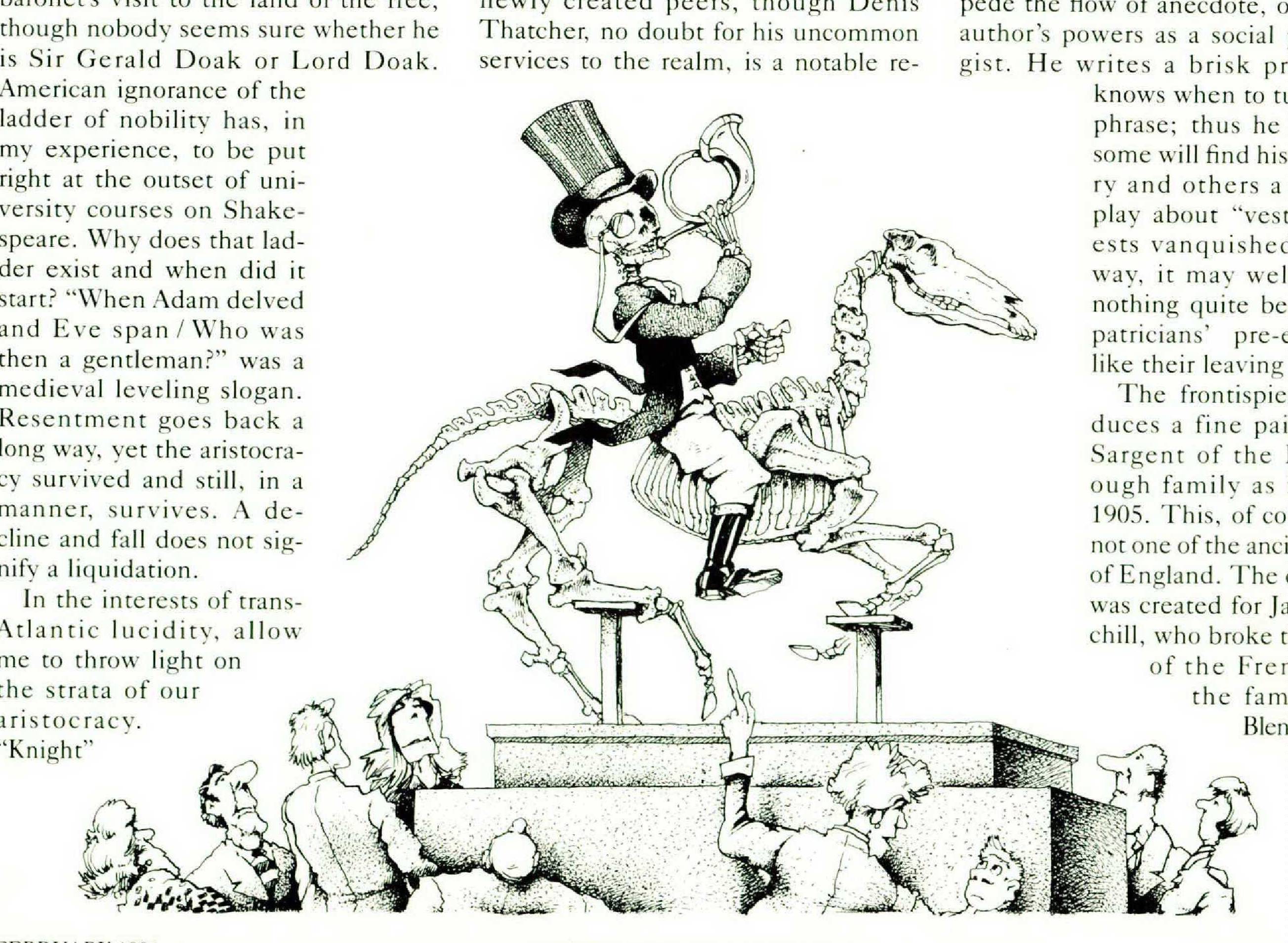
There was doubtless something heroic about this breed of landed magnate, and the component of chivalric stupidity has needed to be celebrated in our lighter literature. The comic magnificence of certain noblemen in P.G. Wodehouse and Evelyn Waugh is curiously capable of modulating into magnificent seriousness: Lord and Lady Marchmain, in Brideshead Revisited, to say nothing of Lord Sebastian and Lady Julia, are genuine myths. Of course, they are Catholic, which may make a difference. In a hundred years readers will meet our nobility as inexplicable dinosaurs. And what will the British monarchy do without that aristocratic cushion between itself and the common sort? Britain as a republic will be almost as dull as America. □