Notes: Rudolph Redux

After many years, the full story
You KNOW THE song, written in 1949, by Johnny Marks, and originally sung by Gene Autry. But chances are you don’t know the book, which was written a decade earlier, by Robert L. May. The original edition of Rudolph the RedNosed Reindeer, with illustrations by Denver Gillen, was never published commercially and has been unavailable in bookstores.Rudolph was commissioned, printed, and bound by the Montgomery Ward department-store chain, which gave it away at Christmastime in 1939 and again in 1946 to a total of about six million holiday shoppers. The book won immediate popularity, and Rudolph’s image and story, along with (eventually) the tinny and cloying song, became Christmas fixtures all over the world. The image and song remain inescapable, but the text itself seems to have largely receded from America’s collective memory. In the most recent edition of Books in Print, between the entries for Rudolph J. Nunnemarher Collection of Projectile Arms (vol. 9) and Rudolph Virchow: Doctor, Statesman, Anthropologist, there are, to be sure, several books listed about a red-nosed reindeer named Rudolph, but all of them are derivative stories. None is Rudolph the Red-Nosed Reindeer by Robert L. May.
That is about to change. Later this month, a half century after its creation,
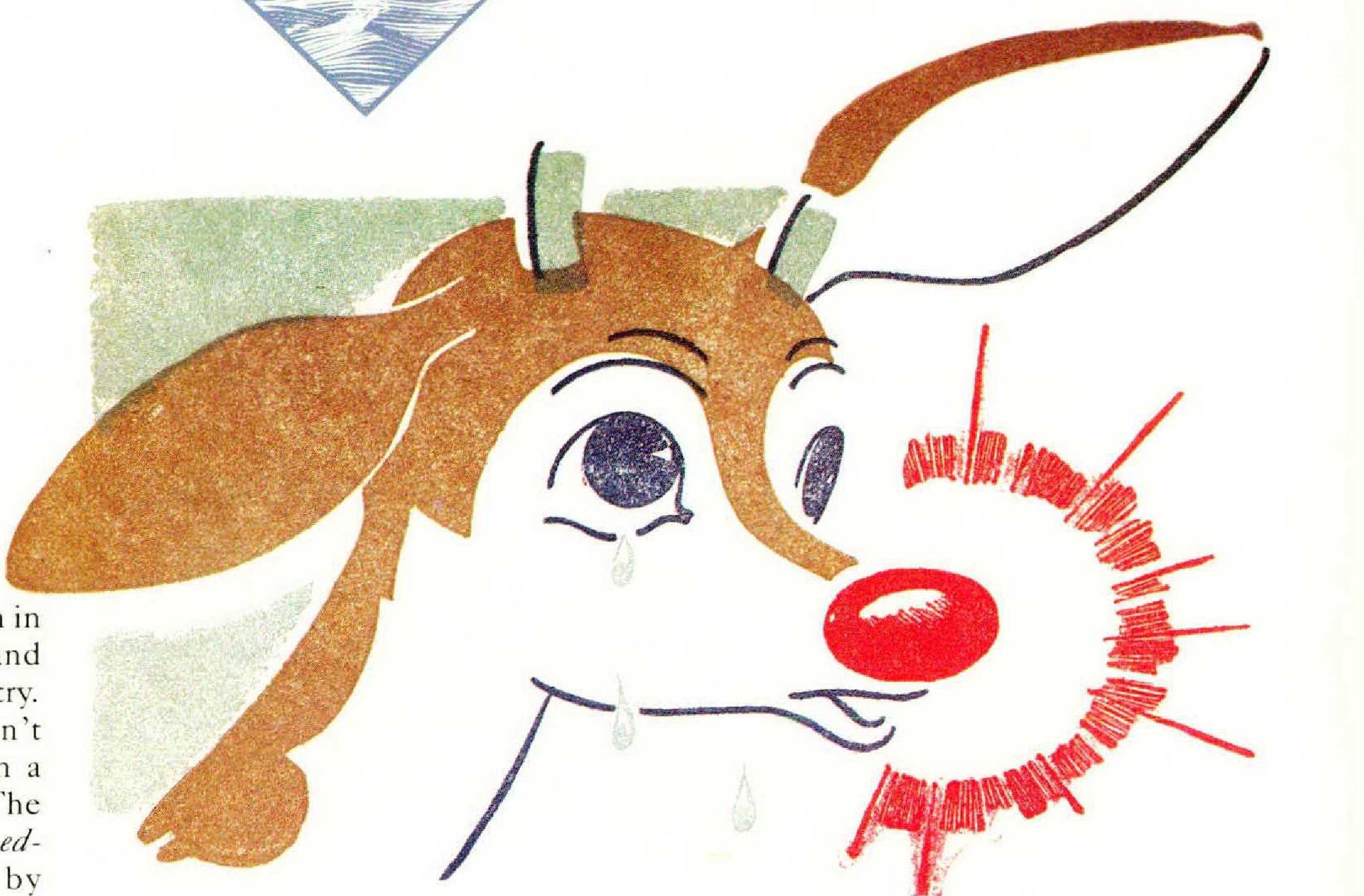
the original Rudolph the Red-Nosed Reindeer will be published for the first time, in facsimile, by a trade publisher, Applewood Books, and it will be sold in bookstores. And I can report, having been vouchsafed a look, that the Ixjok almost makes up for the song.
THE unwelcome SONG, OF piece course, of work, is not an least because its tune, after one or two hearings, takes on the quality of an advertising jingle. Worse still is the way it tells a story. The sociologist James Barnett has observed that the character Rudolph is the twentiethcentury Christmas symbol “most likely to become a lasting addition” to Christmas celebrations. So much more the pity, then, that the version of his life as related in the 113 words of Johnny Marks’s minimalist lyrics—the only version most people now know—is marred by its jaunty moral vacuity. In the song Rudolph can easily be taken for one of Santa’s reindeer
(this is never stated, but it’s what most people assume), and his life is made miserable by a physical anomaly. The other reindeer, who are not the sort you’d think Santa would hire, “laugh and call him names.” Santa himself, inexplicably, makes no attempt to intervene; the one time he talks to Rudolph directly he pointedly calls attention to his “nose so bright.” Rudolph achieves a kind of vindication only when Santa, in desperation, realizes that Rudolph’s nose can be profitably exploited. The other reindeer experience a sudden cynical and superficial transformation in attitude—“Then how the reindeer loved him”—and they shout with glee, happy, like the members of any mob, to bask for a mad spell in a winner’s glory. But does anyone harbor illusions about the likely nature of Rudolph’s life once Christmas is over? Is he now going to be allowed to participate in reindeer games? Will he really become an A-list reindeer? Or will he, rather, despite those glib, high words about his place in history, remain an oddity to be pitied and shunned by his fellows—and hauled out for service (and hollow huzzahs) whenever the fog gets a little thick?
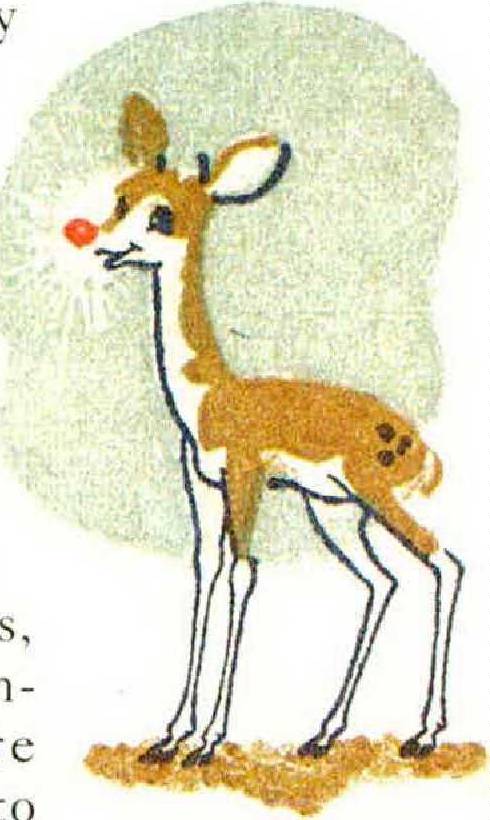
Robert L. May’s original story, in contrast, is full and rich and written in clunky homespun couplets. Rudolph is still a reindeer, of course, but he’s not one of Santa’s and he doesn’t live at the North Pole. His peers do make fun of his nose, but we learn that Rudolph is a responsible and well-brought-up animal who has a sense of his intrinsic worth and enjoys the support of loving parents. When Santa discovers Rudolph, it is completely by chance — he sees a glow emanating from Rudolph’s room when delivering presents to his house. By then it is deep in the night on Christmas Eve, and Santa has begun to worry that the worsening fog, which has already caused accidents and delays, will prevent him from completing his rounds before dawn. Rudolph is eager to help. Once in harness, Rudolph is no passive point of light. He takes command of Santa’s team—proud, mature reindeer he has met for the first time— and skillfully navigates from house to house. As Santa observes publicly upon their return, “By YOU last night’s journey was actually bossed./Without you, I’m certain we’d all have been lost!” The young reindeer (not Santa’s) who had been so cruel to Rudolph express genuine sorrow for their behavior, and Santa (who always refers to Rudolph’s nose tactfully as his “forehead”) announces that Rudolph henceforward will be a regular member of his team. There is no doubt in one’s mind, by the end of May’s book, that Rudolph, despite his nose, will weather adolescence with ease and enjoy a happy and secure future.
THE learned, STORY is very OF much Rudolph, the story I of Robert L. May. He was by all accounts a humble and soft-spoken fellow—odd qualities in a Dartmouth man—who nursed painful memories of childhood bashfulness. In 1939 he was a thirty-five-year-old advertising copywriter in Montgomery Ward’s catalogue department. He had a young
child and a wife who was gravely ill and about to die. Medical bills had put the family heavily in debt. Such were May’s preoccupations when his department head called him in one day and said, in effect, “Robert with your pen so light,/Won’t you write a tale tonight?” Actually, what the department head said, May later recalled, was, “Bob, I’ve got an idea. For years our stores have been buying those little Christmas giveaway coloring books from local peddlers. I think we can save a lot of money if we create one ourselves.” May thought back to the circumstances of his childhood and settled on an ugly-duckling theme for his story; the name Rudolph (at one point, Rollo) was chosen for alliterative reasons. During the 1939 Christmas season Montgomery Ward printed up and gave away 2.4 million copies of Rudolph the Red-Nosed Reindeer, making Robert May briefly famous. He continued toiling over catalogue copy at Montgomery Ward for most of his working life, even as he oversaw the licensing of Rudolph’s story, name, and image, the rights to which Montgomery Ward had bestowed on him. May granted one of those licenses to his friend Johnny Marks; the song “Rudolph the Red-Nosed Reindeer” became the second-best-selling song of all time (after “White Christmas”). Ultimately Rudolph gave May financial independence. He remarried, raised six children in all, and lived quietly and happily ever after, until 1976. “Apart from Rudolph,” he modestly told an interviewer a few years before his retirement, “my life is not outstanding.”
Perhaps not. But, like Rudolph’s, it turned out a lot better than one might have expected. May’s story—and the one he wrote—provide a certain solace, suggesting as they do that the unlikely sometimes turns out to be the ordained. It is in the hope of the improbable that I ask the children of Johnny Marks, who control the rights to the song “Rudolph the Red-Nosed Reindeer”: declare a temporary moratorium on the granting of licenses to play it, and let this be the year of the book. You’ll go down in history.
—Cullen Murphy
About the Author

Cullen Murphy is an editor at large at The Atlantic.