Notes: The 40th Parallel
In search of Nowheresville
NOT LONG AGO in the small town where I live—Medfield, Massachusetts (population: 10,500)—some local actors put on a production of The Music Dreaming Man, by Bonnie Graves Wilder, a musical that celebrates the life of one of Medfield’s most famous citizens, Lowell Mason. Mason was born in 1792 and is known today throughout the town, and perhaps to you, as “the father of music education in the public schools.” We’re pretty proud of Lowell Mason, as we arc of several other prominent Medfield residents, including the historian Hannah Adams (1755-1831) and the painter George Inness (1825-1894).
Medfield was founded in 1649 and has therefore had almost three and a half centuries to produce some famous people. But few towns in the United States have not been in existence for at least a century—a fact that recently made me wonder, Is there anyplace in America that cannot by now associate itself with a single person who arouses a glimmer of recognition? Is there anyplace that has added not one ingredient to the roiling stew of national celebrity? Is it possible, as the twentieth century draws to a close, that some village or burg might justifiably lay claim to the title Nowheresville?
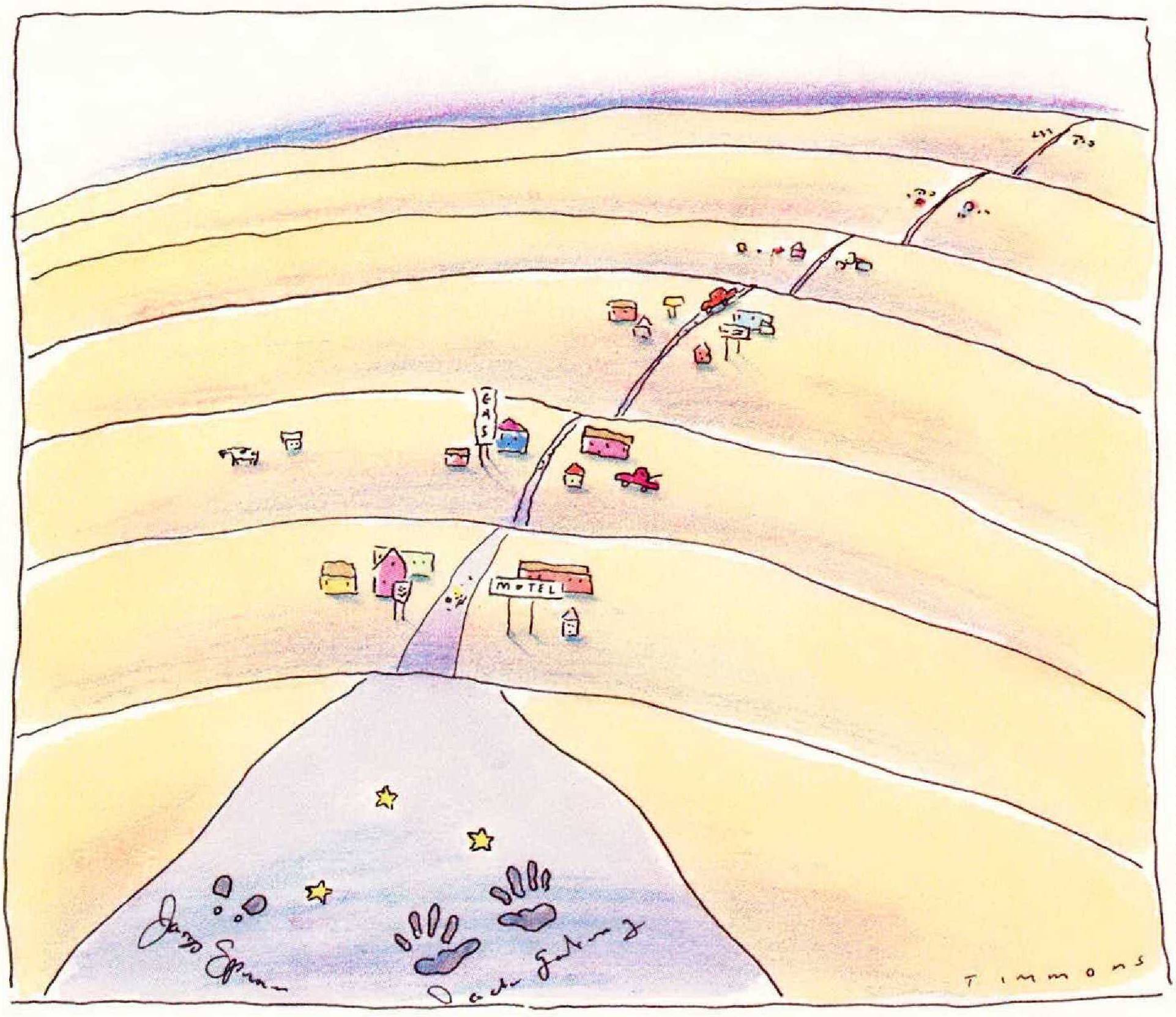
It would, of course, be difficult to check out every little settlement in the United States; that may have to be my life’s work. However, looking at a map one day, I noticed that the 40th parallel neatly bisects the country from coast to coast, and realized that it could provide me with what a trench dug across a large site provides an archaeologist: a glimpse of the big picture. I asked a disinterested bystander to find an atlas and pick out fifty or so towns that lie on or close to the 40th parallel, stipulating that the towns have populations of 20,000 or less—these being the most likely to inhabit the penumbra of history’s gaze—and that they be strung out fairly evenly across the country. A list was duly compiled. Then, starting in the East and moving methodically westward, undeterred by swollen streams and snowbound mountain passes, I began calling up the library or historical society or museum in each town and asking people there if they could think of anyone in the area whose name or accomplishments might have caught the nation’s eye.
THE 40TH PARAGLEE comes ashore, after its nonstop trip from Portugal, a few miles south of the boardwalk at Point Pleasant Beach, New Jersey (population: 5,600). Barbara Kelly, of the Point Pleasant Library, took my call. “Eugene O’Neill married a woman from Point Pleasant and lived here for a while,” she said. “His daughter Oona, who married Charlie Chaplin, considercd this her home town. She went to high school here, and everyone remembers her as being very nice.” The next designated stop was Burlington (10,300)—the birthplace, I learned, of James Fenimore Cooper and of Captain James Lawrence (the last words of whose naval career were “Don’t give up the ship”). Further inland: Mount Holly, New Jersey (10,800). “Offhand,” said Kathryn Heuer, of the Burlington County Historical Society, “I’d have to say John Wollman, the abolitionist Quaker minister.” She went off and found a book. “His dates are 1720 to 1772. The financier Stephen Girard had a house in Mount Holly. He’s 1750 to 1831. And Peter Hill, the black clockmaker, lived in Mount Holly in the early 1800s.” Because my next stop. Palmyra (7,300), was also in Burlington County, I asked Heuer about that town. She said “Hmmm” and called out to someone across the room. After she got a reply, she said into the phone, “Christian Jensen, inventor of the Scoop Washing Machine.”
The 40th parallel crosses the Delaware River at Philadelphia. I picked it up thirty miles to the west, in Downingtown (8,300). Any prominent sons or daughters of Downingtown? “ZebuIon Thomas, who was a principal agent of the Underground Railroad,” said Flora Jeanne Hoch, of the Downing-town Library Company. “In fact, the Underground Railroad went right through this building. There’s an escape tunnel in the basement. Also, Steve McQueen was on location here for a while, because part of his movie The Blob was filmed in Downingtown. The diner scene.” The next town on my list, Coatesville (11,000), is just down the road from Downingtown, on Route 30. A clerk at the Coatesville Area Public Library didn’t hesitate before answering, “This is the birthplace of Susan Richardson, the young woman who was on Eight Is Enough.” I didn’t press; Susan Richardson was clearly just the top of the list.
On to Millersville (7,400), a few miles from the banks of the Susquehanna River. Robert Coley, an archivist at Millersville University’s Ganser Library, produced the names of no small number of Millersville’s most accomplished natives. Among them: E. O. Lyte, who wrote the song “Row, Row, Row Your Boat.” My final stops in Pennsylvania were Mount Joy (6,000) and Connellsvilie (10,300). Nancy Dyer is on the staff of the Lancaster County Library. “Simon Cameron, Lincoln’s Secretary of War, lived just outside of Mount Joy,” she said. “Susanna Wright, a Colonial intellectual and friend of Ben Franklin, lived near Mount Joy. Bruce Sutter, a former pitcher for the Cardinals and Braves, is from here. And Reginald De Koven, who wrote the song ‘Oh Promise Me,’lived in the area. It’s often played at weddings.” I turned my attention to Connellsville, which is about thirty-five miles south of Pittsburgh, on the Youghiogheny River. A librarian at the town’s Carnegie Free Library said, “We have Bubba Braxton. He was a football player. And there’s a runner who came from here, John Woodruff. There’s a park named after him.”
Braxton, I knew, was a fullback and a running back for the Buffalo Bills in the 1970s. I didn’t know about Woodruff, so I asked my father, who is generally abreast of this sort of thing. “Woodruff represented the United States in the 800 meters at the 1936 Olympics, in Berlin,” he said. “In the middle of the race, feeling crowded by the pack, he stopped, let everyone run by him, and then passed them all on the outside to win the gold medal. He had the longest stride I’ve ever seen — maybe twelve feet. He also served under your uncle Bob in the 369th infantry of the New York National Guard. Nice guy.”
THE WEST VIRGINIA panhandle is only a few miles wide where the 40th parallel crosses it. I skipped over the panhandle to Bellaire, Ohio (7,700), which lies on the Ohio River just above Lock & Dam No. 13. John Kniesner, of the Bellaire Public Library, said, “Jacob Heatherington settled in Bellaire. He was an investor in coal mines, and the legend ‘The House That Jack Built’ is based on an incident that involved him.” Jean Gwinn, the librarian of nearby Martin’s Ferry (9,300), the next town on my list, said, “Our most famous citizen was William Dean Howells. James Wright, the poet, is also from Martin’s Ferry. And Lou Groza, a kicker for the Cleveland Browns.” Moving across the state, I checked out Cambridge (12,500), Bexley (13,400), and Greenville (13,000). The first of these towns is the boyhood home of the actor William (Bill) Boyd, who played Hopalong Cassidy. It’s also the birthplace of the astronaut and senator John Glenn. Bexley, the next town, is where Leslie Wexner, the founder of the retail chain The Limited, makes his home. Lori Greer answered the phone at the public library in Greenville, the last town in Ohio that I called. She said, “The only people I can think of from around here are Lowell Thomas and Annie Oakley. But, hey, that’s not too bad.”
If you go north out of Greenville on Route 118, you eventually cross the Stillwater River and enter Ansonia; if you make a left there, onto Route 47, in a few minutes you’ll reach Indiana. The third town you hit in Indiana is Winchester (5,800). Rick and Randy Zehringer—“they later changed the name to Derringer,” said Jenny Stonerock, of the Winchester Community Library—and Randy Hobbs came from there; they sang under the name The McCoys and had the hit single “Hang On, Sloopy” in 1965. Another Winchester native is Robert Wise, who produced and directed West Side Story and The Sound of Music. Moving west: Greenfield, Indiana (12,900). “Well,” said Tina Smith, of the Greenfield Public Library, “there’s James Whitcomb Riley. He was born and lived in Greenfield. And the basketball player Michael Jordan is from Greenfield.”She paused fora second. “No, I’m just kidding about Michael Jordan.”
Elwood, Indiana (10,000), a little farther along, yielded Wendell Willkie; the librarian there played the name like a trump ace, and made no attempt to say more. I headed for Noblesville (16,900)—the birthplace,
I discovered, of the mystery writer Rex Stout—and then for Lebanon (12,500). Rosemary Peterman, the town’s unofficial historian, had just come in the door. “This was Eugene Pulliam’s home town,” she said. “He had the newspaper here, the Lebanon Reporter. He was Dan Quayle’s grandfather, of course. And Dan Quayle lived here when he was small.” following the 40th parallel the rest of the way through Indiana brought me to Frankfort (15,300), the birthplace of the actor Will Geer, who played Grandpa Zeb on The Waltons, and finally to Crawfordsville (13,500), the home of General Lew Wallace, who wrote Ben Hur. “Ezra Pound also lived here, while teaching at Wabash,” said Deatra Smith, of the Crawfordsville District Public Library, who would say no more on the record. However, she did send me an article about Pound in which he described his time in Crawfordsville as living “in the sixth circle of desolation.”
Only two towns on my list were in Illinois. The first was Lincoln (16,300). The theologian Reinhold Niebuhr lived there for a while in the early 1900s, I was told. Also, Langston Hughes lived in Lincoln as a boy, and wrote the class poem for his eighth-grade graduation ceremony. The second Illinois town was Beardstown (6,300). The phone at the Beardstown Public Library was answered by a woman who determinedly gave her name as Mrs. Alice Lou Schnake. “Red Norvo is a famous Beardstown resident,” she said. “He was a xylophonist and he played with Benny Goodman’s band. That was before your time, I suspect. Still living, though, Norvo is. Must be in his nineties.”
THE 40TH PARALLEL meets the Mississippi at the Mark Twain National Wildlife Refuge and then for a thousand miles lies more or less flat as it crosses the Great Plains. It transects northern Missouri, forms the border between Kansas and Nebraska, and then penetrates Colorado, where at Boulder it climbs into the Rockies. Thirteen towns on my list lay between the Mississippi and the mountains. I went through them with dispatch.
Moberly, Missouri (13,400): home of General Omar N. Bradley.
Brookfield, Missouri (5,600): home of General John J. Pershing.
Chillicothe, Missouri (10,000): home of Grim Natwick, the creator of the cartoon character Betty Boop; home of Randy Nosek, a pitcher for the Detroit Tigers.
Trenton, Missouri (6,800): home of General Enoch Crowder, “the father of the Selective Service System”; home of Burleigh Grimes, a spitball ace for the Pittsburgh Pirates and a Hall of Fame member.
Falls City, Nebraska (5,400): birthplace of the runner Gil Dodds, “the flying parson,” a divinity-school student and America’s top miler in the mid-1940s. (“Not the first flying parson, of course,” my father said when I asked if he remembered Dodds.)
Nebraska City, Nebraska (7,100): home of Julius Sterling Morton, “the father of Arbor Day”; home of the business partners Russell, Majors, and Waddell, who created the Pony Express; frequent R&R destination of Frank and Jesse James.
Beatrice, Nebraska (13,000): home of the actor Robert Taylor and the comedian Harold Lloyd; birthplace of the beat poet Weldon Kees, who may or may not have jumped off the Golden Gate Bridge.
Washington, Kansas (14,000): final home and resting place of Charles Becker, who played the mayor of Munchkinland in The Wizard of Oz.
Fairbury, Nebraska (4,900): the place where James Butler (“Wild Bill”) Hickok earned his reputation as a gunfighter, by killing three men in a shootout.
Fort Morgan, Colorado (8,600): boyhood home of Glenn Miller; final resting place of the science-fiction writer Philip K. Dick, whose tomb has become a cult shrine.
Brighton, Colorado (14,700): home of Baxter Black, the “cowboy poet” and Tonight Show oddity.
Golden, Colorado (15,500): home of Adolph Coors, the brewer. William (“Buffalo Bill”) Cody is buried nearby.
In Yuma, Colorado (2,900), I spoke with Stephen Chaplin, the vice-president of the twelve-member Yuma Museum, whom I reached at his place of business, Chaplin Electric. “We have a professional golfer named Steve Jones,” Chaplin said. “Last year he won the Bob Hope Desert Classic and the Tournament of Champions.” Chaplin thought for a minute and then said, “Did you try Otis, Colorado? They must be near the fortieth parallel. They’ve got Bob Layher, one of the original Flying Tigers. Did you try Red Cloud, Nebraska? They’ve got Willa Cather. ” Apparently caught up in the spirit of my quest, Chaplin called me back the next day. “I have some more for you. Dundy County, Nebraska—that’s on the fortieth parallel. They’ve got Ward Bond. Webster County, Nebraska—that’s on the fortieth parallel. They’ve got Cy Young. And St. Francis, Kansas—that’s where Ron Evans, the astronaut, is from.”
BEFORE LONG the 40th parallel was running into the high country. In Meeker, Colorado (1,800), Iva Kendall answered the phone at the White River Museum. “Kenneth Sanderson, who used the stage name Buddy Roosevelt, was born here and lived here,” she said. I learned that Buddy Roosevelt was, among other things, Rudolf Valentino’s double in The Sheik, and that his last film was The Man Who Shot Liberty Valance. Farther west, over into Utah, a young librarian answered the phone at the Payson City (10,000) Library. “This is so embarrassing,” she said. “The only names that come to mind are Ron and Dan Lafferty. They’re from Payson, and they got a lot of attention a few years ago when they murdered their sister-in-law and her daughter. It had to do with polygamy. They’re in prison now, and one of them is on death row.” The young librarian’s supervisor called me the next day. “I can’t believe all she could think of were the Laffertys. Maybe you could use Lewis Feild instead.” Feild was the World Champion All-Around Cowboy in 1985, 1986, and 1987.
The Medicine Bow Mountains, the Park Range, the Sawatch Mountains, the Elk Mountains, the Great Salt Lake Desert— these were behind me now. In Fallon, Nevada (6,400), Bunny Corkill was on duty at the Churchill County Museum. I learned that Fallon was the home of Lieutenant Commander Bruce Van Voorhis, who fought in the Second World War and posthumously became Nevada’s only Congressional Medal of Honor winner, and of Georgie Sicking, the “cowgirl poet” and the first Nevadan to be inducted into the Cowgirl Hall of Fame.
On to California. The first stop was Oroville (10,600). According to James Lenhoff, of the Butte County Historical Society, Erie Stanley Gardner, the author of the Perry Mason novels, lived in Oroville as a boy, and the actor Rod Taylor had a home there. Oroville, I learned, is also where Freda Ehmann developed a successful method for canning olives, allowing them to be marketed commercially. Alberta Guiver, the tour manager and manager of the gift shop at the Ehmann Home, said, “When she died, Ehmann had an obituary published in the ‘Milestones’ section of Time magazine.” My last two stops were Red Bluff (11,500), where Leo Gorcev, of The Bowery Boys series, spent his final years, and Willits (4,000), where Black Bart, the stagecoach robber who left doggerel at the scene of his crimes, lived for much of his life. After completing a prison term Black Bart was asked by a reporter whether he would continue to write poetry. “Young man,” he said, “didn’t you just hear me say I will commit no more crimes?”
The 40th parallel descends from California’s Coastal Range and enters the Pacific Ocean at an uninhabited spot south of a promontory known as Point Delgada. The waters are rich in marine life. On a hunch I called the Scripps Institution of Oceanography and asked the question I had been asking everyone else. A spokesman said, “Television’s Flipper, the dolphin, and Disney’s Sammy, the Way-Out Seal, were both captured off Point Delgada, and probably were born in the vicinity.”
NO, THAT’S A LIE. I don’t know where Flipper and Sammy came from. But the other stuff is all true. If you have been keeping a rough tally, as I have, you will have discovered that the people most likely to be local heroes across the land are, in this order, people in the movie business; writers (including cowperson poets); sports figures and people who have killed other people with guns (a tie); people in the music business; inventors and generals (a tie); and men of the cloth. Make of that what you will. No place that I called, however, was utterly bereft of distinction, or of pride.
Luck? Coincidence? A few days after completing my survey I was looking at a map and noticed that the 100th meridian neatly bisects the country from north to south. I picked up the phone and called the local newspaper in Rugby, North Dakota (3,400), which is one of the northernmost U.S. towns astride the 100th meridian. The receptionist at the Pierre County Tribune heard me out, mentioned in passing that Rugby lay at the exact geographical center of North America, and then put me through to the editor and publisher of the newspaper, Mark Carlson. Carlson didn’t mince words. “Rugby,” he said, “was the home of the florist N. P. Lindberg, who helped think up the slogan ‘Sav it with flowers’ for FTD. That would have been in about 1910.”
As I said, I haven’t found Nowheresville yet. But I must admit, at times I’ve felt awfully close.
—Cullen Murphy