Before the First Sip: How to Start a Good Cup of Coffee

MY COFFEE EDUCATION began full tilt, when I tried to keep up with the instructions and opinions coming at me from a group of coffee experts—frankly, fanatics. Faster than my pen could write, members at a reception given by the Specialty Coffee Association of America told me in urgent bursts about the collapse of the International Coffee Agreement, the superiority of washed arabicas over dry-processed robustas, the destructive hot plates on automatic filter machines, the importance to the true connoisseur of single-estate coffees. People wanted to tell me right away everything they had learned about coffee over their long careers, as if this were their one chance to redress what they saw as overwhelming ignorance (which I was illustrating nicely). Finally, the owner of a specialty coffee shop in San Francisco, who had insistently silenced everyone else and delivered a long monologue about the vagaries of roasting, stopped herself. “You have to understand,” she said by wav of apology. “We all love the bean.”
Over the next two years I grew to love the bean with something more than dogged devotion. In researching coffee up and down Italy, across America, and even in Germany, I found answers to the questions I had started with and to ones I hadn’t known to ask: What matters most in buying coffee? Is it essential to grind coffee beans at home? For that matter, should you roast them at home? What are the best brewing methods? How do you select and use the right equipment? How is espresso different from brewed coffee? These questions led me inevitably to some fundamental ones: How bad for you is caffeine? Can dependence on it accurately be called addiction? Because I drink so much decaffeinated coffee, I searched out the newest methods of decaffeination, hoping to evaluate the dangers of chemically decaffeinated coffee and to find coffee that had more body and flavor than the rinse water that all too frequently passes for decaf. I found very good decaf.
I found out so much about coffee, in fact, that I’ll be discussing it in a series of articles. This one describes tasting, buying, and storing coffee. The next will consider various methods of brewing and grinding. The third will be about caffeine, the perceived health risks associated with it, and ways of decaffeinating coffee (the news seems to be that although caffeine has been accused of being linked to many diseases, a link has never been proved for any of them). The last will examine espresso, which, for its intensity of flavor and the special equipment required to make it, is in a category by itself. Coffee, I learned, is more than a way to wake up. It is a culture.
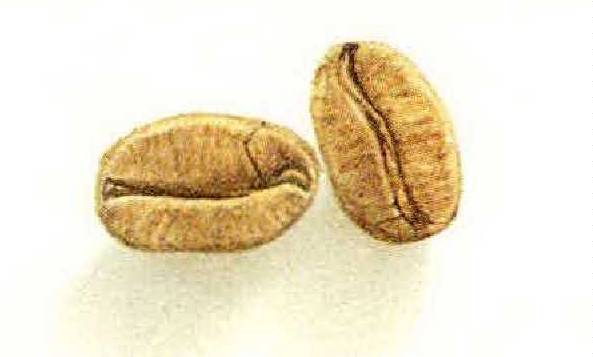
MOST PEOPLE THINK that the first question they ask a coffee expert cuts to the core: “So what’s really the best coffee?” It implies that simply hunting down, say, Kona, Jamaica Blue Mountain, or true Mocha coffee will enable you to appreciate it. In fact the important things are to learn to taste and evaluate what you’re drinking, to brew it with care, and to try something new.
The point of my quest to learn to taste coffee was not to give me something to lord over the wine connoisseurs, whose in-group lingo usually makes me flee, nor was it just to be able to hold my head up in a roomful of specialty-coffee merchants. It was to enhance the pleasure I take in something I will probably drink every day for the rest of my life. I wasn’t looking for an excuse snobbishly to dismiss supermarket brands or chain-restaurant coffee. Ground coffee out of a can is frequently better than coffee beans from a sleek lucite bin or a pretty glass jar, for reasons I’ll explain, and some of the freshest coffee I’ve ever had was in chain restaurants; freshness is often more important than a fancy variety. I didn’t learn, then, to reject. I learned to discriminate—to savor a daily necessity instead of slurp it.
I applied first to Tim Castle, a dealer in specialty coffees in Los Angeles who is eager to teach the public to taste carefully. Casrle is young and especially well-spoken, and has recently finished writing a guide to specialty coffees that will help make a discerning taster of any reader. “People forget that the coffee bean is the seed of a fruit tree,” he told me when I visited him. “Farmers smell coffee flowers in the spring, and in the winter they want the memory of those flowers, not of what roast coffee smells like [a smell I had admitted to being fixated on]. There’s a smell to the land in places in southern Mexico, Guatemala, and Kona, for instance, just the way there is to land in Burgundy.”
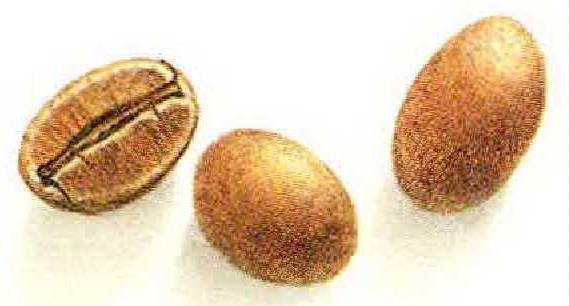
Few people have seen coffee “cherries,” as the fruits of the tree are called, or tasted their seeds, which when dried and roasted are what we know as coffee beans. On plantations coffee trees bear fruit at various times, usually twice a year, and are harvested by hand; in conservatories, where they are often grown because they are decorative, they rarely bear fruit. One coffee roaster I visited had managed to coax a potted coffee tree to bear, and he gave me a cherry to try. It did look like a cherry, although it was an orangey red and ovoid. The flesh was a translucent white, and slimy. The seeds—there are two in most cherries—are buried in two layers of skin beneath the flesh. When the cherries are harvested, the flesh and seed coverings are removed by one of two processes, “dry” or “washed.” The dry process is cheaper, and necessary in areas with little water. It is used for cherries both ripe and underripe, whereas only ripe cherries are washed, which is one reason why washed coffees are generally superior. I stripped off the parchment and got to the two seeds, which did look like immature beans. They were chewy, wet, and bland, and had nothing like the concentrated power in the taste of a roasted bean.
The cherry I was eating was from the species that specialty merchants prefer, Coffea arabica. Arabica grows at high altitudes in semitropical climates, and thrives on the warm days and cool nights there, which slowly develop its flavor; the bean is dense and hard. The coffee we have grown used to. however, is Coffea robusta, named not for its body, which is considerable, but for its resistance to insects and plant disease. Robusta grows at lower altitudes, flourishes in a tropical climate, and bears fruit faster; the bean is softer. Robusta was discovered, growing wild in Africa, only at the end of the nineteenth century (arabica was first cultivated, in eastern Africa and the Arabian peninsula, in the fifteenth century), and because of its hardiness was soon grown on a large scale. This was an unhappy turn of events for coffee drinkers. Robusta has twice the caffeine of arabica (an average of 2.2 percent versus an average of 1.1 percent). Although it has a gratifying mouth-coating quality, its strong, grassy flavor quickly becomes unpleasant unless used with extreme discretion to lend body to the many arabicas that can benefit from it. Big coffee companies, however, reverse the desirable ratio by buying mostly robusta, which is much cheaper than arabica, and blending it with arabica for taste.
MY NEXT STOP was Alfred Peet, the dean of coffee connoisseurs and the founder, in 1966, of Beet’s Coffee and Tea, a specialty coffee shop in Berkeley, California, that soon became famous. As I drove up into the Berkeley hills to meet him at his house (he sold his shop in 1979, but still imports coffee and even sells some to Peet’s, which has retained its popularity), I had visions of cupping, as the analytic tasting of coffee is called, with one of the greats.
Peet, an agile, curt man of Dutch birth who seems ageless (he just turned seventy), ushered me into his house, which is full of Indonesian artifacts and exotic woods from coffee-producing regions. He immediately made it clear that we wouldn’t be tasting any coffee together. “A speed course doesn’t exist,” he said. “The tongue is crude. The nose does the work and tells the flaws.” He motioned for me to sit down in the living room, away from any coffee-making equipment, and spoke for a time on the importance of evaluating green beans before roasting and grinding them. Then he recounted his apprenticeship in the business, which took place at a coffee-trading house in Amsterdam where the experts would silently sample and judge hundreds of coffee shipments a week. After several hours of listening I began to wonder if I would be allowed any contact with coffee at all.
Finally Peet emptied a small plastic bag of green Sumatra beans on the table in front of me, and showed me how he looked for evenness and a healthy green color. The beans had a pretty, almost iridescent surface. Another prime bean, Guatemalan capetillo, had a lovely bluish cast. He put another sample next to them that was made up of dull and shrunken beans. Then he emptied a bag of broken beans, which looked shriveled and terrible. “A black bean should scare you—one stinker can ruin a whole pot—but not broken beans,” he said. He pointed to a bag of Celebes kalossi, a prime bean, beautifully gleaming. “This costs a specialty roaster $3.80 a pound,” he said. The broken beans, an Indonesian robusta, cost forty-five cents a pound. “Those will be roasted and sold,” he said, and named the large commercial roaster that had bought them.
He showed me the technique for properly smelling green beans—grab as many as you can in your two hands, breathe on them hard to warm them up, and then bury your nose in them. Soon I was smelling grass, cut hay, and trees, and a variety of earthy scents. Some smelled clean and fresh, others musty. One sample did smell of ferment, an obvious odor chat would alert any importer to trouble. By the time I left I had begun to see how clearly one could differentiate between samples simply by smelling green beans, I had also picked a lot of them off my face.
IRETURNED TO Los Angeles eager to cup, but Castle thought that I should see a specialty roaster first, so I went to the factory and nearby coffee shop of Martin Diedrich, whose company manufactures roasting machines for the specialty trade and operates a few small retail shops. I had already seen a few commercial roasters in action—for example, Gavina Brothers, a high-quality commercial roaster south of Los Angeles—but the process was more comprehensible at Diedrich, because it was demonstrated on a very small scale.
Roasters are cooks, and they need to be extremely alert during roasting to decide just when beans are done. Every kind of bean has an ideal roast that will best bring out its flavors. In a blend the various coffees should be roasted separately before being mixed, although few roasters have the patience to do this. The machine itself makes a great deal of difference. The most common is like a front-loading clothes dryer, a perforated drum spinning over a gas flame. Temperature is also important: too low and the coffee will be flat; too high and fragrance and taste will be lost. Typically a roast will start at 350° and rise to 375° for twelve to fourteen minutes and, briefly, to a peak temperature between 425° and 450°. Some purists advocate roasting at home, but after several comical and disappointing experiments I saw the truth of an 1872 advertisement for commercially roasted coffee: “Even the best cooks admit they have no luck roasting coffee. Part of the berries are burnt, part are still green, and part have no taste at all.”
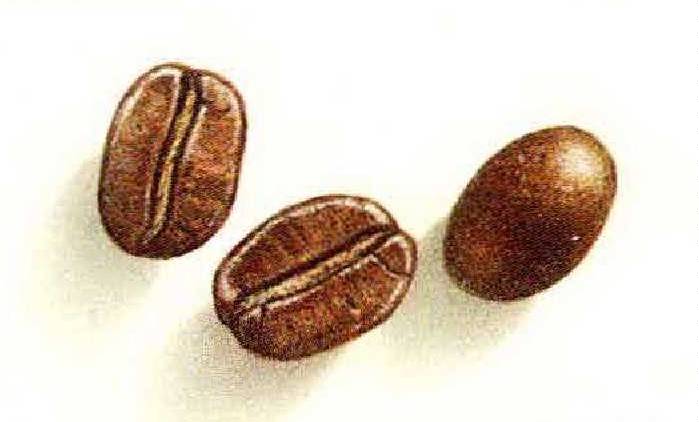
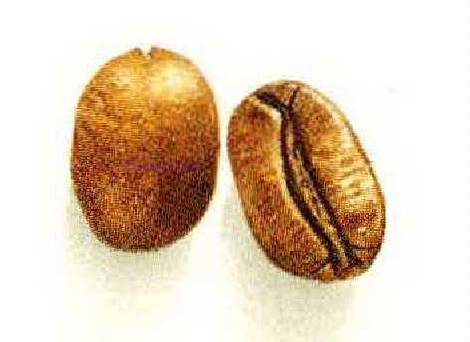
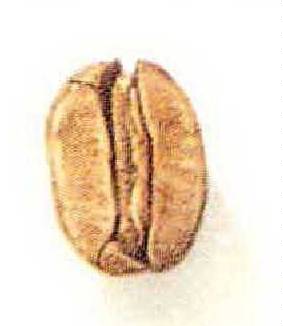
Diedrich roasted a small batch of beans, fishing out samples with a special scoop every few minutes. I watched the beans turn from green to yellow to brown in just a few minutes. As the color changes, starches in the bean turn to sugar and caramelize, which gives coffee part of its flavor and body. Just as the beans turn dark yellow, they pop for the first time, expanding and becoming less dense; the sound is as loud as popcorn popping, although the expansion is not as dramatic, and the beans puff rather than explode. After a few more minutes they pop again. After the second pop oils begin to appear on the surface— the perfect point at which to stop a batch to be used for espresso but too late for many other coffees, which are ready soon after the first pop.
A dark surface glistening with oil is not necessarily a mark of sophistication, I learned. A light roast, for many people synonymous with weak, sour coffee, is often appropriate for good arabicas. A dark roast is useful for smoothing out imperfections in beans that have little flavor or an unbalanced acidic range, because chlorogenic acid, the main acid in coffee, is destroyed at high temperatures. In reference to coffee, “acid” does not mean “sour.” It means brightness and sparkle, and roasters try to preserve, not obliterate, it. “The word freaks out the customer,”says George Howell, the founder and head of the Coffee Connection, the most serious coffee retailer on the East Coast. “‘Liveliness’ is much better.”
Because freshly roasted beans contain a high level of carbon dioxide, they must be stored for one to three days before being packaged, or they would burst their container. This poses a problem for the packager, because after six hours oxygen can enter the beans and stale them, even if they are later vacuum-packed and carbon dioxide is added to the can. One solution to the problem of staling in the can has come from Illy Caffe, an Italian espresso roaster. A few months after my visit to California I was able to tour the futuristic Illy factory, in Trieste. Illy Caffe is considered the world leader in coffee roasting and packing technology. I was guided through the factory by Ernesto Illy, a tall, bouncy man with a shaved head who talks about coffee most of the time and seems to think about it all the time.
Illy’s solution to the staling problem is to add nitrogen under pressure to freshly roasted or ground coffee, which he says forces aromatics back into the light film of oil that covers the beans. This seasoning lasts two weeks, after which the coffee is packed. Some roasters claim that the seasoning obscures distinctive flavor notes, but everyone concedes that Illy Caffe uses extremely high-quality beans (and only arabica; most Italian roasters add robusta), and in Italy, Illy is considered the finest national brand. It is increasingly available in America, and you can call 800-872-4559 to find out where.
Another kind of package on store shelves is the foil “brick pack,” whose package clings tightly to the beans. The roaster puts freshly roasted coffee under a vacuum to de-gas it quickly; unfortunately, this strong and immediate vacuum removes aromatics, too. The best solution so far to the staling problem is the valve-lock system, in which roasted beans are immediately packaged in a foil bag that has a one-way valve in the center. The beans can release gas—“My aroma will kiss you,” reads the legend on valve-lock bags from Tazza d’Oro, the best coffee roaster in Rome — but no oxygen can enter. Once opened, the bags are no better than any others, though. I have encountered bags that were taped shut at the top by merchants who had opened them and taken out some beans to repack; be sure that the top is sealed.
View lucite bins and barrels of coffee beans in supermarkets and gourmet shops with great skepticism. Ask if the seller knows when the beans were roasted. If roasting was more than five or six days earlier, you would do better to buy a vacuum-packed can, a brick pack, or. preferably, a valve-lock bag: the coffee will be fresher.
ALTHOUGH IT SEEMS not to make sense, the best way to get really good and carefully roasted coffee is to order it by mail. You can order a wide range of beans from Caravali Coffee, in Seattle (800-647-0647; the kitchenware shop Williams-Sonoma also sells Caravali coffee under its own name), Seattle being the specialty-coffee capital of America; Torrefazione Italia, a much smaller and excellent Seattle roaster (800-827-2333); the Coffee Connection, in Boston (800-284-5282); and Thanksgiving, a small and very good roaster in northern California (800-648-6491). Peet’s. in Berkeley (800-232-7338), is something of a national cult, but I find its coffees uniformly overroasted, even though that carbon can be delicious. Coffee Connection coffees are at the other end of the spectrum—just dark enough not to be distressingly heavy in acid but light enough to let all of a bean’s high and delicate notes come through. Caravali is between the two. All these companies ship fresh-roasted coffee, and when it reaches you it will certainly be fresher than the loose “gourmet” coffee at the supermarkets, and could well be fresher than a slow-selling coffee at a local coffee roaster. Most companies print leaflets describing the various beans they roast, and usually whoever answers the phone will be happy to start training you straight away.
You don’t have to get the rarest and most expensive kinds and, in fact, will probably be wasting money if you do. “I don’t expect someone who’s been drinking commercial coffee all his life to appreciate a San Sebastian, or a La Minira Tarrazu, or any other single-estate coffee,” Tim Castle told me. (Single-estate coffees are the essential name-drop among coffeephiles.) “The best strategy is probably to try some of the better Brazils, which is what goes into ‘gourmet’ coffee at restaurants and hotels. Then try Central American and African coffees, and experiment with your own blends. Then think about a single-estate or rare coffee.”
Subtle coffee worth such care is disappearing, Castle said. Durable but inferior varieties are being planted in many countries in place of better but laborintensive ones. “If consumers are willing to reject commercial brands and spend more for high-quality coffee,”Castle told me, “they can directly improve the standard of living of the people who grow it, and help it survive.”
The big-name coffees are rarely worth the price and are usually adulterated. Hawaiian Kona, for example, is almost never sold pure, because it is expensive and little is produced. Anyway, it is so bland that I find it unpleasant to drink unblended. The few times I have tasted what is reliably Jamaican Blue Mountain, a medium-acid coffee virtually none of which comes to America (Japan buys most of the annual production), I have thought that it. too, would be better in a blend. (“Jamaican mountain coffee,” grown at lower altitudes, is much more plentiful but, although pleasant, not nearly so distinguished.) One exception is genuine Mocha, from Yemen, beautifully balanced, with just enough body, but nearly impossible to come by, because so little is grown. It has a slight chocolate aftertaste, which is why the name has come to mean the combination of coffee and chocolate; genuine Java is similarly balanced and almost as rare. Many coffees from Guatemala and Costa Rica are of exceptional quality.
Most often a given coffee has pleasant aspects—the cutting sharpness of Kenya, or the subdued and mellow quality of a good Brazil—that are best tasted in counterpoint to something else. If you want to learn how different coffees can taste and what you really like, try ones from a variety of regions, for instance Brazil, Costa Rica, Guatemala, Colombia, and Ethiopia or Tanzania, from a roaster who prefers fairly light roasts. If you just want to drink better coffee without littering your kitchen with bags of coffee, ask what the roaster’s favorite blend is and start there.
Although both heat and oxygen are enemies of roasted coffee, keeping beans or ground coffee airtight is more important than keeping it cool. Beans stored in a refrigerator can dry out and absorb odors; this is even more of a problem with ground coffee, which is so absorbent that in the past it was recommended as a refrigerator freshener. So avoid putting either whole-bean or ground coffee in the refrigerator. The freezer is a better, if controversial, option for whole-bean coffee; some people claim that freezing can destroy aromatics in a light roast, others that the oils in beans, especially apparent in dark roasts, congeal and never return to their original consistency, fry not to freeze beans, then, and never freeze ground coffee, which easily absorbs freezer odors. Find as airtight a container as you can, store whole beans in a cool place, and use them fast.
AT LAST TIM CASTLE judged me ready to cup, and he arranged for a long session at the premises of one of his customers, Alan Chemtob, a coffee wholesaler and retailer. I was finally at the table I had read and heard so much about—the cupping table, where experts gravely and decisively judge samples of coffee that they will sell, either to other roasters or to the public. “I need a cup of coffee,” Castle said as we began.
Cupping is formal and precise, recalling the sixteenth-century ritual boiling and serving of Turkish coffee. First the green beans are examined, usually more for appearance than for smell. Then a pound or so is roasted and the beans cooled and ground. Exactly 7.5 grams are measured into a five-ounce handleless glass or ceramic cup. Boiled water that has been allowed to cool slightly is then poured over the grounds, to the top of the cup. The carbon dioxide in the fresh grounds makes the cup fizz and threaten to spill over, but instead the grounds form a slightly domed crust. They are left to infuse for several minutes. Then the senior cupper breaks the crust with a spoon.
The odors that rush out reveal any defects. Because Alfred Feet had said that learning about coffee should start with identifying defects, I had asked Castle to bring along some bad samples. The first was sour. It smelled acrid and tasted like vinegar. The second was fermented, and tasted even worse than Peet’s fermented beans had smelled—like something bad from the refrigerator. It was so unpleasant that Chemtob hastened to assure me that the sample had come with Castle, not from his inventory. The third was “Rio-y,” meaning it was contaminated by molds, bacteria, or yeasts; the sample tasted like an old potato. The term originally referred to some Brazilian coffees exported from Rio de Janeiro but now is applied to any coffee with that defect. (Santos, a group of coffees also named for their port of origin, surpassed Rio coffees in volume exported in the nineteenth century and have since been regarded as the best Brazils.) “Hard” coffee tasted like an old sock. Next we tasted a robusta grown in the Philippines. “Rubbery,” another term for a defect, is perfectly descriptive. The robusta coffee was grown near rubber trees, and tasted like it.
After the grounds have settled at the bottom of the cup, subtler flavors appear: sweetness, acidity, wine, spice, fruit, earth. I was allowed a few good coffees, and began to appreciate the floral notes of an Ethiopian Yirgacheffe, and the fruity and light aromatics of a kirinyaga, from Kenya, which had heavier aromatics to counterbalance them, a rarity. I saw the necessity of balancing acid and body. I saw how important a light roast is for perfumed coffees when I tasted the same kirinyaga roasted dark: it was still good but no longer distinctive. I realized that even without following every step of the ritual, anyone would be well advised to evaluate coffee first and at length with the nose, and then to inhale it noisily, so as to mix oxygen with the liquid, and swirl it around the mouth before swallowing.
I began to be extremely enthusiastic about these discoveries, having ingested what amounted to a lor of coffee, even though I had, in the time-approved fashion, spat into a spittoon my slurped sips of the seventeen coffees on the table. Seventeen was enough. “I’ve had my cup of coffee,”Castle said. □