America's Store
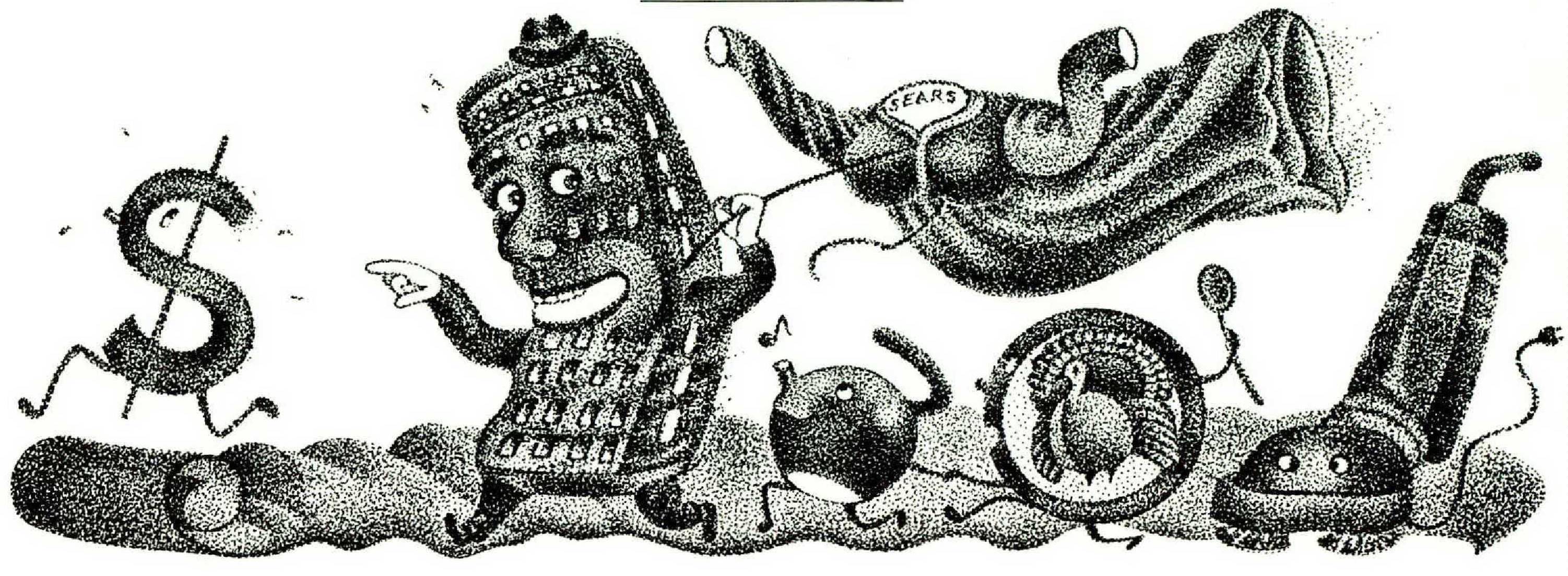
THE BIG STORE: Inside the Crisis and Revolution at Sears by Donald R. Katz. Viking, $22.95.
IN 1983 Edward R. Telling, then the chairman of Sears, Roebuck Sc Co., decided to grant Donald Katz the company’s full cooperation on his research for this book, without asking for any kind of editorial control in return. Katz, a magazine journalist whose first book this is, probably got the freest access that any writer of a non-authorized work has ever had to the inside of a major American corporation. He sat in on many meetings, tagged along on highlevel executives’ trips, interviewed everybody in top management at Sears at length, and got into the company’s archives. He is equipped to report the exact words of executives on discovering that they were fired or passed over for promotion. At a key moment of corporate succession he appears, like a sportscaster in a locker room, to ask the winner how it feels. He describes in detail not only deals that went through, which corporations are often happy to brag about, but also the usually secret subject of deals that didn’t, like Sears’s attempt, in 1981, to acquire Merrill Lynch. Katz had what amounts to a one-time exemption from a basic limitation of journalism, which is that no reporter can have better than a keyhole-peeping relationship with an institution.
Having been given such an unusual opportunity, Katz obviously was determined to make the most of it. He spent several years researching Sears, and has turned out a hefty volume, of more than 600 pages. He has taken care to avoid the appearance that he’s pulling punches in gratitude to Sears for its cooperation—for example, he has a thorough passage on anti-Semitism at Sears, and he reports that Telling regularly used a Sears plane to play hooky at various racetracks with his cronies. Katz wanted, above all, to use his access to Sears to produce a work of literary as well as reportorial merit. He has had a sustained look into the pulsing heart of Middle America: Sears is the thirteenth-largest corporation in the country; one in thirty Americans is a present or former employee; three in four Americans walk into a Sears store at least once a year; its headquarters, in Chicago, is the tallest building in the world; and the company symbolizes practical, white-bread values better than perhaps any other. Katz sees today in Sears the kind of mythic centrality to the culture that Sherwood Anderson saw in the turn-of-the-century inventor-businessman. For some reason, the strain in the national life that Katz rightly feels Sears represents has been difficult for writers to capture lately. It’s there as plain as the nose on your face, but the literary world has no direct contact with it, and there’s a tendency to attitudinize about it—to sneer, to recoil, or to sentimentalize. Katz is trying here to show that a writer can, instead, turn provincial business life into art.
IN THE FIRST decades of this century Sears was a mail-order house; its mostly rural customers used the famous Sears catalogue in place of a real store. When General Robert Wood took over the leadership of the company from Julius Rosenwald, in 1922, he made it his mission to turn Sears into a retail chain; and for fifty years Sears built stores all over the country. Sears was in a curious position with regard to the development of a national market in the United States: because it was one of the pioneers of standardized name-brand shopping, it had to make many concessions to the diversity of the country (which it was helping to destroy). When Wood set his course at Sears, there was no television or jet travel and barely any long-distance telephoning. Massachusetts and California were different cultures to a much greater extent than they are today. So Wood had to give a great deal of autonomy in price-setting and merchandise selection to the local managers.
As a result, by the 1970s Sears was absurdly decentralized. There was virtually no uniform pricing, the company’s own buyers had no guarantee that the stores would stock their goods, and the way goods were displayed was mostly left up to the store managers. Katz reports that once, the head of store operations actually tried to prohibit Sears buyers from setting foot in Sears stores. The hayseed-and-proud-of-it culture of the field operation, combined with Sears’s sense of invincibility and Wood’s lengthy dotage, produced many examples (some of which are still around) of Sears stores that were spectacularly out of it: inefficient, warehouse-like, and cluttered with merchandise that was a good fifteen years behind the times. The expansion of national departmentstore chains and of specialty stores like The Gap lopped off the top of Sears’s market, and K mart, with its air of joyously naked bargain-hunting, took away the bottom. All the company’s economic vital signs were poor by the late seventies, when Telling was vaulted into the chairmanship to shake things up.
The early part of Telling’s tenure was disastrous. He put two old crocodiles in charge of the buying and merchandising divisions, in hopes that they’d establish a sense that headquarters was finally in charge; instead, all they did was fight with each other. The numbers kept getting worse. Then Telling got rid of most of Sears’s older executives, by offering them a generous early-retirement package, and put Edward Brennan, whom he later named to succeed him as Sears’s chairman, in charge of both sides of the stores, buying and selling. Brennan turned the merchandising division around, and Telling spent his time acquiring other companies, most notably Dean Witter, the stockbroker, and Coldwell Banker, the real-estate company. The idea that Sears, the retailer America trusts, could persuade its customers to invest and bank, as well as shop, at its stores entranced Wall Street and the press. By the time Telling decided to cooperate with Katz’s research, he was being hailed as the genius who had saved Sears. Perhaps he had enough confidence by then to feel that a book about Sears would be as favorable as all the articles had been, and more lasting—that it would give him his place in history.
While Katz is remarkably free of the usual sin of the journalist with access, which is lionizing of the access-granter (he conveys Telling’s flaws, and also Brennan’s, very well), he does lionize Sears and the scale of Telling’s accomplishments. Katz seems to have decided that the way to make his book important as a piece of writing would be to emphasize the grandeur of Sears. One can see the reverse-snobbish appeal of this— most bards of Middle America have stressed its banality, or its corruption— but his choice of tone was a big mistake, one that keeps The Big Store from being a real success literarily.
Every so often Katz will burst into a flight of heroic rhetoric that sounds like a cross between a Sunday sermon and a passage from an old-fashioned worldhistory textbook. He compares various Sears executives to Robespierre, Charles de Gaulle, Apollo, Alexander the Great, “medieval barons,” and “the emperors of Rome.” Brennan caused “the deracination of people as in great floods and plagues.” Telling “directed the forces of empire into entirely new realms.” The head of Sears’s far-western territory is “one of the most powerful businessmen in the world.” Trash compactors are “the miracle of trash compactors.” The reason that a large sign saying SELL MORE UNITS is hanging at a sales meeting is that “every great rally in the public squares and great halls of history had a banner.” Sears is important, but it isn’t that important. Katz should have used its employees’ company-as-world outlook as a phenomenon to be examined, rather than appropriating it.
Also, though Telling and Brennan changed Sears a great deal, Katz’s implication that they have restored it to its full former might is a little overblown. Retailing profits have been in another slump since the end of the period covered in the book, and of the new divisions, only Coldwell Banker has performed really well. The federal government has so far prevented Telling’s great dream—that Sears would replace the small-town bank as it once did the general store—from becoming a reality. The publicity attending the accession of Michael Bozic to the top retailing job at Sears this year has been amazingly similar in tone to Katz’s description of Brennan’s accession to the same job in 1980: there has been the same talk of a bureaucracy mired in the past and badly in need of stronger direction from headquarters.
The evidence Katz presents tempts one to be mildly cynical about Telling’s triumph. As an upper-level executive, felling befriended some management consultants that the company had called in to help solve its problems, and the position that was to become his springboard to the chairmanship was a new one that the consultants talked the company into creating. As soon as he got the top job, Telling hired the most involved of the consultants, Phillip Purcell, as his assistant (Purcell appears to have been Katz’s most copious source). Telling’s two great initiatives, centralizing the merchandising operation and diversifying into financial services, were both initially Purcell’s idea. When Telling had finished making his acquisitions, Purcell was given the megabucks job of president of Dean Witter, which has performed poorly since he took it over, even though Wall Street is booming. The next consultant of whom Telling became enamored was Roderick Hills, a former chairman of the Securities and Exchange Commission. He brokered the Coldwell Banker and Dean Witter deals and was rewarded with a fancy new Washington-based division called Sears World Trade, which flopped spectacularly. (Katz is wonderfully wise to the name-dropping, corporate-jetting game that Hills played, and to the way Hills flattered Telling with his confidential talk of lofty matters that no one at Sears but the two of them had the sophistication to understand.)
It has become the standard complaint of books on management that corporate executives spend too much time planning acquisitions with non-operations people, but not minding the store sure worked for Telling. Wall Street rewarded his strategizing by driving up the price of Sears stock, and Brennan did the gritty job of reforming the merchandising division. His “Stores of the Future” are a skillful updating of the Sears mission—they look like department stores, but the decor is much cheaper, and the level of trendiness of the goods is the product of a near-perfect gut instinct for Sears’s place in America. Now that Miami Vice is just a little past its peak, you can buy a wrinkled-look white jacket at Sears for $25, or about a fifteenth of the price of the version Don Johnson wears. There are beige refrigerators for sale, as well as white ones. The celebrities after whom Sears lines of clothing are named—Arnold Palmer, Cheryl Tiegs, Stefanie Powers, Johnny Carson—all have a healthy, betweenthe-coasts kind of appeal.
Brennan comes by his feel for Sears honestly. He is a third-generation Sears employee; when his mother left his father during his childhood and moved to Mexico, she stayed with Sears. (His brother, who left Sears because of sibling rivalry, runs Montgomery Ward.) The book portrays Brennan as efficient in a bone-crushing way that makes you want to run out and buy Sears stock but not to work for him: Katz shows him obsessively smoothing the wrinkles out of his suit jacket, keeping daily tabs on the performance of every major department in every big Sears store, and choreographing the seating of Sears executives during brief car rides. It isn’t so much that he takes Sears seriously as that his identity is inseparable from Sears. Without a hint of irony he can intone the lyrics of Kenny Rogers’s “The Gambler” before an audience of hundreds of people, or say of someone, “The man was the finest polyester-buyer in the whole world,” or hang on his wall a plaque with the Orwellian sales motto “We are they, They is us.” If there is a perfect living antithesis to everything hip, knowing, sophisticated, urban, and cynical, it’s Brennan.
WHAT’S BEST, AND rarest, about this book is not its drum-rolling about the fate of the Sears empire but its portrayal, through the characters of Brennan and several other executives, of what it’s like to work inside a big corporate bureaucracy.
All the top merchandising executives in The Big Store are products of a life that seemed after the Second World War to be the future of America: the life of the organization man. Most of them grew up in small midwestern towns or on farms, in modest circumstances, and joined Sears right after college or the service. They spent the better part of their twenties, thirties, and forties moving every couple of years from town to unglamorous town—in Telling’s case, Danville, Rockford, Decatur, and Fort Wayne, to begin with—and in the process Sears took on for them many of the functions of a family and a community even as it was taking a severe toll on their own family and community lives. It seems to be no accident that the two men who did the best in the Sears system in the seventies, Telling and Brennan, both came from troubled families (Telling’s father never got over losing his job, in a bank, during the Depression) and clearly regarded Sears as a balm for their deep emotional wounds. Telling’s parting words to Katz after he picked Brennan to succeed him were, “Sears is like a beautiful woman, and when you talk about it, talk like you’re making love to a woman.”
By the time they made it to the big payoff job in the Sears Tower in Chicago, in their fifties, these men were totally committed bureaucrats. They engaged in interdepartmental warfare with the passion of people who believe that it’s the stuff of life. The company controller threatened his enemies with expense-account audits. Another executive moved away from a neighborhood he loved after he got a big promotion, because his friends there were all Sears men at his former level, from whom he had to distance himself. Telling, Katz strongly implies, was substantially driven as chairman by the desire to take revenge on those who had wronged him through the long years of his rise. As for Brennan, with his fanatical attention to detail and his fondness for cryptic Searsas-Godhead slogans, he puts all the other company men in the shade. He would have made a great Army Chief of Staff, or Soviet Party Chairman.
General Wood, who was one of the leading American isolationists before the Second World War, established a kind of secular religion of midwestern squareness at Sears that persists to this day. Every one of Brennan’s infinitude of rahrah dinner meetings begins at 6:00 P.M., and the main course is always steak. Katz notices that true Sears men all have pinhole-riddled lapels on their suit jackets from wearing so many HELLO MY NAME IS placards. Daytime meetings always begin with a vigorous call-and-response of “Good morning!” or “Good afternoon!" Naturally, real Sears men hate New York and Washington. Telling closed the overly worldly New York buying office of Sears as one of his early official acts, and once, riding down in the elevator after making a presentation at Morgan Stanley, the plummy investment house, he said, “Say there, fellas, jus’ what is it this here Morgan and Stanley outfit makes, anyhow?”
By now Sears, which for so many years was exactly as unchic as most of the country, is if anything too wholesome for America’s tastes—the Wall Street analysts are pressing it to become more trendy. Organizationally it isn’t as much of a paradigm as it used to be either. The allure of the big company, as an employer and as a purveyor of goods, has faded considerably over the past quarter century; it is hard to imagine that in another quarter century the organization Katz describes won’t seem like a period piece. If it were a period piece already, Katz’s job would have been easier; as it is, its typicality is exactly what makes Sears a difficult subject.
There is a photograph in The Big Store that appears over the caption “Senior Management of the Merchandising Group, 1980.” It shows a group of twelve men arrayed behind Edward Brennan—they’re white, middle-aged, and short-haired, dressed in dark suits, white shirts, black shoes, and striped ties. They spend their lives planning The Challenge Year and quarreling over the Audit Transfer Memoranda. Every - body knows that in some way they represent the absolute center of this country, and yet we’re conditioned to think that there’s something boring and insignificant about them. Is this just prejudice? Maybe. Katz, to his enormous credit, has made them and their work interesting. If they’re more than interesting— if they’re profound — he hasn’t proved it, and whether that is his failing or theirs is an open question.