Notes: The White Peril
WHEN I WAS A Boy Scout, my troop went on Easter Week expeditions. Usually we camped in Yosemite or the Grand Canyon, but one year we toured military bases. We bunked with Marines at Camp Pendleton and wolfed down mess-hall chow. From the decks of big flattops we watched Navy fighter planes scream in to land. We tried on Strategic Air Command helmets and flight suits. The patches said, PEACE IS OUR PROFESSION. This was 1963.
The romance didn’t take. Hardly anyone from the troop subsequently signed up. But one moment made a lasting impression on me. A SAC colonel, who had flown those mighty B-52s and kept his pilots alert for their mission to Moscow, waxed philosophical after he showed us around. “Let me tell you men something,” he said—instantly winning the devotion of fourteen-year-olds in Scout caps. “If you ask me, it’s the Chinese we should be worrying about.” He gestured toward a hulking bomber. “I say, let’s take them out before it’s too late.”
I have thought of the colonel often during the year that I have spent in Asia, perhaps because I read Gore Vidal’s famous “requiem for an empire” speech, delivered at a PEN Authors Evening and later published in The Nation, just before I left. Vidal’s point was that America’s brief, happy run as an empire was over. It began in 1914, when New York replaced London as the world’s financial capital, and it ended in the fall of 1985, when America became a net debtor nation. Since then we’ve gone some $250 billion into the hole. The new empires, he said, would be those of the East. Our only hope was to make peace with the Russians, so as to gird ourselves for the massed Asiatic hordes.
Vidal got into a lot of trouble after the speech, for reasons that seem bizarre from this side of the Pacific. In an article expanding on his point Vidal claimed that Jewish neo-conservatives kept plumping for big defense budgets, thereby destroying our economy, because they loved Israel more than America and wanted to see us bogged down forever in the Middle East. For this he was called anti-Semitic, and that’s not what is surprising. The bizarre aspect of the criticism is what it didn’t include. Only a few people seem even to have mentioned the more blatant racism of Vidal’s argument. Like the colonel, he was warning that the white man and the yellow man were at war.
“Now the long-feared Asiatic colossus takes its turn as world leader, and we— the white race—have become the vellow man’s burden,” Vidal said. We had to get along with the Russians because only with our combined forces would white people have a chance. “After all, the white race is a minority race with many well-deserved enemies, and if the two great powers of the Northern Hemisphere don’t band together, we are going to end up as farmers—or, worse, mere entertainment—for the more than one billion grimly efficient Asiatics.”
Vidal, unlike the colonel, may merely have been sounding arch. If he is trying to be serious, I thought, he must be crazy. The idea that Japan and China are about to team up, in what he called the “Sino-Japanese axis that will dominate the future,” would come as news to either party. In their values and motivations, the two cultures strike me as being about as similar as Mexicans and Swedes. “Grimly efficient” the Japanese may be; but no one who has seen Chinese people eat, gamble, or launch a two-week celebration of the Lunar New Year would apply this term to them. The famous acquisitive drive of the overseas Chinese is usually attributed to their fierce, Mafia-like family loyalty. I interviewed a Chinese merchant in Singapore who had been ruined when his brother-in-law embezzled the assets of their joint business. He seemed weirdly placid, and explained, “At least it’s still in the family.” The Japanese are so much less attentive to dynastic details, and so much more motivated by loyalty to institutions, that leading business families routinely adopt ambitious young men as their “sons” and business heirs. The bitterest, most racist complaints I’ve heard about the Japanese are those I heard in China. When Japanese businessmen talk about China, they tend to rhapsodize about raw materials, cheap labor, huge potential markets—not allies against the round-eyed West.
And if China and Japan make an odd couple, what about us and the Russians? Apart from our “whiteness” (tell it to Jesse Jackson, or the fast-growing population of Soviet Asia), exactly what values are we supposed to share? The Protestant ethic? The pursuit of happiness? I Gotta He Me?
THAT IS WHAT I thought at first. But as time went on, I realized that I was the one being shallow. I had missed the point. Gore Vidal may be wrong about the yellow men — they’re not about to get together—but he is right about the whites. The one thing I’m sure I’ve learned in Japan is this: America doesn’t have a chance to stop declining if it must keep competing with both the Russians and the Japanese.
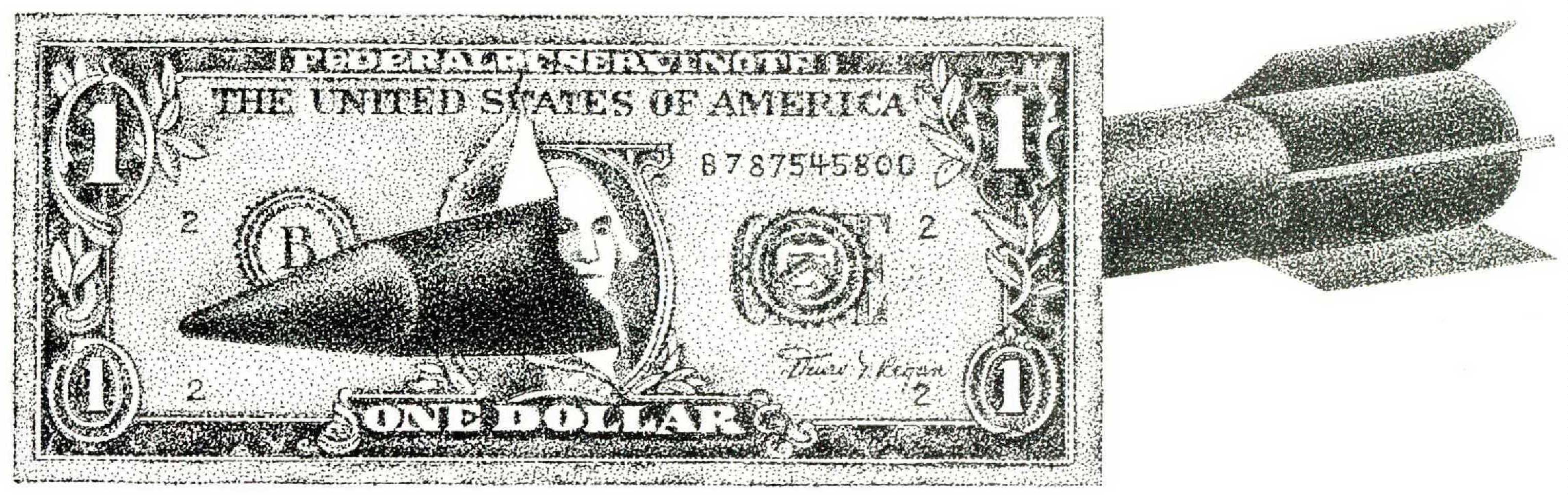
Everybody in America knows that Japan’s “free ride” on defense gives it a big economic edge. The disparity in defense budgets is only the most obvious part of America’s handicap. There is also the diversion of talent. (“Our first-rate engineers are building cars and industrial electronics,” a Japanese man in his sixties, who had lived in Hiroshima just after the war, told me. “Your first-rate engineers are building military lasers. Your best might beat our best, but it is rather too arrogant to think your secondraters will.”) Most important of all, though least noticed or debated, is America’s basic strategic decision as the leader of an alliance: we care more about keeping Japan (and Western Europe) on our side militarily than we do about competing with their industries. “The first principle [of postwar strategy], that American trade policies be subordinated to broader political goals, has been consistently followed,” David Yoffie writes in a new book called America vs. Japan. This is the burden of empire.
Everybody in America also thinks that if we just crack down on the Japanese, we can make them solve our defensespending problem. Maybe they could impose some comparable handicap on their industries, or pick up part of our costs—no one’s ever too specific about what the solution would be. I think we’re fooling ourselves even to hope that the Japanese will bail us out. It’s not simply that every one of Japan’s neighbors—yellow men or brown—would blanch at the idea of a re-armed Japan. We would be very unhappy too. Do we worry about losing those “strategic” bases in the Philippines? They’re no more important than America’s air bases on Japan, nestled right next to the Soviet Union, or our naval bases commanding the straits that bottle up the Soviet Pacific Fleet. Do we grumble about relying on the Japanese for defense technology? We’d feel worse if they took their business elsewhere. It’s a standoff. They need us, but we need them. When we make hollow threats to end the “free ride,” we look like fools.
The yellow men won’t solve our problems. And I’ve come to see that that’s why Gore Vidal is right. It’s up to the white men to find a way to live together—or for Americans of all colors to figure out how to defend ourselves for less. It we can’t, we finally will have something in common with the Russians: a society ruined by “defense.”
—James Fallows