My Cat Book Won't Come
“How’s THE BIG cat novel coming?” are the words I hate to hear. The average person cannot know how it feels to be under the gun as I have been—six and a half years struggling with the big one, the cat book to end them all. The longer it takes, the bigger it has to be. Every day, the question that I must live with grows: whether anything can be that big.
Get off of that!
Like a cat, I am out on a limb. And there is no calling the fire department. As I told Ted Koppel, on Nightline, fire departments today don’t get cats down out of trees. “What you are saving, if I may summarize, then, is this ...” said Koppel—those oddly catlike eyes never quite flicking.
“All I am saying,” I snapped, “is that contemporary fire departments don’t get cats down out of trees. ‘You’ve never seen a cat skeleton in a tree, have you?’ they ask.” The skeletons of cat-book writers, on the other hand . . . The skeletons of true cat-book writers, I mean.
Get off!
To have declared openly, as I did on the CBS Morning News, that the Garfield books are not cat books, because “Garfield is not only unamusing; Garfield does not convince as a cat,” was to fling down a gauntlet before a consensus so entrenched, and so pleased with itself, that the issue is quite simply whose reputation will stand, mine or the literary establishment’s. To have revealed in advance that my protagonist is a cat named Charles J. Guiteau was to take an enormous risk. To prove myself right about Garfield is to prove that millions of so-called cat-book lovers, and millions of professed cat lovers, are wrong in their love.
Get . . .
If one could extrapolate from fragments—as we do in our estimation of Sappho—the disinterested reader (but there are not even, appearances aside, any disinterested cats) would have to conclude that my book is, essentially, there. The chapter in which Guiteau’s “owner,” the Chief Justice of the U.S. Supreme Court, is racked by nightmares that he is Adolf Hitler—dreams accounted for, at length, when the Justice wakes to find that Guiteau, for reasons of his own, has crept into the Justice’s bed and placed one paw beneath the Justice’s nose to create the sensation of a small black moustache—is done. And, according to those who have read it in manuscript, it is fine.
But do they know? Until I know, I cannot move on. And my confidante Irene calls it sexist to depict the Chief Justice of the U.S. Supreme Court as a man. Five times that chapter has undergone anguished recasting. Each time, I have felt that something of what should be its unexampled potency has eluded my slow, stretched, pawing reach.
Get off!
My friend Leo teaches deconstructive approaches to Latin American fiction, but you wouldn’t know it to look at him out somewhere. I think he only does it because it’s what’s happening. He calls himself the Hillbilly Cat. “Elvis was the Hillbilly Cat,” I say. “Was,” he says. “You’re from White Plains, New York,” I say. “Gimme some slack,” he says. Last night he left Lon’s Miracle Mile Lounge with a woman who was . . . tawny. All of a softness well toned. I had her scoped out. She looked pensive, enigmatic, I thought. I was waiting until after “Twilight Time,” thinking it might seem prurient to ask a stranger to slow-dance first. Then the neo-fifties combo swung into “Sixty-Minute Man,” and I was counting down, “Ten . . . nine ...”when Leo—before he can conceivably have known it was the right thing to do— went over to her table and took the painter’s cap from her head (letting her hair flow down like butterscotch over a sundae) and put it on his own. He just now called to say she turned out to be a passionate attorney from Tulsa flushed with victory in a landmark harassment case, eager for a one-night romp punctuated by warm ablutions in her equally go-with-it friend Amber’s condo pool, with flume, steam, shower-massage, and bubbler attachments.
If you don’t get off of that . . . !
GUITEAU IS AN “altered” cat. A modern cat, then. But how much of his character derives from that grim erotic neutrality, and how much from catness an sick? Can I ever know? Can I feel that I know? Guiteau’s look is blank. The question burns.
Cats have no moral sense. Catch a dog on the couch and he leaps as if scalded and exclaims: “I’m off! I’m off the couch now! Oh, Lord! I wasn’t ... I was just ... I was guarding it! Dogs can sense when someone is about to break in and steal a couch and . . . Oh! I can’t lie to you! To you, after all you’ve done for me! I was on the couch! How could I . . . I know better. You know I know better. I just ...”
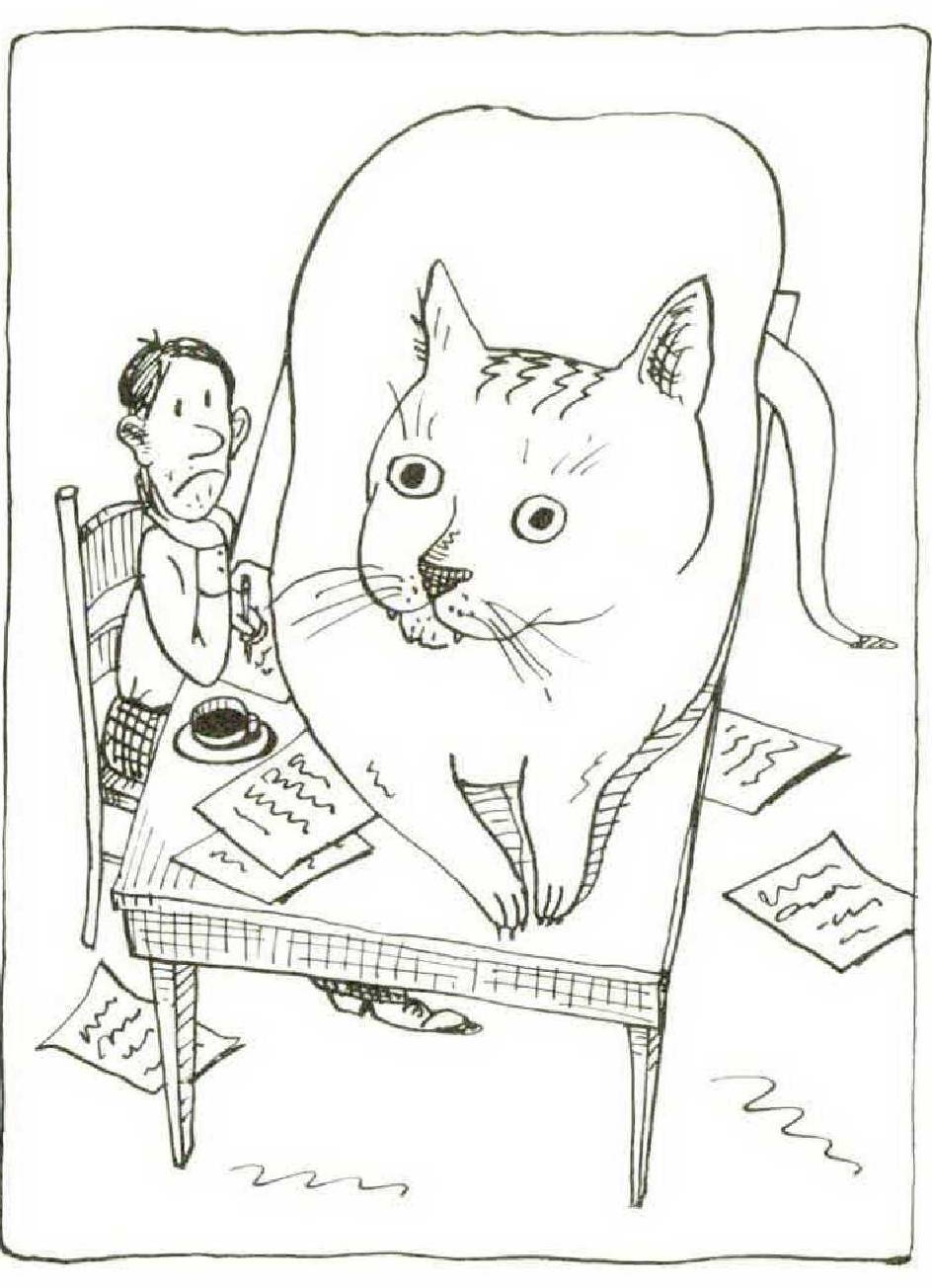
Catch a cat on the couch and it doesn’t even shrug.
Dialogue does not flow from a cat. A cat does not even know its name. Or care. A cat has unreadable eyes.
Yet the books pour out. Keeping Tabs remained on the New York Times bestseller list for ninety-one consecutive weeks. In acquiring the film rights to Another Man’s Persian, Avram Zorich went to eight figures. Real Cats Don’t Eat Couscous, for all its dragged-in antiIslamism, captivated reviewers from coast to coast. Marisha N. Puhl’s Kitten Kin, with its sepia-tone photos of pipesmoking, etc., kittens as archetypal “Uncle Ned,” etc., struck me as too cute. Her Kits, Cats, Sex and Wives I found, frankly, lurid. Yet Puhl’s sales, hardback and paper combined, have passed the four million mark. I happen to know that Amsler Rizell, author of Life With a Purrpuss, bought his first cat—by mail—in order to get a book out of it.
Get off of that!
The only writer in the field today who commands my respect is the French critic Yves Sevy-Ouiounon, who raises such questions as (my translation) “What must the cats look like who enter—as they must, else art is fraud—the world of Mickey Mouse?” Sevy-Ouiounon’s thought breaks frames.
As do cats. The soft touch (with the poufy foot that seems never to weigh upon anything), the cherished photo toppled from the desk ... I have paid my dues. Cats have intercepted my footsteps at the ankle for so long that my gait, both at home and on tour, has been compared to that of a man wading through low surf. And in my book it shows.
Get off!
Only someone whose domestic atmosphere has been permeated with cat hair for more than three decades could have conceived the plot-point whereby my assassin is unmasked. The mailer of the threatening note is a cat owner (cats themselves, pace Garfield, cannot use the postal service) who is too frugal to throw away the first two inches every time he uses Scotch tape, and who has neglected to fit his tape dispenser with a screen covering the exposed lower surface of that first strip of tape between roll and cutter, so that when he uses tape to affix the letters scissored from magazines to the sheet of paper from which the watermark has been removed, he uses—on the first two letters—tape to which adhere traceable cat hairs.
Get off of that.
I would not wish to leave the impression that my cat book is a thriller merely. That I have felt compelled to plot it so strongly—nine deaths—reflects the cultural conservatism (of which cats are part and parcel: dogs are Democrats, cats Republicans) pervading the arts today. The book’s indwelling ambition far transcends “story.” What the book would do would be as near unknowable as the animal entailed. Intrinsically, the book would pounce, loll, and go m’rowr; would present thee with felinity for a while.
Some mused-upon titles, none right:
More Ways Than One
Unkindest Cat
Tabby La Raza
Now I’m the King
To enter the world of my cat book is to enter an ancient consciousness, an abysmal shallows, in whose context narrative focus, as the contemporary book-buyer knows it, is as arriviste a notion as foot reflexology. (Which Leo has taken up. Purely to meet women.) It will not be an easy book to read. It is not easy in the writing. There have been repeated setbacks involving my own cat and the physical manuscript. Get off of that. I’m telling you, Mieu-mieu, get off of that. I swear, I’ll wring your neck! I mean it! Mieu . . .
A dog book comes when summoned. A cat book, when it will.