THE COMPLETE POEMS: 1927-1979 by Elizabelli Bishop.
Farrar, Straus and Giroux, $17.50.
WHEN ELIZABETH BISHOP died, in 1970, she was as highly respected as any poet alive, though her champions had had a hard time explaining themselves. “[Her] work is not easily labelled.” wrote her colleague Howard Moss. “She is not academic, beat, cooked, raw, formal, informal, metrical, syllabic, or what have you. She is a poet pure and simple who has perfect pitch.” Robert Lowell’s metaphor seemed a little stretched: “When we read her, we enter the classical serenity of a new country.” And Randall Jarrell, who usually wrote better than this, said, “Miss Bishop’s poems . . . have a sound, a feel, a whole moral and physical atmosphere different from anything else I know.” Clearly there was something about Bishop’s work that escaped description, for such praise tells us principally that Bishop was the kind of poet that these poets liked to admire. Her publishers took their cue by calling her “one of the master poets of the age.” Now, with the publication of The Complete Poems: 19271979, it may be possible to isolate some of those special qualities that every attuned reader of “The Fish” or “Roosters" or her other anthology pieces will recognize.
Elizabeth Bishop’s life, though not without heartbreak, throws only fitful light on her work and has so far attracted little biographical attention. Her biographer is unlikely to furnish revelations as garish as those recently disclosed by the chroniclers of Robert Lowell and John Berryman. Born in Worcester, Massachusetts, Bishop spent part of her childhood in Nova Scotia and then attended Vassar College with “The Group,” the gaudy generation adorned by Mary McCarthy, Eleanor Clark, Muriel Rukeyser, and other literary lionesses. She lived in Florida, Washington, New York, and eventually, for many years, in Brazil. Her last years shifted between Maine and Boston, where she alternated with Robert Lowell and Robert Fitzgerald in teaching Harvard students about the writing of poetry. She was very agreeable, but not notably brilliant, company—the sort of person it is possible to like very much without knowing exactly why. She bore herself with a sort of naughty gentility, like an unfrocked governess.
Peter Davison is poetry editor of The Atlantic. His most recent book is Barn Fever and Other Poems.
To seek explanations for why Miss Bishop’s admirers stammer so, we must look scrupulously at her poetry. It repays the attention. She was visibly a poet of the open air, of sky and sea. The two words appear in a great many of her poems, and balance each other:
The sun is blazing and the sky is blue. Umbrellas clothe the beach in every hue.
The water is a burning-glass Turned to the sun That blues and cools as the afternoon wears on. . . .
The poems often reflect reality in the way mirrors do—mirrors, moreover, that do not give much room to the personality of the author. She remains out of sight, holding a mirror so as to bring the outdoors in. Even in her earliest poem, her work sparkles with reflections:
His singing split the sky in two. The halves fell either side of me, And I stood straight, bright with moon-rings.
And with color. Such words as “gold,” “silver,” “pale,” “bright,” “dark,” “black,” “white,” “green,” “blue,” “red,” make up the warp of her poetry. Few poets in this century can have been so mindful of color. Yet the favorite play in her work is to mingle all the senses into one harmony, as in “The Prodigal”:
The brown enormous odor he lived by was too close, with its breathing and thick hair, for him to judge. The floor was rotten; the sty was plastered halfway up with glass-smooth dung.
Indoor scenes like this take Bishop partway toward the city, where her poems have a way of turning gloomy and breathless. Cityscape affects her like an asthmatic attack—sometimes she struggles to breathe:
At night the factories struggle awake, wretched uneasy buildings veined with pipes attempt their work.
The city also brings out her sophistication and wit, as in the urban settings of “Invitation to Miss Marianne Moore”:
With dynasties of negative constructions darkening and dying around you, with grammar that suddenly turns and shines like flocks of sandpipers flying. . . .
She likes to associate light not with glare or fire or even knowledge but with peace and tenderness, as in “The Shampoo”:
The shooting stars in your black hair in bright formation are flocking where, so straight, so soon? —Come, let me wash it in this bigtin basin, battered and shiny like the moon.
Here as elsewhere, Bishop is remarkable for the sweetness of her associations. The sky in her poems acts like a shelter, a comfort. Her landscapes are soft and humanized. One of her poems about landscape best describes the nature of her own poetry:
solid but airy; fresh as if just finished and taken off the frame.
In summary, Bishop’s world, rarely harsh, seems to avoid the preoccupations that we once thought of as masculine only—war, sport, overt ambition, violence, heterosexual aggressiveness. In her poems, harshness is everywhere softened by the presence of moisture, of clouds:
There are too many waterfalls here; the crowded streams hurry too rapidly down to the sea, and the pressure of so many clouds on the mountaintops makes them spill over the sides in soft slow-motion, turning to waterfalls under our very eyes.
BISHOP MADE HER name in 1946, with North & South, and brightened it with A Cold Spring in 1955, when she won the Pulitzer Prize and raised everyone’s consciousness. (It’s amusing to read a poem like “Cape Breton” and see how greedily Robert Lowell borrowed from it a decade later in “For the Union Dead” or “Waking Early Sunday Morning.”) Yet not until Questions of Travel (1965), her best book, do her poems soften and mellow into the landscape that is permanently and unmistakably hers:
Here is a coast; here is a harbor; here, after a meager diet of horizon, is some scenery: impractically shaped and—who knows?—self-pitying mountains, sad and harsh beneath their frivolous greenery. . . .
This must be as ingratiating a poem as has opened any volume of American poetry since Robert Frost’s West-running Brook.
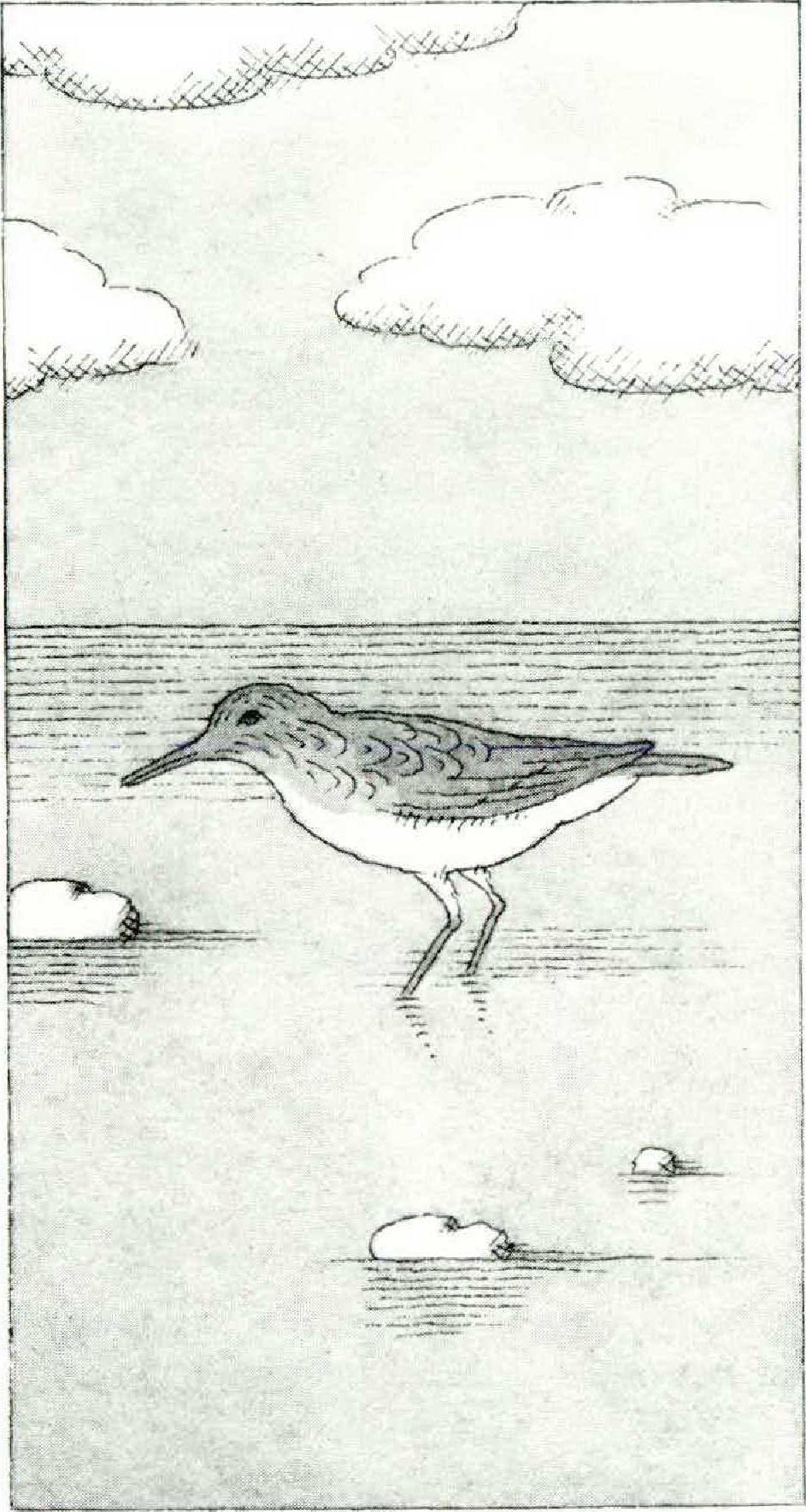
Later on, the energy in her work ran a little thin, though many beautifully modulated poems came into being, like “The Moose,” or the punningly entitled “The End of March.” You may relish the youthful poems, the witty occasional pieces, the glowing translations from Portuguese, but I find myself remembering best a more mature, gentle yet acerb, pawky yet affectionate voice speaking of sea-margin and sky-margin, soft and cloudy, a little breathless, vivid with sound and color. Bishop’s master creation, an observant yet myopic sandpiper, reminds us of the sandpipers she associated with Marianne Moore.
The roaring alongside he takes for granted . . . The world is a mist. And then the world is minute and vast and clear. The tide is higher or lower. He couldn’t tell you which. His beak is focussed. He is preoccupied. . . .
With what? Why, with the evidence of his senses. His role in life, like his creator’s, is to tiptoe along the margin of things,
looking for something, something, something. Poor bird, he is obsessed! The millions of grains are black, white, tan, and gray, mixed with quartz grains, rose, and amethyst.
How else, after all, is one to see eternity in a grain of sand? How else, except through enunciating the quality of seeing? The truest poet—and the hardest to describe in mere prose—sees what others do not see. And then through rhythmical recognition summons up what has been seen. Purity of heart, as Kierkegaard said, is to will one thing.