Agriculture: Will the Corn Belt End Up in the Rivers?
Conservationists are exploring new methods of saving topsoil, which can melt away at the rate of thirty-two tons per acre per year
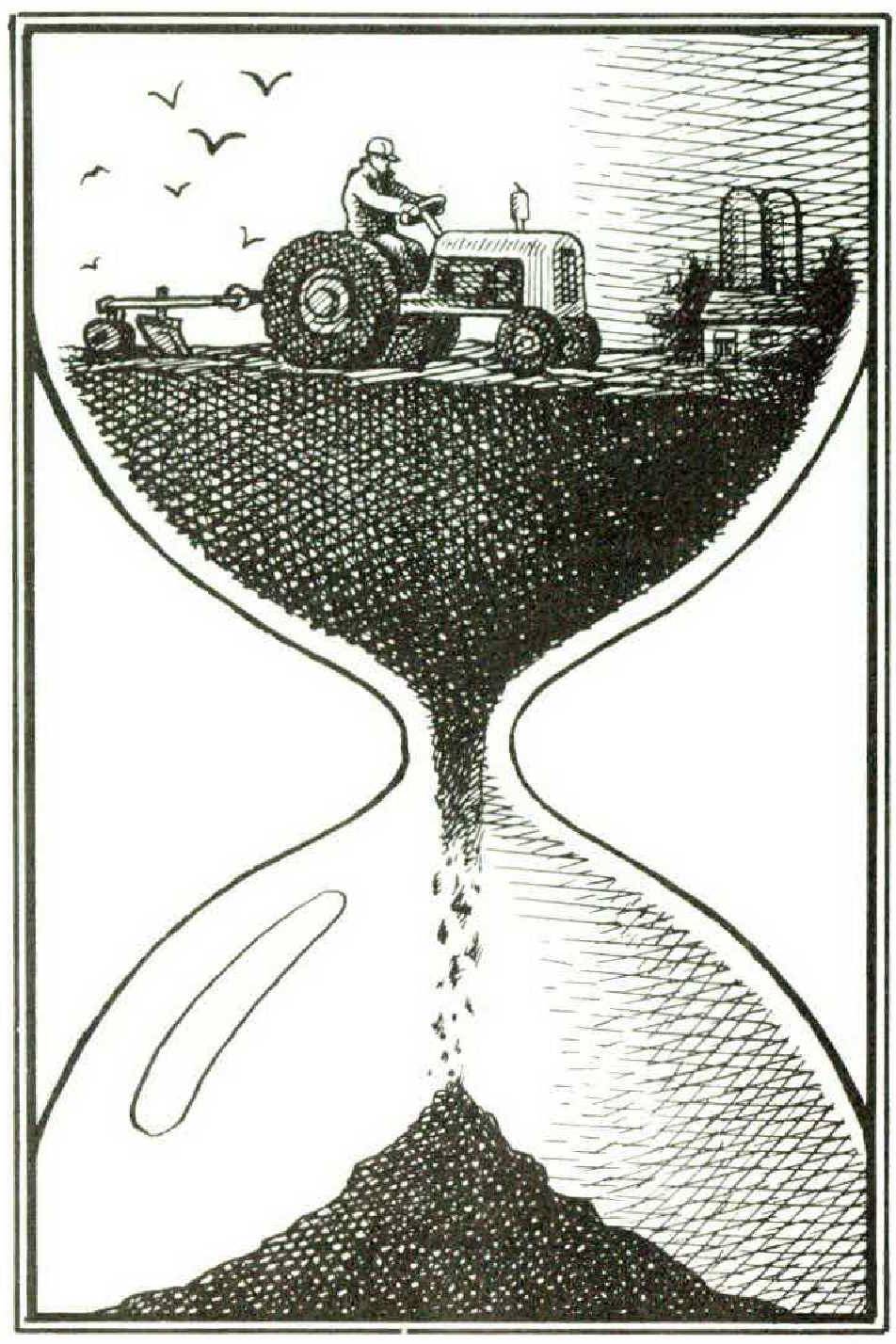
IN TAZEWELL COUNTY, Illinois, about eight weeks before the corn came in, I climbed a barbed-wire-topped fence with Leroy Holtsclaw and Owen Ingram, and crashed into a jungle of cornstalks to see what they are doing to keep the Corn Belt from sliding away down the Mississippi River. The corn was seven feet tall to its tassels, and pollen rained on our heads as we bullied our way through the densely packed stalks, spreading a thick yellow haze through motionless air that felt five or ten degrees warmer than the air outside the field. Ingram, the U.S. Soil Conservation Service’s man in Tazewell County, and Holtsclaw, his boss, the supervisor of a fourteen-county area in central Illinois, were much more adept than I at picking a path through the growth, and I fell behind them a few times, feeling a vague sense of panic at the prospect of being irretrievably lost no more than ten yards from my guides. I blindly followed the sound of the rustling corn and caught up with them only when they stopped to have a look at something they considered significant, which, fortunately, was fairly often.
We were on a sixteen-acre field of fabled Illinois topsoil—the kind responsible for 16 percent of the nation’s corn crop, 17 percent of the nation’s soybeans, and nearly a tenth of all U.S. farm exports—and our tour was divided into two parts. First, the problem, which was in evidence on the western three fourths of the field. Ingram squatted to point out a rivulet between corn plants, a small but well-defined channel carved in the soil by moving water. A little farther on, he stopped to examine a grounded cornstalk, toppled by wind after water had washed the soil from around its roots. These were signs of rill erosion, one of the two major types of water erosion that plague the Corn Belt. (Wind erosion is not much of a problem here.) The other major type, sheet erosion, in which soil is washed away in very thin and fairly uniform layers, was not visible, but it was happening just the same, Ingram assured me. The field sloped from southeast to northwest, losing eight or nine feet in altitude every hundred feet, and, as we walked down the slope, the ground squishing audibly beneath our shoes, the soil grew progressively wetter, the rivulets larger, the felled stalks more plentiful. Some of the soil that was washing off this field would end up in the Gulf of Mexico at the mouth of the Mississippi, traveling via Lick Creek, to the north, and the Illinois River, to the west, carrying polluting agricultural chemicals as it went; some would fill in watercourses along the way, causing floods in low-lying roadways and croplands during and after heavy rains. The rest we found in a sad, barren expanse on the western edge of the field, near the inlet to a drainage lake: here only a few nitrogen-starved corn plants, stunted and yellow, poked up bravely through a cover of soggy black muck. I pushed my middle finger to its second knuckle into the muck. According to the best estimating method available, Ingram said, each of the twelve acres in this part of the field was losing soil at the rate of about thirtytwo tons per year.
Having seen the problem, we turned to the east for the solution. Immediately adjacent to this twelve-acre plot— indistinguishable from it, in fact, from anything more than a few yards away— was a four-acre plot that was losing about six tons of soil per acre each year, much closer to the rate that conservationists think can be permitted without long-term damage. This plot was not soggy, and its rivulets were less conspicuous—an indication that much of the water from the last rain had percolated into the soil instead of running off. Weeds, principally dandelions and orchard grass, were much more plentiful among the corn plants here, but they didn’t seem to be disturbing the crop too much; although they could compete with the corn for water and nutrients, Ingram said, they could not reach high enough to compete for sunlight. Here and there we encountered a bald spot, a place where field mice had got to the seed, but the plant population, as measured earlier in the season, was not much lower here than in the other plot—about 19,500 plants per acre as opposed to about 21,000, a reduction of approximately 7 percent—and Owen Ingram guessed that the water damage we had seen in the first plot would eliminate even that margin of difference. The larger section, however, had been cultivated in the traditional manner: after the last harvest, the earth had been turned over with a moldboard plow, which had buried the field’s weeds and the residue of the previous crop, replacing them with a handsome, flat layer of dark soil from below; then the ground had been disked three times (a less vigorous form of plowing) and planted.
The smaller plot, on the other hand, had been cultivated according to a method called “zero tillage,” or “no till,” which is to say it hadn’t really been cultivated at all: the vegetation on the ground had been left there to protect the soil from erosion, and the corn had been planted right through it, by a machine that cuts only narrow slits for the deposit of seeds. Owen Ingram had no way of knowing for sure how the yields of the two plots would compare at harvest time, but for the moment all looked good, and he was happy.
Ingram had flown over the field the day before, he said, and had challenged his flying companions, one of them a farmer, to distinguish the zero-tilled section from the conventionally tilled one. “I couldn’t even tell them apart,” Ingram said, “and I knew where the line was.” If the yields of the two plots did turn out to be comparable, even roughly so, Ingram would be haranguing farmers about it all winter. For although zero tillage and other, less extreme forms of “conservation tillage” undercut some of the farmer’s most deeply rooted prejudices—for example, the notion that a weedy, unworked field means a sloppy, nonworking farmer— they seem to be the best hope of solving an erosion problem that conservationists see as an impending national disaster. Thus, to put it in the simplest terms possible, the government wants farmers to stop plowing their land.
TEN TONS OF TOPSOIL spread over an acre of ground measures roughly a fifteenth of an inch in depth. In Aroostook County, Maine, the famous potatogrowing region, some sloping fields are losing as much as an inch of soil a year to erosion, according to the Soil Conservation Service (SCS); since intensive cultivation began on these fields after World War II, two feet of soil have disappeared. In the area known as the Palouse, which covers parts of Washington, Oregon, and Idaho, and produces wheat, barley, and peas, the runoff from rain and melting snow carries more than half an inch of soil annually from some fields. Parts of the fertile southern Mississippi Valley, where eastern Arkansas meets Mississippi and Tennessee, are losing almost an eighth of an inch annually. The Corn Belt, the most productive agricultural land on the continent, has trouble spots that equal the worst of these, and, overall, erosion proceeds there at what the SCS calls one of the highest rates in the country.
Illinois cropland loses an average of 6.7 tons of soil per acre per year, about two tons more than the average for cropland nationwide. Iowa and Missouri lose 9.9 and 10.9 tons, respectively. A report by the Illinois Environmental Protection Agency estimates that in parts of Illinois where the topsoil was once thirteen inches deep, more than half of it is now gone. Farmers, conservationists, and others close to the land know that in some places the problem is much worse than that: they have seen crops planted in the yellow, clayey subsoil that once lay far beneath the surface. Much of the rich black topsoil that the area is famous for—and for which farmers pay a premium price—can be found today near the banks of the Illinois and Mississippi rivers in layers of alluvial soil more than twenty inches deep.
In the past, and even now, relating such soil losses to the food supply has been an imprecise and speculative business—one complicated particularly by the steady increases in farm yields brought about by such advances as hybrid seed, fertilizers and pesticides, and more efficient farm machinery (which enables the farmer to plant and harvest quickly, at precisely the right time). Few doubt, however, that the relationship exists, and the small amount of hard data available suggests that it becomes significant as farmers approach the limits of yield-increasing technology. In separate studies conducted in the southern Piedmont region and in western Tennessee, soil losses of six inches have been found to reduce crop yields more than 40 percent. On some soils in the Corn Belt, where 43 percent of the land devoted to row crops is considered highly erodible, the U.S. Department of Agriculture has projected that potential yields of corn and soybeans could be reduced by as much as 30 percent if the present rates of erosion are allowed to continue through the year 2030—this at a time when the demand for food is constantly increasing and hundreds of thousands of acres of prime farmland are being lost annually to highways, subdivisions, and shopping malls.
THE U.S. GOVERNMENT has been working on erosion since 1933, when the Soil Erosion Service was formed as a temporary agency of the Department of the Interior. In 1935, in the wake of the Dust Bowl disaster, it was renamed the Soil Conservation Service and made a permanent part of the Department of Agriculture; and in 1937 it was augmented by a system of conservation districts, which now govern, through locally elected boards, soil and water conservation policies in nearly every county in the U.S. (a measure of local control that makes the SCS something of an oddity among federal bureaucracies). Judging from the few indicators available, the government —though not necessarily the SCS—made headway against erosion for a time, particularly in the 1950s and 1960s, when government efforts to prop up grain prices, by paying farmers to devote land to hay crops and pasture, were at their peak. Since about 1970, however, the difficulty of the conservationists’ task has increased dramatically. Environmentalists have identified “nonpoint-source” (i.e., diffuse) pollution, including runoff of agricultural chemicals and livestock wastes, as a major water-quality problem, and have encouraged the passage of federal and state laws that aim to bring erosion under control. Illinois law, for example, now calls for voluntary programs to reduce all erosion to the “tolerance” level—two to five tons per acre per year, depending on soil type—by the year 2000.
The erosion problem, meanwhile, seems to be getting worse. Various economic influences, including the expansion of foreign markets, have encouraged farmers to plant such crops as corn and soybeans year after year and “right up to the back yard,” as one conservationist put it to me. It is no longer advantageous for Corn Belt farmers to market their crops by feeding them to hogs and cattle. They’ve turned livestock raising—a difficult business, requiring much more labor and day-today attention than crop farming—over to specialized feeding operations, and thus have little need for pastureland or such crops as alfalfa; since 1971, as Illinois has lost more than 1.6 million hogs and cattle, more than 3 million acres in the state have been turned from use for hay crops—which tend to hold down erosion by providing constant ground cover—to the production of row crops, particularly soybeans, the worst of the Corn Belt’s crops from the erosion-control standpoint.
The traditional, topographic methods of erosion control —chiefly contour plowing and terracing, both of which retard the velocity of water as it runs downhill—are often not equal to the conservation problems that modern farming creates. Contouring is simply not effective enough in many cases, and terracing can be prohibitively expensive. Constructing the most modern and effective type of terrace—the “parallel tile-outlet,” or “PTO,” terrace, which involves drainage through underground tiles—costs $250 to $300 per acre, and a typical full-time farmer in Tazewell County, for example, might require several hundred acres of terraces to bring his erosion problem under control. (Cost-sharing help is available from the federal government, but it is limited.) Further, according to Owen Ingram, more than half the land in the county is farmed by tenant farmers, who typically work under yearly contracts, splitting proceeds and most expenses with retired or absentee owners. When the owners are far absent, and care little for the condition of the land, even the most conservation-minded farmer has difficulty justifying the long-term investment that terracing requires— especially at prevailing rates of interest.
This is the mire from which conservation tillage emerges as the salvation of soil conservationists—the only realistic means by which they can hope to reach their goals. The basic idea is not new: because the greatest part of erosion damage is done as raindrops strike the ground, erosion can be decreased significantly by leaving a field covered with crop residue —dead cornstalks, soybean stubble, or whatever happened to be left after the last harvest. One form of conservation tillage, chisel plowing, is already fairly well accepted in the Corn Belt; unlike the conventional moldboard plow, which turns over all the soil in a field, the chisel plow cultivates in strips, leaving a third to a half of the previous crop’s residue undisturbed. Zero tillage is more drastic: it disturbs virtually nothing, leaving as much as 6,000 pounds of residue on each acre of ground. The beauty of zero tillage, as conservationists see it, is that it’s not something the farmer does but something he doesn’t do. By simply forgoing his old plowing habits, the farmer can cut erosion on his fields by more than 90 percent. The special equipment required to cut through the crop residue can be leased or bought at relatively low cost. Indeed, conservationists are fond of pointing out that while conventional farming generally requires a minimum of four trips across a field with fuel-guzzling farm machinery (at least two for plowing, one for planting, and one for harvesting), zero tillage requires only the planting and harvesting; the farmer can actually save fuel, labor, and wear on equipment while doing his bit for posterity.
One problem with zero tillage is that something in a farmer just doesn’t like the idea. The “professional” farmers in Tazewell County number about 1,400, and of these, Owen Ingram estimates, 60 to 80 percent have erosion problems that need correcting. He is aware of precisely twenty-one who are now using zero tillage, most of them on less than 20 percent of their acreage. Farmers resist the technique for various reasons, and some of them are legitimate, rational concerns that will probably be answered, in time, with experience and technology. One of them, however, is that farmers have an attitude that is reflected in the expression they use for the crop residue that conservationists want them to leave on their fields. They call it “trash.”
OWEN INGRAM WILL admit—though it might take him a while to get around to it—that zero tillage is not as easy as it can be made to seem. Farmers say the big problem with it is weed control. One of the chief virtues of the old moldboard plow is that it kills weeds quite effectively—it simply buries them. A farmer who abandons plowing must turn to special herbicides to “burn back” the weeds in his fields, and these herbicides—which don’t always do the job completely—increase chemical costs by about $10 an acre. In the opinion of many farmers and some researchers, this extra cost, combined with others involved in zero tillage, can more than equal any savings. And because zero tillage is relatively new in the Corn Belt, the risks of reduced yield or failure can be significant, especially for an inexperienced farmer. For example, the conventional means of applying agricultural chemicals do not work well on zero-tilled fields: the machines used to pump anhydrous ammonia, a gaseous nitrogen additive used commonly in central Illinois, tend to become clogged with crop residue; powdered nutrients such as phosphate and potash do not leach into the soil through the vegetative cover. Chemicals can be applied with water, but this requires a “carrier” to hold the nutrients in solution; unless the farmer knows enough to use a new type of carrier, he must resist the inclination to apply his special weed killer at the same time—the commonly used clay carrier can nullify the effect of the weed killer. Other problems include insects (plowing buries them), mice (plowing routs them), and seed germination (plowed soil tends to warm up faster in the spring).
But these complications, Ingram insists, can be overcome by any careful, management-minded farmer who seeks expert advice—the kind of advice that Ingram is there to give. More is being learned about zero tillage all the time, and the industries that supply farmers, recognizing it as the wave of the future, are beginning to produce the chemicals and special machines needed to make it virtually risk-free. As proof, Ingram can offer such farmers as Morris Wildermuth, the man who farms the cornfields we tramped through with Leroy Holtsclaw. Wildermuth, a tenant farmer, works about 800 acres on three different farms in Tazewell County, and this year he had 124 acres under zero tillage. On two plots, of twenty acres each, he received a federal cost-sharing grant of $25 per acre, which served, in effect, as “insurance” against the risk of reduced yields. In late summer, it looked as though that money would simply be extra cash in Wildermuth’s pocket. On one forty-acre plot, he harvested winter wheat in the spring and followed it immediately with soybeans for harvest in the fall; without zero tillage, which allowed him to plant the beans quickly, this “double cropping” probably wouldn’t have been possible. The remainder of his zero-tilled acreage was in corn, and his zero-tilled corn was not doing noticeably worse than his conventionally tilled corn.
Some farmers in Tazewell County, of course, are not going to be impressed by Morris Wildermuth’s success, or by anyone else’s. Before the 1981 crop was even out of the ground, they were saying it had been an unusually good year for zero tillage; it had rained prodigiously in central Illinois, and the rain, these skeptics said, had ensured a good zero-till crop by helping to incorporate chemicals into the soil. The previous year was very dry, and, according to Owen Ingram, the same farmers said that was unusually good weather for zero-tilled plots, because they tend to hold moisture better than plowed ground. Guys like that, Ingram says, don’t give reasons, they give excuses. They are afraid to risk a few bushels of corn one year to protect the land for future years. Or they’re afraid the fellow who farms the field down the road is going to make fun of them, or spread stories that they’re lazy. Or they’re going to do it the tried-and-true way because it was good enough for their daddies and granddaddies and it’s good enough for them.
Farmers are often called our best conservationists, but sometimes their hearts can’t agree with what their minds tell them is right. And when you ask a farmer to stop plowing his fields, you’re dealing with a pretty basic matter of the heart. As it turns out, Morris Wildermuth can be offered as proof of this, too. I discussed zero tillage with him one afternoon in Owen Ingram’s office, and he told me, “It’s just a 180degree turn from what we’re used to, and to get people psychologically prepared to do that, it’s gonna be a big step.” Even the less drastic forms of conservation tillage can be hard to swallow, Wildermuth said. “A lot of the conservation tillage that is started in the fall is defeated in the spring. In the fall of the year, instead of moldboard plowing, some of these farmers will come in with a chisel plow—and it looks trashy, you know, it just looks terrible. So when spring comes they’ll come and hit it with a disk and just pulverize that trash, where it doesn’t look like they’ve done any conservation tillage whatsoever. They have defeated their purpose. Once you do that, you might as well go ahead and moldboard plow it and be done with it.” He grinned sheepishly. “I’m guilty of that, too, though I may not do it as much as some of my neighbors.”
Morris Wildermuth is a conservation leader in Tazewell County, the board chairman of the local Soil and Water Conservation District. More than most farmers, he knows the seriousness of the Corn Belt’s erosion problem; he knows that conservation tillage is the only real hope of solving it, and he hopes that farmers will take control of the situation before the government takes control of them. But sometimes even he looks out on a field of ugly brown trash and remembers what farmland is supposed to look like, all black and smooth and scored with stripes, and he feels fear, or revulsion — or something—and sometimes even he can’t help himself, he just has to jump on his tractor and go out there and cut that vile, festering stuff to ribbons.
That’s the sort of thing that makes Owen Ingram’s job interesting, and he seems the right sort of man for it. A large, affable fellow of fifty-four, he has worked for the Soil Conservation Service for nearly thirty years, and he has been stationed in Tazewell County, where his father worked for the local Farm Bureau, since 1960. The farmers know him and accept him. More important, perhaps, he is an easygoing man, and a patient one. Standing one day near a zero-tilled cornfield (one of the handful he can count in his county of 1,400 farms), he told me, “Farmers are an independent lot. I think that’s one of the reasons they farm. And the greatest innovation ever to hit farming was hybrid corn. What did it take to make hybrid corn an accepted practice—fifteen years? It cost nothing but a little seed! Didn’t change anything else! . . . And it took fifteen years to become an accepted practice. Anything else we do is far more drastic than that, and yet we’re gettin’ acceptance on this zero till at a pretty darn rapid rate.”
—Michael Lenehan