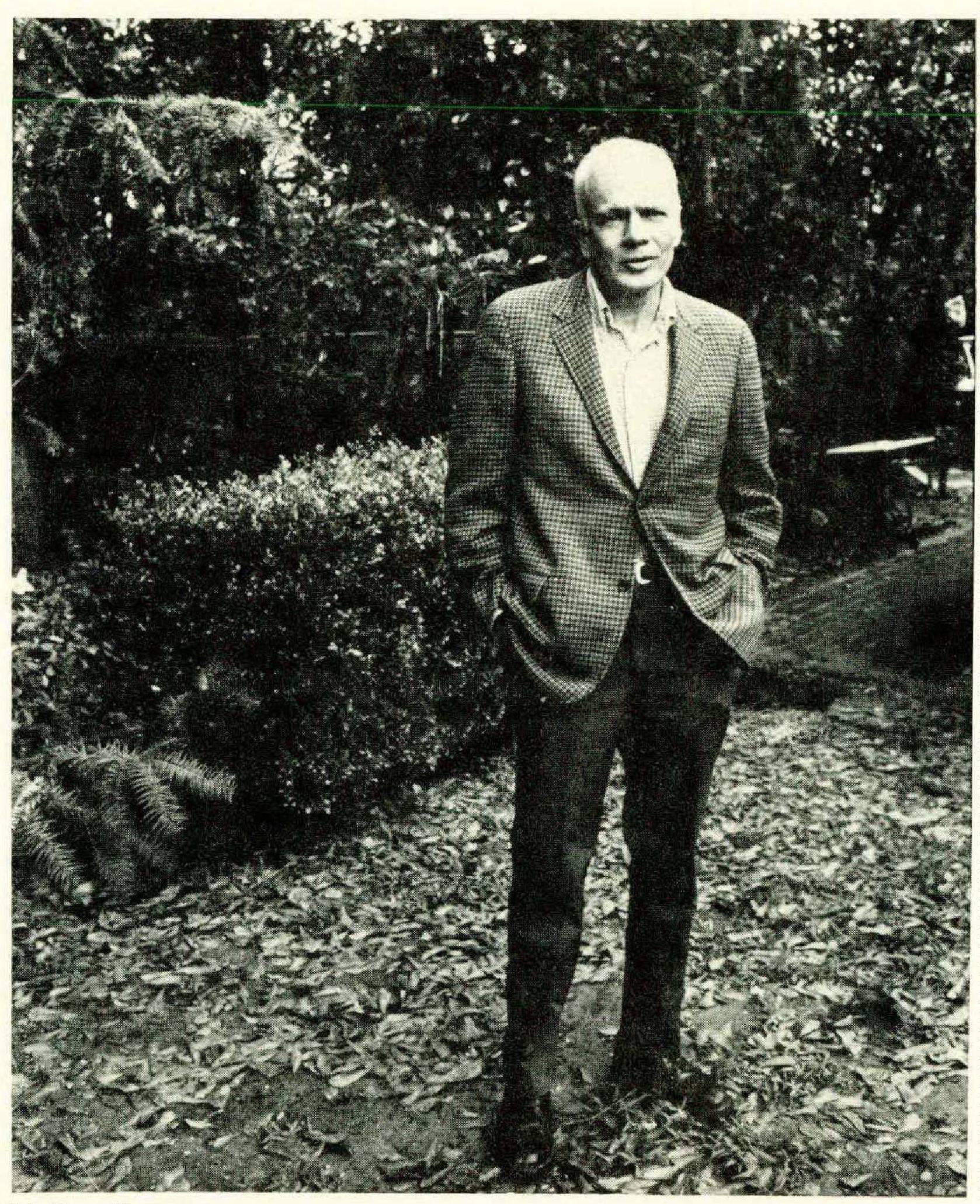
Mention “the Jewish novel,”and everyone knows that you refer to a substantial body of fiction—books that probably represent the most vital force in American letters in the postwar years. Speak of “the Christian novel,” and you will be met by blank stares. No such genre. The term suggests, if anything at all, something you might buy in a forlorn religious bookshop. And yet there are a few writers, though certainly not enough to be called a movement, who do dwell on the increasing strangeness of Christian experience in the United States. One of the most interesting is Walker Percy.
Percy’s new novel, LANCELOT (Farrar, Straus & Giroux, $8.95), is about the problem of faith. I think that is an accurate description, but it may also be an utterly misleading one, since it doesn’t go far toward suggesting the book’s tone or its events. Here is some of what happens. Its hero, Lancelot Lamar, discovers himself to be a cuckold. (He confirms his initial suspicions by spying with the help of a videotape machine.) One night he leaps upon the coupled bodies of wife and lover and attempts to bear-hug them to death. He fails, but he does manage to slit the lover’s throat with a Bowie knife. The New Orleans mansion in which this action takes place has a wing conveniently built atop a capped natural gas well. Lance—as he’s known—uses the residual methane to blow up the mansion. Others perish, but he is thrown clear by the blast, and survives to tell his tale from his madhouse cell, where he harangues inventively about the depravity of modern life. It’s obvious that comedy removes the curse of implausibility from these occurrences. But how they lend themselves to Percy’s theological impulses takes a bit of explaining.
“The specific character of despair is precisely this: it is unaware of being despair.”The quotation is from Kierkegaard, and it serves as the epigraph to Walker Percy’s first novel, The Moviegoer (1961). It also describes the condition of the hero of Lancelot.
Lance Lamar is a southerner of aristocratic descent, a former football star and frat man who grows up to preside over a depleted fortune, a perfunctory law practice, and the mansion “Belle Isle,” which he opens to tourists in the style of an impoverished duke. His life is not without its solace. He dabbles in the “happy strife” of sixties liberalism, but liberalism sours. He marries a beautiful Texas heiress who keeps him in style and (for a while) in a state of exalted nuptial lust. But their appetites sour. He drinks a great deal of bourbon. It is in fact his most durable pleasure. He thinks of himself as “moderately happy,”though it occurs to him to wonder why there are days when he can bear his life only by simultaneously drinking, reading Raymond Chandler, and listening to Beethoven.
Enter Adversity. His apprehension that his wife is unfaithful has an odd effect. It changes his life, and not entirely for the worse. He stops drinking—not out of willpower; he discovers it is unnecessary. No more whiskey, no more Chandler. He looks into the mirror and realizes he has not actually done so for years, he has been avoiding his own glance. “I had lived in a state of comfort and abstraction, waiting for the ten o’clock news, and had not allowed myself to feel anything,” he remarks.
Lance is awakening from the sleep that Walker Percy believes to be endemic in the modern world. “Abstraction” is one of the novelist’s favorite words: by it, he means the dissociation of thought from feeling, of body from soul (a term that causes him little embarrassment), the false shelter that keeps out discomfort but into which despair creeps like a chill.
Lance is reborn by trial, and like his legendary namesake he sets off on a quest of sorts—an “anti-quest” might be a more accurate description. Jealousy leads him steadily into a demented vengefulness, but he thinks of it as a spiritual search. “Can good come from evil? Have you ever considered the possibility that one might undertake a search not for God but for evil?” It’s Lance’s notion that proving the existence of evil—of a single sin— would go further toward demonstrating the existence of God than would any number of perceptions of heavenly order, which can be accounted for by science. He reasons that the diabolical is an even more forgotten concept than the divine. Evil, he points out, has been diluted into craziness. “Everything and everyone’s either wonderful or sick and nothing is evil. . . . The mark of the age is that terrible things happen but there is no ‘evil’ involved.”
So Lance sets out to encounter, in fact to participate in, evil. But he quests in vain. Even at the moment of murder, he feels nothing. “What I remember better than the cutting was the sense I had of casting about for an appropriate feeling to match the deed. Weren’t we raised to believe that ‘great deeds’ were performed with great feelings, anger, joy, revenge, and so on. I remember casting about for the feeling and not finding one.”
Thus to the madhouse. It is one of the devices of this novel that its hero’s tale is given us in the form of a long monologue delivered to a silent interlocutor—not a doctor but an old friend who is a priest. He acts as a mute witness to Lance’s fulminations. Lance rants against the “Sodom” of contemporary society, the “great whoredom and fagdom of America,” revels in misogyny, yearns for a return of chivalry and moral certainty and the Church Militant. His refrain is “I cannot tolerate this age,”and he imagines himself as a one-man crusade for a new one. “There will be honorable men and there will be thieves, just as now, but the difference is one will know which is which, and there will be no confusion, no nice thieves, no honorable Mafia. . . . The New Woman will have perfect freedom. She will be free to be a lady or a whore.”
These tirades are in their way quite glorious, but the burden of the novel lies elsewhere. It ends not in vituperation but in gentle enigma—an enigma wrapped in affirmation. Lance’s voice softens, mellows, grows hesitant. And the priest who has been hearing this 250-page confession at last speaks. He admits that he shares the narrator’s sense of hopelessness about the modern age. The priest nevertheless is going to carry on his own work. “One of us is wrong,” Lancelot exclaims. “It will be your way or it will be my way. All we can agree on is that it will not be their way, Out there.” And the priest assents. Lancelot asks his confessor finally if there is anything he wants to tell him. And the priest responds with the novel’s last word, Yes.
All of Walker Percy’s fiction has been written in the service of the same theme that animates Lancelot, the search for whatever it is that can banish despair. Percy has spent his entire career debriding the same wound. His work is narrow but it cuts deep. In four novels he has essentially created only four characters, and they have much in common: all southern gentlemen, estranged from their world; all on a quest that begins in wistfulness for an imagined past and ends in intimations of the supernatural.
Spiritual journeys are often lonely, and the great limitation of Percy’s work is that he has participated in his heroes’ isolation; there is no fully formed character in any of the novels besides the central figures. They themselves could be tedious fellows, but they are saved from that by Percy’s wit, by his sly social observation, by his affection for the graceful sentence, and by the additional fact that they unpretentiously embody one of the fundamental dilemmas of existence.
It’s the great strength of Percy’s fiction that he looks about him and sees a landscape of moral and emotional confusion, and refuses to offer handy sociological or economic wisdom by way of comforting explanation for it. He speaks directly and challengingly to the private heart. Despite the antic nihilism of Lancelot, despite the devout respect he pays doubt, it seems plain that he means to call attention to the possibility of faith.
Percy, who is a convert to Catholicism, has made his view more explicit in nonfiction than in fiction. In the title essay of his collection The Message in the Bottle (1975), he writes of the dilemma of a “castaway,” a man left as a child in a strange land with no knowledge of his origin. How will the castaway interpret messages that reach him from the world he has left? The critical piece of information he receives will be “news" that he cannot verify. The essay concludes: “And what if the news the newsbearer bears is the very news the castaway had been waiting for, news of where he came from and who he is and what he must do, and what if the newsbearer brought with him the means by which the castaway may do what he must do? Well then, the castaway will, by the grace of God, believe him.”