Why Cops Hate Liberals--and Vice Versa
Policemen are attracted to right-wing politics, says Harvard sociologist Seymour Martin Lipset, because they are recruited from the undereducated, typically conservative working class, and because their job inevitably stresses toughness, authority, and a skeptical view of human behavior. Professor Lipset is the author of Political Man: The Social Bases of Politics, and other books.
by Seymour Martin Lipset
THERE is an increasing body of evidence which suggests an affinity between police work and support for radical-right politics, particularly when linked to racial unrest. During the presidential campaign, George Wallace was unmistakably a hero to many policemen. John Harrington, the president of the Fraternal Order of Police, the largest police organization in America, with over 90,000 members and affiliates in more than 900 communities, publicly endorsed him. And Wallace has reciprocated this affection for some time. While governor of Alabama, he placed the slogan, popularized by the Birch Society, “Support Your Local Police" on the automobile license plates of the state of Alabama. During the 1964 anti 1968 presidential campaigns, he frequently referred to the heroic activities of the police, and denounced the Supreme Court, and bleeding-heart liberals and intellectuals, for undermining the police efforts to maintain law and order. The police were pictured as the victims of an Establishment conspiracy to foster confrontationist forms of protest and law violation, particularly on the part of Negroes and student activists.
Similar reports concerning police support for right-wing or conservative candidates who have campaigned against civil rights and integration proposals have appeared frequently in the press. Thus in 1967, Boston journalists commented on the general support for Louise Day Hicks among the police of that city. Mrs. Hicks had won her political spurs in the fight which she waged as chairman of the Boston School Committee against school integration. And when she ran for mayor, the police were seemingly among her most enthusiastic backers. In New York City, police have stood out among the constituency of the Conservative Party, an organization which also has opposed public efforts to enforce school integration. The New York Conservative Party was the one partisan group in the city to fight a civilian review board of the police department, an issue which has come up in many other communities.
Jerome Skolnick of the University of Chicago made a study of the Oakland, California, police in 1964 based on interviews with many of them. He concluded that “a Goldwater type of conservatism was the dominant political and emotional persuasion of the police.”During the 1964 campaign, a broadcaster on the New York City police radio suddenly made an emotional appeal for support of Senator Goldwater. Many police called in to endorse this talk. Almost no one out in police cars that night phoned in to back Lyndon Johnson, or to complain about the use of the police radio for partisan purposes. In Los Angeles, an official order had to be issued in 1964 telling the police that they could not have bumper stickers or other campaign materials on their police cars, because of the large number who had publicly so supported Goldwater. The late chief of police of the city, William H. Parker, stated his belief that the majority of the nation’s peace officers were “conservative, ultraconservative, and very right wing,” a description which fit his own orientation.
There is also evidence of strong support and sympathy among the police for the John Birch Society. In 1964, John Rousselot, then national director of the Society, claimed that “substantial numbers” of its members were policemen, and a study of the national membership of the Society by Fred Grupp, a political scientist at Louisiana State, confirms this contention. Mr. Grupp sent out a questionnaire to a random sample of the Birch membership with the help of the Society and found that over 3 percent of those who reported their occupations were policemen, a figure which is over four times the proportion of police in the national labor force. In New York City in July, 1965, a reporter judged that the majority of the audience at a large rally in Town Hall sponsored by the Birch Society’s Speakers Bureau wore “Patrolmen’s Benevolent Association badges.” The Society itself “estimates that it has five hundred members in the New York City Police Department.” In Philadelphia, the mayor placed a number of police on limited duty because of their membership in the Society. In a recent interview, Richard MacEachern, head of the Boston Police Patrolmen’s Association, frequently referred to Birch Society material as the source of his information concerning “The Plan” of black militants to destroy the police through use of deliberate violence.
That peace officers in high places are sympathetic with the Society may be seen in the fact that former Sheriff James Clark of Selma, Alabama, who not only played a major role in suppressing civil rights demonstrations in his city but also has been a frequent speaker for the Birch Society, was elected president of the national organization of sheriffs. While serving as chief of the Los Angeles Police Department, William H. Parker took part in the Manion Forum, a right-wing radio discussion program run by Clarence Manion, a leader of the Birch Society. According to William Turner, in his book The Police Establishment, Louis Neese, the police chief of Trenton, New Jersey, “incorporated sections of a Birch ‘Support Your Local Police circular into a declaration of departmental policy.”
All this is no new development. The identification between the police and right-wing extremism is not simply a reflection of recent tensions. During the 1930s, investigations of the Black Legion, a neofascist organization in the industrial Midwest, which engaged in terror and vigilante activities, indicated that it appealed to police. Not only did it include many patrolmen in Michigan and elsewhere, but a grand jury in Oakland County, Michigan, reported that the chief of police in Pontiac was an active member. The Legion, it should be noted, engaged in kidnapping, flogging, and even murder of suspected Communists. Father Coughlin, who was probably the most important profascist leader of the 1930s, also found heavy backing within police ranks. An investigation of his organization, the Christian Front, revealed that 407 of New York’s finest belonged to it.
Gunnar Myrdal, in his classic study of the race problem in America, An American Dilemma, conducted in the late thirties and early forties, asserted that one of the principal sources of Ku Klux Klan activity in the South at that time came from law enforcement officers. This finding jibed with reports of the membership of the Klan during the early 1920s when it was at the height of its power, controlling politics in many Northern as well as Southern states. Klan leaders according to one account “took particular pride in emphasizing the large number of law enforcement officers . . . that had joined their order.” Typical of Klan propaganda which attracted police support was the plank in the program of the Chicago Klan which called for “Supporting Officials in all Phases of Law Enforcement.”a slogan close to the “Support Your Local Police” campaign waged by the Birch Society and George Wallace four decades later. According to Charles Jackson, membership lists seized in different parts of California indicated that “roughly 10 percent of the . . . policemen in practically every California city,” including the chiefs of police in Los Angeles and Bakersfield and the sheriff of Los Angeles County, belonged to the Klan. In Atlanta, the home base of the organization, a study reports that “a very high percentage” of the police were members. Considerable police backing for the Klan was also reported in analyses of its operation in cities as diverse as Portland (Oregon), Tulsa, Madison, and Memphis.
Looking back through the history of religious bigotry in this country, we find that the anti-Catho1ic nativist American Protective Association (APA), which flourished in the early 1890s, also appears to have been supported by the police. My own researches on this movement and its membership indicate that the police were considerably overrepresented among APA members. In Minneapolis 6.5 percent were policemen, in Sacramento 8 percent, and in San Jose 7 percent.
ALTHOUGH there is a general understanding that the police should be politically neutral, their role as public employees has inevitably involved them in local politics. Prior to the emergence of civil service examinations, appointment to the force was a political plum in most cities. And once a man was hired, chances for promotion often depended on access to local officeholders. In many communities, the police were part of the machine organization. The widespread pattern of toleration of corruption and the rackets which characterized urban political life until the 1990s usually depended on the cooperation, if not direct participation, of the police. Those who controlled the rackets paid special attention to municipal politics, to those who dominated city hall, in order to make sure that they would not be interfered with by the authorities.
Although machine and racketeer domination of local government is largely a thing of the past in most cities, the police are of necessity still deeply interested in local politics. High-level appointments are almost invariably made by elected officials, and those who control city politics determine police pay and working conditions. Hence, the police as individuals and as a body must be actively concerned with access to the political power structure. They must be prepared to adjust their law enforcement policies in ways which are acceptable to the political leaders.
Such assumptions would lead us to believe that police would avoid any contact with radical groups, with those who seek to change the existing structures of political power or community leadership. Thus the evidence that significant minorities of police have been moved to join or openly back right-wing and bigoted movements is particularly impressive. For every policeman who has taken part in such activities, we may assume that there were many others who sympathized, but refrained from such behavior so as to avoid endangering their job prospects. (This comment, of course, does not apply to those communities which were actually dominated by extremist movements.)
The propensity of policemen to support rightist activities derives from a number of elements in their occupational role and social background. Many of the police are not much different in their social outlook from others in the lower middle class or working class. Twenty-five years ago, Gunnar Myrdal noted that police in the South were prone to express deep-seated anti-Negro feelings in brutal actions against Negroes and thus undo “much of what Northern philanthropy and Southern state governments are trying to accomplish through education and other means.” He accounted for the phenomenon as resulting from the fact that the police generally had the prejudices of the poor whites. “The average Southern policeman is a promoted poor white with a legal sanction to use a weapon. His social heritage has taught him to despise the Negroes, and he has had little education which could have changed him.” A recent study of the New York City police by Arthur Niederhoffer, a former member of the Department, reports that “for the past fifteen years, during a cycle of prosperity, the bulk of police candidates has been upper lower class with a sprinkling of lower middle class; about ninety-five per cent has had no college training.” In a survey of the occupations of the fathers of 12,000 recruits who graduated from the New York Police Academy, he found that more than three quarters of them were manual or service workers.
The Birch Society apart, movements of ethnic intolerance and right-wing radicalism have tended to recruit from the more conservative segments of the lower and less-educated strata. On the whole, the less education people have, the more likely they are to be intolerant of those who differ from themselves, whether in opinions, modes of culturally and morally relevant behavior, religion, ethnic background, or race. The police, who are recruited from the conservative, less-educated groups, reflect the background from which they come. John H. McNamara recently found that when he separated the New York police recruits into two status groups on the basis of their fathers’ occupations, those “with fathers in the higher skill classification were less likely to feel that the leniency of courts and laws account for assaults on the police” than those who came from lower socioeconomic origins.
Once they are employed as policemen, their job experiences enhance the possibility that whatever authoritarian traits they bring from their social background will increase rather than decrease. McNamara found a sizable increase in the proportion of police recruits who resented legal restrictions on their authority or propensity to use force. At the beginning of recruit training, only 6 percent agreed with the statement “The present system of state and local laws has undermined the patrolman’s authority to a dangerous extent,”while 46 percent disagreed. After one year in field assignments, 25 percent of the same group of men agreed with the statement, and only 19 percent disagreed. Similar changes in attitudes occurred with respect to the proposition “If patrolmen working in tough neighborhoods had more leeway and fewer restrictions on the use of force many of the serious police problems in these neighborhoods would be greatly reduced.” Fourteen percent agreed with the statement at the beginning of their career, as compared with 30 percent after one year in the field, and 39 percent among a different group of policemen who had been employed for two years.
In general, the policeman’s job requires him to be suspicious of people, to prefer Conventional behavior, to value toughness. A policeman must be suspicious and cynical about human behavior. As Niederhoffer points out, “He needs the intuitive ability to sense plots and conspiracies on the basis of embryonic evidence.” The political counterpart of such an outlook is a monistic theory which simplifies political conflict into a black-and-white fight, and which is ready to accept a conspiratorial view of the sources of evil, terms which basically describe the outlook of extremist groups, whether of the left or right.
The propensity of police to support a radical political posture is also related to their sense of being a low-status out-group in American society. The Oakland study revealed that when police were asked to rank the most serious problems they have, the category most frequently selected was “lack of respect for the police. . . . Of the two hundred and eighty-two . . . policemen who rated the prestige police work receives from others, 70 per cent ranked it as only fair or poor.” The New York City study also indicated that the majority of the police did not feel that they enjoyed the respect of the public. James Q. Wilson found that a majority of Chicago police sergeants who completed questionnaires in i960 and 1965 felt that the public did not cooperate with or respect the police. Many articles in police journals comment on the alleged antagonism to the police voiced by the mass media. Studies of police opinion have indicated that some police conceal their occupation from their neighbors because main people do not like to associate with policemen.
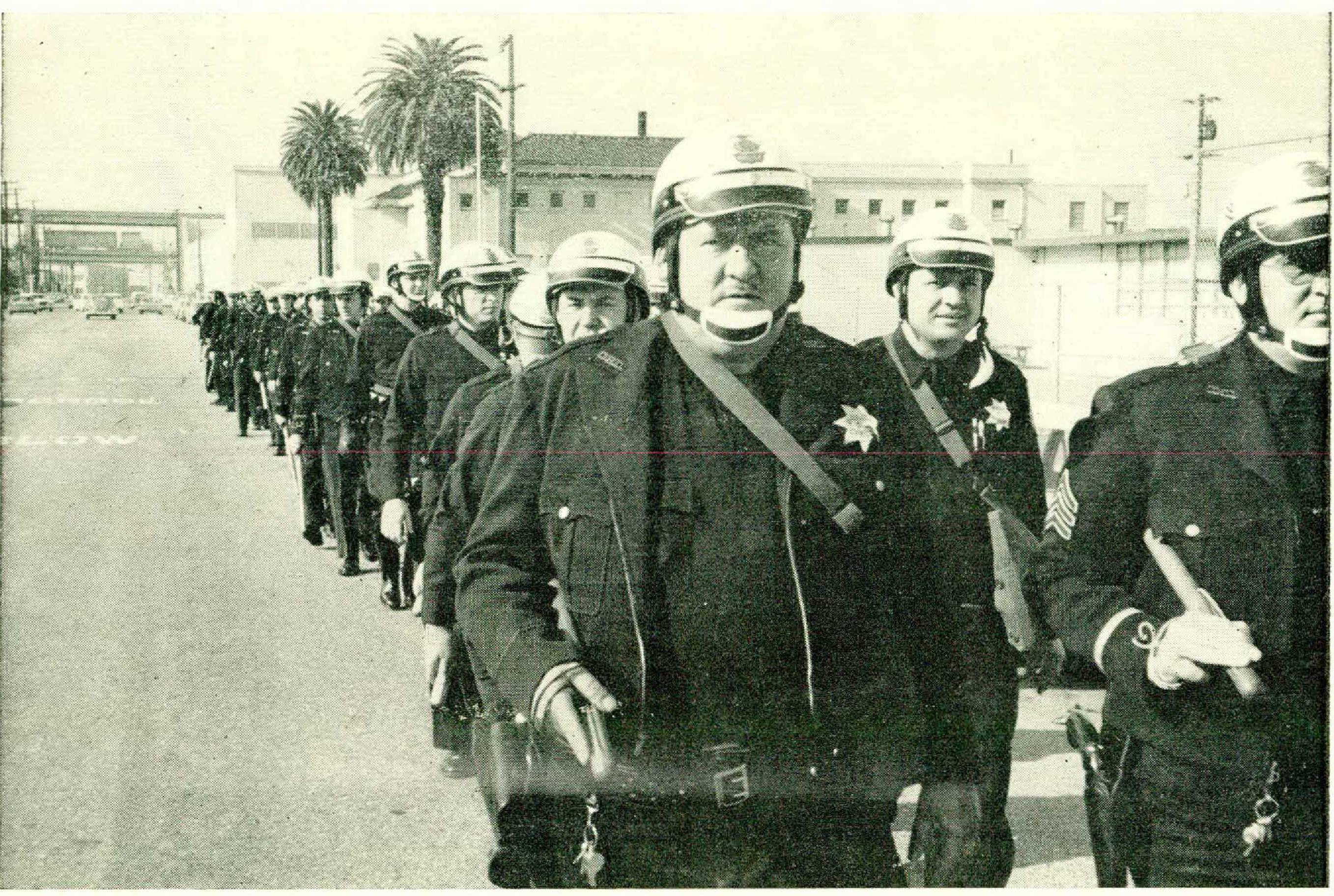
If policemen judge their social worth by their incomes, they are right in rating it low. A recent article in Fortune reports that “the patrolman’s pay in major cities now averages about $7,500 per year— 33 percent less than is needed to sustain a family of four in moderate circumstances in a large city, according to the U.S. Bureau of Labor Statistics.” As a result, many are torced to moonlight to earn a living. Fletcher Knebel cites an expert estimate that from a third to half of all the patrolmen in the country have a second job. The relative socioeconomic status of the police has worsened over time. Richard Wade, an urban historian at the University of Chicago, points out that the situation has changed considerably from that of fifty years ago when “policemen had an income higher than other trades and there were more applicants than there were jobs.” John H. McNamara, who has studied the New York Department, concludes:
During the Depression the department was able to recruit from a population which included many unemployed or low-paid college graduates. . . . As general economic conditions have improved, however, the job of police officer has become less attractive to college graduates.
In his surveys of police opinion in Chicago, Boston, and Washington, D.C., Albert J. Reiss reports that 59 percent believe that the prestige of police work is lower than it was twenty years ago. Lower police morale is not simply a function of a relative decline in income or in perceived status. The police believe their conditions of work have also worsened. Eighty percent state that “police work [is] mote hazardous today than five years ago.” Sixty percent believe that the way the public behaves toward the police has changed for the worse since they joined the force.
The policeman’s role is particularly subject to fostering feelings of resentment against society, which flow from a typical source of radical politics, “status discrepancies.”This term refers to a sociological concept which is used to describe the positions of individuals or groups who are ranked relatively high on one status attribute and low on another.
Presumably the fact of having a claim to some deference makes people indignantly resent as morally improper any evidence that they are held in low regard because of some other factor in their background or activities. In the case of the police, they are given considerable authority by society to enforce its laws and are expected to risk their lives if necessary; on the other hand, they feel they receive little prestige, and they get a relatively low salary as compared with that of other occupational groups which have much less authority.
Many police have consciously come to look upon themselves as an oppressed minority, subject to the same kind of prejudice as other minorities. Thus Chief Parker explained some of the bitterness of the police as stemming from the “shell of minorityism” within which they lived. This view was given eloquent voice in 1965 by the then New York City Police Commissioner, Michael J. Murphy: “The police officer, too, belongs to a minority group—a highly visible minority group, and is also subject to stereotyping and mass attack. Yet he, like every member of every minority, is entitled to be judged as an individual and on the basis of his individual acts, not as a group.” Clearly, the police appear to be a deprived group, one which feels deep resentment about the public’s lack of appreciation for the risks it takes for the community’s safety. These risks are not negligible in the United States. In 1967, for example, one out of every eight policemen was assaulted. This rate is considerably higher than in any other developed democratic country.
The belief that police are rejected by the public results, as Wilson argues, in a “sense of alienation from society" which presses the police to develop their own “sub-culture” with norms which can provide them with “a basis for self-respect independent to some degree of civilian attitudes.” Given the assumption of the police that they are unappreciated even by the honest middle-class citizenry, they are prone to accept a cynical view of society and its institutions, and social isolation and alienation can lead to political alienation.
The police have faced overt hostility and even contempt from spokesmen for liberal and leftist groups, racial minorities, and intellectuals generally. The only ones who appreciate their contribution to society and the risks they take are the conservatives, and particularly the extreme right. The radical left has almost invariably been hostile, the radical right friendly. It is not surprising therefore that police are more likely to be found in the ranks of the right.
In the larger context, American politics tends to press the police to support conservative or rightist politics. Liberals and leftists have been more concerned than conservatives with the legal rights of the less powerful and the underprivileged. They have tried to limit the power of the police to deal with suspects and have sought to enlarge the scope of due process. Efforts to enhance the rights of defendants, to guarantee them legal representation, to prevent the authorities from unduly pressuring those taken into police custody, have largely concerned liberals. The American Civil Liberties Union and other comparable groups have fought hard to weaken the discretionary power of the police. To many policemen, the liberals’ constant struggle is to make their job more difficult, to increase the physical danger to which they are subject. Many are convinced that dangerous criminals or revolutionists are freely walking the streets because of the efforts of softhearted liberals. To police, who are constantly exposed to the seamy side of life, who view many deviants and lawbreakers as outside the protection of the law, the constant concern for the civil rights of such people makes little sense, unless it reflects moral weakness on the part of the liberals, or more dangerously, is an aspect of a plot to undermine legitimate authority. And the fact that the Supreme Court has sided with the civil-libertarian interpretations of individual rights in recent years on issues concerning police tactics in securing confessions—the use of wiretaps, and the like—constitutes evidence as to how far moral corruption has reached into high places. Reiss’s survey of police opinion found that 90 percent of the police interviewed felt that the Supreme Court “has gone too far in making rules favoring and protecting criminal offenders.” The liberal world, then, is perceived as an enemy, an enemy which may attack directly in demonstrations or riots, or indirectly through its pressure on the courts.
_THE fights over the establishment of civilian police review boards which have occurred in many cities have largely taken the form of a struggle between the liberal political forces which favor creating such checks over the power of police departments to discipline their own members and the conservatives who oppose these. In the best-publicized case, the referendum in New York City of November, 1966, to repeal the law creating such a board, the ideological lineup was clear-cut. The Patrolmen’s Benevolent Association was supported in its successful efforts by the Conservative Party of New York and the John Birch Society. It was opposed by New York’s liberal Republican mayor, John Lindsay, as well as by Robert Kennedy, the reform Democrats, the Liberal Party, the New York Times, and the New York Post. There can be little doubt that this struggle has helped to strengthen the police backing for the Conservative Party.
The greater willingness of police to join or back groups which have been antagonistic to religious (Catholics in the nineteenth century, Jews in the twentieth) and racial minorities also may be a function of concrete job experience, as well as of the degree of prejudice present in their social milieu. Ethnic slums characteristically have been centers of crime, violence, and vice. Most immigrant groups living in urban America in the past, as well as more recent Negro migrants, have contributed disproportionately to the ranks of criminals and racketeers. Hence, the police have often found that their experience confirmed the negative cultural stereotypes which have existed about such groups while they lived in the crowded, dirty, slum conditions. The ethnic minorities have, in fact, often appeared as sympathetic to criminals, as supporters of violence directed against the police. The ethnic slum historically has been an enemy stronghold, a place of considerable insecurity. Right-wing political groupings which define minorities or leftist radicals as conspiratorial corrupters of American morality have strongly appealed to the morally outraged police.
In evaluating the disposition of the police to participate in the radical right, it is important to note that only a minority of the police are involved in most communities. Most police, though relatively conservative and conventional, are normally more concerned with the politics of collective bargaining, with getting more for themselves, than with the politics of right-wing extremism. The Patrolmen’s Benevolent Association is basically a trade union which seeks alliances with other labor unions, particularly those within the civil service, and with the powerful within the dominant political parties. Police have struck for higher wages, much as other groups have done. There have been occasions when they have shown sympathy for striking workers on the picket line, particularly when the workers and the police have belonged to the same ethnic groups. One of the main attractions of police work is the lifelong economic security and early pensions which it gives. In this sense, the policeman, like others from low-income backgrounds, is concerned for the expansion of the welfare state.
Like all others, the police are interested in upgrading the public image of their job. They do not like being attacked as thugs, as authoritarians, as lusting for power. Some cities have successfully sought to increase the educational level of new recruits and to have a continuing education program for those on the force. The academic quality of the courses given at police academies and colleges in various communities has been improving, and there is much that is hopeful going on.
Yet the fact remains that recent events have sorely strained the tempers of many police. Almost two thirds of the police interviewed in Reiss’s study feel that “demonstrations are a main cause of violence these days.”The reactions of police organizations around the country suggest that Ortega y Gasset was correct when he suggested in his book The Revolt of the Masses, published in 1930, that free societies would come to fear their police. He predicted that those who rely on the police to maintain order are foolish if they imagine that the police “are always going to be content to preserve . . . order [as defined by government]. . . . Inevitably they [the police] will end by themselves defining and deciding on the order they are going to impose—which, naturally, will be that which suits them best.” In some cities, leaders of police organizations have openly threatened that the police will disobey orders to be permissive when dealing with black or student demonstrators. The Boston Police Patrolmen’s Association has stated that the police there will enforce the law, no matter what politicians say. The president of the New York Patrolmen’s Benevolent Association has announced that his members “will enforce the law 100 per cent,”even when ordered not to do so.
Police Salaries
Policemen complain, and the experts tend to agree, that police salaries are not high enough to attract college-educated or other highly-skilled persons, and that policemen are not adequately compensated for the hazards and responsibilities they are asked to accept. Painters, carpenters, electricians, mechanics, firemen, for example, tend to earn as much or more than policemen in the south and midwest and in the smaller eastern cities. Only on the west coast do policemen have a statistical edge, and it is slight.
| Top 10 Cities, 500,000 or more population | MinimumBase Pay | Maximum BasePay |
|---|---|---|
| SanFrancisco | $9935 | $10,535 |
| Chicago | 8710 | 11,000 |
| LosAngeles | 8580 | 10,105 |
| Philadelphia | 8480 | 9000 |
| Seattle | 8340 | 9600 |
| SanDiego | 8150 | 9900 |
| Cleveland | 7935 | 8935 |
| NewYork | 7930 | 9380 |
| Detroit | 7500 | 10,300 |
| Houston | 7200 | 8100 |
| Top 5 Cities, 100,000-500,000 | ||
| Oakland | 9875 | 10,535 |
| Berkeley | 9385 | 10,345 |
| Torrance | 9240 | 10,190 |
| SanJose | 8665 | 10,535 |
| Fresno | 8410 | 9840 |
| Lowest 5 Cities, 500,000 or more | ||
| SanAntonio | 6000 | 7200 |
| Memphis | 6120 | 7440 |
| KansasCity | 6180 | 8150 |
| Atlanta | 6210 | 8220 |
| Boston | 6345 | 8320 |
| Lowest 5 Cities, 100,000-500,000 | ||
| Knoxville | 4500 | 5700 |
| Mobile | 4910 | 6120 |
| LittleRock | 5100 | 6120 |
| Portsmouth,Va. | 5400 | 6900 |
| Chattanooga | 5520 | 6480 |
These statistics are minimum and maximum base pay figures far patrolmen as of January 1, 1969, except for Chicago and Philadelphia estimates, which include pay raises to take effect July 1, 1969. A retroactive pay hike, which will place them just below San Francisco in the big-city standings, is expected for New York patrolmen early in the year.
These figures do not reflect pay differentials based on longevity (which in Los Angeles, New York, Cleveland, Detroit, and Houston, for example, can increase pay rates as much as $800 annually), paid holidays (New York patrolmen get $335 to $405 extra each year), or uniform allowances. Nor do they reflect cost of living variables, which tend to reduce the apparent gap between metropolitan police salaries and the pay scale for smaller cities, particularly in the South.
This “rebellion of the police" is a response to their being faced with “confrontation tactics” by student and black radical militants. New Left radicals and black nationalists openly advocate confrontation tactics. They seek deliberately to inflame the police so as to enrage them into engaging in various forms of brutality. Stokely Carmichael has declared that a demonstration which does not result in police action against the participants is a failure. The events at Chicago during the Democratic Convention constitute the best recent example of the way in which a major police force can completely lose its head when faced by a confrontationist demonstration.1 Some black and white New Radicals openly declare that the killing of police in the ghetto area is not murder, that it is an inherent form of self-defense. But police have been shot at and occasionally killed in ambush. The current tensions between the police and New Left student and black nationalist radicals probably involve the most extreme example of deliberate provocation which the police have ever faced. The tactics of the campus-based opposition rouse the most deep-seated feelings of class resentment. Most policemen are conservative, conventional, upwardly mobile working-class supporters of the American Way, who aspire for a better life for their families. Many of them seek to send their children to college. To find the scions of the upper middle class in the best universities denouncing them as “pigs,”hurling insults which involve use of the most aggressive sexual language, such as “Up against the wall, Mother F—,” throwing bricks and bags of feces at them, is much more difficult to accept than any other situation which they have faced. Police understand as normal the problems of dealing with crime or vice. They may resent violence stemming from minority ghettos, but this, too, is understandable and part of police work. But to take provocative behavior from youths who are socially and economically much better off than they and their children is more than the average policeman can tolerate.
The deliberate effort to bait and provoke the police by contemporary New Left radicals is rather new in the history of leftist movements. The American Socialist Party in its early history actually pointed to the police department as a good example of the way the government could provide needed services efficiently. The Communists, of course, never described the police in this fashion, but in the twenties, European Communists concerned with attaining power rather than with symbolic demonstrations defined the police, like the rank and file of the military, as exploited workingclass groups who should either be converted to the revolution or at least be neutralized. They directed propaganda to the self-interests of the police, calling on them to refuse to serve the interests of the ruling class during strikes or demonstrations. The European left has often sought to organize the police in trade unions, although it is, of course, also true that they have had an ambivalent attitude toward them. The police have been involved in brutal suppression of left-wing and trade-union demonstrations in Europe, which have made them the target of left-wing criticism and counterviolence. Nevertheless, the left there remembers that the police come from proletarian origins. During the May, 1968, student demonstrations and strikes in Italy, a leading Communist intellectual, Pier Paolo Pasolini, told the New Left students that in a conflict between them and the police, he stood with the police: “Your faces are those of sons of good families, and I hate you as I hate your fathers. The good breeding comes through. . . . Yesterday when you had your battle in the Valle Giulia with the police, my sympathies were with the police, because they are the sons of the poor (quoted from the Corriere della Sera by Melvin Lasky in the August issue of Encounter) .
Given the interest shown in the welfare of the police by sections of the European left, their membership in trade unions, and their working-class origins, it is not surprising that the political behavior of European police has been more ambivalent than that of their American compeers. On various occasions, segments of the police in Europe have shown sympathy for left and working-class forces, particularly where they have been serving under leftist governments for some time. This was true in Social Democratic Berlin and Prussia generally before 1932, in Vienna before 1934, and in parts of Republican Spain before 1936. The ambivalent attitudes of the police have shown up most recently in France, where a number of police unions issued statements after the May, 1968, events, denying responsibility for use of force against student demonstrators, The police organizations wanted it known that the government, not the police, was responsible for the vigor of the actions taken.
It is doubtful that the American New Left students will ever come to see the police in a sympathetic light, as exploited, insecure, alienated members of the underprivileged classes. As members of the first leftist youth movement which is unaffiliated with any adult party, they are unconcerned with the consequences of their actions on the political strength of the larger left-wing movement. To a large extent, their provocative efforts reflect the biases of the educated upper middle class. Lacking a theory of society and any concern for the complexities of the “road to power” which have characterized the revolutionary Marxist movement, they are prepared to alienate the police, as well as conventional working-class opinion, in order to provoke police brutality, which in turn will validate their total rejection of all social institutions. Hence, we may expect a continuation of the vicious circle of confrontation and police terror tactics.
Liberal moderates properly react to this situation by demanding that the police act toward deviant behavior much as all other professionals do, that they have no more right to react aggressively toward provocative acts than psychiatrists faced by maniacal and dangerous patients, that no matter what extremists do, the police should not lose their selfcontrol. Such a policy is easy to advocate; it is difficult to carry out.
Furthermore, it ignores the fact that most of the police are “working-class” professionals, not the products of postgraduate education. As James Q. Wilson points out, “This means they bring to the job some of the focal concerns of working-class men —a preoccupation with maintaining self-respect, proving one’s masculinity, ‘not taking any crap,’ and not being ‘taken in.’ Having to rely on personal qualities rather than on formal routines . . . means that the officer’s behavior will depend crucially on how much deference he is shown, on how manageable the situation seems to be, and on what the participants in it seem to ‘deserve.’ ” If society wants police to behave like psychiatrists, then it must be willing to treat and train them like psychiatrists rather than like pariahs engaged in dirty work. At present, it treats their job like a semiskilled position which requires, at best, a few weeks’ training. Norman Kassoff of the research staff of the International Association of Chiefs of Police has compared the legal minimum training requirements for various occupations in the different American states. Calculated in terms of hours, the median minimums are 11,000 for physicians, 5000 for embalmers, 4000 for barbers, 1200 for beauticians, and less than 200 for policemen. The vast majority of policemen begin carrying guns and enforcing the law with less than five weeks’ training of any kind.
The new tensions have increased the old conflict between the police and the liberals. For it must be said that liberals are prejudiced against police, much as mam white police are biased against Negroes. Most liberals are ready to assume that all charges of police brutality are true. They tend to refuse to give the police the benefit of any doubt. They rarely denounce the extreme black groups and left radicals for their confrontationist efforts. They do not face up to the need for tactics to deal with deliberate incitement to mob violence. If the liberal and intellectual communities are to have any impact on the polite, if they are to play any role in reducing the growing political alienation of many police, they must show some recognition that the police force is also composed of human beings, seeking to earn a living. They must be willing to engage in a dialogue with the police concerning their problems.
- Ironically, the Chicago police force has been one of the few major ones which had made real efforts to adjust to changing conditions. William Turner’s recent book, The Police Establishment, states that close to 25 percent of the force is Negro, a proportion far above that of New York and Los Angeles. It also deliberately lowered the height requirements “to make more Puerto Ricans eligible.” Although, as Turner documents, there has been considerable tension between the Chicago police and the black community, a study of the attitudes of Negroes in four cities by Gary Marx in his Protest and Prejudice reported that the percentage of adult Negroes answering “very well” or “fairly well” to the question of how they thought the police treated Negroes in their city was 64 percent in Chicago, 56 percent in New York, 53 percent in Atlanta, and 31 percent in Birmingham. In spite of the fact that the Chicago Police Department has been in the lead in adapting its recruitment policies to the new climate of race relations, in a study of three cities Reiss found that police in the Windy City were much less likely than those in Boston or Washington, D.C., to blame “civil rights groups” for arousing the public against the police. These comparative data also indicate that the morale of the Chicago police was higher than that of those in Boston and Washington. Over half of the Chicago police interviewed believe that the public rate the prestige of police higher than twenty years ago, while only a fifth of those in the Eastern cities have this opinion. “Chicago police officers are considerably more likely to advise both their sons and other young men to consider a career as a police officer” than are those in the other communities. George O’Connor, the director of professional standards for the International Association of Chiefs of Police, has rated the Chicago department “the best equipped, best-administered police force in the United States.” Given such data, it is likely that Tom Hayden, one of the leaders of the Chicago demonstrations, is right in his contention that the brutal reaction of the Chicago police could have occurred in most other cities.↩