"God Help Our City"
Detroit — Nearly two years after the fearsome race riots of 1967, this city still seethes with tension. “The lines for combat are drawn,”writes William Serrin, a reporter for the Detroit Free Press. He portrays a city angrily divided and not at all certain about who controls the streets.
by William Serrin
DETROIT is a city in trouble. Hit in 1967 by the most costly Negro riot in American history, and the scene in recent months of a series of clashes between police and Negroes, the city simmers in kind of armed truce. Its abysmal police-Negro relations are a symbol of all that is wrong with the city: a teetering war on poverty, shoddy schools, an inhuman urban-renewal program, polluted air and water, an archaic tax structure, and, for the most part, its unconcerned politicians, business leaders, and citizenry.
Even allowing for inaccuracy of crime statistics, Detroit crime is at an all-time high, as evidenced most strongly by its record 426 homicides in 1968, a figure approached only by the violence-marked Prohibition years, when Detroit totaled 326 homicides in 1926, and by 1967, with its 315 homicides.
Negroes, much more militant and united since the 1967 riot, see police as their enemies, in many cases correctly. The police, almost entirely white and from the lower middle class, return the hatred in kind. Since the clashes with Negroes that led to the disciplining of a number of patrolmen, police have become convinced that Detroit Mayor Jerome P. Cavanagh will sacrifice them to appease the Negro community. Last November, police sentiment for presidential candidate George C. Wallace ran high. “Morale is lower than whale shit,” says Eljay Bowron, head of the Detectives Association, in the argot of the beat patrolman. Some say that the police are near a stage of open revolt, and if that is overstating the case, it is true that any racial incident is sure to bring highly repressive police response.
Furthermore, an issue is at hand between the city’s civilian leaders and the old-line police commanders over who controls the Detroit police: civilians or the police themselves. The Detroit Police Officers Association openly battles Cavanagh and is becoming far more powerful than the simple bargaining agent that city officials thought they were recognizing in 1967. Recently, to the dismay of many liberals, the DPOA announced that it was confederating with a number of outstate police associations in a statewide lobbying agent. And late in 1968, Carl Parsell, DPOA president, declared that a leftist-liberal plot existed in Detroit to destroy the Detroit police. With talk like that, Negro leaders like Representative John Conyers, Democratic National Committeeman Coleman Young, and Common Councilman Robert Tindal repledge themselves to confront the police at every opportunity. “Every time the police point a gun, guys like Tindal point a gun back,” says Richard Marks of Detroit’s Commission on Community Relations. Clearly, the lines for combat are drawn.
Johannes F. Spreen, who became the city’s police commissioner last July, has been so harried by the police-Negro clashes that he has had little time to implement reforms, except for establishing a seemingly comic but apparently promising Scooter Patrol that combines the mobility of the police cruiser with the direct involvement of the old-time beat patrolman. But observers are convinced that Spreen is in trouble if he rests on this accomplishment. His police-trial-board apparatus is archaic. The Citizens Complaint Bureau, which functions as a police review board, is, in the eyes of Detroit’s Negro newspaper, the Michigan Chronicle, simply “worthless.” The Detroit Police Academy provides only minimal training. Detroit has no on-force police training. Top-level command officers are often inefficient, lazy, and resistant to change.
George Edwards, a former Detroit police commissioner and now a federal judge, estimates that 90 percent of the 4767-man Detroit Police Department are bigoted, and that dislike for Negroes is reflected constantly in their language and often in physical abuse.
Late in 1968, Mayor Cavanagh ordered Spreen to hire Negroes at a rate of 4 to 1 over whites, until the number of Negroes on the force—now at 412, one of the lowest percentages in America—began to approach 40 percent, the number of Negroes among Detroit’s 1,620,000 citizens. But the highcommand officers, police critics say, simply disregard the mayor’s order.
Moreover, Spreen is beset by the fact that for years Detroit has not had a strong police commissioner, at least not one who lasted long. Says the Community Relations Commission’s Marks: “There’s always been a saying among cops in Detroit: We don’t give a damn who’s commissioner. He’ll do things our way, or we’ll break him.”Tom Johnson, an official of the Michigan Civil Rights Commission, adds: “When you get right down to who runs the department, I’d say the DPOA runs it. They may not be in the commissioner’s chair, but the decisions that the commissioner makes are influenced by what the DPOA will do.”
On top of all this, Detroit is not willing, nor does it have the taxing power, to come up with the funds necessary to upgrade the Detroit Police Department. At present, Detroit is $10 million in debt. Moreover, the city’s state-equalized valuation, which has shrunk 12.7 percent in recent years, has deprived the city of $36 million in revenue. At the same time, the cost of city services, including the $72 million it takes to operate the Detroit police each year, has risen by $105 million. Additionally, Detroit is saddled with a conservative Common Council and an unconcerned state legislature dominated by rural and suburban legislators. And Mayor Cavanagh shows little of the zest that in the early 1960s marked him as one of America’s most talented and hardworking city administrators.
Reverend Hubert Locke, an articulate Negro who was community relations aide to former Police Commissioner Ray Girardin, comments: “All the things that police departments are supposed to do —precinct councils, encouragement of block clubs, storefront offices—were pioneered in Detroit, and they just haven’t done the job.” Asked what he envisions Detroit’s police-Negro relations will be by, say, 1979, Locke shrugs and says bleakly, “I’m not sure we’ve got ten years left.”Spreen himself says, “If we don’t solve Detroit’s police problems, then God help our city.”
HISTORICALLY, Detroit has a record of violence, crime, and shoddy race relations. In the Prohibition Era, the Purple Gang received just notoriety, and homicides averaged 216 a year, a pace unmatched until the last two years. In the 1930s, violence was a life-style, as the Depression forced layoffs and the unions sought to organize the auto plants. For years, a strong Mafia has operated in Detroit. The first white riot against Negroes in Detroit occurred in 1833, and half a dozen have occurred since then. In 1943, whites and Negroes erupted into a savage confrontation that ended with thirty-four Detroiters dead, and held the record as the most costly American racial disturbance until the Watts riot in 1965. In 1967, the second Detroit riot occurred, with its forty-three dead and $45 million in damage. Detroit once again held the American riot record.
In 1961, after a series of muggings and killings in Detroit, conservative Mayor Louis Miriani ordered a police crackdown on crime, meaning a crackdown on Negroes. Negroes rebelled, and their vote was largely responsible for Cavanagh’s election in 1961. For the next several years, a detente was reached, as Cavanagh appointed first Edwards, a humanitarian of the first order, and then Girardin, one of the city’s legendary crime reporters and a veritable bleeding heart, as Detroit’s police commissioner. An influx of federal money—more than $267 million—brought an easing of the racial situation, and Detroit’s war on poverty and urbanrenewal programs promised great hope. But by 1966, as Cavanagh’s image began to tarnish, and it became apparent that the $53 million war on poverty and the $129 million urban-renewal program were grossly underfunded and in many cases poorly managed, Negro frustrations began to increase. More important, no real progress was being made in upgrading the Detroit Police Department.
Edwards, and then Girardin, gave promises of reform, but neither was able to effect any meaningful reform in a department hog-tied by outdated methods and equipment, lack of funds, and resistance to change. Always, it was the old-line inspectors who had real control. Young men quickly became cynical too, Caring little for Negroes and not understanding their problems. Edwards acted against the custom of beating Negroes in police garages, but much excess force is still used in Detroit. Girardin moved the Citizens Complaint Bureau out of Detroit police headquarters to the Downtown YMCA, where for the first time Negroes felt they had an opportunity to be listened to. Girardin also set up the Tactical Mobile Unit, an elite crimefighting force.
But Edwards, with his aggressive personality and his unabashed liberalism, won the antipathy of many of the old-line commanders, attitudes still prevalent today, as many old hands continue to resent any civilian commissioner, even Spreen, who has twenty-four years of service with the New York Police Department, ten years on the beat. As for Girardin, he relied heavily on men he had known in his newspaper days. A Cavanagh aide admits privately: “I think Ray promoted a lot of guys he knew in the newspaper days, and I think a lot of those promotions backfired.”
In the early 1960s, the Detroit Police Officers Association began to emerge as a potent force. “They began running with the ball in Edwards’ time,” says Marvin Brown, Spreen’s community relations aide. “In Girardin’s time, they really began running downfield. They didn’t even need interference.” In 1967 the DPOA, set up in the 1940s as a company union, displayed its burgeoning power when one fourth of the Detroit police force walked off the job in a pay dispute, the first police strike in America since the Boston one in 1919. The DPOA forced the city to accept a pay schedule of $7500 for beginners to $10,300 for officers with four years of service—higher than Detroit teachers, beginning lawyers, and social workers, and now, almost two years later, still one of the highest police salaries in America.
All this time, police-Negro relations were quietly bubbling, and in 1967 they erupted once again. The police response to these riots was both characteristic and simplistic: a few weeks after the tumult had died down, at least 400 Detroit police joined the National Rifle Association to obtain cheap carbines from the Department of Defense.
The DPOA under Parsed became increasingly belligerent. In October, 1967, Girardin, reaching sixty-five and tired of being under fire, announced he would resign, and Cavanagh promised he would scour America to find a top-flight successor. It was not until July, 1968, that Spreen. an unknown, was unearthed in New York, and Girardin finally stepped aside. Spreen took the job after nine men had turned it down, among them Sanford Garelik, chief inspector in New York, and Patrick V. Murphy, new director of the federal Law Enforcement Assistance Administration. In the time it took to find Spreen, the Detroit police disintegrated badly. Scores of complaints of brutality went unacted upon by Girardin. Promotions were stalled.
After the riot, rumors of planned invasions by Negroes spread through the white enclaves of Detroit and the white suburbs. White militant associations sprang up, with organizations like the right-wing Breakthrough finding vastly increased support. At least three suburban communities set up marksmanship classes.
IN NOVEMBER, 1967, three and one half months after the riot, both Detroit’s daily newspapers, the Detroit News and Detroit Free Press, shut down in a labor dispute. The longest newspaper strike in American publishing history, like the riot, left its tragic legacy. Gun sales hit an all-time high (Detroit police estimate that there are at least one million firearms in Detroit, with the number perhaps going as high as 1,620,000—one for every citizen), and rumors ran unchecked, there being no effective news media to counteract them. At one point, Cavanagh was forced to take to radio and television to plead for an end to rumors. In the spring, a strike newspaper, the Detroit American, was organized, with crime news as its main selling point, along with the constant implication that Negroes were the main perpetrators of crime in Detroit.
While it lasted, the American sold well, and when the strike ended in August, 1968, both the News and Free Press were left with a dilemma: how to cover crime news, which for years had been largely ignored, except for sensational kidnappings, rapes, and murders.
The News turned to a well-displayed crimeblotter, complete with identifications of the perpetrators of crimes by race. Negro organizations, plus liberal leaders like Walter P. Reuther, head of the United Auto Workers, Representative Conyers, and U.S. Judge Wade McCree, insisted that this was smearing all Negroes, and arousing emotional responses among whites, rather than leaning toward a reasoned program for social change. The News, a powerful Detroit institution, replied that it was attempting to convince law-abiding Negroes that crime was a major problem and to cooperate with police in moving against the lawbreaking element. The result was that for thousands of News readers (the Free Press briefly ran a similar crime-blotter) crime seemed suddenly to be increasing, and the opportunity to put it into perspective was lost.
Additionally, the News, again reflecting the views of much of white Detroit, walled in its large building, making it, for all practical purposes, a fortress. Part of the reason for bricking up its windows is perhaps the desire to be prepared to break any future newspaper strike in Detroit. But the News, like the white community, is running scared of crime. In November, for example, the publisher, Peter Clark, told the New York Times that the walling up of News windows was “just good business practice.” He noted that all around Detroit, “anyone can see a number of windows broken, mostly in retail establishments.” In that, at least, Clark is correct. Detroit inner-city business is now conducted behind solid walls of cement block, an architectural style that wags have dubbed “riot renaissance.” Shop windows are covered at night with fencelike burglar guards, and vigilante patrols are in vogue, with three in Detroit’s Northwest side numbering at least 100 people, who take turns patroling a fifteen-square-mile area.
According to the most recent FBI report, crime in Detroit is up 10 percent, homicides occurring at the rate of more than one a day. Spreen says this is actually progress, noting that crime in major American cities is up a total 21 percent. Yet crimes of violence are rising drastically. Rapes in Detroit in 1968 totaled 954, compared with 733 in 1967, an increase ot 30.2 percent. Robberies were up from 11,973 in 1967 to 13,774 in 1968, an increase of 15 percent. Assaults, burglaries, and larcenies were down—2.7 percent for assaults, one percent for burglaries, and 1.7 for larcenies. Auto thefts, however, jumped from 16,215 in 1967 to 19,303 in 1968, an increase of 19 percent. Overall, total serious crimes were up 3.3 percent; however, murder and rape, the most violent crimes, were up a chilling 31.7 percent. Recently the Detroit Streets and Railways, operator of the city’s bus system, was forced to change to an exact fare and script system, because bus drivers were being robbed so frequently. Cabdrivers are demanding that bulletproof shields be installed in their cabs to separate passenger and driver seats. Much of downtown Detroit remains deserted at night. Said the Detroit News in a January editorial, “Detroit is in a fight for its life.”
To put Detroit crime into perspective, then, it should be noted that interracial crime is in many cases exaggerated, and that the enemy is not, by and large, a stranger on a dark street, but often a relative or acquaintance. A recent analysis, for example, showed that 61 percent of Detroit’s 315 homicides in 1967 were committed by Negroes against Negroes, that 44 percent were committed by relatives or acquaintances of the victim; that 69 percent of the 733 rapes were committed by Negroes against Negroes, that 64 percent were committed by relatives or acquaintances of the victim. ( The national average, however, for interracial homicides and rapes in large cities is under 15 percent and often under 10 percent. Statistically speaking, Detroiters seem to have greater cause for fear of interracial attack than most other metropolitan residents.) Only in robberies were crimes committed largely by Negroes against whites, but whites make up the bulk of the self-employed businessmen and clerks in Detroit. In i960, for example, Negroes constituted 1191 of 26,884 private self-employed businessmen, and 6167 of 71,110 clerks.
Many observers are convinced that Detroit’s mushrooming homicide rate is tied to the city’s post-riot increase in gun sales. In 1965, for example, Detroit police registered 4876 handguns. In 1966, the number jumped to 6416, and in 1967 to 10,416. For an eight-month period in 1968, police registered 13,145 handguns, almost three times the total for 1965. Moreover, the use of guns is also on the increase. In a five-month period in 1968, for example, the number of shootings totaled 580, an increase of 68.4 percent over the same period in 1967. Stabbings decreased markedly. Clearly, guns accelerate Detroit’s homicide rate, but Com-
mon Council, always concerned about crime but dominated by conservatives, refused last year to pass a strict gun-control bill proposed by Cavanagh.
With the riot came an increasing hatred between police and Negroes. At the height of the riot, three Negro youths were gunned down in the Algiers Motel, in the incident that became a cause celebre in Detroit’s Negro community. Three Detroit policemen and a private guard, a Negro, were linked to the killings, but now, more than a year and a half after the incident, the cases drag on in the courts. Last summer, three additional incidents occurred which served to upset further the already fragile police-Negro relations. In May, mounted police marched on demonstrators from the Poor People’s Campaign at Cobo Hall, Detroit’s convention center. Months later, two officers were disciplined by Spreen for their part in the encounter, but only after they had been singled out by officials from the Justice Department. In October, police marched on dissidents, both white and black, protesting a campaign appearance by George C. Wallace at Cobo Hall. A number of demonstrators were injured.
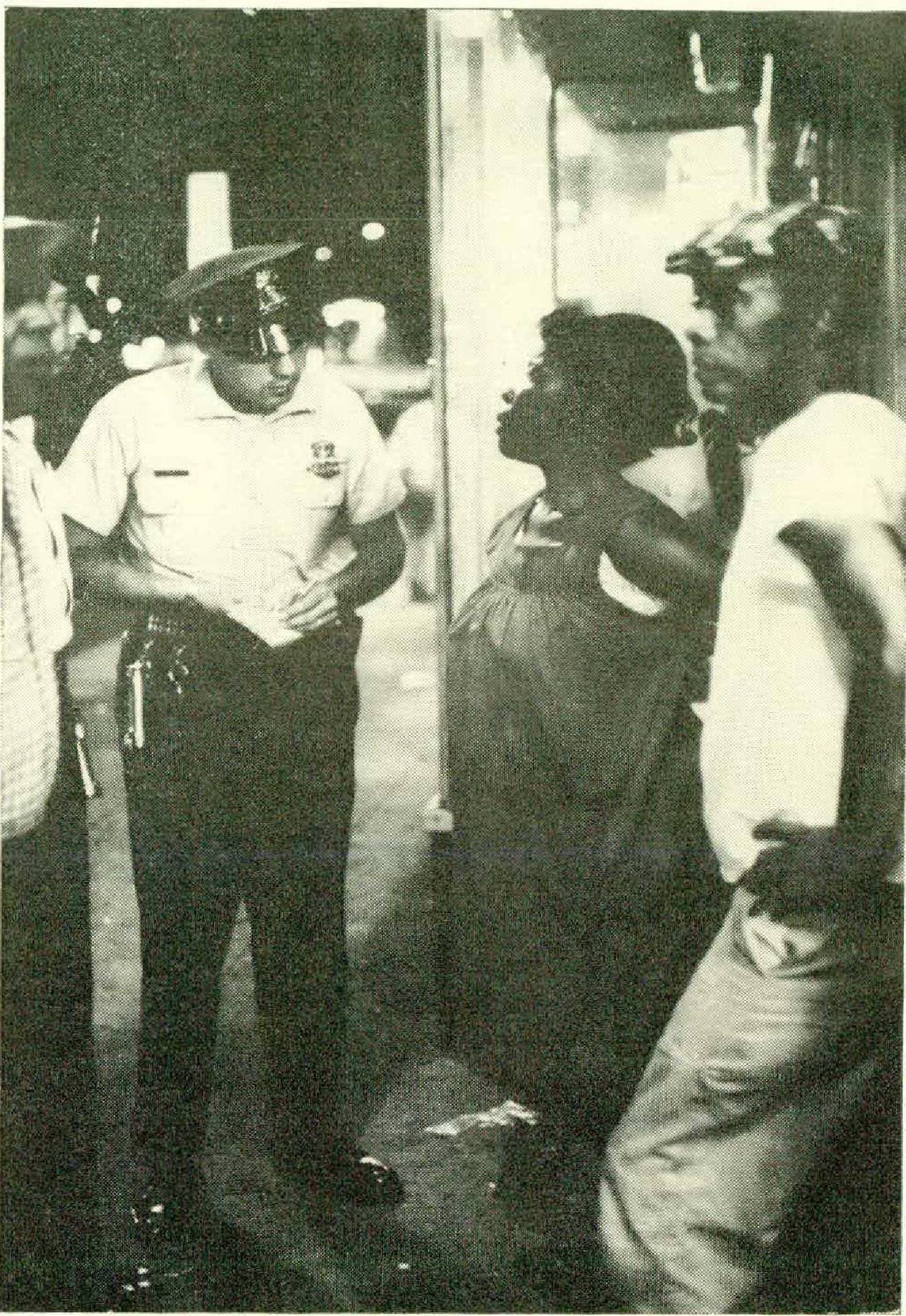
In November, off-duty Detroit policemen attending a dance sponsored by the Detroit Police Officers Wives Association beat up a group of wellto-do Negro youths, who, according to the officers, had made obscene gestures to their wives. Spreen suspended nine officers because of the incident, and the Wayne County Prosecutor charged one with assault and battery and another with felonious assault. However, the actions came only after Mayor Cavanagh had angrily charged that a “blue curtain” of police secrecy—he meant the DPOA— was hampering the investigation. Interestingly, immediately upon being summoned to police headquarters, the accused policemen demanded their rights under the Miranda and Escobedo decisions, rights the DPOA for months had been condemning as unduly favoring criminals. Moreover, in an attempt to support the accused officers, the DPOA took the rather ironic step of hiring a private detective to do its investigating work. No evidence was gathered, however, to support police claims that they were harassed by Negro youths.
In late December, a Negro youth charged that he had been pistol-whipped by a Detroit police officer, and the charge again made bad headlines for police when Negro politicians amplified it and the Detroit News and the Free Press gave it pageone space. Police officials then suspended one of the officers involved—the fifteenth suspension since the Detroit riot. Now, police-Negro relations are at the breaking point.
Last summer, dozens of Detroit policemen angrily walked out on Tindal, then campaigning for Common Council, as be spoke at Common Council chambers against a proposal to allow Detroit police to live out of town. And on November 5 police anger at Cavanagh and other city officials was doubled when, by 26,000 votes, Detroit residents voted to weaken police pension benefits, a move that Cavanagh had campaigned for and the DPOA had opposed with an ad and billboard campaign that cost more than $250,000.
On top of this, it was revealed in December that New Detroit Inc., a high-powered thirty-nine-member committee of business and community leaders set up to guide Detroit’s post-riot reconstruction, was going ahead with a $367,000 study of police practices and management of the Detroit Police Department. Spreen had opposed the study, believing that after twenty-four years of police work, he knew which management and crime-fighting practices were best, and that he should be given the opportunity to put these plans into practice. Individual Detroit policemen were also angry, making no bones about the fact that they view the New Detroit members as enemies of police. “The big guys are on the niggers’ side,” says one high-ranking officer. And Walter S. Nussbaum, a DPOA attorney, perhaps not unreasonably challenged the New Detroit executives to “leave their ivory towers and their pleasant suburban homes . . . [and] find their way more frequently into the precinct houses, bureaus and cars of the Detroit Police Department.”
Parsed, whom Spreen has gone out of his way to court, voiced especially strong objection to the study, saying, “If Common Council, the mayor, and New Detroit would stop trying to make grandstand plays, we could be the most effective police department in the country. Right now, to the man on the street, a study of the police department means an investigation.”The Detroit Police Department doesn’t need an investigation, Parsed declared, saying that if New Detroit had $367,000 to give away, it ought to purchase a $50,000 helicopter, additional portable loudspeakers, and equipment to expand Spreen’s new $8000 closed-circuit television system to monitor demonstrations. At the same time, in an editorial in the DPOA newspaper, Tuebor, Parsell explained the DPOA’s battle plan:
The DPOA has every right to speak out on issues affecting the welfare of its members. . . .
Frankly, we would rather not get involved in politics. We believe we have a far more important job to do of working towards our goal of professionalism of the police. But until such a time as proper bargaining procedures can be made effective, we will not abandon the political arena, and [will] campaign in behalf of police causes and resist every attempt at “union-busting.”
The DPOA believes . . . the charges of police brutality are part of a nefarious plot by those who would like our form of government overthrown. The blueprint for anarchy calls for the destruction of the effectiveness of the police. Certainly it must be obvious that every incident is magnified and exploited with only one purpose. A lot of well-meaning people, without realizing their real role, are doing the job for the anarchists.
Then, to the amazement of libertarians, editorialists, and middle-of-the-roaders, Parsell (an NAACP member) added: “In the 1967 riot, when police were restricted in the beginning from exercising their legal powers, the situation got out of hand. When proper force was used in the Cobo Had [incidents] . . . peace and order was [sic] restored.”
SPREEN has a number of plans to make the Detroit Police Department more efficient, beginning with expanding his Scooter Patrol, which he first devised in New York during a rash of Manhattan holdups and introduced to Detroit during the World Series. He has increased the number of scooters from 32 to 64, and hopes eventually to have 342 of them so that he will have scooter teams in all 13 precincts.
It is already clear that Spreen is experiencing difficulty in asserting his control over old-line command officers—the same problem that Edwards and Girardin had. In August, the mayor sem a private memo to Spreen directing that Negroes he hired at a 4 to 1 ratio over whites until the number of Negro officers, now at 8.6 percent of the force, was dramatically increased. A few days later, the letter turned up in the hands of Common Councilman Philip Van Antwerp, a former police inspector himself. Cavanagh, unaware that the letter had been leaked, denied at a news conference that any such order had gone out. Van Antwerp then gleefully released the letter, citing it as another example of Cavanagh’s contributions to reduced police morale. Moreover, despite the mayor’s order, top police officials continue to work against Negro recruitment. In an eleven-month period in 1968, 291 out of 2856 white applicants were hired as compared with 176 of the 2908 black applicants. Even allowing for more unqualified Negroes than whites, the evidence suggests to people like Councilman Tindal that highlevel police administrators are opposed to Negro recruitment. One observer says flatly, “There’s some hanky-panky here,” meaning that Robert Quaid, police personnel director, and other officials are putting obstacles in the way of Negro recruitment.
Even people that Spreen has already won over— like Marvin Brown, the Negro community relations aide—believe that Spreen must now begin to strengthen his control. Shortly after Spreen appointed Brown, Van Antwerp obtained material from classified police files suggesting that a decade before, when Brown had applied to become a patrolman, he had failed his police tests. Cavanagh and Spreen were then forced to defend Brown, as was Brown himself, saying, “The reason I was turned down was because I was too aggressive for a colored boy.” Ranking police officials were obviously involved in helping Van Antwerp obtain information from Brown’s file.
Additionally, during the bitter November election campaign, Spreen requested his officers not to put bumper stickers on city cars or campaign while in uniform. The request was ignored. Says one observer: “Spreen can’t be a hero to the troops, and do his job as commissioner. He’s got to stop trying to woo the DPOA.”
CLEARLY, the Detroit police force needs to be drastically improved. First it must make real efforts to increase the number of black officers. Says Richard Marks: “Even the white bigots want black officers on the police force. The only guys who don’t are the white cops themselves.” At present, Negroes constitute about 14 percent of Detroit’s population between the ages of twenty-one and thirty-one, the basic age-group from which Detroit police recruit. The Negro police should therefore be upped to 14 percent; ultimately, they should constitute 40 percent, the same percentage as Negroes represent in the total Detroit population figure. The Civil Rights Commission’s Tom Johnson says, “Every person who is qualified ought to be hired, it’s that simple.”
Quaid, the personnel director, says, “We re hiring every Negro we can—as long as they pass the tests,” adding, “Frankly, we re making concessions to get Negroes on the force.” Whoever is right, the Tindals or the Quaids, the fact remains that Detroit must re-examine its police qualification standards in an attempt to increase the hiring of blacks. Special Detroit-schools-sponsored courses to help promising Negroes qualify is one suggestion that liberals advance. Carefully monitored selection that would disregard at least some police records of Negro applicants is another. In addition, the naming of some black precinct commanders (all but two of the thirteen commanders are white) would certainly be a spur toward black recruitment. Spreen himself says, “If we are to give more than lip service to the objective of dramatically increasing the ratio of Negro officers, ordinary efforts will not produce the desired results.” He vows that “if unprecedented steps are necessary,” the Detroit police will take them. Now, he must carry through on that promise.
Second, the Detroit police training is abysmal. The Detroit Police Academy, for example, lasts just 12 weeks, with class time totaling some 400 hours, hardly a period to prepare a man to face the problems that police are confronted with daily, and hardly in line with the 9000 training hours that lawyers receive, the 11,000 for doctors, the 5000 for undertakers.
Under Commissioner Girardin, a police-training course, in which about 200 officers are now enrolled, was set up at Detroit’s Wayne State University, but officers who wish to enroll must pass the Wayne State University entrance examinations. This means that many officers are automatically disqualified because of their lack of schooling. An on-force training program to alter police behavior, to teach officers to resist taunts that helped spark the incidents at Cobo Hall, and ultimately, to change police attitudes is mandatory. Even Parsell, the conservative DPOA chief, agrees.
Detroit’s Citizens Complaint Bureau must be reformed, so that the disciplining of errant police officers is assured. Of 102 allegations of police abuse or misconduct, involving 150 officers, upheld by the CCB from 1965 to 1967, not one has ended in the discharge of an officer, and fewer than 10 officers suffered loss of pay.
In addition, Detroit must use its manpower to the best advantage. A recent look at police records showed that only 2232 of the then 4706 Detroit police officers were assigned to the precincts, where effective crime prevention must begin. Moreover, only 1985 officers, 42 percent of the total force, were assigned to street patrol. Indeed, on the Sunday morning when the Detroit riot began, there were only 193 men on the street.
Beyond that, many people feel that the citizens of Detroit must be given the opportunity to observe, if not participate in, the police discipline structure. Tindal favors citizen representation on the police trial board. Edwards seems to favor a polite-community ombudsman. Others, like Sheila Murphy, the twenty-four-year-old head of the Ad Hoc Action Committee—Citizens of Detroit, a 200-member police-watching group, advocate a citywide governing board to make recommendations to Spreen and Cavanagh for administering the police force. The Michigan Chronicle declares, “Nothing short of civilian control will relieve the uneasy peace which now hovers over our city.”
Most important, the upper-level command structure in Detroit must be cleaned out, for it is here, observers say, that improper police attitudes and actions are condoned and civilian control is opposed.
In addition, Reverend Hubert Locke suggests that when men take police examinations, they also should take college entrance examinations. If they pass, suggests Locke, the men should be required to finish two years of college as they finish their first three years on the Detroit police force. Locke also suggests that specific penalties, such as a year in jail, be spelled out for infractions of rules of conduct. Police would then think twice before committing infractions that presently end, at the most, in brief suspensions.
Most of all, Detroiters and the suburbanites, who also benefit from efficient police performance, must realize that police service should be upgraded, and that money must be found to accomplish this goal —the $30.4 million that it will take each year, for example, just to pay the salaries and pension benefits of the 1690 additional policemen that Spreen and Cavanagh say Detroit must have if its streets are to be safe. If bumper stickers and speeches by politicians were any indication, Detroit would be solidly behind its police. Sadly, this is not the case. When Spreen decided to purchase his first 32 scooters, for example, he was forced to bypass a bureaucracy-bound Common Council, and tap the Detroit business community for $10,000. Furthermore, once the $367,000 New Detroit police study is completed, Detroit’s business and community leaders must be as dedicated in implementing its recommendations as they were in setting up the study. “Unless it’s implemented,” says Brown, “it doesn’t mean a thing.”