Ernest Hemingway: Living Loving Dying
He was thirty-seven when this chapter of his life begins, already established as one of the greatest American writers, and living as if to prove Alfred Kazin’s characterization of him as “the bronze god of the whole contemporary literary experience in America.” THE SUN ALSO RISES, A FAREWELL TO ARMS, and Some of the finest short English prose ever written were behind him. So was one marriage, that to Hadley Richardson, and his second, to Pauline Pfeiffer, was moving toward the rocks. He had three young sons, John (of his first marriage), Patrick and Gregory (of the second). This installment, and a second to follow in the February ATLANTIC, are drawn from ERNEST HEMINGWAY: A LIFE STORY by Carlos Baker of Princeton. The authorized biography will be published in April by Scribner’s, publishers of almost all of Hemingway’s seven novels, dozens of short stories, and one play.
PART 1
During the last week in July, 1936, Ernest was busy preparing for another visit to the Nordquist ranch in Wyoming. This was the week that marked the beginning of the Civil War in Spain. The Loyalists had just stormed the Montaña Barracks in Madrid when Ernest wrote his young friend Prudencio de Pereda that “we ought to have been in Spain all this week.” But he did not seem to be in any great hurry to go. Nor did he show any outward signs of disappointment as he loaded the Ford car for a trip that would take him in exactly the opposite direction from Spain.
Besides Ernest, his wife Pauline, and the two boys, Bumby and Patrick, Pauline’s sister Jinny and Professor Harry Burns were riding along as far as New Orleans. It was hurricane weather, and the drive to Louisiana was wet and sultry. Through Texas and Colorado heavy showers repeatedly drenched the car. Late in the afternoon of August 10 they crossed the echoing plank bridge into the L-Bar-T Ranch. The two boys leaped into action like colts let out to pasture. Next day, Ernest wrote Mrs. Pfeiffer that in the first twelve hours Patrick had stayed off his horse only long enough to eat.
The Hemingways moved into the Sidleys’ cabin on the knoll beside the river. It was larger than any of the others, and included a living room with a fieldstone fireplace and a spare bedroom that Ernest used to write in. The mailbag was filled with letters from people who had read and admired “The Snows of Kilimanjaro.” John Dos Passos’ wife, Katy, guessed that it had “made more people cry than anything since the Armistice.” The same was true of the Spanish Civil War. “I never look for the Spanish news,” she wrote, “without that sick cold feeling I only used to have about my personal affairs and miseries.” Dos wrote that Luis Quintanilla had become an officer in the Spanish Republican Army. He had participated in the attack against the Rebel garrison at the Montaña Barracks on July 20. Some of the wounded Rebels had been thrust into the very prison where Quintanilla had languished until Ernest and Dos had helped to secure his release.
In spite of his words to de Pereda, Hemingway was of two minds about going to Spain. He spoke longingly of another trip to Bimini and even of a second African safari. Yet the war troubled his conscience. At the end of September he told Max Perkins that he hated having missed “this Spanish thing” worse than anything in the world. He was still hoping to go if the fighting had not ended by the time he finished his novel. Premonitions of possible death struck him periodically like twinges of rheumatism. He confided to Marjorie Kinnan Rawlings his feeling that he would soon die, though he would much prefer to become a wise old man, wearing a white beard and chewing tobacco. Soon after setting down these sentiments, he sounded a more sinister note in a letter to MacLeish. He loved life so much, said he, that it would be a “big disgust” when the time came for him to shoot himself.
In September, Ernest returned to his novel To Hare and Have Not with renewed zest, hoping to complete the first draft sometime in October. He wrote Max Perkins that it was shaping up as a hell of a fine book, full of poor people, rich people, reactionaries, and revolutionaries. So far, except for the opening in Havana, all the action took place in and around Key West. The writing had been hard to do, but also the best kind of fun. He had brought the book along to the point where the whole course of its development stood forth clearly in his imagination.
Though the major action was invented, he had drawn directly on his own experience for innumerable supporting details. The Thompson submachine gun with which Harry Morgan killed the Cubans was a twin to the weapon Ernest had acquired from Leeds in Bimini and had been using ever since against marauding sharks. He also made good use of the Key West terrain, familiar now as the back of his hand after eight years of residence. The former submarine base at the navy yard where Harry stole back his boat was the very place in which the Pilar, Hemingway’s boat, had ridden out the hurricane of September, 1935. Josie Russell was the prototype for Freddy Wallace, the owner of Freddy’s Bar. Ernest even made him complain, as Josie had done that spring, about the way his legs ached from standing up all day behind the bar waiting on customers. Bee-lips, the lawyer with whom Harry did business, was drawn to the life from Georgie Brooks, a well-known Key West barrister and politician.
All through the weeks of writing, Ernest had behaved like a novelist instead of trying not to hurt the feelings of his friends. Shortly before Easter, he had amused Dos Passos with an account of their friend Jack Coles. Jack had brought his “new squaw” to Key West. Ernest maliciously described her as a crop-haired woman with a bad complexion and the build of a lady wrestler. Now in his book, he continued to indulge his taste for personal satire with a scene in Freddy’s Bar involving Harry Morgan and a Mr. and Mrs. James Laughton. The Laughtons were thinly disguised portraits of Jack Coles and his wife. A third tourist, who sported a rust-colored mustache and a green-visored sun hat, was a professor of economics named John MacWalsey. The professor spoke sardonically “with a rather extraordinary movement of his lips as though he were eating something too hot for comfort.” This eccentric educator, who gradually evolved into a minor hero in the subplot of the novel, was based on a rough approximation of Professor Harry Burns and Arnold Gingrich.
Late in October, Pauline began packing for the return trip to Key West. Ernest’s contribution to the preparations was to borrow a pair of Nordquist’s hair clippers, which he dipped in alcohol and then used to shave off half his beard. As he assembled the pages of his book for the journey, he computed that since the middle of August he had written 352 longhand pages, roughly 50,000 words — “working like a bastard,” as he put it.
The trip east was accomplished without incident. Back in Key West he began to wrestle with the climactic scene of his novel, in which Harry Morgan lay dying in the captain’s bunk of a Coast Guard cutter. For all Ernest’s boastful words to Perkins and Gingrich that fall, the attempt to fashion a full-length novel by the attachment of a subplot to the three Morgan stories was giving him more trouble than he cared — or dared — to admit. After all the years of sturdy independence, the refusal to follow literary or political fashion, the repeated assertion of his own will and willfulness, the fierce determination not to knuckle under, a counterforce was beginning to boil up from the depths, it was summarized in the dying words of Harry Morgan, who like Ernest had tried to stand by himself but was now less than certain that “one man alone” could survive in such a world as this. Maybe strength, or the renewal of strength, could be gained only through some kind of group action, such a united front as the Spanish Republic was seeking to forge against the Rebels under Franco.
Around Thanksgiving time, Spain came closer. A note in one of Walter Winchell’s gossip columns said that Ernest would soon be going over for a look at the war. The mail presently brought Ernest a letter from John N. Wheeler, general manager of the North American Newspaper Alliance. Wheeler said that he had seen Winchell’s statement, that his own organization serviced sixty leading newspapers, and that Ernest ought to think about the idea of covering the war for the NANA. Ernest replied cordially. This was the break he had been waiting for. Sidney Franklin, who was in Cuba, agreed to go along. Both Pauline and Max Perkins were much against the idea, though Pauline was somewhat mollified by the knowledge that Franklin would be at Ernest’s side. He helped the Republican cause in a preliminary way by paying passage for two volunteers who were going to join the Loyalists. He also borrowed $1500 to be paid in two monthly installments to the Medical Bureau of the American Friends of Spanish Democracy, pledging a like amount to be handed over on demand. The money was to be used to buy ambulances. Ernest’s interest centered on the practical details of shipment. The cars would reach Le Havre in chassis form and be equipped with bodies after delivery in Spain. He strongly advised driving them down through France so that the engines would be broken in and they could be put to work immediately on arrival.
While Ernest continued his work on the novel, he made two new acquaintances among the winter visitors to Key West. They were James T. Farrell, author of the recently completed Studs Lonigan trilogy, and Rexford Guy Tugwell, a member of Roosevelt’s Brain Trust. Farrell was a short and intense young man with unruly hair. He was much impressed by Ernest’s generosity and kindness. Ernest immediately took him into his inmost confidence, or so Farrell thought, and even asserted during a wine-drinking session one evening that Faulkner was a far better writer than either himself or Farrell. A man named Jonathan Latimer had appeared in Key West. Farrell gave him a public tongue-lashing for putting on literary airs. Ernest, who was present, took Farrell aside. “Jesus Christ, Jim,” he said, “don’t do that. Those fellows have nothing but their writing. Take that away from them and they’ll commit suicide.” Tugwell did not share Farrell’s admiration for Hemingway. “He was fascinated by the New Deal,” wrote Tugwell in retrospect, “but not willing to undertake an understanding of its issues. He was puzzled by me — not a politician, but close to political affairs.” When Tugwell tried to interest him in politics as a subject for fiction, Ernest shrugged his shoulders.
ONE day in December Ernest was sitting in Sloppy Joe’s place, nursing a drink and talking with Joe Russell, when a trio of tourists wandered in. One was a handsome blue-eyed woman in her middle fifties. She was accompanied by a goodlooking boy of college age and a tall girl whose bright blond hair reached to her shoulders. The older woman had just been sending a telegram at the Western Union office nearby and had come in with her son and daughter to look over the establishment with the curious name of Sloppy Joe’s. It developed that they were on vacation from their home in St. Louis, that they had disliked Miami, and that on an impulse they had boarded a bus for a ride down the Keys. The boy’s name was Alfred, the girl was called Marty, and they addressed their mother as Omi.
The girl Martha looked askance at the large dirty man in shorts and a grubby T-shirt. But Ernest turned on his charm, introduced himself in a shy mumble, and said that he had known St. Louis in the days of his youth. Both his wives had gone to school there, and so had Bill and Katy Smith. The blue-eyed lady said that she had lived there all her adult life. She was Edna Fischel Gellhorn, the recent widow of a gynecologist and obstetrician, Dr. George Gellhorn, an Austrian by birth. Her daughter, Martha, had been educated at the John Burroughs School, afterward entering Bryn Mawr College in Pennsylvania. Both mother and daughter spoke with a recognizable Bryn Mawr accent.
Martha was restless and ambitious, determined to rise by her considerable talents, and already launched as a writer of fiction. Her first novel, What Mad Pursuit, had borrowed its title from Keats and its epigraph from Hemingway. The Trouble I’ve Seen, a collection of her short stories, had just been published in September, with an appreciative preface by H. G. Wells. She had lately been in Germany at work on a third book, and was very bitter about the rise of the Nazis. After this visit to her mother and brothers, she was planning to return to Europe.
The friendship with the Gellhorns ripened quickly. Ernest showed them around the island and invited them to meet Pauline. After her brother’s return to school and her mother’s departure for St. Louis, Martha stayed on for a while in Key West. Ernest was much in her company, sometimes taking her to a place called Penna’s Garden of Roses or back to Sloppy Joe’s. She spent so much time at his house that, as she presently told Pauline, she nearly became a fixture there, “like a kudu head.” Subjective observers like Lorine Thompson began to think that Ernest was badly smitten by the bright-haired visitor. Pauline was far too perceptive not to notice, but she kept her counsel, at least publicly, in the apparent hope that nothing would come of it.
Ernest was meantime trying to finish his novel. He inserted a series of satiric passages on the private lives of the wealthy yachtsmen whose craft lay moored at the finger piers in the yacht basin. He also introduced a curious commentary on die oncewealthy suicides who had died of carbon-monoxide poisoning in locked garages, dived out of the windows of skyscrapers, or followed “the native tradition of the Colt or Smith and Wesson.” His own chief worry now was the freedom with which he had exploited some of his friends and associates under thin disguises. Max Perkins spent the morning of December 8 at a lawyer’s office with Tom Wolfe, who had been named defendant in a libel suit for $125,000. Ernest wrote Max that when his own book reached print, Scribner’s would have to insert an “air-tight” denial that any of the characters were based on actual people. As a preliminary safeguard, he summoned Arnold Gingrich from Chicago and Maurice Speiser from New York to look over the manuscript with libel suits in mind.
This process took most of a week, with afternoon interludes of fishing. Gingrich warned that the book clearly libeled Dos Passos through the figure of the novelist Richard Gordon, as well as Grant and Jane Mason, who in his view might be mistaken for the fictional Tommy and Helene Bradley. Being well acquainted with all of them, Gingrich thought that he could see “through every reference as through a screen door.” The offending passages must be removed or reworked. But Ernest argued back, reminding Arnold that Jane Mason had been “flattered” when people said she was the model for Margot Macomber. Nobody would be likely to see any connection between the Masons and the Bradleys, anyway. Richard Gordon bore no real resemblance to Dos Passos, and if Dos should happen to object, Ernest was ready with a “neat stratagem.” Knowing that Dos did not like Gingrich, he would merely tell Dos that Gingrich objected to a given passage. Dos would then be certain to approve it.
It was well into January when Martha Gellhorn left by car for Miami on the first leg of her trip back to St. Louis. She had no sooner departed than Ernest left with some deliberate haste on a business trip to New York. When they met in Miami, he took her to a restaurant for a steak dinner under the chaperonage of the boxer Tom Heeney. Afterward they caught the same northbound train, parting company en route and continuing to their respective destinations. Shortly before their train left, Gingrich wired Ernest, having heard a rumor that he was seriously ill. Between the lines of Pauline’s reply, the merest hint of acerbity might have been detected: “SECONDHAND REPORT ABSOLUTELY BASELESS ERNEST IN MIAMI ENROUTE TO NEW YORK IN SHALL WE SAY PERFECT HEALTH THANKS FOR SOLICITUDE.”
Her feelings, whatever they were, could not have been palliated by a letter from Martha in St. Louis several days later. She reported that St. Louis was wintry and damp. She longed to set sail for more exotic regions. She had enjoyed the steak dinner in Miami and admired Mr. Heeney. As for Ernest, whom she was now calling Ernestino, she had been reading his collected works with great admiration, and thought him a lovely guy. Whatever Pauline’s opinion of this letter, it must have struck her as curiously reminiscent of some of those that she herself had sent to Hadley Richardson Hemingway from Bologna in the spring of 1926.
NEARLY every move that Ernest made in New York that January brought him one step closer to besieged Madrid. Some of the expenses of his trip were to be met through his first return to bona fide journalism since 1923. The contract he signed with John Wheeler called for $500 per cabled story, and $1000 for those sent by mail up to 1200 words. He also quizzed Jay Allen about conditions in Madrid, from which Allen had lately returned after resigning his post as Spanish correspondent for the Chicago Tribune. But the greater part of Ernest’s time was given to working with the young novelist Prudencio de Pereda on a documentary film called Spain in Flames. Frankly propagandistic, the film included sequences on the siege of the Alcázar in Toledo, the Loyalist triumph in the Guadarrama Mountains, the destruction of defenseless towns by Fascist warplanes, and the evacuation of the children of Madrid to escape Franco’s relentless artillery bombardment of the center of the city. A previous but inept commentary accompanied the film. Ernest scrapped it and began afresh.
His position on the war was still largely humanitarian. Even if the “Reds” were as bad as they were rumored to be, he wrote Pauline’s mother, they still represented the people of the country as over against the absentee landlords, the Moors, the Italians, and the Germans. He knew very well that most of the “Whites” were “rotten.” Part of his purpose in going to Spain was to see how the lines of social demarcation were being drawn “on the basis of humanity.” The struggle must affect all men because it was so plainly “a dress rehearsal for the inevitable European War.” His intent in working for the NANA would be to serve as “anti-war war correspondent,” seeking to keep the United States from becoming involved in the future conflict.
On his return to New York in February, he found Dos Passos engaged in fund-raising for a second documentary film, designed like the first to acquaint American sympathizers with the plight of the Spanish people. It was to be directed by a gifted Dutch Communist named Joris Ivens, with John Ferno as cameraman. Archie MacLeish, Lillian Heilman, Dos, and Ernest formed a corporation called Contemporary Historians to help with the funding and eventually with the distribution of the completed film. Both now and later, Ernest disagreed with Dos Passos on matters of emphasis. Dos wanted to stress the predicament of the common people in the midst of civil war. Ernest was far more interested in the military aspects.
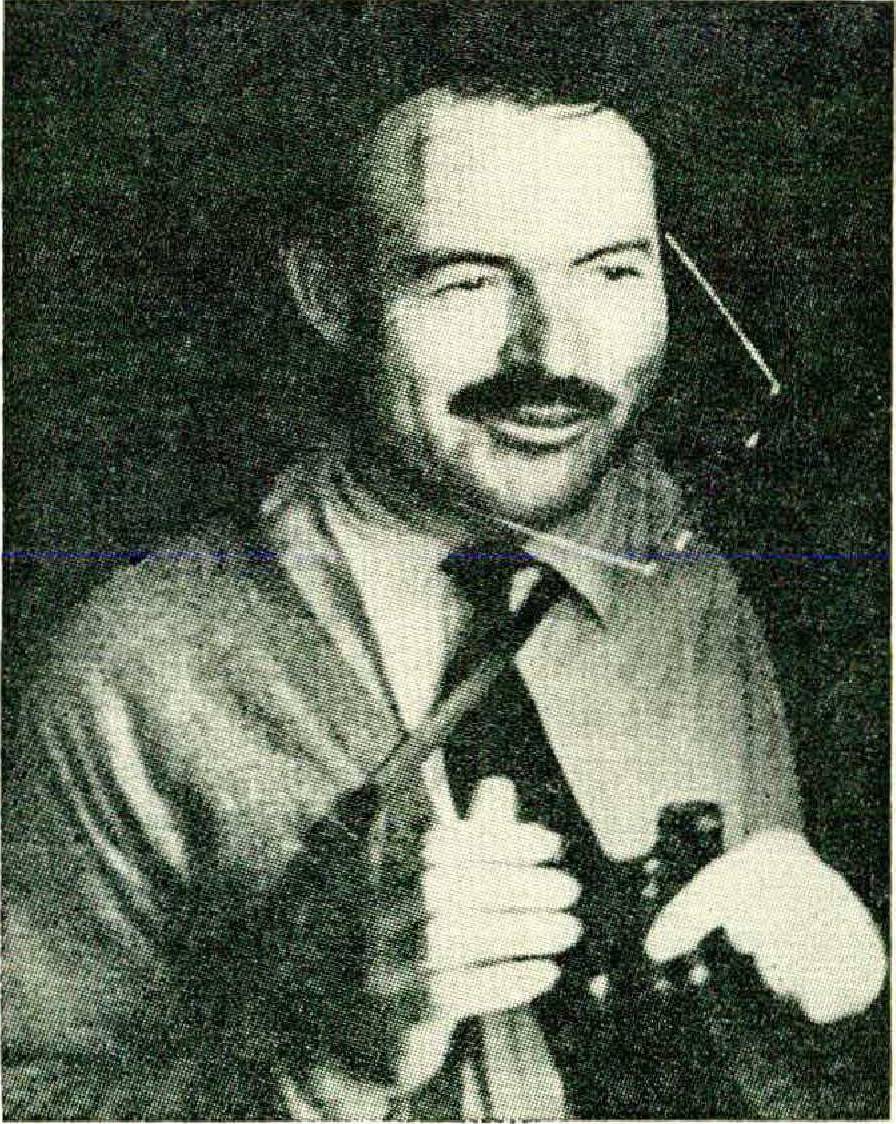
When he embarked at last aboard the liner Paris, his traveling companions were Sidney Franklin and the poet Evan Shipman. Each of the group behaved characteristically at dockside. Shipman vanished anonymously into the ship’s bar. Franklin held audience for reporters in a noisy stateroom where his four handsome sisters were giving him a farewell party. Ernest submitted to an interview in which he said it was his purpose to make Americans aware of the new kind of war now being waged by Franco and his foreign allies. It was a total war, said he, in which there was no such thing as a noncombatant. A young reporter named Ira Wolfert carefully set down these views in his notebook, though his chief interest was in Hemingway’s appearance and personality. “His chest,” wrote Wolfert, “bulged through his coat like a parapet.” Even at thirty-seven he looked extremely youthful. Behind his black mustache his round and rosy countenance beamed with health. He peered at his interlocutors through steel-rimmed glasses and spoke from the side of his mouth, answering questions with a “yop” or a “nope,” and holding his large hands at waist level, as if prepared either to slap a friend on the back or to throw a punch at the jaw of anyone he did not like. His destination was Madrid, he explained, but he planned to visit all the nearby towns to find out what the war had done to the “little people” — waiters, cabdrivers, cobblers, shoeshine boys. After that he would tour the front lines to “see what the boys are doing with the new toys they’ve been given since the last war.”
The seriousness of the situation in Madrid was brought home to Ernest when he met the painter Luis Quintanilla early in March. Since his release from jail, Luis had turned from a man of art to a man of action. Having begun at the Montaña Barracks in July, he had afterward seen service in the Sierra de Guadarrama, Toledo, and the suburbs of Madrid. A bomb had gutted his studio.
“And the big frescoes,” said Ernest, “University City and the Casa de Pueblo?”
“Finished,” said Luis. “All smashed.”
“What about the frescoes for the monument to Pablo Iglesias?”
“Destroyed,” Luis said. “No, Ernesto, let’s not talk about it. When a man loses all his life’s work ... it is much better not to talk about it.”
Ernest’s fraternal feelings were deeply engaged. He had never forgotten the loss of his own early manuscripts at the Gare de Lyon in Paris. The fate of Quintanilla’s work must now be classified among los desastros de la guerra.
The question of Franklin’s visa for Spain was unsettled, and Ernest invoked the aid of Quintanilla’s superior, Luis Araquistain, ambassador to Paris from Republican Spain, and went on alone to Toulouse, the staging area for flights south.
Arriving on the fourteenth, he chartered a car and went to check the French border patrol. The car was twice stopped by mobile guardsmen with fixed bayonets. A police commissioner at the frontier said that only special visas from the French government could assure entry. It was one of the ironies of the time, thought Ernest, that 12,000 Italian troops had recently landed on the south coast as part of Mussolini’s aid to Franco while the French continued to haggle over the passports of neutral observers. On the sixteenth he boarded an Air France plane which put down briefly at Barcelona and then continued south.
The scenery on the low-level flight down the coast did not suggest a nation at war. Small waves curled peacefully along the white beaches; trains chuffed over undamaged roadbeds; men were plowing the fields: factory chimneys sent up plumes of smoke. Not until Tarragona, where a Loyalist freighter lay heeled over at the water’s edge, looking, Ernest thought, like a beached whale with smokestacks, was there any visible evidence of the conflict. Beyond the yellow sprawl of Valencia, the plane climbed briefly over a mountain range and settled to the “African-looking” shoreline of Alicante. Here the people were celebrating news of the Loyalist victory over the Italians at Guadalajara. Men and women sang and shouted, the streets resounded with guitar and accordion music, and pleasure boats with names like Rosa de Primavera cruised the bay, filled with lovers holding hands. There were queues before the recruiting stations. The fiesta atmosphere prevailed all the way up the coast to Valencia. Half asleep in the front seat of the car, Hemingway reflected that even the orange groves were celebrating, wafting rich perfume across the dusty roadway. He sat there drowsily, thinking of weddings.
At the press bureau in Valencia he secured official transport from Constancia de la Mora, a tall aristocratic woman in her early thirties, with the dark eyes, long neck, and oval face of a Modigliani model. The chauffeur assigned to him was called Tomás. He looked like a dwarf out of Velásquez modernized with a proletarian suit of blue denim. On the twentieth they set out on the long drive out of the green Valencian plain and up through the arid gray mountains, with many wayside stops for warmth and wine. At length Ernest saw once again the yellow plateau of Castile, with the snowcrowned peaks of the Sierras to the north, and the city rising like a white fortress from the surrounding plain. “Long live Madrid,” cried Tomás, “the capital of my soul.” He sped down the Gran Vía to the Plaza de Callao and delivered his passenger to the grimy portals of the Hotel Florida.
Ernest was in a great hurry to visit the site of the victory at Guadalajara and Brihuega, which had been so proudly hailed all over Republican Spain the day he flew in. He was already speaking of it as “the biggest Italian defeat since Caporetto.” Now he wished to examine the terrain before the burial squads had completed their work. He paused in Madrid only long enough to register with the censor in the tall white building of the International Telephone and Telegraph Company, known locally as the Telefonica. Here he met a stiff-backed, Prussian-looking German Communist named Hans Kahle, who had fought in the Kaiser’s war on the western front, fled Nazi Germany, and reached Spain in time to hold a command under Miaja in the winter’s defense of Madrid.
Early in the morning of March 22, guided by General Hans and with Tomás at the wheel, Ernest was driven north through a mixture of gray rain and intermittent snow flurries. The weather prepared him for the evidence of disaster which they found on reaching the battlefields some fifty miles from Madrid. Here lay the mute debris of struggle and flight: abandoned machine guns, light mortars, piles of boxed ammunition, and a nightmare of tractors, trucks, and small tanks, stalled on the road shoulders, capsized in the ditches, or hubdeep in the fields. Tomás displayed little stomach for the war. On a muddy road which angled up a hill just below Brihuega, they met a Republican tank which had stalled on a hairpin turn with six others behind it. The target attracted three Rebel bombers, which plastered the wet hillside “in sudden, clustered, bumping shocks.” From that time on. Tomás’ handling of the car was notably inefficient.
On the heights above Brihuega, behind boulders where they had huddled for protection, they found the Italian dead, small and pitiful as forgotten dolls, their faces gray and waxen in the sullen rain. Once more Ernest noticed the curious abundance of letters and papers around them, as well as the entrenching tools with which they had tried vainly to dig foxholes in the rocky soil. Kahle said that the defeat of the Italians had destroyed Franco’s hope of encircling Madrid. The city’s climate might be atrocious, but its marvelous natural defense position more than made up for other deficiencies. Coming back, he pointed out that fortification had now progressed to a point where direct assault could no longer take the city. In order to win, Franco must drive through Teruel to the coast, separating Barcelona and Valencia. Meantime, Republican forces in Castile were growing stronger each day. In a few months, as Ernest wrote in a dispatch that drew heavily on Kahle’s knowledge, the Loyalists could take the offensive.
ERNEST was at dinner in the basement restaurant of the Gran Via Hotel across the street from the Telefónica when Martha Gellhorn and Sidney Franklin appeared. They had reached Valencia by widely different routes and driven up together. Ernest’s greeting enraged Martha. In spite of her intrepid spirit, she was tired, dusty, and cold from the day’s journey. “I knew you’d get here, daughter,” said Ernest expansively, “because I fixed it so you could.” Beyond a phone call or two he had in fact done nothing, and Martha resented the implication that she had needed help. The food in the restaurant was bad, and the waiters were visibly distressed by the late arrivals. Martha’s first meeting with Ernest since January could hardly have been accomplished under less romantic circumstances. His interest in her was still mainly that of a successful author for a younger aspirant, though they shared an idealistic concern for the plight of the common people. Rightly or not, Martha saw herself as more politically aware as well as more fiercely anti-Fascist than he was.
Next day Ernest took her to the Telefónica and introduced her to Arturo Barea and Ilsa Kulcsar, who together directed the office of censorship and provided newcomers with hotel rooms, petrol vouchers, and safe-conduct passes. This fantastically overworked pair stared in disbelief at the “sleek woman with a halo of fair hair, who walked through the dark fusty office with a swaying movement" which they associated with American film stars. Had she known of it, this opinion would have enraged Martha anew. She went north with Ernest on the twenty-seventh, the first warm spring day, to stand among the red hills of the Guadalajara sector and watch the scores of Rebel soldiers who moved like ants up a steep bluff across the narrow valley, fortifying their tableland against an expected Loyalist attack. The troops around Ernest and Marty smoked and laughed, “sunbathing and seam-picking” in the warm air. It was hard to imagine one’s way back into the seven bitter days, much of it in foul weather, which had ended in the rout of three Italian divisions.
Now, at least, the situation was happier in the field than it was in the city. Franco’s artillery on Garabitas Hill bombarded Madrid daily. Granite dust and the acrid fumes of high explosive lay everywhere. The morning after his return from the north, Ernest was awakened by the scream and boom of a shell in the square outside. In bathrobe and slippers he hurried down to see a middle-aged woman being helped into the lobby, bleeding from a wound in the abdomen. Not twenty yards from the hotel entrance was a great hole in the sidewalk and the body of a man covered with dust in a heap of rubble. The noise from the University City sector, seventeen short blocks away, often kept up all night.
He made a point of frequent calls at the hotel called Gaylord’s, the social center of operations for the Russian contingent. Once he was known there, he enjoyed the feeling of being able to wave familiarly to the sentries who guarded the porte cochere with fixed bayonets, of striding through the marble entrance hall and stepping unchallenged into the slow-moving elevator. At first, he did not like the place. Food and drink were too abundant, the appointments too luxurious for a besieged city. The talk struck him also as far too cynical. Yet he returned often, convinced that if he kept his ears open, he would be able to learn precisely how the war was being conducted. One immediate discovery was that many of the Spanish commanders had received thorough Soviet indoctrination. Enrique Lister from Galicia, who commanded a division, spoke Russian fluently. Juan Modesto of Andalusia, in charge of an army corps, had “never learned his Russian in Puerto de Santa María.” El Campesino, ex-sergeant in the Spanish Foreign Legion, “with his black beard, his thick negroid lips, and his feverish staring eyes,” was a fine brigade commander who talked far too much for one in his position. But Ernest was all attention.
His chief informant at Gaylord’s was Mikhail Koltsov, correspondent for Pravda and Izvestia, a youngish intellectual with high-colored mobile features, horn-rimmed glasses, and a mop of crinkled hair. Koltsov knew, said Ernest, that his American friend had no leanings toward Communism. But since he believed in Ernest as a writer, he tried to show him how everything was actually run so that he could later provide a true account of it. One evening Ilya Ehrenburg found Ernest in Koltsov’s suite, morosely drinking whiskey. After some preliminary exchanges, Ehrenburg asked in French if Hemingway cabled home only feature stories or sent spot news dispatches as well. He was astonished when Ernest sprang up in a black rage and advanced menacingly upon him with a whiskey bottle because he had mistaken the word nouvelles for novels. Bystanders intervened, and the incident ended in laughter. Even such behavior could not disguise from Ehrenburg the fact that Hemingway was basically a cheerful man, attached to life, eager to talk by the hour of hunting and fishing. He spoke seriously of the film he was going to make and the purposes he hoped it would serve. He was committed to the war, thought Ehrenburg, “attracted by danger, death, great deeds.” He was daily seeing men who refused to surrender. “He was revived and rejuvenated.”
These were exact terms for what was happening to Ernest that spring. He had returned to scenes not unlike those he had known in Italy long ago. He had lately spoken in Green Hills oj Africa about the “pleasant, comforting stench of comrades,” the happy interdependence of a brotherhood in arms. In the time between the wars, he had largely abandoned these in the pursuit of his lonely vocation. Now he was back in the breach. Difficulty and danger were elements in which he flourished. Fully, and for the most part unselfishly, committed to the Spanish people and their cause, he knew at the same time that this was the kind of experience by which he could grow, adding new dimensions to his stature as a novelist.
Apart from Martha Gellhorn, Ernest’s chief associates among the foreign journalists in Madrid were Herbert Matthews and Sefton Delmer. Both had been there far longer than he, Delmer since the start of the war in July and Matthews since November. Matthews was tall and slender, serious and studious in manner, with a thin ascetic face that reminded Ernest of Savonarola. Delmer, called Tom, was an Oxford graduate in his early thirties, six feet tall and weighing 220 pounds. In Ernest’s eyes he might have passed for a “ruddy English bishop.” Delmer was a good deal less enthusiastic than his companions about the way in which the Communists were directing the fortunes of the Spanish Republic. Nor did he fully share Matthews’ conviction that these months in besieged Madrid were the “great days” of his life as a journalist, so much better than sitting at a desk in Paris rewriting official handouts from the embassies. Ernest’s euphoria surpassed even that of Matthews. After his first two weeks at the Florida, he developed an impersonal feeling of freedom, as if he had neither wife nor children, house nor boat, nor any other domestic possessions or entanglements.
During April, he threw himself wholeheartedly into the preparation of the documentary film, which was going to be called The Spanish Earth. He was much in the company of Joris Ivens, the director, and John Ferno, the taciturn and businesslike cameraman. Ivens was a solidly built man of middle height, with thick brown hair and the look of a Left Bank intellectual, an artist, and a Communist to his fingertips. He began functioning as Ernest’s Political Commissar, convinced that his friend was ready at last to become part of a genuine collective movement.
The film-making was not easy. When they followed the Loyalist tanks and infantry through the broken gray hills in the Morata de Tajuna sector, the wind from the mountains showered them with dust, caking the moisture in their eyes and nostrils, and clouding the lenses of the cameras. On the ninth, after a carouse that continued past midnight, Ernest lay awake for hours listening to Rebel artillery pounding Loyalist positions around Carabanchel. Soon after six, Ivens knocked on his door, eager to make an early start on the work of the day. The Loyalists were starting an attack against the Rebel lines beyond the Casa de Campo, a broad open valley north and west of the city. With Hank Gorrell of the Linked Press and Ferno, the cameraman, they left the hotel without breakfast and set out for brigade headquarters. Rebel artillery was shattering the ancient linden trees in the woodland near the old royal hunting lodge. They soon found that they had gone too far downgrade to get a clear view of the action, and climbed back, panting and sweating, to an eminence above the eastern edge of the woods.
From this point the whole battle was spread out before them. A thin line of infantry was advancing on a trench which angled down the opposing hillside. Three Loyalist bombers unloaded on the Rebel earthworks, and the view from the ridge was blotted out in rising towers of dirt. But the exposed position of Ernest and his friends soon attracted enemy sniper fire. Ferno crawled away to find a location where the larger of the cameras, equipped with a telephoto lens, could be safely installed. The place he chose was a sort of grandstand seat in the row of apartment houses that fronted on the Paseo Rosales, commanding a long view westward into the valley. The buildings were ruined from five months of shelling, but one apartment on the top floor was intact enough to serve as a vantage point. Ernest nicknamed it “The Old Homestead,” thinking of his grandfather Anson’s house on North Oak Park Avenue. They camouflaged the camera with rags and spent the afternoon watching and filming the battle. It was too far off to film well. At a thousand yards, as Ernest said, “the tanks looked like small, mud-colored beetles bustling in the trees and spitting tiny flashes, and the men behind them were toy men who lay flat, then crouched and ran . . . spotting the hillside as the tanks moved on.”
At twilight they carried the large camera down the stairs, removed its tripod, made three loads, and then sprinted, one at a time, across the dangerous corner of the Paseo Rosales into the lee of a stone wall. In the bare cobblestoned Plaza de Espana, they hunched their shoulders and ducked low as a big German monoplane bombed the Loyalist batteries and then swept on in their direction. But the enemy crew had done their work, and the plane roared away over the city.
Next day a large group converged on “The Old Homestead,” including Dos Passos, Matthews, Sid Franklin, Tom Delmer, Martha Gellhorn, and Virginia Cowles. Delmer irritated Hemingway with scathing comments on the slow advance of the Loyalist tanks. Ernest was extremely careful “that no reflection from his or our binoculars should give away our hideaway and provoke a shell or two.” He commented on the poor planning which caused the heaviest Loyalist attacks to come in the afternoon. The westering sun glinting on the camera lenses made them easily visible to the Moorish riflemen. “If you wanted to be properly sniped,” said Ernest, “all you had to do was use a pair of [field] glasses without shading them adequately. They could shoot, too, and they had kept my mouth dry all day.”
His liaison with Martha Gellhorn had only lately begun. Tom Delmer admired the “humorous indulgence” with which she treated Ernest, showing none of the “servile obsequiousness” with which his wants were commonly met by others. But Delmer was not aware that they had become lovers until a Rebel shell burst in the hot-water tank of the Hotel Florida. The steam that escaped made the place look like a corridor in hell. “All kinds of liaisons were revealed.” said Delmer, “as people poured from their bedrooms to seek shelter in the basement, among them Ernest and Martha.” He noticed particularly the French writer Antoine de Saint-Exupéry, who had been hoarding a cartload of grapefruit in his room. “He stood with a basket at the staircase,” said Delmer. As each woman passed, “he held out a yellow grapefruit with all the graciousness of an old-world French aristocrat and said, ‘ Voulez-vous une pamplemousse, Madame?’ ”
But Ernest spent little time in the Hotel Florida. A succession of chauffeurs drove him to the various fronts around the outskirts of the city. After Tomás came one who made off with an official car and forty liters of petrol. Third was an anarchist boy named David from a village near Toledo. He spoke a language so inconceivably foul that Ernest’s education in profanity entered a new orbit. David was passionately devoted to the idea of war until the day he saw a grocery queue of women hit by a Rebel shell near the Plaza Mayor. He soon left for the village of Fuentidueña de Tajo, where Ivens and Ferno were filming domestic scenes for The Spanish Earth, and did not reappear. His successor was Hipolito, tough, laconic, completely unromantic, and so capable that Ernest could easily imagine him as a sergeant of conquistadores in the heyday of Spain’s colonial empire.
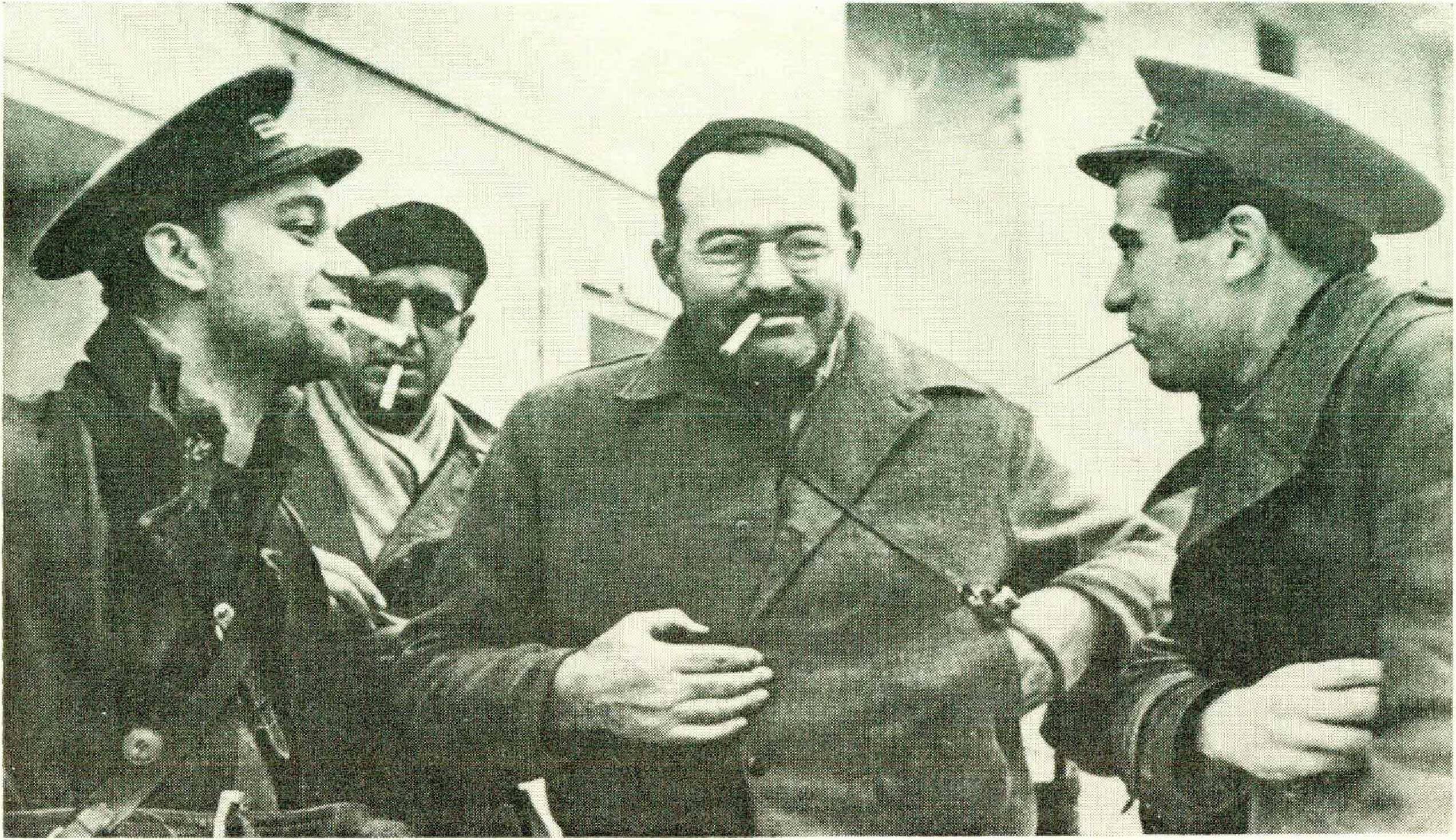
ERNEST’S military acquaintance broadened rapidly. Among his favorites were the American volunteer aviators Whitey Dahl, who was said to be wanted by the police of Los Angeles on a checkforging charge, and Frank Tinker, who came from Arkansas, near where Pauline grew up. Another of his flying friends was Ramon Lavalle, whom he had known during Lavalle’s boyhood in Paris. Still another acquaintance from the Paris days was Lieutenant Colonel Gustavo Duran, who had formerly been a student and composer of music. At the outbreak of the war he had held a reserve commission as second lieutenant, but had since risen rapidly in the Loyalist hierarchy and was now commanding the 69th Division at Torrejón de Ardoz and Loeches, east of Madrid. The lukewarm friendship of the Paris days now reached a new intensity. Like Luis Quintanilla, Duran was an artist turned soldier, and Ernest soon began to speak of him as one of his heroes.
He was a frequent visitor to the Eleventh International Brigade, largely composed of German Communists and commanded by Hans Kahle, with whom he had made the trip to Brihuega in March. Many of Kahle’s men were veterans of the Kaiser’s war, and all had had military training. For a time Ernest thought of doing a book on Kahle until he reflected that “we have too much together for me ever to risk losing any of it by trying to write about it.” But it was the Twelfth Brigade which most engaged his affections, chiefly for the people and their esprit de corps, though also because they welcomed him with the respect due a creative artist while making him feel more like a soldier than a noncombatant. The commander, whose nom de guerre was General Lucasz, was a forty-oneyear-old Hungarian who had written some short stories and a novel: “Short, chunky, jovial-looking, with pale blue eyes, thinning blond hair, and a gay mouth under a bristly yellow mustache,” Lucasz delighted Ernest with his relaxed good humor. He was also much attracted to Werner Heilbrun, chief medical officer of the brigade, a gentle, efficient man who was a model of stoic fortitude and humanitarianism. “With his cap tilted sideways on his shock of black hair,” Heilbrun moved among the wounded “like a weary beggar-monk,” working day and night, “his deep-set eyes glowing with the sense of his mission.” Lucasz’s political commissar, Gustav Regler, was the third of Ernest’s favorites in the Twelfth. A German Communist with a tawny complexion, a deeply lined forehead, and the jaw of a fighter, he had begun as a boy soldier in 1918. Since then he had been a persistent antiFascist and more recently a refugee from Nazi Germany.
Ernest’s greatest hatred was reserved for André Marty, commander of the International Brigades at the crowded base in and around the city of Albacete, a large man, as Ernest described him, “old and heavy, in an oversized khaki beret,” with “bushy eyebrows . . . watery gray eyes . . . and double chin.” In Ernest’s view Marty’s “gray face had a look of decay,” as if it had been modeled “from the waste material you find under the claws of a very old lion.” Ernest was not alone in his prejudice. Ehrenburg found Marty “imperious, very short-tempered, and always suspecting everyone of treason.” Regler stated flatly that Marty covered his inadequacy as a soldier “with an unforgivable, passionate spy-hunt.” He quarreled publicly with many of his subordinates who disagreed with his neurotic or even psychotic decisions, including the heroically hardworking American, Louis Fischer, who served for a time as his Quartermaster General.
Although Ernest saw little of Marty, he formed a useful working acquaintance with a Polish officer whose real name was Karol Swierczcwski. Like many other officers in the International Brigades, he fought under a pseudonym, in this case General Walter. Born in Warsaw, raised chiefly in Russia, he had served with the Red Army during the revolution, and was teaching military science and tactics at the Frunze Military Academy when the Spanish Civil War erupted. Since then he had commanded the Fourteenth Brigade during the battle of Coruña Road in December and January, moving on afterward to the defense of Madrid. He greatly impressed Ernest, both by his military knowledge and by his singular appearance, “with his strange white face that never tanned, his hawk eyes, the big nose and thin lips and the shaven head crossed with wrinkles and scars.”
The bombardment of Madrid continued all through April. The Gran Via was so often strewn with broken glass that Ernest came to think of it as one would think of a hailstorm that happened every day. Ilsa Kulcsar’s shoes were burned to cinders in her hotel room by a red-hot chunk of shrapnel. One of the porters at the Florida was shot through the thigh by a stray machine-gun bullet. Another bullet made a neat round hole in a mirror in Martha’s room while she was away. Food in the capital was in shorter supply than ever, though supplies from Valencia constantly rolled into Madrid, only to be inefficiently stored in locked warehouses until they rotted. Hungering for game, Ernest borrowed a shotgun and went hunting along the Pardo front on the morning of April 21, returning with a wild duck, a partridge, four rabbits, and an owl.
That evening he wrote a news dispatch, his first in ten days. Martha left it for Franklin to file, with a note:
Dear Sidney: I am going back to the Jarama front for the night. I have read and corrected [i.e. proofread] E’s article. Will you please take all three copies to Ilsa, Room 402, in the Telefonica, and have her pass them. She keeps one copy, the other two should be sent to the addresses attached to them. I have no envelopes, but you can surely find some up there in the press room — 401 —or even ask Ilsa. Probably these should go tonight. E. wanted them to go in the diplomatic valise for the sake of speed; kindly tell Ilsa that, and tell her it is important as E. has not sent a story for some days and this is good for the cause. . . . Thank you. Regler has bad fever again, and Bethina still thinks it is typhoid. . . . All food is in my room, for his [Regler’s] dinner. Gracias. Marty.
Next day Ernest left with Martha, and Hipolito as driver, for what he described as “ten hard days visiting the four central fronts.” The itinerary included the 4800-loot Sierra de Guadarrama, where they spent hours on horseback climbing to inspect the Loyalist positions. He was impressed by the smartness and the discipline of the seasoned mountain troops. Once they rode in an armored car up a road exposed to Rebel machine guns. Hunched in the dark interior, they listened to the sharp rivet-hammering of four separate bursts against the protective metal plates. Even such an experience seemed less dangerous to Ernest than daily life in Madrid. Upon their return they found the air gritty with granite dust, saw new jagged craters in the pavements along the Gran Via, and reflected that beside this senseless shelling of the civilian population the mountain front seemed almost idyllic.
Ivens wrote from Valencia late in April. Sidney Franklin and John Ferno were to finish the final scenes of The Spanish Earth in the village of Fuentidueña on the twenty-eighth and twenty-ninth, and Ivens asked Ernest to join them there. He himself was on the point of leaving for New York, and Ernest had been promised plane passage out of the country about the sixth of May. Dos Passos was still actively protesting the murder of his friend Robles, and had lately been to see the American ambassador in Valencia. Ivens hoped that Dos would eventually come to recognize “what a man and comrade has to do in these difficult and serious war times.”
With the film footage for The Spanish Earth completed and boxed for shipment, Ernest was ready to go home. He filed his last dispatch at the Foreign Ministry Building in the Plaza de la Cruz. The Telefonica, white in the morning sun, had become so good a target to Franco’s artillery that Ilsa Kulcsar had asked and got permission to move the offices of censorship to the new location. Arturo Barea was close to a breakdown from overwork and the daily horrors of the bombardment. But Ernest, cheerful and hearty, knew nothing of this the day he said good-bye to Barea, standing on the flagstones in the Ministry courtyard, laughing and joking in colloquial Castilian.
He was equally gay at the farewell party given in his honor by the Twelfth Brigade. It took place on the evening of May Day in the grounds of the ancient castle at Moraleja, which served as their base hospital. Lucasz the commander was there, as well as Dr. Heilbrun and Gustav Regler. Ernest afterward remembered how Lucasz had played “the tune he only played so, very late at night, on a pencil held against his teeth; the music clear and delicate like a flute.” It was his final meeting with Heilbrun and Lucasz. But for a fluke of fortune, it might also have been his last with Gustav Regler.
ON SUNDAY, the ninth of May, Ernest reached Paris after forty-five days in Spain. Looking bronzed and healthy, he told reporters that he had not expected the war to last so long. He said that his purpose in returning to the United States was to revise the first draft of a novel. When this job was done and the book had been seen through the press, he would return to Spain for the “big war of movement” which he expected to begin during the summer.
After the interview with the reporters he spent four busy days in Paris, conferring with Luis Araquistain about the medical needs of the Loyalist Army, making a speech before the Anglo-American Press Club and another to the Friends of Shakespeare and Company at Sylvia Beach’s bookshop. He stuttered and stammered through both the speeches, and his auditors got the impression that he would much rather be elsewhere. Joyce was present for the meeting at Sylvia’s, huddled in a corner, fiercely uninterested in Spain and politics. Ernest assured the company that writing was very hard work. With the possible exception of The Sun Also Rises, he had never been wholly satisfied with any of his books. He spoke of these matters in an offhand fashion, and turned with evident relief to the reading of passages from his short story “Fathers and Sons.”
When he reached New York aboard the Normandie on May 18, his immediate plans were to go to Key West, gather up his wife and children, and spend most of the summer at Bimini, revising the novel and fishing. Only two major interruptions confronted him. One was a speech he had agreed to deliver before the Second American Writers’ Congress in New York early in June. The second was The Spanish Earth, which must now be cut, provided with a theme and a sound track, and then used for the all-important purpose of raising money for Loyalist ambulances. He was busily relaxing at Bimini on June 2 when Joris Ivens wired from New York that President and Mrs. Roosevelt had agreed to see the film at the White House early in July. Phis important meeting had been arranged by Martha Gellhorn, a good friend of Eleanor Roosevelt’s. Meantime, Joris sent along a statement of the theme of the film for Ernest’s scrutiny and revision. “Our people,” it said, “gained their position by a democratic election. Now we are defending our rights. We are forced to fight against the military clique and foreign intervention. The whole country is united in the fight. The peasants make better use of their own land, better than their former landlords. They bring forth the full potentialities of the Spanish Earth.” Hemingway’s version reduced Joris’ six sentences to three: “We gained the right to cultivate our land by democratic elections. Now the military cliques and absentee landlords attack to take our land from us again. But we fight for the right to irrigate and cultivate this Spanish Earth which the nobles kept idle for their own amusement.”As a summary of the causes of the war, both versions were somewhat simplistic. But they stated with economy the basic theme of the film.
On the fourth of June, Ernest flew from Bimini to keep his engagement with the Writers’ Congress. Scott Fitzgerald was in town, and they met briefly. Scott had “come back to life” in January, and was now working for Metro-Goldwyn-Mayer under a lavish contract. “ I wish we could meet more often,” he told Ernest. “I don’t feel I know you at all.” Once again, as so often in the past, he was impressed by Ernest’s sanguine vitality. The program at Carnegie Hall was already well along when Ernest strode in. He stood in the wings, muttering that he was not a speechmaker. The huge auditorium was hot and filled with tobacco smoke. The orchestra and all the balconies and boxes were jammed with a capacity audience of 3500, and another thousand had been turned away at the doors. Printed programs identified the sponsors as the League of American Writers, whose president was Donald Ogden Stewart. Besides Stewart, the speakers for the evening were Earl Browder, the Secretary of the Communist Party of the U.S.A., Jons Ivens, with the still unfinished film, and finally Hemingway, with Archibald MacLeish as chairman and master of ceremonies.
Browder’s paper was restrained and straightforward. The European dictators had shattered the Ivory Tower with their bombs; all writers must now address themselves to the life of the common people, “the source of all strength in art.” Ivens introduced The Spanish Earth, which still lacked a sound track. “Maybe it is a little strange,” said he, “to have at a writers’ congress a moving picture, but I think it belongs here. . . . This picture is made on the same front where I think every honest author ought to be.” Ernest sat through these speeches in the company of MacLeish and Martha Gellhorn. He was dressed too heavily for the hot weather, and clawed at his tie as if it were choking him. When MacLeish introduced him, the applause was thunderous. His glasses fogged, his tanned cheeks gleaming with moisture, he leaped up nervously and launched into his seven-minute speech before the ovation had died down.
A writer’s problem [he said] does not change. He himself changes, but his problem remains the same. It is always how to write truly and having found what is true, to project it in such a way that it becomes part of the experience of the person who reads it. . . . Really good writers are always rewarded under almost any existing system of government that they can tolerate. There is only one form of government that cannot produce good writers, and that system is fascism. For fascism is a lie told by bullies. A writer who will not lie cannot live and work under fascism.
The rest of the speech was not especially notable for its internal logic. But its faults were far less important than the fact of Hemingway’s willingness to speak at all. Paul Romaine, the bookseller from Milwaukee, was among the hundreds in the audience who watched and listened with undisguised fervor. “It was magnificent,” said he, “as if everyone had taken him into their arms, truly a companion ... in the fight against fascism. How could this fight be lost now, with Hemingway on our side?” Waves of applause swept the great hall as Ernest, “excited and wet, dashed into the wings not to appear again.” His obvious sincerity, as well as “the strange power of his presence,” had taken the place by storm.
THE war of movement that Ernest had predicted for the summer of 1937 had moved mostly in the wrong direction. During his absence, none of the Loyalist offensives had lifted the siege of Madrid or prevented the Rebel conquest of the northern provinces. General Walter’s attack on the Segovia front late in May had begun well and then fizzled out. Bilbao had fallen to Franco on June 18. The bloody battle of Brunete in the blistering heat of July had cost the Loyalists heavy casualties. The Basque provinces were conquered, and the Rebel drive against Santander was launched on August 14, the very day Ernest had sailed from New York.
When he and Martha met Herbert Matthews at the Café de la Paix one afternoon in early September, the news was still dark. Franco held two thirds of Spain, and a fresh assault on Madrid was daily expected. But when they reached the Aragon front, the gloom lifted. A Loyalist offensive below Zaragoza had taken Belchite, and they went to explore the rubble and stench of the ruined town. Ernest talked to some of the volunteers in the 15th International Brigade and learned of the tactics they had used at Belchite. Their leader, Major Robert Merriman, had “bombed his way forward,” in spite of many wounds from hand-grenade splinters, and had refused to stop until his men had reached and occupied the cathedral. Merriman immediately entered Ernest’s gallery of heroes.
Ernest, Martha, and Herbert Matthews were the first American correspondents to make a complete survey of the sector around Belchite. They climbed steep, rocky trails on foot and horseback and followed raw new military roads in trucks and borrowed staff cars. Food and lodging gave them the most trouble. The peasants provided bread and wine, and they cooked over open fires. They slept in an open truck equipped with mattresses and blankets from Valencia. Parked in roofed-over courtyards among chickens, cattle, sheep, and donkeys, they were awakened each dawn by a chorus of lowing, braying, and crowing. Snow had already fallen in the mountains, and glacial winds blew in over the tailgate of the truck. Martha endured these hardships with typical courage and aplomb. For years afterward, Ernest remembered and praised her conduct in those September weeks.
Madrid in late September was far quieter than it had been in April and May. Siege warfare still went on in Usera, Carabanchel, and University City, but whole days sometimes passed without shelling from the Rebel batteries across the Casa de Campo. Ernest and Martha moved into the Hotel Florida, this time without the jealous presence of Sidney Franklin. There were other changes. During the summer, Rubio Hidalgo had brought Constancia de la Mora from Valencia to replace Ilsa Kulcsar and Arturo Barea in the Censorship Bureau. On learning that they had been superseded, Ernest shook his head and frowned. “I don’t understand the whole thing,” he said, “but I’m sorry. It seems a lousy mess.”
Early in October, Martha and Ernest went out with Matthews and Delmer to inspect the Brunete front. They peered down from the heights at Rebel soldiers walking in the streets, and were surprised to find most of the town not only intact but quiet. Delmer had mounted British and American Hags on the front fenders of his Ford in token of neutrality. This nearly got them killed its they raced north toward Villanueva de la Canada. Rebel artillerymen mistook the Ford “for some sort of super-staffcar,” and shells bracketed the road they were following. “Shells are all much the same,”wrote Ernest. “If they don’t hit you, there’s no story, and if they do, you don’t have to write it.” Nevertheless, Delmer drove cautiously home through the blacked-out suburbs of Madrid. Constellations shone bright in the sky. Ernest and Herbert Matthews watched them from the back seat while Ernest discoursed learnedly on navigation by starlight in tropical latitudes.
His euphoria still persisted, though less markedly than it had done in the spring. His room at the Hotel Florida was a haven for men on leave from the International Brigades. One was Captain Phil Detro, a Texan well over six feet tall, who returned to the headquarters of the 15th Brigade near Albares with tales of Hemingway’s hospitality— hot baths, ham and cheese, hard liquor, a blanket for crap shooting, a record player, and even now and then a girl. Ernest’s meetings with the young Americans sometimes took place at Chicote’s Bar, one of his favorite hangouts on the Gran Vía. It was here that he first met Milton Wolff, platoon commander in the Lincoln Machine-Gun Company. Wolff was twenty-two, as tall as Detro, with a large nose and a Lincolnesque build. He found Ernest in the company of a beautiful girl. “Hemingway bought the drinks.”wrote Wolff, “and after a while I was alone with the girl. . . . Papa had fixed me up. Ten wonderful days in Madrid. I owe him that.” Another visitor was Freddy Keller, a stocky boy with bright blue eyes who was commissar for the Lincoln Machine-Gun Company, and had lately distinguished himself during the battle of Fuentes del Ebro. Fred appeared with a Greek named Johnny Tsanakis, a fierce anti-Fascist who had served with the Greek underground. Phil Detro introduced them to Hemingway, with whom they hit it off at once. Tsanakis had an amusing habit of holding forth with a monologue in Ernest’s room, only to pause in midcareer, look around suspiciously, and ask. “These other guys in the party?” Ernest picked it up as a temporary watchword.
LRNEST was still busy in Madrid when To Have and Have Not appeared in mid-October in New York. As always, he followed the sales figures with worried concentration. Between October 30 and December 9. he cabled Perkins three times to learn how the book was going. By early November, Perkins was able to report that the book stood fourth among national best sellers, with some 25,000 copies sold. Most of the reviewers, however, had displayed mixed feelings. Louis Kronenberger called the book contused or transitional or both. Despite Hemingway s success with Morgan and a handful of superb scenes, the book fell apart in the middle and displayed “shocking lapses from professional skill. J. Donald Adams thought that the Hemingway record would be stronger without the book, which struck him as distinctly inferior to A Farewell to Arms. Time magazine carried a cover story, reproducing Waldo Peirce’s action portrait of Ernest in a blue-striped fisherman’s jersey and a long-billed cap. Ihe story itscll held that Hemingway’s writing method was now becoming dated, even though (under pressure from the political left and the political right) he had emerged into a new maturity of outlook. The Spanish Civil War, it was suggested, was mainly responsible for arousing his “hitherto well-hidden social consciousness.” The reaction in England was somewhat more enthusiastic. The Manchester Guardian’s reviewer was moved by the relationship between Harry Morgan and his wife, but accused Hemingway of “loading the dice against the people of leisure.” The Times Literary Supplement admired the dialogue of understatement and the excitements of the narrative; the book’s deficiencies arose from the narrowness of the author’s scale of values.
As always under adverse judgment, Ernest simmered. boiled, blew up, and subsided. But his memory retained a file of names of those who did not like the book. They were numerous enough to justify the term he had used before and would use again whenever any of his books failed to earn universal praise: once more, said he, there had been a “critical gang-up” obviously designed to put him “out of business. But the book was behind him, and he was already well into another. All summer he had been thinking about a three-act play. It would seek to make dramatic use of materials that he had picked up from conversations with various Republican officials in Madrid the previous spring. Up to late July, he had conceived it as a long short story of counterespionage. During August and September, it had begun to take shape as a melodrama. When the lull on the lighting fronts seemed, in John Wheeler’s words, “to obviate the necessity” of further NANA dispatches, Ernest got to work.
He had long considered writing a play, without going any further than “Today Is Friday, the tasteless little account of the aftermath of the Crucifixion. As early as 1927, he had broached the subject of playwriting to Perkins, saying that he knew nothing about working for the stage, though it might be fun to try. Now, ten years later, he was as ready as he would ever be. Late in October he wrote Pauline that the play was done. On November 8 she sent the news along to Perkins. The New York Times presently broke the story, and interested theater people began badgering Scribner’s with phone calls, asking for further details. But Max Perkins was still very much in the dark about the title and contents: all he knew was that the play existed in rough typescript in Ernest’s luggage at the Hotel Florida.
Those to whom Ernest had shown the play must have been struck by its autobiographical aspects. He had amused himself by giving his protagonist, Philip Rawlings, certain habits and qualities of his own. Rawlings had “big shoulders and a walk like a gorilla,” commonly skipped breakfast, read all the morning papers, liked sandwiches made of bully beef and raw onion, drank regularly at Chicote’s Bar, and protested that he was “not supposed to be a damned monk.” His social behavior included much drinking and fighting, many irrational quarrels, frequent assertion of his manhood, and a determination not to surrender to the domination of women. In short, the figure of Philip Rawlings, a correspondent secretly engaged as a counterspy in besieged Madrid, was a projection of Ernest himself, based on his imagination of how it might feel to be an actual insider, working with someone like Antonio, a dramatic re-creation of the thinlipped executioner of Madrid, Pepe Quintanilla. With his passion for exactitude, he even used in some of the scenes a virtual replica of the room he was then occupying at the Florida, with the cretonne-covered chairs, the tall armoirc where extra food was stored, the portable phonograph with Chopin records, and even a chambermaid called Petra. Further, since he was writing the play in the fall of the year, he introduced allusions to the recent capture of Asturias and to the signs of the coming winter.
The lady correspondent of the play, Dorothy Bridges, bore an unmistakable resemblance to Martha Gellhorn. She was a tall, handsome blonde with long smooth legs, a curiously cultivated accent, and a college degree. Like Martha, she disliked dirt, displayed a passion for making rooms homelike, and even owned a silver-fox cape. While she bore no physical resemblance to Pauline, she represented one more step in the gradual rejection of his second wife which Ernest had publicly begun in “The Snows of Kilimanjaro.” When Philip scornfully named over the places to which he and Dorothy might go if he were not otherwise occupied, they were identical with those that Ernest had visited with Pauline in France, in Kenya, and in Cuba. All that, said Philip, was now behind him: “Where I go now I go alone, or with others who go there for the same reason I go.”These were places where he went for duty’s sake and in the company of men like Max, the broken-faced comrade who had spent his entire mature life in the fight against Fascism. The Moorish tart Anita told Philip that he was making a mistake in taking up with “that big blonde,” Dorothy Bridges. Philip agreed that she was indeed “enormously on the make.” But she was also beautiful, friendly, charming, rather innocent, and brave. “I’m afraid that’s the whole trouble,” said Philip to Anita. “I want to make an absolutely colossal mistake.” There, in the midst of his play, was Ernest’s curious characterization of his developing love affair with Martha Gellhorn.
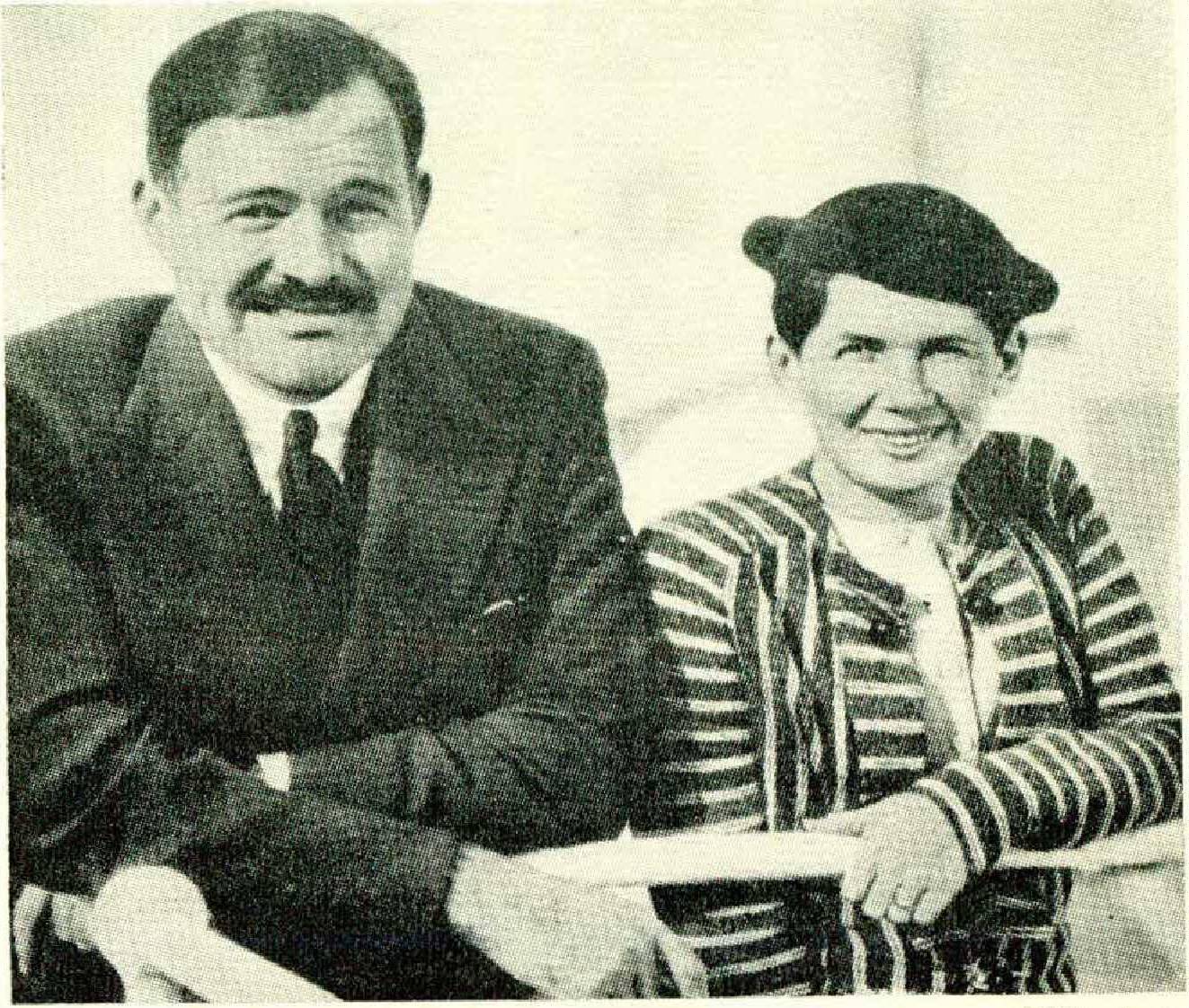
While Ernest and Martha celebrated a quiet Catalonian Christmas, Pauline reached Paris alone and unannounced in a last-ditch attempt to save her marriage. She had even let her hair grow in a long bob like Martha’s, although she. told Jay Allen that her purpose in coming to France was to understand the causes of the war and to see why it meant so much to men like her husband. She asked Allen to intercede with the American Consul General to get her a visa for Spain. But Ernest was back in Paris before the visa was ready. He consulted the physician Robert Wallich for a severe liver complaint. Wallich put him on a regimen of Chophytol and Drainochol and forbade all further drinking. While they waited to embark for New York. Ernest and Pauline stayed on the top floor of the Hôtel Elysée Park at the Rond Point des Champs Elysées. Bill Bird paid a call on them, meeting Pauline for the first and last time. The atmosphere was gloomy. Bill heard afterward that they were quarreling bitterly over Martha, and that Pauline had threatened to jump off the balcony of their room.
They sailed for New York aboard the Gripsholm on January 12. It was a far cry from the pleasant voyage they had made aboard the same ship out of Africa four years earlier. Gales harassed them all the way across, and the seas were still running high when Ernest went to Miami to bring the Pilar down to Key West. He was full of multiple angers, complaints, and self-pity. His upset liver contributed heavily to his bilious view of the world. His rejection of Pauline in favor of Martha stirred up the remorse that had remained quiescent ever since his rejection of Hadley in favor of Pauline. Without being precisely beside himself, he continued to be petulant, quarrelsome, and almost pathologically suspicious all through the early months of 1938.
In this condition of mind and body, everything was an irritant. Advance publicity from the new Ken magazine had named him as one of the editors. He sent Arnold Gingrich a statement to be printed in the first number: “Ernest Hemingway has been in Spain since Ken was first projected. Although announced as an editor, he has taken no part in the editing of the magazine or in the formation of its policies. If he sees eye to eye with us on Ken we would like to have him as an editor. If not he will remain as a contributor until he is fired or quits.” Smart and Gingrich accepted the retraction, and Ernest composed a 1600-word piece called “The Time Now, the Place Spain,” which he airmailed to Gingrich on March 2. It was a very strong statement, as he aggressively told Gingrich, and there was plenty more where it had come from. The point was that if the United States would reverse its neutrality and sell the Loyalists the war materials they needed. Fascism could be beaten on Spanish soil. Otherwise, and in the very near future, the United States would have to face far tougher people than the legions of Mussolini or the forces of General Franco.
Ernest was fighting a battle of his own between the urge to return to Spain and a determination, almost equally strong, to stay on in Key West to write some stories about his recent experiences in and around Madrid. It did not help his state of mind that the stories would not come. When Patrick and Gigi caught the measles, the household was disturbed and his surliness increased. He scolded Perkins for having failed to advertise To Plate and Plane Not, and when he read somewhere that Scribner’s had given a tea party for Max Eastman, he filled a page with angry mutterings about what he would do to Eastman if he ever caught him alone. When Perkins gently remarked that Tom Wolfe had recently been behaving like a manic depressive. Ernest answered that Wolfe was an enormous baby, adding that it must be very difficult to be a genius. Even Scott Fitzgerald’s praise could not sweeten his rancor. Scott had described him, said Perkins, as the most dynamic personality in the world. Or was it only the United States? Max could not remember the geography of the compliment. Once more Ernest exploded irritably. He had never wanted to be dynamic. All he ever wanted to be was a writer, and by Jesus Christ that was what he was going to be.
WHAT I have to do now is write,” declared Ernest. “As long as there is a war you always think perhaps you will be killed so you have nothing to worry about. But now I am not killed so I have to work. . . . Living is much more difficult and complicated than dying and it is just as hard as ever to write. ... In stories about the war I try to show all the different sides of it, taking it slowly and honestly and examining it from many ways. So never think one story represents my viewpoint because it is much too complicated for that. We know war is bad. Yet sometimes it is necessary to fight. But still war is bad and any man who says it is not is a liar. But it is very complicated and difficult to write about truly.... In the war in Italy when I was a boy I had much fear. In Spain I had no fear after a couple of weeks and was very happy. Yet for me not to understand fear in others or deny its existence would be bad writing. It is just that now I understand the whole thing better. The only thing about a war, once it has started, is to win it—and that is what we did not do. The hell with war for a while, I want to write.”
Apart from his dispatches on the chauffeurs of Madrid and the old man at the Amposta bridge, the first result of Ernest’s war experience was a series of short stories. He was still in Paris in midNovember when “The Denunciation” appeared in Esquire. It told of a waiter in Chicote’s Bar who recognized a customer as a Rebel spy and turned him in with a telephone call to the secret police. Gingrich was also enthusiastic about a second story, “The Butterfly and the Tank,” which was based, like the first, on an actual incident from the fall of 1937. Ernest had already summarized it briefly in The Fifth Column. A drunken citizen named Pedro took to squirting waiters in Chicote’s with a flit gun of eau de cologne. Disgusted soldiers first beat and then shot him to death. When Steinbeck read it in the December number of Esquire, it struck him as “one of a very few finest stories in all time.” To have seen it as a story was in itself a great thing, he wrote to Ernest. But to have written it so superbly was “almost too much.”
The February number of Esquire contained his “Night Before Battle,” which he had sent to Gingrich from Paris in October. He composed a free-verse poem, “On the American Dead in Spain,” for publication in the New Masses, donating the typescript of the poem and the manuscript of The Spanish Earth to be auctioned off for the rehabilitation fund of the Abraham Lincoln Brigade. He was already planning a new book of short fiction for the fall of 1939. Besides collecting the recent war stories from Esquire and Cosmopolitan, he wanted to write three more very long ones. Two would deal with Spain and the other with an old Cuban fisherman. The first, to be called “Fatigue,” would try to recapture the battle of Teruel; the second would describe the storming of a pass in the Sierra de Guadarrama by a detachment of Polish Lancers. The third and most ambitious had been in his mind for several years. He had already outlined it in “On the Blue Water, published in Esquire in April, 1936. It would tell of an aged commercial fisherman out of Casablanca on the eastward side of Havana Harbor. All alone in his skiff for four days and four nights he had fought a huge marlin, only to lose it to a pack of sharks because it was too big to get into his boat. The story would say everything that the old man did and thought during his long and lonely battle. Properly told, it could be “great,” thought Ernest, and its presence in the new volume would “make” the book. He said that on his next trip to Cuba he hoped to go out in a skiff with old Carlos Gutiérrez to make sure that all his details were authentic.
His visit to Cuba was not long postponed. Beginning on February 14 he went there for a month. Each day he worked from eight to two, then played tennis, swam, or fished. He did not write any of the new stories he had proposed to Perkins. Instead he finished another called “Under the Ridge.” The scene was a bleak hilltop in the Jarama sector where the 12th International Brigade had just made an abortive attack. The force of the tale came from the anger of a man from Badajoz, who resented the murderous disciplinary measures of the battle police, a pair of cold-faced Russians in black leather jackets.
But the major achievement of his Cuban visit was to make a start on his novel of the Spanish Civil War. It was a task so ambitious, as he told Perkins, that he had not expected even to attempt it for a long time. In Paris at the end of October he had mentioned having finished two chapters of a novel. But he personally counted March 1, 1939, as the real beginning. By the end of three weeks, it had grown to 15,000 words. He thought it twenty times better than “Night Before Battle,” and his excitement rose as he became more deeply involved. Already he was beginning to get that old familiar feeling of being emptied out each day, yet ready to return to his task with renewed energy every morning.
HE RETURNED to Key West in the middle of March, largely to see Bumby, who was on spring vacation from school. The only trouble was that the Key West social season was then at its height. Pauline had made many new friends during Ernest’s absence in Spain and France, and showed little disposition to shoo them away so that he could get on with his work. The Ben Gallaghers arrived from Paris, and Jinny Pfeiffer came down to drink and argue with Pauline and Ernest. Shipwreck Kelly appeared, eager to talk about a movie based on “The Short Happy Life of Francis Macomber.” The new road down the Keys, as Ernest complained, was like a tacit invitation to “every son of a bitch who had ever read a line” of Hemingway to come and be entertained. The small house where Ernest worked beside the swimming pool was constantly assailed with the sound of voices. When Tom Shevlin and Hugo Rutherfurd invited him to fish in a tuna tournament, Ernest bowed out. He was seething to get back to Cuba and his novel. Now, he knew, was the time of his career when he had to write “a real one.”
On April 10 he crossed to Havana to resume his former life of writing, drinking, fishing, swimming, and tennis playing, though this time with the difference that he was presently joined by Martha Gellhorn. It was her first trip to Cuba, and she came prepared to stay. Ernest had agreed to look for a house. But when she found him in the Ambos Mundos bar, although he seemed genuinely happy to see her, he had done nothing in the way of house-hunting. Martha soon located an old estate called Finca Vigía in the village of San Francisco de Paula some fifteen miles from downtown Havana. It was owned by a family named Dorn and occupied a hilltop with distant views of the sea and the city. It had fallen into disrepair, smelled of drains, and could be rented entire for a hundred a month. When Ernest went out with Martha to see it, he was immediately scornful. It was too far gone, too far from Havana, and too expensive. He turned on his heel and departed to go fishing. But Martha was persuaded that the house had possibilities. During his absence, and at her own expense, she hired artisans and servants to make the place cheerful and homelike. When he returned, she showed him the results. He liked it so well that he promptly moved in.
For the sake of appearances, he continued to use the Ambos Mundos as his mailing address. But by early May he had begun to mention to Perkins a “joint on the top of a hill ” where there was always a breeze. His novel was progressing at the rate of 700 to 1000 words a day. He said that he was so happy with his work that it was sometimes seven thirty in the evening before he remembered to drink his usual three scotches before dinner. He was now predicting that the book would be done by late July or early August. Beside that possibility, everything else seemed far away and completely unimportant.
Except for weekend fishing trips whenever he felt stale, he stuck steadily to his task. He had been in Cuba for a month when a polio epidemic broke out in Key West. He wired Perkins to send $500 to J. B. Sullivan, who promptly used it to ship Patrick and Gregory out of the danger zone. They would stay in New York through june and then spend July and August at a camp in Connecticut. As soon as the novel was finished, Ernest would take them away to Wyoming.
But the novel kept on expanding. When the manuscript reached 76,000 words and a logical stopping place in mid-August, Ernest decided to go west anyway. Pauline was abroad with Paul and Brenda Willerts. Ernest wrote Hadley that he had approved the trip. Pauline might as well have a good final fling before the lights began going out again all over Europe. For himself, Wyoming would do. He asked Otto Bruce to pick up the boys when their camp closed and to bring them by train to join him and Bumby at the Nordquist ranch. On the twenty-seventh he dropped Martha in St. Louis to stay with her mother and drove on alone from there.
Hadley had lately been much in his mind. At the time of his fortieth birthday in July, he had written her twice, signing the letters with his old nicknames of Tatie and Edward Everett Waxen. The more he saw of women, said he, the more he admired her. If heaven was something that people enjoyed on earth rather than after death, then he and she had known a good slice of theirs in the Black forest and at Cortina and Pamplona in 1922—1923. Hadley was on vacation with her husband, Paul Mowrer, at a ranch near Cody. When they returned from a fishing trip, they found another car parked near theirs. It was Ernest listening to the radio while he waited for them to come back. He had not seen either of them for ten years. The meeting was quiet and cordial, centering chiefly on Bumby, who had already gone ahead to the Nordquist ranch to wait for his father’s arrival. Once again Ernest was persuaded that Hadley’s future was in the best possible hands.
His arrival at the L-Bar-T precisely coincided with the outbreak of the war in Europe. He stayed up most of the night listening to the newscasts on his portable radio. The war was hardly a surprise. He had been predicting it regularly in public and private for the past six years. But he felt about it just as he had felt about the onset of the Spanish Cavil War in the summer of 1936. At that time, too, he had had a novel in progress, and had resolved to finish it before he thought of visiting the scene of the conflict. Now the pattern repeated itself. Although his letters of early September hinted at the commitments that the war might eventually bring, he was quite ready to gather his sons around him and bide his time. Europe, as he said, would be at war for many years to come.
He had scarcely settled in at the ranch when Pauline telephoned from New York. She had come back from Europe on the last day of August and was flying out to join him. But she arrived with such a bad cold that she was obliged to go to bed. Ernest later said that he cooked her meals and did his best to take care of her, though the cold weather and primitive living conditions made nursing so difficult that she got worse instead of better. Moreover, as he complained, he was very lonely at the ranch, with “nothing to do” when he had finished his work for the day. Whatever his excuses, he was at last determined to complete the break with his second wife. After what he regarded as a suitable interval he packed up his car, summoned Martha to meet him, and drove yet farther west to a new establishment called Sun Valley among the Sawtooth Mountains of central Idaho. Ernest washed the dirt from his throat in the ultramodern bar at Sun Valley Lodge and moved with Martha into Suite 206, among the most luxurious of the twelve-dozen rooms at the lodge.
Next morning, he had breakfast with two young Midwesterners who ran publicity for Sun Valley. Gene Van Guilder was a handsome and talented man in his middle thirties, a great rider and hunter who wore his Western clothes with dash and style and spoke enthusiastically of painting and writing. His companion, Lloyd Arnold, was the chief photographer. They found Ernest friendly enough, but also wary and suspicious, as if fearful of being exploited for publicity purposes, as if he could not yet make up his mind what manner of men they really were. He was far more at ease with Taylor Williams, the chief guide at Sun Valley, a lean and caustic Kentuckian who was variously known as Beartracks or the Colonel.
His first suspicions vanished when he explored the country under the guidance of his new friends. His love of wing shooting and his appetite for game birds literally knew no bounds, and he settled happily into a rough pattern of work in the morning and play in the afternoon. By the end of October he had brought his novel to the middle of Chapter 18. He wrote Perkins that his story contained what people with Communist Party obligations could never write, what most of them could never know or — it they knew allow themselves to believe. So far, said he, there were two wonderful women in the book. The locale was a Loyalist guerrilla camp in the Sierra de Guadarrama range northwest of Madrid. He was just now beginning to work on a flashback with scenes at Gaylord’s, the Russian headquarters near the Prado, where he had talked so often with Koltsov, the Izvestia correspondent. Koltsov was already in the book, thinly disguised as Karkov. So were Valentín González, called El Gampesino, ex-sergeant in the Spanish Foreign Legion; Enrique Lister, the Galician stonemason turned soldier; Juan Modesto from Andalucía; and Kleber, Lucasz, Hans Kahle, and Gustavo Durán — all the general officers Ernest had known that spring of 1937.
Martha set off to cover the war in Finland for Collier’s magazine. Ernest made no serious attempt to oppose her plans, though he soon began to refer dramatically to the dark depths of his loneliness without her. After she left, he renamed Suite 206 “Hemingstein’s Mixed Vicing and Dicing Establishment,” and made it an evening haven for crap and poker games. One day he tried killing coyotes with a shotgun from a low-flying Piper Cub. Every fair afternoon he went hunting for pheasants, ducks, and jacksnipe with the novelist Christopher La Large and a Philadelphia lawyer named Sturgis Ingersoll.
In spite of his friendships he often spoke of being “stinko deadly lonely” in Martha’s absence. It was like living in limbo, said he, with the additional problem of having to write good prose. Both Hadley and Clara Spiegel asked him to Chicago for Christmas, but he declined on the ground that he was in the midst of the most exciting part of his novel. When he invited himself to Key West to spend Christmas with his sons, Pauline advised him that if he expected to come home only to leave after Christmas to rejoin Martha in Cuba, he had better not come at all. Ernest immediately complained to Hadley that Pauline’s conduct was atrocious and unbearable. But if people thought only of themselves, he felt, this was all that could be expected. When Otto Bruce arrived to drive Ernest to Florida, he reported that Pauline was still determined not to see her husband again. She was leaving for New York with Patrick and Gregory to spend the holidays with her sister Jinny.
A week later Ernest and Otto were back in Key West. As Pauline had promised, she and the children were gone and the house was empty. On the day after Christmas a man in Phoenix, Arizona, wired Ernest’s publishers to ask for his current address. Next day Scribner’s telegraphed a reply: “HEMINGWAYS ADDRESS KEY WEST FLORIDA.” But it was not. From that date onward his address was Finca Vigía, San Francisco de Paula, Cuba.
WHEN Martha returned from Finland in the middle of January, 1940, she found that “the Pig,” as she fondly called Ernest, was working wonderfully. She had been home only a few days when he completed Chapter 23. As advance evidence of the quality of the book, he sent Perkins two samples—the opening paragraphs of the first chapter and Pilar’s story of the massacre of the Fascists in Pablo’s Ronda-like native village. A spell of cold weather drove him back to his old habit of writing in bed to keep warm. In this manner he completed Chapter 24, though he said that it was unlucky for verisimilitude to be shivering while trying to write about a hot morning in June, 1937.
He had planned a far shorter book than this one was turning out to be. By the end of Chapter 28 he complained of feeling restive after so many months of solid work. Yet he knew that he must not become panicky and try for greater speed. He told Perkins that if he chose to write as sloppily as Sinclair Lewis, he could do 5000 words a day year in and year out. His own practice was the opposite: constant daily control to avoid the necessity of complete rewriting when he was done. His work, as he explained to Charles Scribner, was a disease, a vice, and an obsession. To be happy, he had to write, which made it a disease. He also enjoyed it, which turned the disease into a vice. Since he wished to write better than anyone else had ever done, the vice quickly became an obsession.
In order to reassure himself of the quality of what he was doing, he kept showing parts of the novel to a variety of close friends—Joris Ivens, Esther Chambers, Christopher La Farge, Otto Bruce, and of course Max Perkins. They all responded so ecstatically that he decided to risk a reading by Ben Finney, whom he revered as a veteran of the Marine Corps and fearless bobsled pilot. Finney read through all that Ernest had written in a marathon bout that lasted from four one afternoon to four the next morning. He tried to make Ernest admit that he had personally experienced the action described in the novel. “Hell, no,” said Ernest, vastly pleased. “I made it up.” Despite such assurances, he still had moments of doubt. Pauline now hated him so much, he said, that she had refused to look at the book. This was a damned shame because she had the best literary judgment of any of them.
But the novel was still far from finished. At the end of the first week in April he completed Chapter 32, the twelfth that he had done since his return from Sun Valley. One of these was the superb account of El Sordo’s last stand on the hilltop. Another was Maria’s harrowing story of having been raped by Fascist soldiers. Chapter 32 was a cynical interlude at Gaylord’s Hotel in which Ernest could hardly contain his anger at both the warring sides. For all his Loyalist sympathies, he had never been able to swallow the program of propaganda which had elevated Dolores Ibarruri peasant woman from the Basque provinces, into La Pasionaria (“ The Passion Flower”), a kind of leftist saint. “Dolores always made me vomit always,” he emphatically told his friends. He took pleasure in painting a travesty portrait of the First Lady of Republican Spain, allowing his nausea to spill over into Robert Jordan’s bilious reflections on other “flowers of Spanish chivalry” from Cortes to the present day. “There is no finer and no worse people in the world,” Jordan had said.
Many of his friends appeared in the book, sometimes under their actual names, sometimes in thin disguises. He had lately been corresponding with Gustavo Durán, the Loyalist commander who had fled to London in 1939. Durán appeared by name, as did Petra, Ernest’s chambermaid at the Hotel Florida. General Lucasz of the 12th International Brigade was described with loving precision. So was the Polish general Karol Swierczewski, known to his troops as General Walter, and in the novel as General Golz. Koltsov the journalist stalked through Gaylord’s under his fictional name of Karkov. María, the heroine, bore the name of the nurse whom Ernest had met at Mataro in the spring of 1938, although her physical characteristics, including the blond hair “like a wheatfield in the wind,” were evidently designed as a secret tribute to Martha Gellhorn. Robert Jordan, the professor from Montana, owed at least something to the courageous figure of Major Robert Merriman of the 15th International Brigade, the onetime professor of economics from California. Like most of Ernest’s heroes, however, Jordan shared many of the personal characteristics and opinions of his creator. Jordan’s parents were clearly modeled on Dr. and Mrs. Hemingway. The elder Jordan had shot himself to death with a Smith and Wesson Civil War pistol. His son was made to reflect on his father’s cowardice (“the worst luck any man could have”) and his mother’s aggressiveness (“because if he wasn’t a coward he would have stood up to that woman and not let her bully him”). Ernest even gave Jordan one of his own most prominent traits — a “red, black, killing anger” that spread scorn and contempt as widely and unjustly as a forest fire spreads ruin, only to die away and leave his mind as quiet and emptycalm as a man might be after “sexual intercourse with a woman he does not love.”
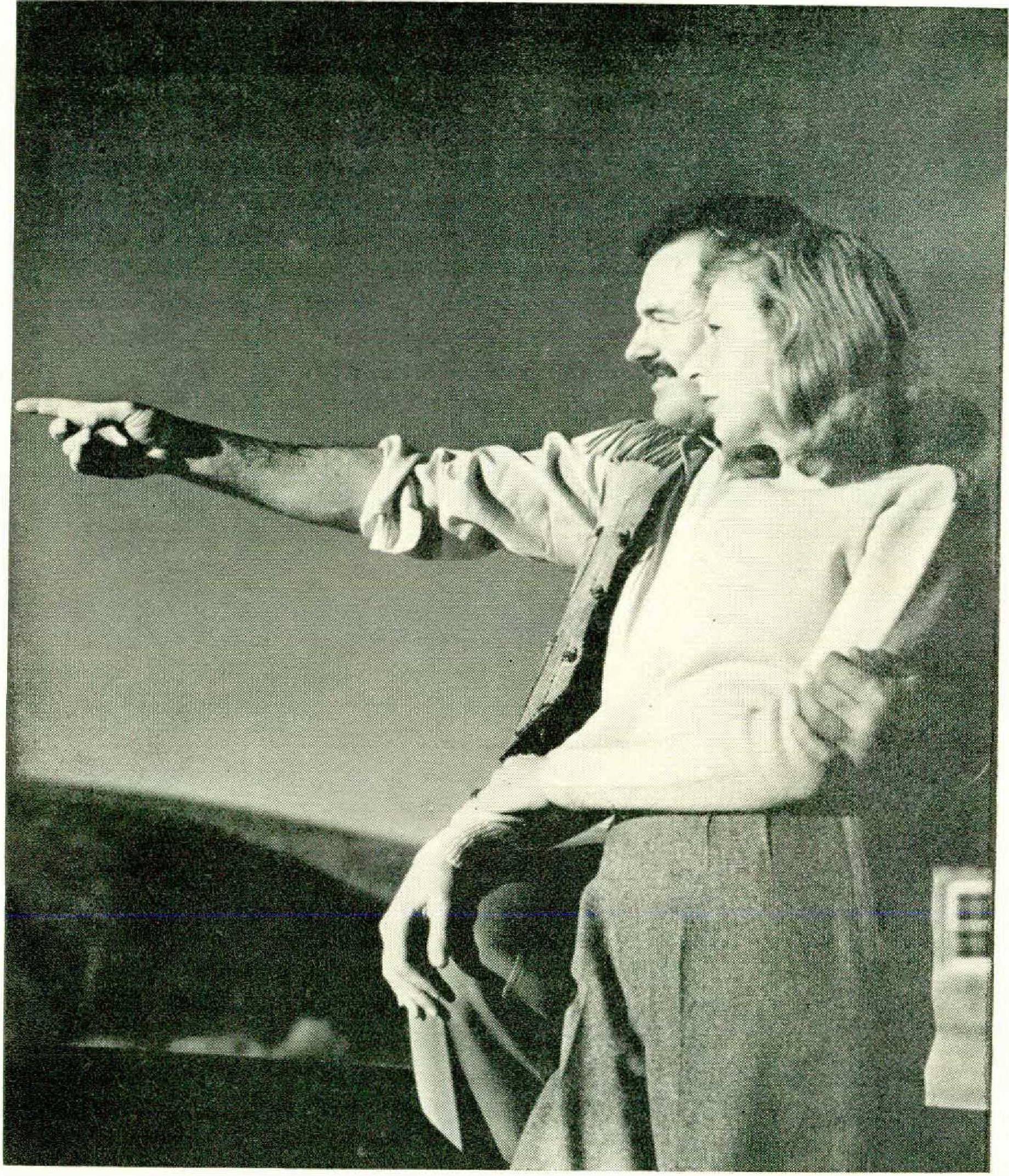
Throughout the rest of April and May, Ernest complained to Perkins that Pauline was trying to put him “out of business.” She did not like to face the fact that he was writing a hell of a good book while living with someone else. She had been “shelling” him “plenty, plenty.” He had tried growing armor plate to no avail. It had become a point of pride with him to write so well now that any book he ever wrote in Pauline’s company would seem slight by comparison. In parting from her he had agreed to pay $500 a month for the support of Patrick and Gregory, but he told Perkins that in case he died these payments were to stop immediately. His mother wrote to say that she had heard he was doing a novel and hoped that for once it might contain “something constructive.” Ernest answered coldly. Who could say? Perhaps the book might indeed turn out as she wished.
By Memorial Day Ernest believed that the end of his novel had come into view, though still far off—like a heavenly city. As if to signalize this apocalyptic moment, the living-room ceiling fell down, covering everything with plaster dust, which the leaking rains soon converted to a hard white coating. When Patrick and Bumby arrived for a short visit, the living room looked to Martha like a wading pool. This was a blow to her sense of neatness, but she was even more upset by the noises from the American mainland, including false political speechmaking, the threat of increased taxation, and the constant waste of federal funds. Twice a day she fell into “paroxysms of rage” over the state of the nation and the world. She would have liked to go to Europe to see if anything could be done, and her itch at least to get away from the isolation of the Finca was becoming intolerable. When Ernest, preoccupied with his own work, became profanely critical of her social interests, Martha picked up and left to spend a month in New York.
When she returned late in June, bringing her mother for a visit, Ernest assured her that he was nearly done. He had sworn not to have a haircut until the novel was finished, and his appearance was notably unkempt. He had found the blowing of the bridge almost unbearably exciting. After it was over he felt, as he said, nearly as limp and dead as if he had been there himself. He professed to be reluctant to kill his hero after having lived steadily in his company for seventeen months. On July 1, however, he decided that the end was near, and sent Perkins a cable: “BRIDGE ALL BLOWN AM ENDING LAST CHAPTER.” It was time at last for a visit to his barber in Havana.
He was padding down the sidewalk in the old city when he caught sight of Joe North and a man named Douglas Jacobs, whom he had first met at Jay Allen’s. He let out a whoop and seized North in a bear hug. He said that he was eager to tell Joe all about the new novel before Joe read it and got angry at it. They arranged to meet for lunch at the Floridita, Despite the profound differences of political opinion between North and Hemingway, the lunch went so well that they were still deep in talk at four o’clock. Suddenly the door of the bar swung open and Martha stalked in. “She was obviously in a rage,” said Jacobs, “and made little effort to hide it.” Ernest had promised to meet her and her mother at two. He mumbled an apology, which Martha shrugged off. “You can stand me up,”she cried, “but you can’t do that to my mother.”Ernest paid the bill, excused himself, and sheepishly followed her out.
In spite, of his ceremonial haircut, the forty-third and final chapter continued to give him trouble. By July 13, Jordan was lying prone beneath a tree, watching the approach of the Fascist Lieutenant Berrendo. The book could obviously end there, yet Ernest was still vaguely dissatisfied. He spent the final week before his forty-first birthday in composing a kind of epilogue, two short chapters designed to knit up every dangling thread as neatly as possible. One part told of a meeting between Karkov and General Golz after the failure of the Segovia offensive, and of their driving together back to Madrid, discussing Jordan’s blowing of the bridge and his subsequent disappearance. The short final chapter described Andres and his visit to the abandoned camp of Pablo and Pilar, where he stood for a moment gazing at the wrecked bridge in the gorge below. It was evidently necessary for Ernest to write these anticlimactic sections in order to find out that they were neither necessary nor desirable.
He waited anxiously until the manuscript was typed and then carried it to New York. A late July heat wave covered the whole Eastern seaboard. and the train was like an oven. In the poor light of the parlor car he worked over the typescript until his eyes gave out, and staggered out at Pennsylvania Station feeling like “a blind sardine in a processing factory.” His room at the Hotel Barclay was only a few blocks from Scribner’s, and he began to deliver the book piecemeal by runner boy at the rate of 200 pages a day. Galling at his hotel a few days later, Bob Van Gelder of the New York Times Book Review found him wearing an unbuttoned pajama jacket and surrounded by a lively company. One of his companions was the exiled Loyalist commander, Gustavo Durán, who had recently married an American girl named Bonte Crompton and moved to the United States. Durán listened politely to the talk between Hemingway and Van Gelder, and Ernest occasionally paused to translate for his benefit. When Duran left the room to make a phone call. Ernest explained in a whisper that he had often longed to get information from him while he was writing his novel. But Duran had now assured him that the story as written was perfectly sound. When Duran left for his bride’s summer home in New Hampshire, Ernest asked him to read the galley proofs to make sure that the Spanish was correct. Ernest observed modestly that he himself was obviously unqualified to do a book on Spain, the Spaniards, the movement, or the war, and was moreover acutely embarrassed to ask Durán, a native Spaniard who was also his “God damn hero,” to read what he had written. Durán complied, partly out of curiosity. He was not much impressed by the quality of Ernest’s Spanish. But with some reservations, he thought the book surprisingly effective.
On August 26 Ernest airmailed from Havana the first 123 galleys of his book. He had been uncommonly docile about revising to meet the objections of Perkins and Scribner, and had carefully rewritten a passage of onanism to make one of the love scenes less offensive. But he argued back vigorously against their view that Pilar’s disquisition on “the smell of death to come” was not in good taste. It was harsh all right, said he, but to delete it would be like removing the bass viol or the oboe from his symphony orchestra merely because they sounded ugly when played alone. The passage was meant to be horrifying, but not gratuitously obscene: he had needed to get across the earthy vulgarity of the gypsies he had known in Madrid. They were a very strange people. He had not wanted to “pretty them up” any more than he had done with the Michigan Indians in the Nick Adams stories.
Finally, and most important, he had decided to remove his epilogue. His original motive, he explained, was like a good sailor’s determination to have everything knitted up and stowed away shipshape. But now he saw that the novel really stopped when Jordan lay on the pine-needled floor of the forest just as he had lain sixty-eight hours earlier in the opening sentence of the first chapter.
ERNEST had begun 1940 by asking Perkins for another thousand-dollar advance on his halffinished novel. Perkins complied, with the hope that this would be a big year. With the combined income from the Broadway play, which was now launched and doing well, and the publication of the novel, it was certain that Ernest’s royalties would exceed the $6000 he had earned in 1939. Perkins’ hope was fulfilled late in August when the Book-of-the-Month Club chose the novel for October, and proposed a first printing of 100,000 copies. Scribner’s was planning to match this figure in the regular trade edition. Ernest wrote wryly to Arnold Gingrich, computing what For Whom the Bell Tolls had cost him — the loss of one wife and ol a year and a half out of his life. But he made no attempt to conceal his pride in the novel, which contained no loose writing and was all of a piece, with “every word depending on every other word” straight through the grand total of forty-three chapters. He now planned a vacation in Sun Valley with Martha and his sons, who would assemble from diverse points of the compass during early September. After more than three years of what Martha called “living in contented sin,” she and Ernest were planning to be married as soon as Pauline’s divorce became final.
With the approach of publication day, Perkins kept up a reassuring postal barrage about the book’s probable reception. But Ernest was too nervous to wait for the first shipment of reviews, and telephoned Jay Allen in New York to ask him to read some of them aloud. Jay kept protesting that the phone call was too expensive, but Ernest did not care. His responses were like those of a small boy. “Did he really say that?” he would ask. Or, “That guy is just digging his grave as a critic.” He was pleased with John Chamberlain’s opinion that the novel had “the bracing quality of brandy" and with J. Donald Adams’ conviction that this was “the fullest, the deepest, and the truest” of Hemingway’s novels. Adams found the love scenes between Jordan and Maria the best in American fiction, far beyond those in A Farewell to Arms and infinitely preferable to the “casual couplings” of The Sun Also Rises. Bob Sherwood in the Atlantic called the book “rare and beautiful,” containing “strength and brutality, ” but also “a degree of delicacy,” which proved that “this fine writer, unlike some other fine American writers,” was “capable of self-criticism and self-development, Clifton Fadiman in the New Yorker likewise emphasized the principle of growth: the book expressed and released the adult Hemingway, “whose voice was first heard in the groping To Have and Have Not.” In the Nation, Margaret Marshall said that the bad taste left in the mouths of readers by The Fifth Column was now dissipated, and that Hemingway had set himself a new standard in characterization, dialogue, suspense, and compassion for the human being faced with death. While the novel did not embody “the deeper social meanings of the Spanish Civil War,” it provided “as moving and vivid a story of a group of human beings involved in that war as we are likely to have.”
Like any author with much at stake, Ernest accepted the praise as his just due and was indignant about the adverse comments. But when Donald Friede advised from Hollywood that he was holding out for a figure of $150,000, Ernest cannily urged him to sell the book for $100,000 “plus ten cents a copy for each copy sold including Book of the Month.” Since the Book-of-the-Month organization had now contracted for 200,000 copies, and Scribner’s had printed another 160,000 copies, Ernest stood to gain $136,000 from the film sale alone, apart from royalties on Book-of-the-Month printings and the regular Scribner trade edition. He thought it wise to settle matters with Paramount Pictures during the first flush of victory. There was no telling when a counterattack might come. By the end of October the sale was completed on these terms. It struck Ernest as “bloody wonderful.” In fact, it was, since Friede had secured the highest price ever yet paid for film rights to a book.
News of his final divorce from Pauline reached Ernest over the Associated Press wire from Miami on November 4. The uncontested decree was based on charges of desertion, and Pauline was given custody of her sons. Ernest showed no outward sign of contrition at the end of a marriage which had lasted thirteen years, during which he had produced seven books, acquired the Pilar and the house in Key West, and enjoyed an African safari, frequent visits to Europe, many sporting vacations in Montana and Wyoming, and the freedom to spend two years in warring Spain. In leaving Hadley for Pauline he had suffered remorse for at least three years. Something inside his association with Pauline had finally served to cauterize his conscience. In “The Snows of Kilimanjaro” he had obliquely blamed her for being wealthy. A good deal later he attributed the failure of his second marriage to sexual maladjustment growing out of Pauline’s ardent Catholicism and the fact that she could not safely bear more children. Somewhere among his motivations in giving up Pauline for Martha lay the hope of having a daughter. Pappy Arnold took some handsome prenuptial pictures of Martha and Ernest, sun-bronzed, healthy, and gazing westward into the sunset, and they left Sun Valley on November 20. A justice of the peace performed a quiet civil ceremony next day in the Union Pacific Railroad dining room at Cheyenne. Ernest found it “wonderful to be legal” after four years of association, and proudly drove Martha to New York.
Ernest’s Christmas gift to himself and Martha was the purchase of the Finca Vigía. Fearing that the news of his recent successes with For Whom the Bell Tolls would raise the asking price, he empowered Otto Bruce to conduct negotiations without revealing the buyer’s name. Bruce concluded the arrangements on December 28 at $12,500. To celebrate the event, Ernest went quail shooting in Pinar del Rio Province, romantically returning under starlight to the house he now owned and meant to occupy for the rest of his life.
His pleasure in the new house was marred by the leftist counterattack on his new novel. Although he had expected and predicted it, he was not prepared for the virulence of the assault. Mike Gold used one of his “Change the World” columns in the Daily Worker to assail Hemingway as “limited, narrow . . . mutilated by his class egotism . . . [and] the poverty of his mind.” The novel merely proved, said Gold, that an unprincipled man who understood neither democracy nor Communism was able to join in the Spanish Cavil War for various personal reasons and to maintain an appearance of loyalty for a few years. When the cause seemed lost and democracy defeated, he chose to desert—as Frederic Henry had done in A Farewell to Arms—“leaving a trail of alibis, whines, and slanders.”
Alvah Bessie’s review in the New Masses was both fairer and better informed. As a veteran of the Lincoln Brigade, he had twice seen Ernest in Spain and began his long and thoughtful analysis with a tribute to Ernest’s intimate participation in the struggle. Yet he found the novel very deficient both in depth of understanding and breadth of conception. “He has yet to expand his personality as a novelist,”said Bessie, “to embrace the truths of other people everywhere; he has yet to dive deep into the lives of others, and there to find his own.” But Bessie was also the author of a long open letter to Ernest, dated November 20, and forwarded to the Daily Worker over the signatures of Milt Wolff, national commander of the Veterans of the Abraham Lincoln Brigade, Freddy Keller, New York post commander, and Irv Goff, acting secretary-treasurer. Hemingway had “mutilated" the cause for which so many brave men had fought and died. He had maligned La Pasionaria and slandered André Marty. He had misrepresented the attitude of the Soviet Union toward the Spanish Republic. Worst of all, he had failed to show the relevance of the war in Spain to the world of 1940, where Fascism still ran rampant. In sum, his friends repudiated Ernest’s work as false, distorted, slande rous, and undemocratic.
He was still defending his position the day before Christmas. He had heard from Hans Kahle, former commander of the 15th Brigade and the 45th Division, that For Whom the Bell Tolls was a great and true book. Gustavo Durán, who had participated along with General Walter in the very Loyalist attack on Segovia that appeared in the book, had also praised it. So had Mirko Markovich, commander of the Washington Battalion, and Steve Nelson, the battalion’s political commissar and perhaps the best-liked member of the International Brigades. Such an array looked formidable, Ernest thought. He said that he had once been asked by Andre Malraux when he planned to write about the Spanish Civil War. His answer was that he would wait until he could write truly about that son of a bitch Marty without harming the Loyalist cause. If only Marty were not such a bloody symbol, Ernest believed they would have shot him long ago.
When Milt Wolff made the mistake of writing him a private letter accusing him of having been a mere “rooter for the Loyalists and a part-time “tourist in Spain, Ernest was hurt enough to answer with an angry blast:
Dear Milt: I won’t try to explain how concieted [sic ], confused and stupid your letter was. Will only take up one point. So I was just a rooter in Spain, O.K. Did it ever occur to you that there were 595,000 some troops in the Spanish army beside the 15th Brigade and that the entire action of my book took place and was over before you personally had ever been in the line and before Alvah Bessie had ever left America? While Mike Gold, that other heroic denouncer hasn’t reached Spain yet. I guess he is saving himself for the next movement there. At the time the book deals with you did not know Marx from your ass and neither did Freddy [Keller], I know because I remember the date on which I advised him to do some reading. . . . O.K. scientist given what experience I have and what talents I may possess what would you like me to have done to aid the cause of the Spanish Republic that I did not do? So I was a rooter because I did not command a battalion of the 15th International Brigade. O.K. Scientist. Have it as you want it. But we are not friends anymore after that letter which will doubtless be a relief to you as you can believe any kinds of lies you hear about me now and even work up some special personal denunciations of your own. . . . I have never seen you after you have been wounded. It takes guys different ways. So don’t talk loo snotty about the things you haven’t done yet. And scientist old pal I was in wars, commanded troops, was wounded etc. before you were dry behind the ears. So don’t give me the old soldier talking to the non-combatant. . . . You have your Marty and I’ve married my Marty and we’ll see who does the most for the world in the end. And I’ll keep right on trying to get you out of jail and one thing and another and you’ll keep on denounceing [sic] me every time vou are ordered to. It’s all fine. After your letter I think you are a prick if that makes it any easier for you to knife your friends in the back. . . . Does that make you feel better? Hemingstein.
Ernest’s big year ended solemnly enough with a letter from Max Perkins, who had just returned from Scott Fitzgerald’s funeral. “I thought of telegraphing you.”said Max, “but it didn’t seem as if there were any use in it, and I shrank from doing it. Anyhow, he didn’t suffer at all, that’s one thing. It was a heart attack and his death was instantaneous.” Scott’s final letter to Ernest in November had thanked him for an inscribed copy of For Whom the Bell Tolls, calling it a better novel than anyone else could have done. “I envy you like hell and there is no irony in this,” Scott had said. “I envy you the time it will give you to do what you want.”
The envy was justly directed. At the time of Scott’s death, For Whom the Bell Tolls had sold 189,000 copies.
Next month’s installment begins in the summer of 1948 and takes Hemingway back to Italy, to his home in Cuba, to Africa, and to the triumph of the Nobel Prize.