My Life Is a Crystal Teardrop
An extraordinary daughter here tells about her extraordinary parents and talks about war, protest, pacifism, and human frailty in an excerpt from Daybreak, the journal of Joan Baez.

The book will be published this month by The Dial Press.
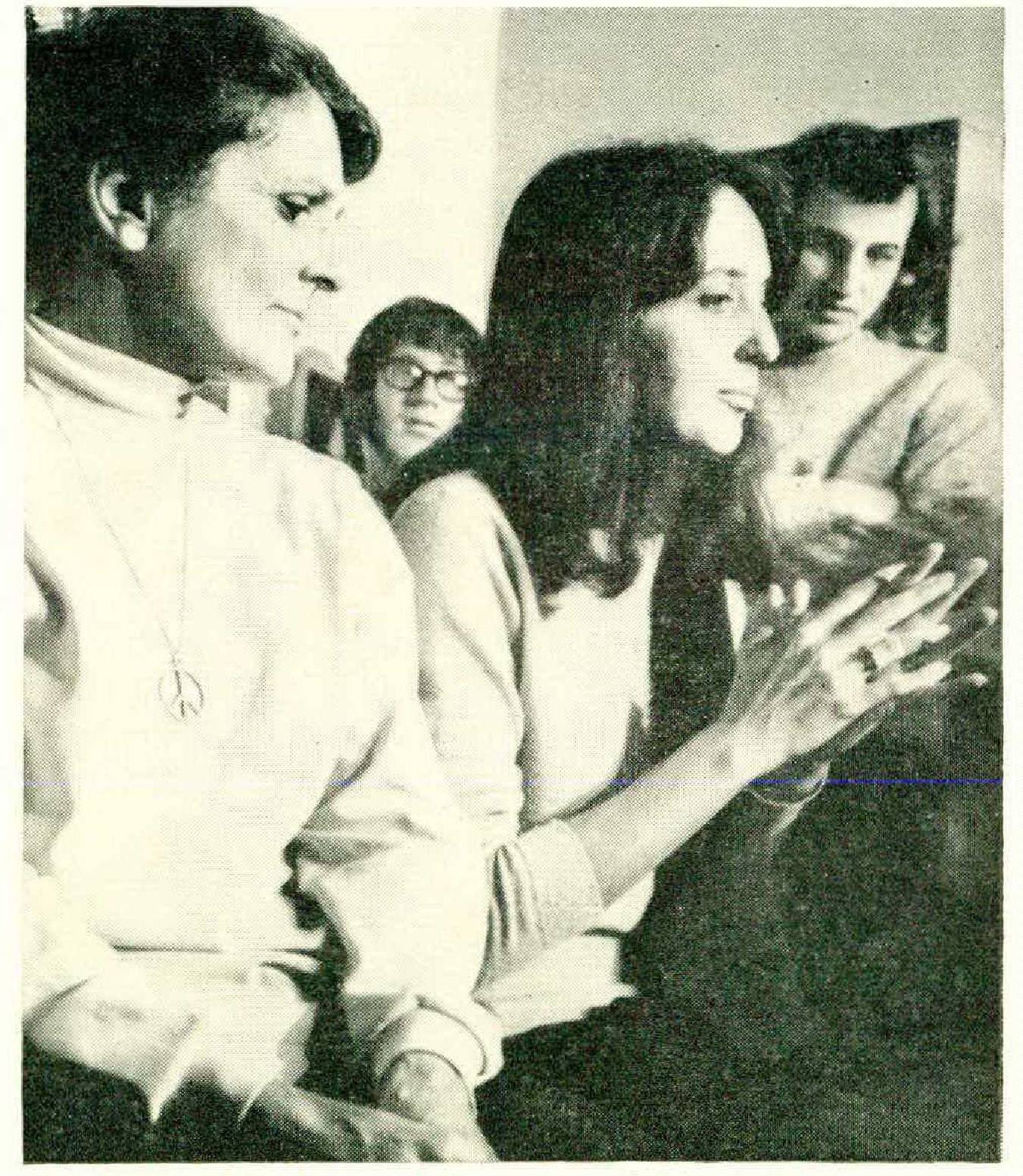
My mother can’t stand anything phony. She refuses to go to teas, prefers young people to older. She works in the garden, making flowers come up out of the dirt. She wears her hair long, down her back when she’s at home, and up in a braided roll when she goes out. Her back is strong, and her hands are gnarly and full of veins. I think she must have worked very hard when she was little to have such hands. Her eyes are huge, frightened, deep, and magnificent; her forehead almost always in a worry design; her mouth too tight and her chin tense. Yet there is an overwhelming strength in her face, and she is one of about five women I can think of who are in her category of beauty. Her figure is excellent. When she runs, on the beach, dressed in blue jeans and a T-shirt, with her hair all down, she looks nineteen. She is fifty-four.
Mother was born in Scotland, and brought to America when she was two. Her mother died when she was three. Her father was a very far out Episcopalian minister who loved the theater, sang offkey from the pulpit, dressed his children out of the missionary barrel, fought a fiery public battle with the DAR, and had a weakness for marrying domineering women. Mother says I would have loved him. I can think of only one picture of him, a portrait showing a weak, thin-nosed, rather nicelooking sad man. There comes to mind now a picture of Mother’s mother, carrying Mother’s sister on her back: She is very pretty, also sad, tilting her head back as though to bump it in a nice way against the baby’s head. Now I think of the picture of Mother which I have hanging in my house. It was taken when she was ten. She is standing on a beach in the wind with the ocean in back of her, her arms outstretched in youthful grace, her dark legs poking out of an oversized black bathing costume, coming a bit together at the knees, the wind blowing her hair across her face, across an exquisite smile. Her head is tilted back, as though butting the wind. She is like a lovely bit of dark heather. She has kept the grace and beauty through unbelievable odds, odds which have given her a power and wisdom which she tries very hard not to acknowledge.
Her first stepmother was classically frigid, and appears dressed in white, smiling very sweetly, in all the old albums. She’s the one who would hand Mother and her sister fifteen cents and say, “Here’s your allowance for this week,” and before they could close their fingers over the coins, she’d say, “And now, because you’ve spilled the ink in the study and made a mess in the john and stolen peanut butter from the big jar, I am taking it away. Maybe you can learn to be good children, and then you will get your allowance.” Money was dirty to touch, Jews were dirty to live near, sex was dirty to think about or have; children were taught by punishment; and in the meantime, dressing everyone in white frocks would tide things over (to her credit she grew up to become a very spunky old lady). She let go her grip long enough to produce a son, a half-brother for Mother and her sister to look after. He grew up to be a right-wing fanatic, made it through medical school to become a urologist on sheer strength of will because his mother told him he was too stupid to pass the exams. I heard he’s an excellent doctor.
“Heavens!” he said, sweeping down from the pulpit and rushing out of the church. He arrived home too late, as Meg had dragged Mother’s older sister around by the hair, beaten and kicked her until she was unrecognizable, and locked her in her room.
Meg’s sadistic energies were centered on the older sister because of her closeness to her father, and Mother was more often than not just ignored.
She declared her independence when she was thirteen. Meg threw a pot of steaming boiled potatoes at her from across the room. Mother ducked the potatoes and went about washing the dishes. Meg came up behind her and slapped her full strength on the side of the face. Mother whirled around and said, “Damn you!” and Meg froze in shock. When she regained her fury she raised her arms to beat Mother, but Mother caught her arms midflight with her own slippery hands, and lowered them to her sides, saying, “Don’t you ever do that again.” Meg fumbled in her defeat, and finally said, “Go outside and fill this up with berries,” handing Mother a pot, and Mother said, “If you want berries, pick them yourself.” From then on Mother kept her coat hanging near the front door, with two nickels in the pocket, one for bus fare, and the other to call a friend.
At some point in her childhood she lived in a sort of gypsy camp for a while, eating potato crusts charcoaled in the fire on sticks. She and her little friends ate them because there wasn’t much food around and no one bothered to feed the children. She found communion wafers delightful, but not very filling. And she was guilty of stealing peanut butter — she would steal it in great globs, knowing that she would eventually be caught and punished. She’s not hungry like that anymore, but she still has a craving for peanut butter.
There was one school she was sent to which she loved. They left her alone there, and she could sit by a brook and not go to class. She was good in drama and wanted to act, but the ghosts of stepmothers, sweetly and regretfully explaining to her that she was inadequate in every way and not very bright, kept her from pursuing anything beyond the first few steps. It was the same with nursing. She loves it, and is brilliant with sick people, but she never got beyond being a nurse’s aide.
She has told me of when she was left in charge of a dying girl. The child had been in an accident and was fatally hurt, and Mother was supposed to mark down the exact time of her death. She watched the little girl struggle, and give, and struggle again, always fading, and always in pain. When her small muscles sank into the hospital bed for the last time, Mother felt very deeply the blessing of that final defeat.
Her father by blindness to his children, and the stepmothers out of jealousy and the etiquette of the times, convinced Mother that she was not pretty. When she and her sister were little, their hair was pulled tightly back and braided, lest anyone should notice that Pauline had soft yellow curls and Mother had shiny handsome brown hair. Still, in every picture I’ve seen of her when she was young, she is nothing less than strikingly beautiful.
In a snapshot taken of her when she was about eighteen she stands sideways to the camera, dressed in satin, with some feathery shawl around her shoulders, her eyes looking into the lens. She is a vamp, a gypsy queen, a mystic, a blueblood. She is all of those things still, and the battle rages inside and outside Mother as to whether she will ever admit to the fact that she is glorious.
My mother’s been to jail with me twice now. We did civil disobedience together at the Oakland induction center. She told me she didn’t know if it would do any good, but that it might give other mothers some courage to do the same, or something just as radical. It did. On our second trip to Santa Rita Prison, there were at least three women in with us who said that Mother had given them the strength to act out their convictions.
Mother really hated it in jail, because it was so easy for her, and so unfair to the regular inmates. The black dope addicts and prostitutes and boosters and pushers called her “Mama.” Whenever they swore in front of her, they said “Scuse me, Mama.” On Christmas Day, one of the three toughest girls in the women’s side of the prison came to Mother’s bed, and said, “Ooooo, Mama. Ah’m down. They doin’ it to me. Ah’m way down. I wanna see mah kids. An I don’t never cry. But I b’lieve I’m gone have to today!” and she folded up in Mother’s arms and shook her head and cried. Mother patted her black angora hairdo and kissed her on the forehead, and said softly but angrily, “Yeah. It’s all pretty rotten, isn’t it. Just plain stinking.”
We were sprung from jail two weeks early. The jailers were afraid of the uproar which might ensue
when we were to say good-bye to our friends, so they didn’t tell us we were going home until a half hour before we left. We sat in the lieutenant’s office and talked to her. Mother had never spent any time with this woman. She asked if she could go back to the building where she had been working and say good-bye to her friends.
“No,” said the lieutenant.
“But I have to say good-bye to Gladys,” said Mother.
“I’m sorry, but I’m afraid you can’t.”
“You’re not sorry,” I said, “and you know we can. If you’ll let us.”
“Are you asking for special privileges, Joan?”
“Sure, if that’s a special privilege. I didn’t notice that it was. Everyone around here gets to say good-bye.”
“I won’t leave until I’ve said good-bye to Gladys and Jean,” said Mother. The lieutenant changed the subject.
“You know, I’ve never had the time to really speak with you, Mrs. Baez. It’s a pity, because you look like an interesting person.”
“Well,” said Mother. “I’m glad I came here. I think I’ve learned a lot. In fact I know I have. Stuff I could never have learned anywhere else.”
The lieutenant brightened. “Really?” she said. “What have you learned?”
“Oh,” said Mother, looking at the lieutenant from under her contraband eye makeup. “I know how to steal now. I think I could steal about anything, if it was necessary. I can smuggle. I can get all sorts of stuff into the cells.”
The lieutenant looked jarred and suspicious. Mother went on. “I never thought I would be able to lie. In fact I’ve never been able to lie, all my life. But now I find that I can look someone right in the eye and tell a bold-faced lie. It’s not so hard if it’s for someone who’s locked up and not being treated well.”
“Are you serious?” said the lieutenant.
“Oh, yes,” said Mother. “It’s marvelous.”
I butted in. “So you’re letting us out of here on good behavior, is that it?”
“To be truthful with you, Joan, it was not my idea to let you go. I would not have recommended you for good time.” She turned to Mother. “You know, Mrs. Baez, I don’t think jail is a good place for your daughter. She has a tendency to, well, kind of fit in awfully fast. I could see her easily beginning to fall into some of the patterns that the regular inmates have formed, and you know, whether we like it or not, we are dealing with two very different classes here.”
“What are you trying to say?” I asked her.
“Well it just doesn’t seem like a good atmosphere for you, some of the habits that —”
“She’s afraid I’m going to turn queer,” I said to Mother with a smile.
“Oh, heavens,” Mother laughed. “My daughter’s been queer for years. Don’t let that bother you. She got it from me.”
We ended our chat right about then, and all the deputies and sergeants began hustling us to get processed and out before the prison grapevine had spread the news that Mama and Joan Junior were being sprung. They kept rushing us, and I kept telling Mother to take her time, that they had no right to rush us. So we ironed our crumpled street clothes, and distributed all our candy and skin lotion and stamps, and the grapevine began to hum, and within fifteen minutes our most beloved and devoted friends made it through two locked doors and past the lieutenant’s office to the ironing room to embrace us and kiss us good-bye, and then to vanish down the starched but internally crumbling hallways of Santa Rita. And Mother hit the damp, chilly morning on the outside with a labeled Santa Rita kitchen apron stuffed under her pea jacket, and fourteen letters tucked into her long winter underwear.
MY FATHER
My father is short, honest, dark, and very handsome. He’s good, he’s a good man. He was born in Mexico, and brought up in Brooklyn. His father was a Mexican who left the Catholic Church to become a Methodist minister. My father worked hard in school. He loved God and the church and his parents. At one time in his life he was going to be a minister, but the hypocrisy of the church bothered him, and he became a scientist instead. He has a vision of how science can play the major role in saving the world. This vision puts a light into His eyes. He is a compulsive worker, and I know that he will never stop his work long enough to have a look at some of the things in his life which are blind and tragic. But it’s not my business to print. About me and my father I don’t know. I keep thinking of how hard it was for him to say anything nice about me to my face. Maybe he favored me and felt guilty about it, but he couldn’t say anything nice. A lot of times I thought he would break my heart. Once he complimented me for something I was wearing. “You ought to wear that kind of thing more often,” he said, and I looked into the mirror and I was wearing a black dress which I hated. I was fourteen then, and I remember thinking, Hah, I remind him of his mother in this thing.
My father is the saint of the family. You work at something until you exhaust yourself so that you can be good at it, and with it you try to improve the lot of the sad ones, the hungry ones, the sick ones. You raise your children trying to teach them decency and respect for human life. Once when I was about thirteen he asked me if I would accept a large sum of money for the death of a man who was going to die anyway. I didn’t quite understand. If I was off the hook, and just standing by, and then the man was killed by someone else, why shouldn’t I take a couple of million? I told him sure, I’d take the money, and he laughed his head off. “That’s immoral,” he said. I didn’t know what immoral meant, but I knew something was definitely wrong taking money for a man’s life.
My father teaches physics. He is a Ph.D. in physics, and we all wish he’d had just one son who wasn’t so opposed to school, to degrees, to formal education of any kind, one child to show some interest when he does physics experiments at the dinner table. But then it must be partly because we felt obligated to be student-types that we have all rebelled so completely. I can barely read. That is to say, I would rather do a thousand things before sitting down to read. He used to tell us we should read the dictionary. He said it was fun and very educational. I’ve never gotten into it.
When we lived in Clarence Center, New York (it was a town of eight hundred people, and as far as they knew, we were niggers; Mother says that someone yelled out the window to me, “Hey, nigger!” and I said, “You ought to see me in the summertime!”), my father had a job working in Buffalo. It was some kind of armaments work. I just knew that it was secret, or part of it was secret, and that we began to get new things like a vacuum cleaner, a refrigerator, a fancy coffeepot, and one day my father came home with a little Crosley car. We were so excited about it that we drove it all over the front lawn, around the trees and through the piles of leaves. He was driving, Mother was in the front seat, and we three kids were in the back. The neighbors knew we were odd to begin with, but this confirmed it. Mother was embarrassed, and she kept clutching my father’s arm and saying, “Oh, Abo!” but he would take a quick corner around a tree and we’d all scream with laughter, and Mother gave up and had hysterics.
Then something started my father going to Quaker meetings. We all had to go. It meant we had to sit and squelch giggles for about twenty minutes, and then go off with some kind old lady who planted each of us a bean in a tin can, and told us it was a miracle that it would push its little head up above the damp earth and grow into a plant. We knew it was a miracle, and we knew she was kind, but we made terrible fun ol her the entire time and felt guilty about it afterward.
While we were in the side room with the kind old lady, watching our beans perform miracles, my father was in the grown-up room, the room where they observe silence for a whole hour, and he was having a fight with his conscience. It took him less than a year of those confrontations with himself in that once-a-week silence to realize that he would have to give up either the silences or his job. Next thing I knew we were packing up and moving across the country. My father had taken a job as a professor of physics at the University of Redlands for about one half the pay and one tenth the prestige — against the advice of everyone he knew except my mother. Since leaving Buffalo in 1947, he’s never accepted a job that had anything to do with armaments, offense, defense, or whatever they prefer to call it. Last night I had a dream about him. I dreamed he was sitting next to himself in a theater. One of him was as he is now, and the other was the man of thirty years ago. I kept trying to get him to look at himself and say hello. Both faces smiled very understanding, but neither would turn to greet the other.
I don’t think he’s ever understood me very well. He’s never understood my compulsiveness, my brashness, my neuroses, my fears, my antinationalism (though he’s changing on that), my sex habits, my loose way of handling money. I think often I startle him, and many times I please him. Sometimes I have put him through hell, like when I decided to live with Michael when I was twenty.
“You mean you’re going to . . . live with him?”
“Yes,” I said, and my father took a sleeping bag and went to the beach for two days, because Michael was staying in the house. Years later he sent me an article by Bertrand Russell, whom he respects very much, underlining the part which said that if young people could have a chance at “experimental marriages” while they were in college, they might know more about what it’s all about before they actually got married. My father wrote that it always amazed him how I came to conclusions intuitively which took him years to realize.
THE WATER LEAVES
My sister Mimi and I were hanging around the Club 47 coffeehouse in Harvard Square. We were on the way home from Newport, ‘67. We were seeking old friends from eight years before, but also new faces, lots of new faces lined up in the warm New England evening. They let a blind girl in so she could find a seat. I watched the ticket lady hold her hand out timidly to return the change, not wanting to bump the blind girl’s hand. When her things were in order the blind girl took the change and began calculating where she would sit, tapping a radar route around the tables and chairs. I went up to her and helped her find a seat.
“This is sort of comfy,” I said, showing her the chair. “You’re at the back, but on the aisle.”
“Thank you very much,” she said, sitting down and folding up her funny collapsible metal cane. Then she faced me, and said, “Excuse me, but your voice sounds vaguely familiar . . .”
I told her my name, and she let out a squeal.
“I’m Paula. Remember me? From Perkins? That was eight years ago! Gee, it’s good to see you!”
I sat down with her, and we chatted. She asked about Mimi, and I called Mimi over. Paula grabbed her cane and purse and jumped up to hug her. Of course, I thought, I had heard stories about the devoted blind kids who had showed up at 47 every time Mimi and Dick were on the bill. Paula fell into an enraptured chat with Mimi, who sat with her head tilted, watching the funny blind girl’s face.
“We went to the Winter Festival. It was terrible,” she was telling Mimi. “We were in a snowstorm, and my eyes were freezing. I thought I would die!”
“Your eyes were freezing?”
“Oh,” she said, dropping her head back and facing me, and indicating her eyes by tapping her fingertips around her cheekbones. “These are just shell. See?” I saw two identical clear blue eyes. One of them was sunk a little in the socket.
“You mean glass?” I asked, and then looked closer and saw that her eyes were making almost
imperceptible jerking motions in every direction, and that where we have the little dip next to the nose where gnats and sleep settle, Paula had an open place. In that place existed not the miraculous network of an eye, but something more like a dark cavern.
“Yes, they’re glass,” she said. “When it’s really cold they get freezing and press against the socket, and it’s killing.” She showed Mimi her eyes.
“Anyway,” she went on, “the festival was a big bore, except for Pete Seeger, of course.” Her face broke into that magnificent odd smile which had never been checked in a mirror.
“Tell me,” I said, “what you think of Perkins.”
“Well,” she said, trying to figure out how I felt about it.
“I was fired from there, myself,” I said, to give her free rein. “For sitting on the boys’ side, and taking one boy’s watch home to be fixed. But it was really because I didn’t wear shoes enough of the time, and because I loved the kids. I thought the school was set up for the kids. But it wasn’t. It was set up for the teachers and housemothers.”
“You’re not kidding,” said Paula in a low voice. “I didn’t even know how to go out till I left Perkins and took a cane course.” She took the folded-up metal off her lap and flipped it into the air, and it snapped itself into a cane, as though it were a magic wand.
“Wow!” Mimi and I were impressed. “That’s something. Do you like the cane?”
“Oh, I love it. It makes me much more independent than if I had a dog. You know, you’re always having to tie the dog to something when you go into a store. This way I’m free to go anywhere I want, whenever I want.”
Mimi and I played with the cane for a while.
Perkins Institute for the Blind. Stuffy housemothers and overeducated teachers. Turn out nice clean well-behaved blind types. I wondered how Paula had survived, and then I began remembering the kids. I had worked with the kindergarteners. I was in charge of seven children, twenty hours a day, six days a week. And I lasted for two months.
Little Archie, the problem child, eight operations on his eyes by the age of six, cleft palate, no taste buds or sense of smell, chewed his vitamins up in the morning, dropped his glass eye in the oatmeal and cried in noisy sorrow that he’d lost his eye — I felt sick trying to wash his face the first day, because both his eye sockets were infected and oozing, so at the breakfast table I couldn’t eat, and when the head housemother said, “Is something wrong?” I said, “Archie’s face, it’s sort of icky,” and began to cry.
“Oh, goodness, dear, we can’t let a little thing like that get us down,” she said brightly, and she took Archie off to wash his face and threw up her breakfast.
Archie’s mother was always the first parent to drop him at the school on Sunday afternoons and the last to pick him up on Fridays, and the housemothers didn’t give a damn about him in between because he was a bad boy and all the operations had made him hard to look at. I begged the women to quit calling him a bad boy, and said I would spend extra time with him. It turned out that Archie didn’t know how to hug. So every time he came around I’d grab all the children I could find and be hugging them when he got near. He had a tiny bit of vision in his one eye if he poked it with his fist, and he’d climb up over the kids to find out what was happening. I’d be saying, “Oh, Gail, what a lovely hug, thank you!” and so Archie, with one fist jammed into his good eye, was beginning to see that he’d been missing something that looked like fun. And then one night after I’d put him to bed, and we’d said the horrible little Perkins prayer,
I gave Archie a kiss on the forehead and said goodnight, and as I got up to go he said, “Hey, Miss Joan, don’t I get a hug?” and after we’d had a big warm hug there was a fiendish smile on his funny cock-eyed face on the pillow, and he said, “You know what, Miss Joan? You’re a good kid.”
WHAT WOULD YOU DO IF?
“OK, you’re a pacifist. What would you do if someone were, say, attacking your grandmother?”
“Attacking my poor old grandmother?”
“Yeah. You’re in a room with your grandmother, and there’s this guy about to attack her, and you’re standing there. What would you do?”
“I’d yell, ‘Three cheers for Grandma!’ and leave the room.”
“No, seriously. Say he had a gun, and he was about to shoot her. Would you shoot him first?”
“Do I have a gun?”
“Yes.”
“No. I’m a pacifist, I don’t have a gun.”
“Well, say you do.”
“All right. Am I a good shot?”
“Yes.”
“I’d shoot the gun out of his hand.”
“No, then you’re not a good shot.”
“I’d be afraid to shoot. Might kill Grandma.”
“Come on. OK, look. We’ll take another example. Say you’re driving a truck. You’re on a narrow road with a sheer cliff on your side. There’s a little girl standing in the middle of the road. You’re going too fast to stop. What would you do?”
“I don’t know. What would you do?”
“I’m asking you. You’re the pacifist.”
“Yes, I know. All right, am I in control of the truck?”
“Yes.”
“How about if I honk my horn so she can get out of the way?”
“She’s too young to walk. And the horn doesn’t work.”
“I swerve around to the left of her, since she’s not going anywhere.”
“No, there’s been a landslide.”
“Oh. Well, then, I would try to drive the truck over the cliff and save the little girl.”
Silence.
“Well, say there’s someone else in the truck with you. Then what?”
“What’s my decision have to do with my being a pacifist?”
“There’s two of you in the truck and only one little girl.”
“Someone once said, ‘If you have a choice between a real evil and a hypothetical evil, always take the hypothetical one.’ ”
“Huh?”
“I said why are you so anxious to kill off all the pacifists?”
“I’m not. I just want to know what you’d do.”
“If I was with a friend in a truck driving very fast on a one-lane road approaching a dangerous impasse where a ten-month-old girl is sitting in the middle of the road with a landslide one side of her and a sheer drop-off on the other.”
“That’s right.”
“I would probably slam on the brakes, thus sending my friend through the front windshield, skid into the landslide, run over the little girl, sail off the cliff, and plunge to my own death. No doubt Grandma’s house would be at the bottom of the ravine, and the truck would crash through her roof and blow up in her living room, where she was finally being attacked for the first, and last, time.”
“You haven’t answered my question. You’re just trying to get out of it.”
“I’m really trying to say a couple of things. One is that no one knows what he’ll do in a moment of crisis. And that hypothetical questions get hypothetical answers. I’m also hinting that you have made it impossible for me to come out of the situation without having killed one or more people. Then you can say, ‘Pacifism is a nice idea, but it won’t work.’ But that’s not what bothers me.”
“What bothers you?”
“Well, you may not like it because it’s not hypothetical. It’s real. And it makes the assault on Grandma look like a garden party.”
“What’s that?”
“I’m thinking about how we put people through a training process so they’ll find out the really good, efficient ways of killing. Nothing incidental like trucks and landslides — just the opposite, really. You know, how to growl and yell, kill and crawl and jump out of airplanes — real organized stuff. Hell, you have to be able to run a bayonet through Grandma’s middle.”
“That’s something entirely different.”
“Sure. And don’t you see that it’s so much harder to look at, because it’s real, and it’s going on right now? Look. A general sticks a pin into a map. A week later a bunch of young boys are sweating it out in a jungle somewhere, shooting each other’s arms and legs off, crying and praying and losing control of their bowels. Doesn’t it seem stupid to you?”
“Well, you’re talking about war.”
“Yes, I know. Doesn’t it seem stupid?”
“What do you do instead, then? Turn the other cheek, I suppose.”
“No. Love thine enemy but confront his evil. Love thine enemy. Thou shalt not kill.”
“Yeah, and look what happened to him.”
“He grew up.”
“They hung him on a damn cross is what happened to him. I don’t want to get hung on a damn cross.”
“You won’t.”
“Huh?”
“I said you don’t get to choose how you’re going to die. Or when. You can only decide how you’re going to live. Now.”
“Well I’m not going to go letting everybody step all over me, that’s for sure.”
“Jesus said, ‘Resist not evil.’ The pacifist says just the opposite. He says to resist evil with all your heart and with all your mind and body until it has been overcome.”
“I don’t get it.”
“Organized nonviolent resistance. Gandhi. He organized the Indians for nonviolent resistance and waged nonviolent war against the British until he’d freed India from the British Empire. Not bad for a first try, don’t you think?”
“Yeah, fine, but he was dealing with the British, a civilized people. We’re not.”
“Not a civilized people?”
“Not dealing with a civilized people. You just try some of that stuff on the Russians.”
“You mean the Chinese, don’t you?”
“Yeah, the Chinese. Try it on the Chinese.”
“Oh, dear. War was going on long before anybody dreamed up Communism. It’s just the latest justification for self-righteousness. The problem isn’t Communism. The problem is consensus. There’s a consensus out that it’s OK to kill when your government decides who to kill. If you kill inside the country you get in trouble. If you kill outside the country, right time, right season, latest enemy, you get a medal. There are about one hundred and thirty nation-states, and each of them thinks it’s a swell idea to bump off all the rest because he is more important. The pacifist thinks there is only one tribe. Three billion members. They come first. We think killing any member of the family is a dumb idea. We think there are more decent and intelligent ways of settling differences. And man had better start investigating these other possibilities because if he doesn’t, then by mistake or by design, he will probably kill off the whole damn race.”
“It’s human nature to kill.”
“Is it?”
“It’s natural. Something you can’t change.”
“If it’s natural to kill why do men have to go into training to learn how? There’s violence in human nature, but there’s also decency, love, kindness. Man organizes, buys, sells, pushes violence. The nonviolenter wants to organize the opposite side. That’s all nonviolence is — organized love.”
“You’re crazy.”
“No doubt. Would you care to tell me the rest of the world is sane? Tell me that violence has been a great success for the past five thousand years, that the world is in line shape, that wars have brought peace, understanding, brotherhood, democracy, and freedom to mankind, and that killing each other has created an atmosphere of trust and hope. That it’s grand for one billion people to live off of the other two billion, or that even if it hasn’t been smooth going all along, we are now at last beginning to see our way through to a better world for all, as soon as we get a few minor wars out of the way.”
“I’m doing OK.”
“Consider it a lucky accident.”
“I believe I should defend America and all that she stands for. Don’t you believe in self-defense?”
“No, that’s how the Mafia got started. A little band of people who got together to protect peasants. I’ll take Gandhi’s nonviolent resistance.”
“I still don’t get the point of nonviolence.”
“The point of nonviolence is to build a floor, a strong new floor, beneath which we can no longer sink. A platform which stands a few feet above napalm, torture, exploitation, poison gas, A and H bombs, the works. Give man a decent place to stand. He’s been wallowing around in human blood and vomit and burnt flesh screaming how it’s going to bring peace to the world. He sticks his head out of the hole for a minute and sees an odd bunch of people gathering material and attempting to build a structure above ground in the fresh air. ‘Nice idea but not very practical,’ he shouts, and slides back into the hole. It was the same kind of thing when man found out the world was round. He fought for years to have it remain flat, with every proof on hand that it was not flat at all. It had no edge to drop off or sea monsters to swallow up his little ship in their gaping jaws.”
“How are you going to build this practical structure?”
“From the ground up. By studying, learning about, experimenting with every possible alternative to violence on every level. By learning how to say No to the nation-state, No to war taxes, No to the draft, No to killing in general, Yes to the brotherhood of man; by starting new institutions which are based on the assumption that murder in any form is ruled out; by making and keeping in touch with nonviolent contacts all over the world; by engaging ourselves at every possible chance in dialogue with people, groups, to try to begin to change the consensus that it’s OK to kill.”
“It sounds real nice, but I just don’t think it can work.”
“You are probably right. We probably don’t have enough time. So far we’ve been a glorious flop. The only thing that’s been a worse flop than the organization of nonviolence has been the organization of violence.”
A friend of mine told me it would be risky to write about Jesus. . . . I wonder if Jesus knows what’s happening on earth these days. Don’t bother coming around, Jesus.