Joe Bananas
by Sam Toperoff
THE dream of sailors is to own a ship. For horse players the ultimate dream is to own a horse. My dream began to become a plan, but the plan died aborting when I came to know Joe Bananas (Bonano was his real name), a local restaurateur — Italian cuisine — who bought and raced as pathetic a two-year-old filly as ever planted a hoof in the loam of a New York State racetrack.
The bar in Joe’s place was a sports bar, a place where every sport — curling and tossing the caber included — could be discussed with every appearance of intelligence. Often on a Friday night, I’d sit with a friend at the bar in Joe’s place, eating Joe’s sausage pizza, drinking Joe’s cold beer, and discussing sports with every appearance of intelligence. Simply stated, Joe was a “sports nut”; he knew boxing very well and horse racing fairly well. He had fought a bit as a kid in Brooklyn at one hundred and twelve pounds: now he was a heavyweight restaurateur with a bum knee and a perfectly shaved head.
“I’m looking for a horse,” Joe announced at the bar one snowy night in ‘63.
“I know a very sound trotter you could claim for thirty-five hundred, and he’s racing fit,” said my friend Richie, a curmudgeon who preferred standardbreds.
“A trotter? They ain’t horses,” Joe said, as though he were dismissing a drunk. “I want a thoroughbred.” The word was uttered with reverence. “Who needs a trotter?” — he spit the word roughly — “I want a real thoroughbred.” The word now became almost a love song. “ Trotters are pigs; but a thoroughbred . . .” His dark face blanched, and he kissed the tips of his fingers and tossed away a kiss.
“A thoroughbred is too much of an investment,” said the trot fancier coldly.
“You know me, Richie,” answered Joe; “if I go, I go first-class. You know what I mean?”
And that was an end to it until the fall of ‘64. We were at the far end of the bar, the dark, private end. Richie and I talked seriously about pooling our miserable bankrolls and putting a down payment on either a bar or a horse. The bar seemed a growth business beyond any doubt. We’d often talked about such investments, fairly secure that they’d never materialize. Richie, for example, had talked for five years about claiming a trotter.
Then I noticed, hanging from a wall hook, a tiny gray silk shirt. I picked it off. Under it was a tiny gray silk cap. For laughs, and since there was no lampshade handy, I stuck the cap on the top of my head. “Hey, Joe, who do these belong to, a Confederate midget?”
“They’re mine,” Joe called back from the bright end of the bar without even turning around.
Then I realized. “Hey, they’re silks. Jockey silks!”
Joe, who had been busy with other customers and other thoughts, came alive now that I’d found his treasure.
“Where’d you get them?” I asked.
“Where do you think? I bought them. Fifty bucks.” He hesitated and tried desperately to throw the next line away. He failed miserably: “I bought the horse that goes under them too. A thoroughbred, Richie.”
So Joe Bananas had a thoroughbred, Para Bola, by Mona Star out of Out Strip. I was thrilled. I began describing Joe to my friends as a close friend of mine who had racehorses. I stopped in to see him as often as I could. Progress was slow. He’d found a trainer, a man who had marginal successes over a number of years at various tracks, some of those marginal, too. Joe’s trainer’s greatest success seemed to be that he continued in the business of training horses.
On January 1, 1965, Para Bola and every other racehorse in this country became a year older. In the early spring the horse was schooled on a halfmile track in Westbury; she was taught to tolerate the presence of other horses, to respond to a rider, to change leads around a turn, and to keep to a straight path. These things Para Bola learned to do, with neither ease nor remarkable success.
Joe Bananas finally got his owner’s license. Not without some trouble though. “They’re very careful,”Joe explained. “I apply, but I don’t hear nothing for a long time, Then one night this guy walks in. You can tell right away he’s a cop — a fed maybe. But I’m not out here. I’m in the kitchen making pizza dough. My father-in-law, he don’t know what to do, but he sends the guy back to the kitchen. Turns out the guy’s an investigator for the New York Racing Association. He shows me a pile of credentials. So we sit at a table in the back. I’m covered with flour from making the pizzas. And he tells me that there’s a K.B. in Corona with the exact same name as mine. Another one yet, as if I ain’t got enough trouble. So I show him that I run a respectable place. That I never had committed a crime of any kind, because I hadn’t.” Joe was passionate in the retelling.
I interrupted: “oe, Joe, wait a second. What’s a K.B.?”
“Known Bookmaker. So I tried to show the guy I was clean. He said he could see that, but that he was just checking; it was his job. They checked everyone who applied for a license. I asked him if he wanted a drink. He said absolutely not. Then he filled out a report on me. And I got my license the next week.” He showed it to me proudly. Joe Bananas, Ogden Phipps, and Joan Whitney Payson were now of a kind. “It’s amazing. They check out everyone. You’ve got to be absolutely clean to race a horse in this state.” The triumph of passing the investigation welled up in Joe and seemed to make racing and trying to win something with his horse an afterthought. Then he showed me his membership card in the Horsemen’s Benevolent and Protective Association. He positively beamed.
“How’s the horse?” I asked rudely.
“Oh, her. She’s had a workout — forty seconds breezing.”
“That’s not bad for that training track,” I consoled.
“What training track? It was on the main track at Belmont. She’s stabled at Belmont now.” Joe was proud; Kelso was stabled there too. “They say she was picking up other horses toward the end of her workout. Really wanted to run, they say. Looks like she can go a distance. Besides, it was her first workout. She probably felt strange. They’re delicate mechanisms, those thoroughbreds. I’ll show you how delicate.” He went over to his drawer and opened it with difficulty. It overflowed with training bills. “Floating [grinding] the horse’s teeth — twelve dollars. Shots for something I can’t even make out — twenty dollars. Special bit — ten dollars . . .”
“When’s the horse going to start?”
Joe’s eyes narrowed to buttonholes. “I wish I knew; I just wish to hell I knew. They’re schooling her from the gate now. She went in Tuesday morning with three or four other horses. Sat quiet in the gate. The bell rang. The doors popped open. The other horses broke out. Para sat.” Joe imitated his frightened charger. He writhed. His bald head fell back, round eyes wide and blank. He twitched a shoulder. Very funny. “I’m laughing, but I’m crying,” Joe said. “Every day that horse doesn’t start, it costs me twenty dollars. But they tell me she may get the hang of the gate just like that”; he snapped his wet fingers crisply. “Yeah. They really protect the bettors. The Racing Association won’t let you put a horse in a race who can’t leave from the gate. Anyway, if she learns to break, we’ll give her a couple of good workouts and then get her entered in a race. The sooner, the better.”
“You can’t rush her, Joe.”
“No, not rush her, but get her in a race as soon as possible. We want to make our claim.”
“What’s the hurry?”
“What’s the hurry? What’s the hurry?” Joe was invoking the oldest kids’ trick in the world — repeating the question in order to stall around until an answer came. “You’ve got to have a horse in one of the races at the meeting in order to make a claim during that meeting. So if we don’t make a claim this spring, we’ll have to wait until they come back from Saratoga. Got to get Para in a race. I ain’t shipping her up to Saratoga. Don’t care if she’s last by twenty lengths. Just get her in a race. Of course” — he smiled sideways — “that little filly of mine got a lot of run in her. I figured her at least in the money.” He secretly dreamed Para Bola a champion. “I really think she’ll come in the money, but it doesn’t really matter. All those two-year-olds are green as hell — and some of them are real pigs.”
“Be realistic, Joe; she hasn’t even learned to break out of the gate yet.”
“Realistic? Why she’s got more heart in her than —” He couldn’t think of an honest comparison. “Audie Murphy,” he said finally.
“When does your trainer think you’ll be able to get her into a race?”
“He won’t say. Frankly, I’m not too sure about that guy. He’s one of those quiet, patient types. Never says nothing but ‘Be patient, be patient.’ ”
“Well, he must know what he’s doing. I mean, after all, he is the trainer. And these young horses are very delicate creatures. He’s probably right. What the hell arc you paying him for anyway if you won’t listen to him?”
“I’m not so sure. I was talking to another trainer about Para, and he says —”
“Joe! That’s unethical. When one man has your horse, you’re not even supposed to look at another trainer!”
“Oh, come on. Doctors tell you to get another opinion, don’t they?” He had me there. Trainers, by and large, were a bit more ethical than doctors. “What did this other guy say?”
“He didn’t say anything specific about my horse, but he did say that my trainer is much too careful — overcareful, he said. Meanwhile, the bills are piling up, and Para hasn’t even learned to break yet.” He went away and washed a few beer glasses. He returned to punctuate his thoughts. “Sure I’m getting impatient — because I know my horse has got it here! He clamped his fist over his own abundant heart.
Two weeks passed, and when I inquired about Para, Joe told me she still hadn’t broken. “She’s got a mental block,” he said. A week later the block still hadn’t been lilted. “Lookit,” he pleaded, “you know a lot about horses.” I slipped on some humility. “Suppose you come out with me to watch her work tomorrow morning. Tell me what you think. If he’s training her right.”
I thought I’d better not come between an owner and his trainer. “No, no. I really don’t think I ought to.”
“Well, I’m gonna go, and I’d better like what I see tomorrow.”
I got the story of what happened at the track from two different sources, and it was essentially the same in each telling, Joe got to the barn area very early. Dawn had not quite stretched her finger-rays over Belmont Park, joe had walked down the shedrow, past the stalls. Most of the horses were at attention at their feed bags. He stopped at a stall where a horse was over on his side. Completely still. A solitary lly buzzed around his eyes. Then another came and buzzed his posterior. The nameplate on the stall read Croquet King, and his trainer was the gentleman to whom Joe had gone for “another opinion.” Croquet King was an Irish horse that had run creditably in claimers in this country, but the trainer was looking forward to bigger things on grass in June and July. Joe gave a shrill whistle and stamped; the flies reacted, but the horse didn’t. He shouted: “C’mon King. Up boy. C’mon boy.” Nothing. So he let it be.
Joe moved to Para Bola’s stall. She recognized him immediately, and both of them perked up. He caressed her. She tried to bite his hand. He gave her some sugar. She took it and then tried to bite his hand. At moments like these Para Bola was more than Joe’s means to claiming a winner. She was a winner — the two-year-old filly champion. Joe was playing with his dream horse when his trainer ambled into the barn. He was a man who thought that owners ought to put up the money and stay away from the horses. He winced at Joe’s display.
Joe and his trainer greeted each other tentatively. Both sensed the importance of the day, the need for a resolution.
“She gets another shot out of the gate today,” the trainer drawled.
“She’d better come out,” Joe said, feeding Para Bola his knuckle.
“She’ll come out when she comes out. Nothin’ kin hurry that.”
Joe sensed that his ultimatum had been understood, so he could afford to change the subject: “What’s wrong with Croquet King down there? He’s out like a light.”
“Nothin’ wrong. He just a very sound sleeper is all. Whyn’t you go down an’ wake ‘im up.” It cannot be absolutely determined precisely how ironic this simple man was, but the evidence suggesting strong irony is considerable. Joe went back to Croquet King’s stall and blew six shrill whistles at the horse. Other horses bolted and stomped and whinnied.
'‘He’s a sound sleeper. Get closei’,” came the professional advice from the end of the barn.
Joe entered the stall and blew shrilly into the dormant ear.
“You’ve got to hit ‘im,” the advice curled in through the door,
Joe slapped the horse’s neck while making a clucking with his mouth. The two flies flew out of the stall, but the horse didn’t move.
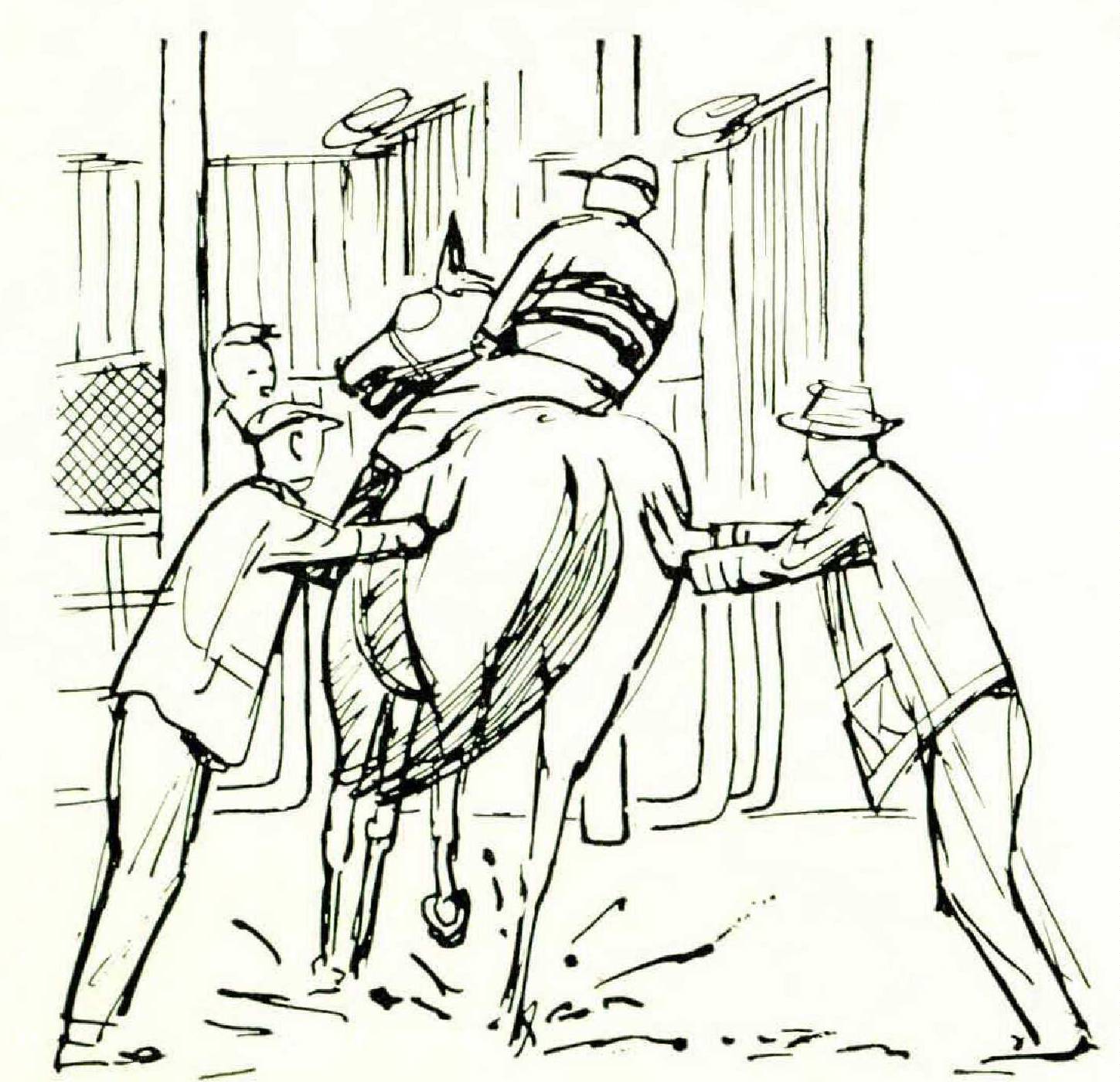
Para Bola was set for a light gallop and then schooling from the gate. She was saddled and ready to take the track, so Joe returned to his first love. Para Bola was a bit frisky, but she warmed up nicely. She went to school in the starting gate with four other two-year-olds. She had to be pushed in by three assistant starters. Another kept her head straight. The gate opened, and Para Bola flew out in running stride. The boy was under orders to work her if she broke, and surprised though he was, he did — five furlongs in a minute and five seconds. Poor time, but better than Croquet King would ever run. He’d been dead since about 1 A.M. Joe’s trainer must have peeked in and seen the indubitable marks. Croquet King’s trainer was now standing thunderstruck over the carcass. Joe Bananas had been had, but he didn’t seem to mind — his horse had broken from the starting gate.
For the trainer of Croquet King there were rounds of commiseration from other trainers, the owners, the exercise boys, the grooms — all were secretly pleased that they hadn’t lost their own horses. The explanations were sensible: King had bled from the mouth after his last race; had gone off his feed; great temperature fluctuations. Everyone around the track is tense and edgy when a horse dies. The tenderness a horse engenders in these hard-bitten people is impossible to discover from the outside, but the racehorse is loved by them —loved in the way that a man loves his own pulse, a love usually unannounced.
Para Bola broke well twice the following week and finally graduated from gate school. However, getting her in a race was another story. In late May she “bucked a shin.” This is a common ailment among young horses, roughly equivalent to “shin splints” in human athletes. A bucked shin is an inflammation and extreme tenderness in front of the cannon bone, the upper “shin” of a horse’s leg. Trainers expect bucked shins and pray that their young horses buck both shins at the same time, since each separate ailment takes a horse out of training for about a month. Para Bola bucked her left shin and was out six weeks. She was slowly coming back when she bucked the right shin.
“Joe,” I asked, “when is that horse of yours going to race?”
“Takes time. Takes time. You can’t rush these things. My man knows what he’s doing.”
“Now you’re talking like a horse owner, Joe.”
“Except,” Joe added, “I told him to do what he could for the horse — nature is the best healer and all that — but I told him that horse had better run before they move up to Saratoga. I mean there’s a limit even to my patience. And, what the hell is Bute anyway?”
“What’s what?”
“Bute. Bute. Here’s a bill from the vet.” He, of course, produced it from the stuffed drawer. “Ten cc. Bute — forty-five dollars. What the hell is Bute?”
“You’ve got me there, Joe. I never heard of it.”
“I thought you were supposed to know your way around a racetrack, and you don’t even know Bute?” Joe was cranky.
“I’m not a doctor, Joe,” I bit back mildly.
Late in July I spoke to Joe again about his dream. “When’s that horse of yours going to race, joe?”
“Next week,” came his crisp reply. He was certainly not exultant. The fact was an anticlimax. “You know,” he continued after missing a beat, “how much it costs to just get a horse used to the paddock and a crowd?” I must have gone blank because he explained. “You can’t take a young horse and just put him cold in front of all those people; he’s liable to go nuts. So you van him over to Aqueduct during the day, saddle him, and walk him around in the ring. Gets him used to the people, the other horses, the excitement, you know.” It made perfect sense. I must have nodded. Joe said, “You know what that costs?” I must have shaken my head. “Thirty-five bucks,” Joe said.
“Now you know why it’s called the sport of kings, Joe.” Joe didn’t laugh.
But the horse didn’t start, and August came and they shipped her up to Saratoga. August went by, and they shipped her back to New York, and still the punters had been deprived of Para Bola. It’s ironic that in a sport devoted to speed, patience is a prime virtue. A jockey may sit on a horse’s back for two minutes and earn 10 percent of a hundredthousand-dollar purse, but that same horse must be properly “cooled out” for nearly an hour afterward, or he may never earn another penny.
Joe pressured, but the trainer withstood every attempt. Finally, in September Para Bola was entered. The race, a filly two-year-old claimer, was flooded with other entries. Para didn’t get to start the race because there were simply too many entries. “She got stars for entering, though,” Joe explained. “Every time we enter her she gets stars. Finally, she’ll have enough stars so that they got to let her run. All those horses had more stars than she did, that’s how come they got in.” I wondered if King Ranch or the Wheatly Stable ever had to worry about “stars” for their two-yearolds. I assumed they did and told that to Joe. “Oh, yeah,” he said, “it’s all on the up-and-up. It’s the same for everyone. Ogden Phipps is the same as me.” I wanted to say that Phipps’s fillies couldn’t possibly work five furlongs in a minute and five, but it would have been too cruel.
She’s going,” Joe blurted.
“Great! When?”
“Tomorrow. Fourth race.”
“Great! I’ll be there.”
“She’s fifteen-to-one on the morning line. She’ll go off something like twentyor thirty-to-one, I’ll bet. And, listen” — he leaned over the bar and whispered sincerely — “it’s not impossible. Know what I mean?”
“Of course it’s not. She could finish in the money.”
“What ‘in the money’?” Joe’s eyes were piercing black beans. “She could” — he checked his rising voice level and looked around — “win it all.” I tried to get him to be a lot more realistic. “She could, she could,” he fired quickly. “It’s a race, and you’ve been around horse racing long enough to know that anything can happen.”
“Yes,” I agreed, “But—”
“So,” he said conclusively. Then he asked me if I wanted to stop by the stable at Belmont with him in the morning on the way out to the track. “For luck,” he said proudly. I’d never actually seen his horse, and he’d like my opinion. Joe was, as always, a remarkable combination of intelligence, credulity, and tenderness. Of course I’d take a look at Para Bola.
She was a petit thing, only about fifteen hands and six hundred pounds. Her head was well shaped and intelligent; her color ranged from a misty brown to a dark, rich mocha. Her coat was fine, and she was obviously in good health. Even though she was small, I didn’t feel obliged to pet or feed her the lump of sugar Joe offered me; her teeth snipped at anything that moved.
“How do you like her?” Joe asked almost rhetorically.
“Fine. She’s a really fine young filly,” I said.
“Then go ahead and feed her,” he pressed.
“No. I’d rather not.”
“’Fraid? Nothing to be afraid of. Watch.” And Joe did a remarkable thing. He walked under Para’s neck and placed his own shaved head right under her mouth, which she opened as wide as she could. She bit! Her teeth slid along the surface and clicked shut. Again she opened her mouth and tried to bite the ripe sphere. Like a small child, Para teethed on the human nub. She twisted her head to get a better toothhold. It had no corners. Para munched until she had enough. Joe dabbed his wet head with a handkerchief. Ogden Phipps probably didn’t have that sort of relationship with his horses.
Joe bought me breakfast. When Joe offers to buy, the easiest alternative is acceptance. He questioned me about Para’s chances. The Telegraph was no help here. I certainly didn’t want to fan Joe’s natural enthusiasm. It was obvious that what had started out as a business venture for him had become an affair of the heart. You can’t handicap those things. I wanted Para to do well for Joe’s sake. Who knows? Maybe she could come in in the money. After all, workouts aren’t races. There are horses who run their races in the morning; and others who can’t do a thing right in a workout win in the afternoon. It’s happened. And if she can get in the money, how much more does it take to win? On such logic hopes become fantasies.
We separated, Joe and I; he went to pick up his wife and some relatives, his partners and their wives and their relatives. I saw them in the clubhouse before the race; they bubbled and laughed and snuck little looks at themselves. The horses arrived saddled from beneath the stands. Among them, wearing a large white “three” on a black saddlecloth, was the playful teether of the morning. Now her eyes rolled in her head and her ears twitched. She seemed to be sweating a bit at the kidney — an unhappy sign. Her tail had been braided — I wondered what that had cost Joe. Joe was very proud and excited, He had been graced with a beautiful autumn day. Then the jockeys arrived from the depths of the stands. Number three’s jockey wore the tiny gray outfit I’d discovered hanging on the wall in Joe’s place almost a year earlier. A year! The track program described it as “blue, silver star, silver sleeves, two blue hoops, silver cap, blue tassel.” The alchemy of this day had turned gray to silver; it would turn silver back to gray again. The jockey, an undistinguished young man who had done well when he rode with an apprentice allowance two years before, listened to a few terse words from the monosyllabic trainer and mounted the horse.
I thought the “three” post position would hurt Para Bola, since she might not break well from the gate. The field was large (fifteen horses) and unwieldy (they were indeed very “green”), so a horse that didn’t get off well would have trouble picking her way through the field. Because it was late in the season, they were asked to run six furlongs instead of the five furlongs they run in the spring; this extra furlong might help Para Bola. I saw Joe at the fifty-dollar window, and he was there for quite a while. I bet Para Bola two dollars across the board. A token gesture.
Para didn’t get off well and finished ten seconds off the track record, about twenty-five lengths behind the winner. I felt very sorry for Joe and wanted to say something, but Para’s performance had made words impossible.
A week later the scene was replayed exactly, although the day was not so nice. This time, however, Para trailed only eleven other horses. It was a twelve-horse field. I didn’t bother Joe with stupid commiseration. I gave the matter five winter months to sink to forgetfulness. Then, in March, I saw the name “Para Bola” listed in a cheap claiming race up at Lincoln Downs. Someone must have put some sense in Joe’s head. The purses in New England were smaller, but the competition was more realistic for Joe s horse. He had obviously shipped up to Rhode Island where he wouldn’t have to compete with some of the best stock in the country.
I couldn’t find the result of Para’s race in the newspapers, so I had to buy a Telegraph. Para was a constant reminder of the adage You have to walk before you can run — she finished seventh, half a length ahead of the last horse. I used her moral victory as an excuse to renew the sympathetic bond between Joe and me.
A chilly afternoon in April. Joe was at the bar reading Ring magazine. He came alive when he saw me, but I took the play right away from him. “Joe, that’s a smart thing you did, shipping up to Rhode Island. The horse is in her class up there. She’ll be in the money when the weather warms up. And that’s the place to make your claim too. I hear there’s a gentlemen’s agreement up there —I don’t claim your horse, you don’t claim mine; you know, that sort of thing. That’s the place to claim all right. They’ll hate you when you take something good away from them, but so what! So you’re not a gentleman, big deal. And if you get something really good, you can ship him to New York, and if they want him back they’ll have to come and get him —— at New York prices! Yeah, that’s a smart move, Joe, shipping up there. A smart move; I’m proud of you.”
Halfway through my pep talk Joe turned back to Ring magazine. When I finished, he looked up again. “I sold her. I don’t own Para no more.” The bill for the Bute stuck out of the drawer behind him. Then he continued: “No, it wasn’t no good. Cost too damn much to run her here. Too much. Yet this is the only place to do it, New York I mean. If you can’t cut it here, then you just can’t cut it. You know what I mean?” Joe was sadder but wiser — but sadder.
I nodded agreement. Joe drew me a beer.
“It was a wild, crazy dream. So I gambled and lost. But a man’s got to have a dream. Right?
“You think anyone can beat Clay?” he asked, stunning me with his abrupt change of mood and subject. I must have blinked. He expanded: “Cassius Clay. Do you think there’s anybody around who can beat him?”
“No,” I said.
“Yes, there is,” Joe corrected me. “But no one knows who he is yet. He may not even know it himself. But somewhere there’s a kid corning up who can beat Cassius Clay.”
I shook my head.
“I’m looking to buy a fighter. You don’t know any, do you?”
“How would I know a fighter, Joe?”
“Yeah, me and Chick are looking for a fighter—”