Dada and Son
ART
by Elisabeth Stevens
An evening of pseudo-revolution in New York. “Bourgeois slobs!” screamed one demonstrator. “Go to Schrafft’s!” sneered another. The objects of the invective were à la mode art-establishment types arriving for the opening of the Museum of Modern Art’s show “Dada, Surrealism, and Their Heritage.”
If the protest lacked the bang of the old Dada “gestes” (New York demonstrators were held behind police lines and outnumbered by helmetcd cops), the show at first glance looked unexplosive too. In the name of history, the museum had attempted to reduce Dada and surrealism from psychic explosions to a polite series of pops. In a 252page exhibition catalogue (Museum of Modern Art: hardcover, $9.95; paperbound, $4.95), William S. Rubin, the curator of painting and sculpture, had written: “. . . art cannot be made from life alone, even less from particular psychological methodologies; more than anything else it is made from art.”
Rubin’s hobbyhorse is art as selfperpetuating history, and he has ridden it assiduously, gathering more than 300 works to illustrate his story of how Dada was baptized in Zurich in 1916, succeeded by surrealism in the early 1920s, and ultimately transmuted to nourish such diverse later movements as abstract expressionism and pop. The chronology is copious, and some of the art is excellent. Duchamp’s superintelligent creations introduce a Dada section that includes Picabia, Man Ray, Grosz, Richter, and Schwitters. A fine selection of de Chirico’s stands in precursor position to a big-name surrealist gathering that includes Max Ernst, Yves Tanguy, René Magritte, Dali, Miró, and Picasso. A final “heritage” section includes the post-1942 European exiles such as André Masson and Roberto Matta as well as Arshile Gorky (“the last important artist to be associated with Surrealism”), a smattering of abstract expressionism (Rothko, Gottlieb, Newman, Pollock), and a pinch of pop art (Oldenburg, Johns, Kienholz).
Art history is necessary for attributions and records. Art history can be illuminating, even interesting. But the monothematic devotion of Rubin and many other art historians and critics to the idea of art as an inevitable and progressive process of influences and counterinfluences drearily and mechanically grinding out new styles is visually deadening and intellectually oppressive. Under such an approach, the influential and the new are valued above the excellent and the enduring, and art that docs not “progress" — such as the primitive or the naive — is greeted with impatience rather than approbation.
Dada, Surrealism, and Their Heritage
The Museum of Modern Art March 27 to June 9, 1968 Los Angeles County Museum of Art July 16 to September 8, 1968 The Art Institute of Chicago October 19 to December 8, 1968
The Dada and surrealism show is an example, par excellence, of the “Influential Movement” exhibition that can be found, with minor variations, in museums all over the country. In Rubin’s exhibition, the impact of Dada and surrealism is muted. These movements are important, the show subtly but chauvinistically suggests, as “influences” on later and really major movements such as abstract expressionism. Distasteful as such historicizing might have been to a surrealist such as André Breton, Dada and surrealism are used to serve more recent movements in the same way that ancestors are used to puff the importance of the ladies of the D.A.R.
Although it would seem unorthodox to all the avid art genealogists, it would be easier to appreciate the original impact of Dada and surrealism if the space devoted to their “heritage” were given over to a selection of the art of the years preceding Dada. In spite of Rubin’s contention that all art comes from art, he might have been hardpressed to discover among impressionists, postimpressionists, fauves, or even cubists an appropriate set of ancestors. It would be scraping the bottom of the barrel to go all the way back to Blake, but the work of nineteenth-century romantics such as Odilon Redon (or, in a pinch, a landscape or two by Caspar David Friedrich or the American luminists) would not suffice. Baudelaire and poets who came after him might be considered legitimate ancestors, but poetry is seldom impressive when hung on museum walls.
That Dada and surrealism represented a dramatic and unprecedented revolution against the rational approach that had been dominant in Western art since the Renaissance may be an embarrassing thing to historians devoted to the delicate cross-hatchings of slow-moving dialectic, but it is nonetheless true.
André Breton’s Second Surrealist Manifesto goes to the heart of the matter:
Everything suggests the belief that there is a certain point of the mind where life and death, the real and the imaginary, the past and the future, the communicable and the incommunicable, the high and the low are no longer perceived as contradictions.
It would be vain to look for any motive in surrealist activity other than the hope of determining that point.
Or as Hans Richter explains in his history of the Dada movement:
The myth that everything in the world can be rationally explained had been gaining ground since the time of Descartes. An inversion was necessary to restore the balance.
The realization that reason and anti-reason, sense and nonsense, design and chance, consciousness and unconsciousness, belong together as necessary parts of a whole — this was the central message of Dada.
“An inversion was necessary,” as Richter says, and the Dadaists, disgusted by the spectacle of a “rationally justifiable” world war, set out to restore the irrational, the unconscious, and the contradictory to prominence. Chance, dreams, the mythology of Freud, and such techniques as automatic drawing all served as means to this end.
The balancing of the irrational against the rational involved the ancient idea of the union of opposites. In the late medieval Dutch manuscript called “The Hours of Catherine of Cleves,” for instance, a devout little painting of a saint believed to have been fed by the birds is subtly negated by the marginal image of a grinning monkey stealing birds’ eggs from a nest. Such devils of contradiction, although familiar in Romanesque and medieval art, were confined during the Renaissance to isolated strongholds such as the fantasies of Bosch. However, Dada again placed the “monkey” of the irrational next to the “saint” of reason and at times employed the saint instead of the monkey as the marginal image. What resulted was far more than nihilism or nonsense: Dada was a fertile reaffirmation of psychic wholeness.
To savor the original impact of Dada and surrealism instead of merely observing their several languages (the biomorphic abstraction and surrealist illusionism that Rubin notes), it is necessary to devour contradictions. This is not always easy because a piece such as Duchamp’s bottlerack (a reproduction of one of his famous Readymades) is no longer an everyday object. The suggestive contrast between the bottlerack seen in use and the bottlerack seen in isolation at an art show is therefore lost. The bottlerack is now a mere artifact of Dada — bearing the same relation to the movement that a reproduction of Napoleon’s hat does to Napoleon.
Another difficulty was that the show as it was arranged in New York was hard to see. Perhaps the Los Angeles County Museum and the Art Institute of Chicago will do better, but the Modern not only hung paintings too closely in small rooms packed with super-serious notetakers (no one laughs at Dada anymore) but also saw fit to allot only two benches to the entire exhibition. The effect was to hurry the viewer through the rooms devoted to Dada and early surrealism into the slightly larger and less crowded rooms devoted to more recent art, after a quick glance at such standard shockers as Magritte’s girl tearing a live bird with her teeth or Dali’s The Great Masturbator.
Still, the contradictions that lie at the heart of Dada and surrealism abound. With these works the naive question (Why is Delvaux’s naked lady promenading with a fully dressed man?) is always the incisive question. Unexpected combinations of things not usually found in congruence, of real and unreal, and of life and art, are both the essence and the animating force.
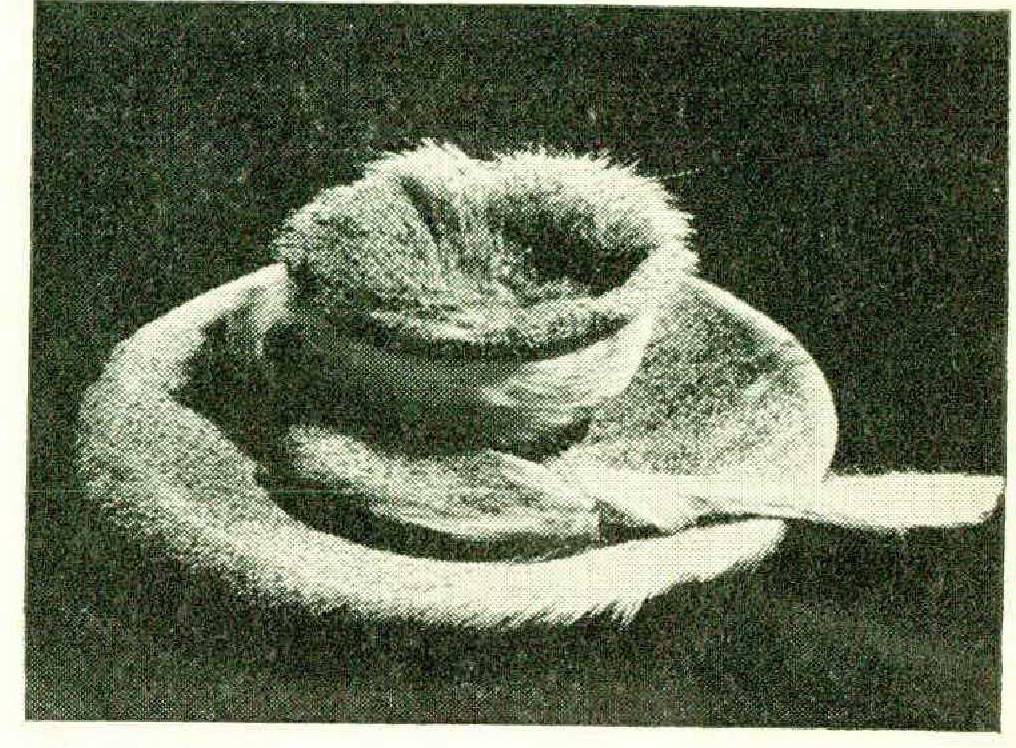
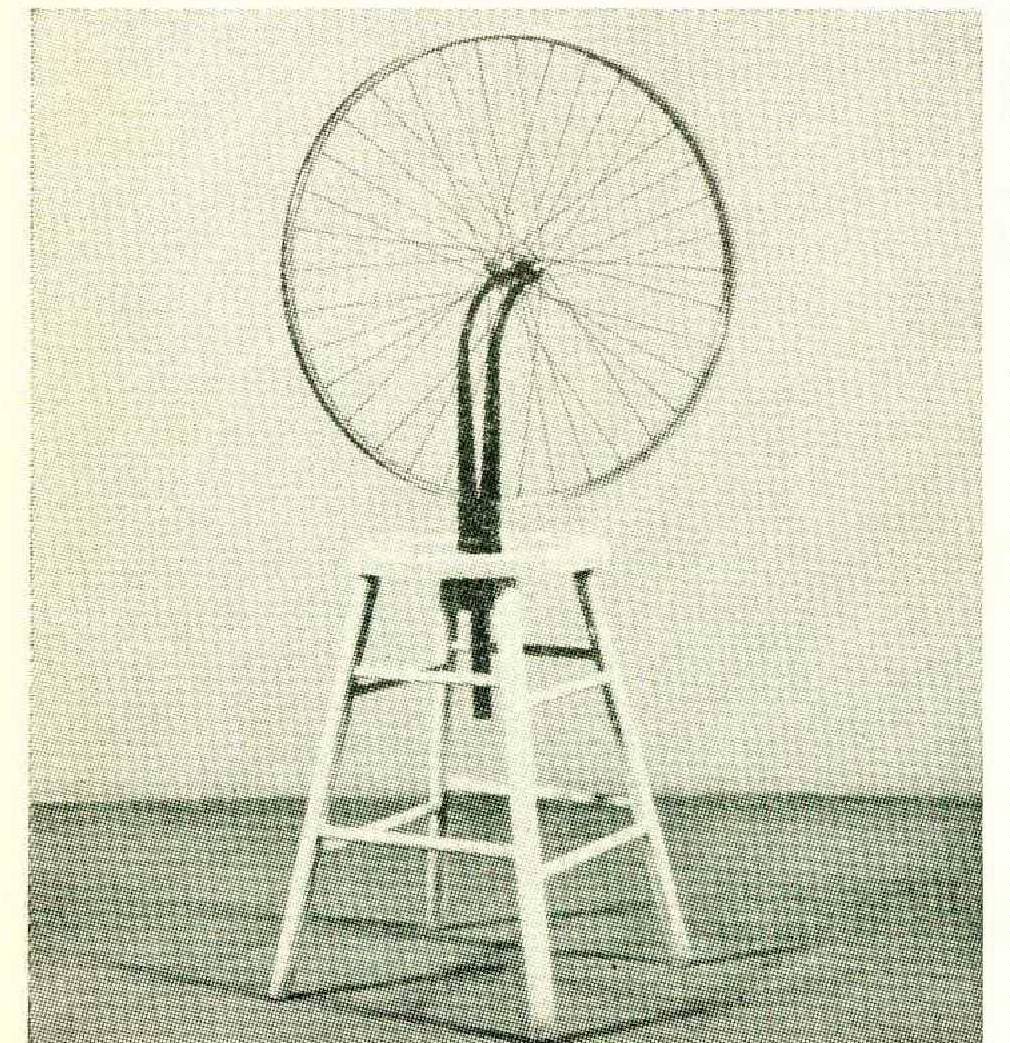
In this world where opposites meet, Duchamp’s bicycle wheel is sitting on a stool, Meret Oppenheim’s teacup is covered with fur, Picabia’s painting of gears suggests a sexual joining, and Yves Tanguy’s forms may be seen as stones, semi-animate shapes, or even as patterns of thought. Scale is inconsistent and variable: de Chirico paints a classical head and a glove that dwarf the wall of a building; Magritte designs a cake of soap that overshadows a bedroom rug. Matta’s abstract shapes in dynamic motion can be read as a pattern of activity which is either enormous or microscopic. Metamorphosis freely transforms objects or slyly substitutes one thing for another: a head painted by Picasso turns into a hand clutching a sphere; the nose in George Grosz’s collage “Remember Uncle August, the Unhappy Inventor” is found to be a photograph of a machine fragment. Parts can be read for the whole: a few lines by Miró are sufficient to suggest a face or a figure. Wholes are constructed from incongruous but suggestive parts: a Picabia collage forms a woman’s face from matches, coins, hairpins, and leather curlers. Even titles or the words included in certain paintings and collages add a counterpoint of contradiction rather than explanation; Magritte’s realistic representation of a supersize pipe is neatly negated by the legend “Ceci n’est pas une pipe,” and further complicated by the title — “The Wind and the Song.”
The non sequiturs, visual puns, and myriad contradictions of this art are not readily categorized. Most standard discussions of Dada and surrealism stick to the safety of history interlarded with Freudian platitudes, but the movements could be better apprehended with reference to metaphysics, poetry, magic, mysticism, and Jungian psychology.
Seldom entirely explainable but forever demanding explanation, the art of Dacia and surrealism remains as tantalizing and provocative as dreams. Viewed historically, both movements are dead and cannot be revived by demonstrations, stylish openings, or a definitive catalogue, yet the contradictions of Dada and surrealism have endured - - not because they are influential but because they are archetypal. As Andre Breton wrote, “I believe that men will long continue to feel the need to follow to its source the magical river flowing from their eyes, bathing with the same hallucinatory light and shade both the tilings that are and the things that are not.”